

In the world of aviation, clear communication is paramount. Aircrafts fly at high speeds, often crossing multiple time zones, while their crews, ground staff, and air traffic controllers coordinate to ensure safe and efficient air travel. Miscommunication can lead to disastrous consequences. To mitigate such risks, the International Civil Aviation Organization (ICAO) introduced a phonetic alphabet system, known as the ICAO Alphabet. This universal language has become a cornerstone of global aviation communication.
History of Aviation Alphabet
The ICAO Alphabet, also known as the NATO Phonetic Alphabet, traces its roots back to the early 20th century. Initially, there was no standardized system of communication in aviation, leading to confusion and misunderstandings. The first alphabet, introduced during World War I, was the British Royal Navy’s phonetic alphabet, known as the Signaling Phonetic Alphabet. However, this system was not standardized and varied from one organization to another, leading to confusion.
In 1927, the first international phonetic alphabet, known as the International Radiotelegraph Convention Phonetic Alphabet, was introduced. It was comprised of international code words, including Amsterdam for A, Baltimore for B, and so on. However, this system, too, was fraught with inconsistencies and lacked universality.
The Second World War highlighted the need for a more universally understood and standardized phonetic alphabet. In 1941, the US introduced the Joint Army/Navy Phonetic Alphabet, also known as the Able Baker alphabet, which became widely adopted during the war. However, the Able Baker alphabet suffered from its lack of consideration for non-English speakers.
ICAO Alphabet Development and Adoption
The need for a universally understood and easy-to-use phonetic alphabet led to the birth of the ICAO Alphabet. The International Civil Aviation Organization, established in 1947, made it its mission to develop a system that could be understood by all, regardless of linguistic background. This led to an extensive process of testing, consultation, and modification.
In 1956, the ICAO introduced the first version of its phonetic alphabet. However, some of the words chosen, like ‘Bar’ for B and ‘Don’ for D, led to confusion as they sounded similar over poor quality radio transmissions. Following a series of revisions, the final version of the ICAO Alphabet was officially implemented in 1967.
The ICAO Alphabet
Today, the ICAO Alphabet consists of 26 code words, each corresponding to one letter of the English alphabet: Alfa, Bravo, Charlie, Delta, Echo, Foxtrot, Golf, Hotel, India, Juliett, Kilo, Lima, Mike, November, Oscar, Papa, Quebec, Romeo, Sierra, Tango, Uniform, Victor, Whiskey, X-ray, Yankee, and Zulu.
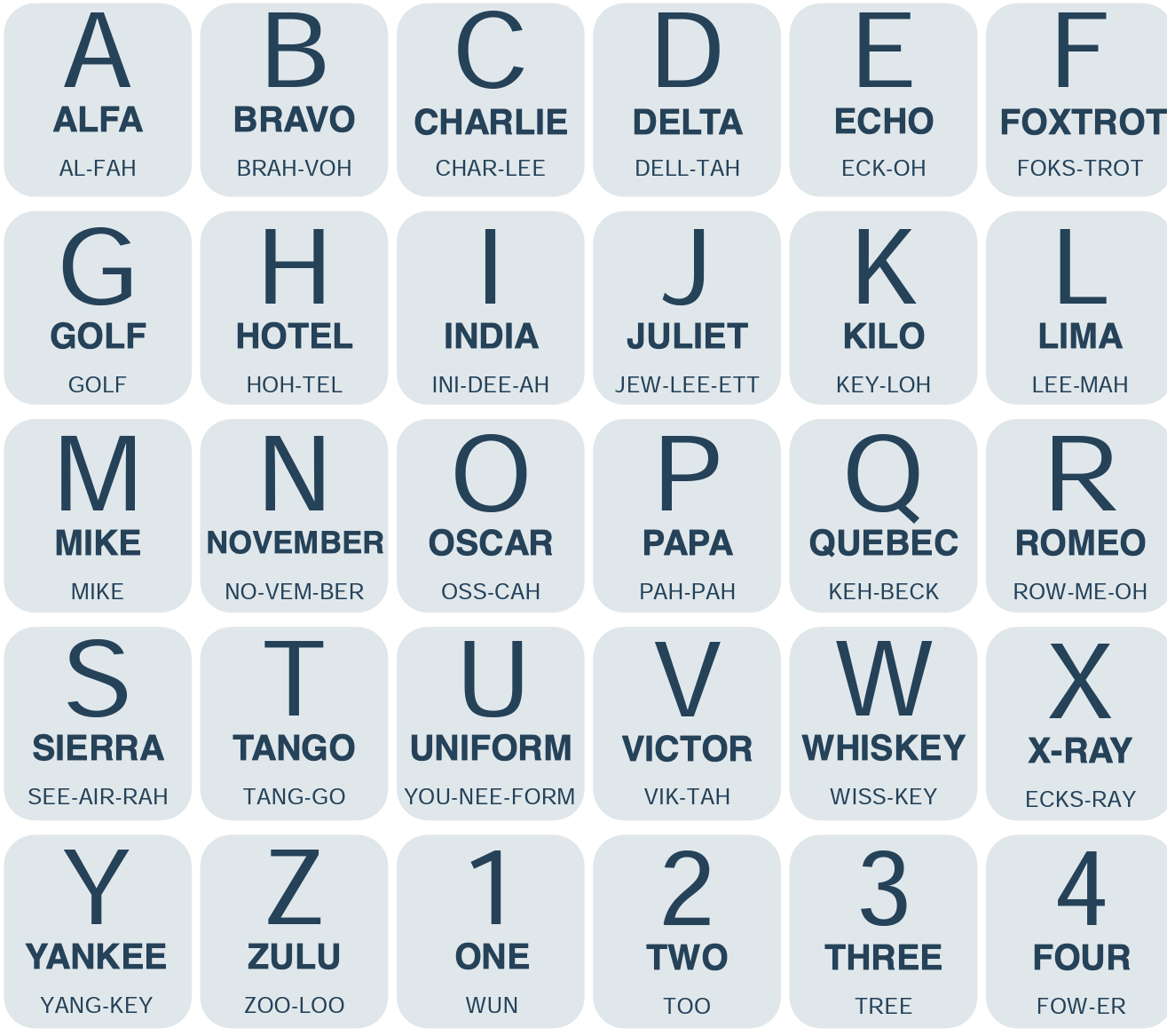
These words were carefully selected through extensive testing, taking into consideration factors such as intelligibility, pronunciation, and distinctiveness. The phonetic alphabet is now used universally in aviation, by pilots, air traffic controllers, and ground staff, to ensure clear and unambiguous communication.
The ICAO Alphabet has also been adopted by other non-aviation fields, like telecommunications, where clear and unambiguous communication is essential. It is used by the military, emergency services, and even in customer service scenarios, to spell out words over the phone or radio.
The ICAO Alphabet is a testament to the importance of clear communication in ensuring safety, efficiency, and coordination in aviation. Its development and adoption required decades of international collaboration, testing, and refinement. The alphabet has become an integral part of aviation and other fields requiring precise verbal communication. The journey of the ICAO Alphabet from a set of disjointed phonetic systems to a universally accepted standard is a compelling story of human collaboration and innovation in the face of global challenges.
In reality, the ICAO Alphabet is a perfect example of how the need for safety, clear communication, and universal understanding can lead to the creation of a system that transcends linguistic and cultural barriers. Today, whether you’re a pilot in Peru or a dispatcher in Denmark, the ICAO Alphabet provides the language of clarity and understanding, connecting our world through the skies. Help yourself out by becoming a master of the aviation alphabet from the best instructors–Angle of Attack!

ON THE SAME TOPIC

IFR vs VFR: The Two Sets of Rules Every Pilot Flies By
IFR vs VFR: The Two Sets of Rules Every Pilot Flies By 19 min read Last updated June 2026 · Chris Palmer The difference between IFR and VFR is which set of rules you fly under. VFR — visual flight rules — lets you navigate by looking outside and staying clear of clouds in good […]
 Read more
ASOS vs AWOS vs ATIS: How to Pull the Right Weather Before You Fly
ASOS vs AWOS vs ATIS: How to Pull the Right Weather Before You Fly 13 min read Last updated June 2026 · Chris Palmer The difference comes down to who is talking and what the broadcast covers. ASOS and AWOS are automated, computer-generated weather observations of the conditions right at the field. ATIS is a […]
Read more 
What Is RNAV Navigation? Area Navigation for VFR Pilots
What Is RNAV Navigation? Area Navigation for VFR Pilots 17 min read Last updated June 2026 · Chris Palmer RNAV — Area Navigation — is a method that lets an aircraft fly any desired path within the coverage of ground- or space-based navigation aids, rather than being forced to fly directly to and from stations. […]
Read more 
NDB and ADF Explained: The Oldest Radio Nav System You Still Need to Understand
NDB and ADF Explained: The Oldest Radio Nav System You Still Need to Understand 16 min read Last updated June 2026 · Chris Palmer An NDB (non-directional beacon) is a ground-based radio transmitter that sends a signal in all directions, and an ADF (automatic direction finder) is the cockpit receiver whose needle points straight at […]
Read more 
Stay Connected
Be the very first to get notified when we publish new flying videos, free lessons, and special offers on our courses.
