Part 61 vs Part 141 CFI Training: Which Path Should You Take in 2026?

Part 61 and Part 141 are two regulatory frameworks for becoming a CFI. Part 61 is the default. You train with any qualified flight instructor on your schedule. Part 141 is a school-based framework where the FAA approves the curriculum, requires a minimum 40 hours of ground and 25 hours of flight training under Appendix F, and conducts stage checks. The certificate at the end is identical. The decision isn't which is "better." It's which fits you.
Walking into your first lesson with a 50-page binder won't help you.
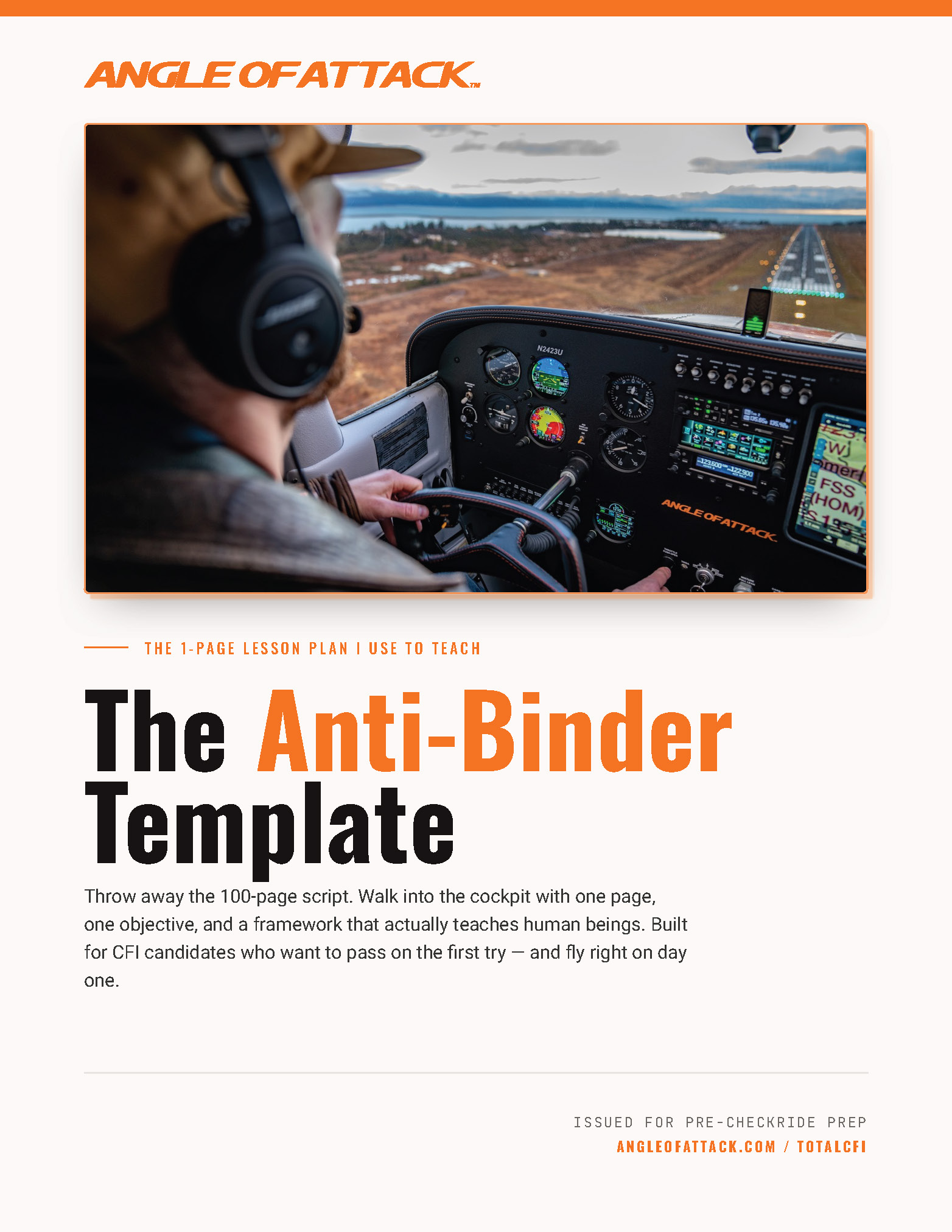
Get my Anti-Binder One-Page Lesson Plan Template free — the lesson plan tool I built for CFI candidates who want to be ready Day 1.
Get the Anti-Binder Template Free
- Part 61 and Part 141 produce the same FAA flight instructor certificate. There is no "Part 141 stamp" on the plastic.
- For the CFI initial specifically, Part 141 Appendix F locks in a 40-hour ground / 25-hour flight minimum. Part 61 has no syllabus minimum, only the underlying experience and 15 hours PIC in category/class under 14 CFR 61.183(j).
- 2026 cost ranges: Part 141 CFI initial $5,000–$9,000 bundled; Part 61 independent CFI initial $3,000–$6,000; aviation degree program $50,000–$200,000+ all-in.
- The R-ATP wedge under 14 CFR 61.160 is the one place Part 141 mathematically wins for airline-bound pilots: 1,000 hours with a Bachelor's degree in aviation from an authorized school, 1,250 hours with an Associate's, 750 hours for military pilots.
- Airlines do not have a hiring preference for Part 141 over Part 61. They care about total time, multi time, recency, and training records.
- The "fewer hours under 141" argument is mostly a PPL/Commercial story, not a CFI story. For the CFI initial, Part 141 doesn't subtract from a minimum; it adds 25 structured hours.
WHAT'S IN THIS GUIDE
- 1What's the Difference Between Part 61 and Part 141 for the CFI?
- 2The 5 Structural Differences That Actually Matter
- 3How Many Flight Hours Does a CFI Need Under Part 141 vs Part 61?
- 4Part 141: Real Strengths and Real Limits
- 5Part 61: Real Strengths and Real Limits
- 6Airlines Don't Care Which Path You Took
- 7The R-ATP Wedge (When 141 Actually Pays Off)
- 8How Much Does a CFI Initial Cost in 2026?
- 9Decision Framework: Pick Your Path
- 10The Hybrid Reality: Most Working CFIs Use Both
- 11The Independent-Voice Point: Why This Article Is Different
- 12Frequently Asked Questions
| Part 61 | Part 141 | |
|---|---|---|
| Curriculum | Part 61">Your CFI's call. No FAA-approved syllabus. | Part 141">FAA-approved syllabus. Specific lessons in specific order. |
| Flight hour floor (CFI initial) | Part 61">None for the CFI rating itself. 15 hours PIC in category/class under 61.183(j) on top of commercial. | Part 141">25 hours flight + 40 hours ground per Appendix F. |
| FAA oversight of school | Part 61">Indirect. The CFI is regulated; no school certification. | Part 141">Direct. School holds a Part 141 certificate, subject to inspection, stage checks required. |
| Schedule | Part 61">Flexible. Pay-as-you-go. Train around a day job. | Part 141">Structured. Typically full-time, M-F. |
| Tuition model | Part 61">Hourly rates, instructor + aircraft. | Part 141">Bundled programs, lump-sum or financed. |
| GI Bill / VA benefits | Part 61">Not eligible at independent CFIs. | Part 141">Eligible at approved IHEs. |
| R-ATP eligibility | Part 61">Not applicable. | Part 141">Available at IHEs with §61.169 LOA (Bachelor's → 1,000 hrs, Associate's → 1,250 hrs). |
| Certificate produced | Part 61">FAA Form 8060-4 → standard CFI certificate. | Part 141">Identical FAA Form 8060-4 → standard CFI certificate. |
| Typical 2026 cost (CFI initial) | Part 61">$3,000–$6,000 | Part 141">$5,000–$9,000 |
What's the Difference Between Part 61 and Part 141 for the CFI?
 Part 61 is the FAA's default regulatory framework for individual pilots and instructors. It tells you what hours, knowledge, and experience you need to hold a certificate. But it doesn't tell your CFI what order to teach you in, or what days of the week you have to fly, or what stage checks you need to pass before the next lesson. The structure is whatever the CFI and the student agree to. The reg lives at 14 CFR Part 61.
Part 141 is a regulatory framework for *schools*, not for the individual pilot but for the institution. A Part 141 school applies for and holds a Part 141 certificate. The FAA approves its training course outlines. The school is required to conduct stage checks, keep specific records, and submit to inspections. In return, the FAA reduces some flight-hour minimums for the certificates the school offers. The reg lives at 14 CFR Part 141.
Here's what most candidates get wrong: the certificate you walk out with at the end is identical. There is no separate "Part 141 CFI" or "Part 61 CFI." Both produce an FAA Form 8060-4 temporary certificate, and ultimately the same plastic flight instructor card. The DPE who tests you isn't asking which Part you trained under. The ACS standard is the ACS standard.
So when somebody says "Part 141 is more professional" or "Part 61 is more flexible," they're describing the *training environment*. Not the certificate. Not the pilot you'll be on the other side.
Part 61 is the FAA's default regulatory framework for individual pilots and instructors. It tells you what hours, knowledge, and experience you need to hold a certificate. But it doesn't tell your CFI what order to teach you in, or what days of the week you have to fly, or what stage checks you need to pass before the next lesson. The structure is whatever the CFI and the student agree to. The reg lives at 14 CFR Part 61.
Part 141 is a regulatory framework for *schools*, not for the individual pilot but for the institution. A Part 141 school applies for and holds a Part 141 certificate. The FAA approves its training course outlines. The school is required to conduct stage checks, keep specific records, and submit to inspections. In return, the FAA reduces some flight-hour minimums for the certificates the school offers. The reg lives at 14 CFR Part 141.
Here's what most candidates get wrong: the certificate you walk out with at the end is identical. There is no separate "Part 141 CFI" or "Part 61 CFI." Both produce an FAA Form 8060-4 temporary certificate, and ultimately the same plastic flight instructor card. The DPE who tests you isn't asking which Part you trained under. The ACS standard is the ACS standard.
So when somebody says "Part 141 is more professional" or "Part 61 is more flexible," they're describing the *training environment*. Not the certificate. Not the pilot you'll be on the other side.
The 5 Structural Differences That Actually Matter
 The trade-off between Part 61 and Part 141 lives in five places. Everything else is noise.
1. Curriculum structure
Part 141 schools follow an FAA-approved syllabus. Lesson 7 always comes after Lesson 6. The lesson objectives are set. The stage checks are scheduled. There is a defined path from "first flight" to "checkride." Part 61 has none of that. Your CFI picks the order. Your CFI decides when you're ready for solo, ready for cross-country, ready for the practical. The structure is whatever you and your CFI agree to, and it can change week to week based on weather, your progress, and the airplane. For a candidate who needs structure to learn well, Part 141 is the gift. For a candidate who already has a strong CFI mentor and prefers flexibility, the rigidity of 141 becomes a constraint.2. Stage checks and FAA oversight
Part 141 builds stage checks into the syllabus. These are formal evaluation points where you must demonstrate proficiency to a different instructor (usually a chief or assistant chief CFI) before you can advance. This is an FAA requirement, not a school preference. Stage checks are rigor. They're also a money risk. If you fail a stage check, you redo training to fix the deficiency and re-fly the check. Both cost money. For a strong stick who's a weak standardized-test taker, stage checks can become a money trap. Part 61 has no stage checks. Your CFI decides when you're ready for the practical. The accountability is direct, between you, your CFI, and the DPE.3. Schedule and pace
Part 141 tends to be full-time, Monday-through-Friday. Especially at academies and university programs, the assumption is that you're there to fly. Five-day weeks. Standardized briefings. A morning schedule on the whiteboard. Part 61 is whatever you and your CFI can fit in. Three lessons a week around your day job. Two days off, two days flying, repeat. A week off because the weather rolled in. A push to finish before currency expires. The pace question matters because for the CFI initial specifically, the candidate already holds a commercial certificate. The clock that matters now is your underlying ratings staying current. Drag the CFI training out over 14 months and you'll burn instrument currency and possibly need recurrent training before the practical. Part 141's structured pace can be the difference between finishing in 90 days and finishing in 12 months.4. Tuition model
Part 141 schools usually bundle the CFI initial into a flat program price, sometimes financed. You pay upfront (or finance), you fly the syllabus, you take the practical. Predictable cost, predictable timeline, but a lump-sum commitment. Part 61 is pay-as-you-go. Hourly rates for the instructor, separate aircraft rental, separate fees for the practical. The total cost is harder to forecast, but the cash flow is forgiving. You can pause for a month if your finances get tight. For a candidate using GI Bill / VA education benefits, this is the cleanest financial differentiator: VA benefits work at approved Part 141 schools, not at independent Part 61 CFIs. If you have the GI Bill, the choice is essentially made for you.5. Aircraft and instructor availability
Part 141 schools have fleets and instructor pools. If your assigned CFI is sick, another CFI flies your scheduled lesson. If your assigned airplane is in maintenance, you fly the spare. Part 61 lives or dies on the relationship between you and your CFI. If your CFI gets hired by a regional (and they will; this is a structural reality of being a CFI in 2026), you're starting over with a new instructor. If the airplane is down for a month, your training pauses. The availability question is real. So is the relationship question. Both cut both ways.How Many Flight Hours Does a CFI Need Under Part 141 vs Part 61?
 Here's where the popular framing fails CFI candidates specifically.
The widely-repeated claim, "Part 141 lets you finish in fewer hours," is true for the Private and Commercial certificates, and not for the CFI.
For the Private Pilot certificate: Part 61 requires 40 hours total; Part 141 allows 35. A real 5-hour savings, on paper.
For the Commercial certificate: Part 61 requires 250 hours; Part 141 allows 190. A real 60-hour savings, on paper.
For the CFI initial certificate: there is no Part 61 hour minimum to beat. The eligibility requirement under 14 CFR 61.183 is that you hold a Commercial or ATP certificate, hold an instrument rating, pass the Fundamentals of Instructing (FOI) and Flight Instructor Airplane (FIA) knowledge tests, get the spin endorsement, get the areas-of-operation endorsement, log 15 hours PIC in the category and class you're going to instruct in, and pass the practical test. There is no fixed flight-training minimum for the CFI rating itself.
So what does Part 141 Appendix F require for the CFI initial? Per 14 CFR Part 141 Appendix F:
- 40 hours of ground training (initial) or 20 hours (additional rating). Up to 20 of those hours can be credited for two years of college-level study in education theory.
- 25 hours of flight training for airplane, rotorcraft, or powered-lift. Glider category requires 10 hours plus 10 flights.
- Specified areas of operation must be covered: fundamentals of instructing, technical subjects, preflight prep, preflight lesson on a maneuver, preflight procedures, airport operations, takeoffs/landings/go-arounds, fundamentals of flight, performance maneuvers, ground reference, slow flight and stalls and spins, basic instrument maneuvers, emergency operations, postflight procedures.
- Simulator credit capped at 10% of total training (combined airplane and simulator); FTD-alone credit capped at 5%.
Read that twice. For the CFI initial, Part 141 adds 25 hours of structured flight training on top of what you already have. It doesn't subtract from a Part 61 minimum that doesn't exist.
That doesn't mean Part 141 is wasteful. Those 25 hours of structured CFI training are some of the most valuable hours in the certificate path. It just means the "save hours by going 141" argument that holds for PPL and Commercial is mostly false for the CFI. The wedge for choosing 141 isn't fewer hours. It's structure, syllabus, GI Bill access, and the R-ATP pathway.
Here's where the popular framing fails CFI candidates specifically.
The widely-repeated claim, "Part 141 lets you finish in fewer hours," is true for the Private and Commercial certificates, and not for the CFI.
For the Private Pilot certificate: Part 61 requires 40 hours total; Part 141 allows 35. A real 5-hour savings, on paper.
For the Commercial certificate: Part 61 requires 250 hours; Part 141 allows 190. A real 60-hour savings, on paper.
For the CFI initial certificate: there is no Part 61 hour minimum to beat. The eligibility requirement under 14 CFR 61.183 is that you hold a Commercial or ATP certificate, hold an instrument rating, pass the Fundamentals of Instructing (FOI) and Flight Instructor Airplane (FIA) knowledge tests, get the spin endorsement, get the areas-of-operation endorsement, log 15 hours PIC in the category and class you're going to instruct in, and pass the practical test. There is no fixed flight-training minimum for the CFI rating itself.
So what does Part 141 Appendix F require for the CFI initial? Per 14 CFR Part 141 Appendix F:
- 40 hours of ground training (initial) or 20 hours (additional rating). Up to 20 of those hours can be credited for two years of college-level study in education theory.
- 25 hours of flight training for airplane, rotorcraft, or powered-lift. Glider category requires 10 hours plus 10 flights.
- Specified areas of operation must be covered: fundamentals of instructing, technical subjects, preflight prep, preflight lesson on a maneuver, preflight procedures, airport operations, takeoffs/landings/go-arounds, fundamentals of flight, performance maneuvers, ground reference, slow flight and stalls and spins, basic instrument maneuvers, emergency operations, postflight procedures.
- Simulator credit capped at 10% of total training (combined airplane and simulator); FTD-alone credit capped at 5%.
Read that twice. For the CFI initial, Part 141 adds 25 hours of structured flight training on top of what you already have. It doesn't subtract from a Part 61 minimum that doesn't exist.
That doesn't mean Part 141 is wasteful. Those 25 hours of structured CFI training are some of the most valuable hours in the certificate path. It just means the "save hours by going 141" argument that holds for PPL and Commercial is mostly false for the CFI. The wedge for choosing 141 isn't fewer hours. It's structure, syllabus, GI Bill access, and the R-ATP pathway.
Part 141: Real Strengths and Real Limits
 Part 141 is the right path for a specific kind of candidate. Here's what it actually offers, honestly framed.
Real strengths:
- Structured pace. If you'd drag a Part 61 timeline to 14 months without external accountability, the Monday-through-Friday rhythm of a 141 program can be the difference between finishing and stalling out.
- FAA-approved syllabus. You know what's covered, in what order, with what objectives. Less risk of an underprepared CFI mentor missing a topic.
- Stage checks for rigor. A second CFI signs off on your readiness before you advance. The check itself catches gaps you and your primary instructor might both have missed.
- GI Bill / VA benefits. If you're a veteran, this is almost certainly the right path. VA education benefits do not cover instruction at an independent Part 61 CFI. They do cover instruction at approved Part 141 IHEs.
- R-ATP pathway via aviation degree programs. This is the math wedge. Bachelor's degree in aviation from an authorized institution drops the ATP minimum from 1,500 to 1,000 hours. (More on this in the R-ATP section below.)
- Instructor and aircraft backup. Your training doesn't stop because your primary CFI got hired at the regionals last week.
Real limits:
- Schedule rigidity. Most 141 programs assume you're a full-time student. Doing it around a day job is harder.
- Lump-sum or financed tuition. You commit dollars upfront. If life intervenes, you may be financing a partial credit.
- Stage check failures cost money. Built into the system. Repeat training plus the re-check.
- Location-locked. You go where the school is. If the school is across the country, factor housing and the move.
- Variable quality. Not every Part 141 school is equally good. "Part 141" is a regulatory framework, not a quality guarantee. Visit. Talk to current and former students. Watch a stage check if they'll let you.
Best for: GI Bill veterans, full-time students under 25, aviation degree students pursuing the R-ATP, candidates who need maximum structure to finish, candidates without a strong local CFI option.
Part 141 is the right path for a specific kind of candidate. Here's what it actually offers, honestly framed.
Real strengths:
- Structured pace. If you'd drag a Part 61 timeline to 14 months without external accountability, the Monday-through-Friday rhythm of a 141 program can be the difference between finishing and stalling out.
- FAA-approved syllabus. You know what's covered, in what order, with what objectives. Less risk of an underprepared CFI mentor missing a topic.
- Stage checks for rigor. A second CFI signs off on your readiness before you advance. The check itself catches gaps you and your primary instructor might both have missed.
- GI Bill / VA benefits. If you're a veteran, this is almost certainly the right path. VA education benefits do not cover instruction at an independent Part 61 CFI. They do cover instruction at approved Part 141 IHEs.
- R-ATP pathway via aviation degree programs. This is the math wedge. Bachelor's degree in aviation from an authorized institution drops the ATP minimum from 1,500 to 1,000 hours. (More on this in the R-ATP section below.)
- Instructor and aircraft backup. Your training doesn't stop because your primary CFI got hired at the regionals last week.
Real limits:
- Schedule rigidity. Most 141 programs assume you're a full-time student. Doing it around a day job is harder.
- Lump-sum or financed tuition. You commit dollars upfront. If life intervenes, you may be financing a partial credit.
- Stage check failures cost money. Built into the system. Repeat training plus the re-check.
- Location-locked. You go where the school is. If the school is across the country, factor housing and the move.
- Variable quality. Not every Part 141 school is equally good. "Part 141" is a regulatory framework, not a quality guarantee. Visit. Talk to current and former students. Watch a stage check if they'll let you.
Best for: GI Bill veterans, full-time students under 25, aviation degree students pursuing the R-ATP, candidates who need maximum structure to finish, candidates without a strong local CFI option.
Part 61: Real Strengths and Real Limits
 Part 61 is the path I took. Private and Instrument in Utah. Commercial in California. CFI in Wisconsin. CFII in North Carolina. Tailwheel in Texas. Seaplane Commercial in Alaska. Six states, six different CFIs, six different airplanes, all under Part 61. I picked Part 61 every time because I picked the *instructor* every time. That's the wedge.
Real strengths:
- Scheduling flexibility. Train around a job. Train around weather. Train around your family. Part 61 lets you build a timeline that fits your life.
- Choice of instructor. This is the underrated one. You can pick the *best CFI in your area*. The one who has the reputation, the experience, the teaching style that works for you. In Part 141 you're assigned. In Part 61 you choose.
- Pay-as-you-go. No lump-sum commitment. If you need a slow month, slow down. If you have a windfall, accelerate.
- Lower total cost (often). A 2026 Part 61 CFI initial frequently lands $2,000-$4,000 below the bundled Part 141 program for the same outcome, especially if you fly hours efficiently.
- Mentor relationship. If you build a real relationship with a CFI you respect, that relationship becomes the most valuable variable in your training. Better than any syllabus.
Real limits:
- Variable quality. Your CFI matters a lot. A weak CFI under Part 61 produces a weak CFI candidate. There is no syllabus to backstop a thin teacher.
- No GI Bill. If you're a veteran with education benefits, Part 61 doesn't take them.
- No stage check accountability. If your CFI doesn't catch a gap, nobody does until the DPE finds it.
- Slower if you don't manage the schedule. Without external structure, the timeline drifts. A candidate who plans to finish in 90 days can easily slip to 9 months.
- Loss-of-CFI risk. Your CFI might get hired tomorrow. It happens constantly in 2026. If they leave, you're rebuilding a relationship from scratch.
Best for: working professionals who can't do a full-time M-F program, candidates with limited capital, anyone with a strong CFI mentor already lined up, candidates in regions where the local Part 61 community is strong.
Part 61 is the path I took. Private and Instrument in Utah. Commercial in California. CFI in Wisconsin. CFII in North Carolina. Tailwheel in Texas. Seaplane Commercial in Alaska. Six states, six different CFIs, six different airplanes, all under Part 61. I picked Part 61 every time because I picked the *instructor* every time. That's the wedge.
Real strengths:
- Scheduling flexibility. Train around a job. Train around weather. Train around your family. Part 61 lets you build a timeline that fits your life.
- Choice of instructor. This is the underrated one. You can pick the *best CFI in your area*. The one who has the reputation, the experience, the teaching style that works for you. In Part 141 you're assigned. In Part 61 you choose.
- Pay-as-you-go. No lump-sum commitment. If you need a slow month, slow down. If you have a windfall, accelerate.
- Lower total cost (often). A 2026 Part 61 CFI initial frequently lands $2,000-$4,000 below the bundled Part 141 program for the same outcome, especially if you fly hours efficiently.
- Mentor relationship. If you build a real relationship with a CFI you respect, that relationship becomes the most valuable variable in your training. Better than any syllabus.
Real limits:
- Variable quality. Your CFI matters a lot. A weak CFI under Part 61 produces a weak CFI candidate. There is no syllabus to backstop a thin teacher.
- No GI Bill. If you're a veteran with education benefits, Part 61 doesn't take them.
- No stage check accountability. If your CFI doesn't catch a gap, nobody does until the DPE finds it.
- Slower if you don't manage the schedule. Without external structure, the timeline drifts. A candidate who plans to finish in 90 days can easily slip to 9 months.
- Loss-of-CFI risk. Your CFI might get hired tomorrow. It happens constantly in 2026. If they leave, you're rebuilding a relationship from scratch.
Best for: working professionals who can't do a full-time M-F program, candidates with limited capital, anyone with a strong CFI mentor already lined up, candidates in regions where the local Part 61 community is strong.
Airlines Don't Care Which Path You Took
 This one needs to be said plainly because the myth costs candidates real money.
No regional airline, and no major airline, has a published hiring criterion based on the Part you trained under. They care about total time. They care about multi-engine time. They care about recency. They care about whether your training records are clean. They do not care whether your CFI initial was conducted under Part 61 or Part 141.
I know senior pilots at the regionals who trained Part 61. I know senior pilots at the regionals who trained Part 141. They sit in the same flight deck. They make the same pay. The Part they trained under stopped mattering the day they signed their offer letter.
There is one exception: the R-ATP rule under 14 CFR 61.160 lets graduates of authorized aviation degree programs reach ATP eligibility at 1,000 or 1,250 hours instead of 1,500. That's a Part 141 pathway because the degree program runs under a Part 141 IHE certificate. We'll do the math on that wedge in the next section. It's the one place where the Part you train under mathematically changes your timeline to the airlines.
But "Part 141 looks better on a regional application" as a general claim is wrong. Total time. Multi time. Recency. Clean records. Those are what the airlines look at.
This one needs to be said plainly because the myth costs candidates real money.
No regional airline, and no major airline, has a published hiring criterion based on the Part you trained under. They care about total time. They care about multi-engine time. They care about recency. They care about whether your training records are clean. They do not care whether your CFI initial was conducted under Part 61 or Part 141.
I know senior pilots at the regionals who trained Part 61. I know senior pilots at the regionals who trained Part 141. They sit in the same flight deck. They make the same pay. The Part they trained under stopped mattering the day they signed their offer letter.
There is one exception: the R-ATP rule under 14 CFR 61.160 lets graduates of authorized aviation degree programs reach ATP eligibility at 1,000 or 1,250 hours instead of 1,500. That's a Part 141 pathway because the degree program runs under a Part 141 IHE certificate. We'll do the math on that wedge in the next section. It's the one place where the Part you train under mathematically changes your timeline to the airlines.
But "Part 141 looks better on a regional application" as a general claim is wrong. Total time. Multi time. Recency. Clean records. Those are what the airlines look at.
The R-ATP Wedge (When 141 Actually Pays Off)
 The Restricted Airline Transport Pilot certificate is the mechanism Congress created to let certain pilots reach airline-eligible status before 1,500 hours. The rule lives at 14 CFR 61.160, and it has three pathways:
- 750 hours for military pilots with a DD-214 and graduation from undergraduate pilot training.
- 1,000 hours for graduates of a Part 141 institution of higher education holding a Bachelor's degree with an aviation major and at least 60 FAA-approved semester credit hours of aviation coursework, who completed flight training under a Part 141 curriculum at the same IHE.
- 1,250 hours for graduates with an Associate's degree in aviation under the same conditions, with at least 30 credit hours; OR a Bachelor's pathway with 30-59 credit hours.
The institution must hold a current Letter of Authorization under 14 CFR 61.169. UND, Embry-Riddle, Purdue, Auburn, Western Michigan, and a dozen other aviation schools hold the LOA. Not every aviation degree program does, so verify before you commit.
Here's the math.
If you graduate the Bachelor's R-ATP pathway, you reach ATP eligibility at 1,000 hours instead of 1,500. That's 500 hours of hour-building you skip. At a typical 2026 CFI instructional revenue rate of $50/hour earned, those 500 hours represent $25,000 in saved instructional grind, plus four to six months of calendar time, depending on how fast you log hours.
For a 19-year-old planning a four-year college degree anyway, the R-ATP wedge is enormous. You're already going to college; you might as well pick a major and a school that knocks 500 hours off your airline timeline.
For a 32-year-old career changer with a non-aviation Bachelor's already, the math gets harder. Going back for a second Bachelor's costs $50,000-$100,000 and four years. To get $25,000 in hour-building savings. The math usually says no.
When the R-ATP wedge is worth the higher Part 141 tuition: under 25, airline goal, willing to commit to a 4-year (or 2-year) program at an authorized IHE, no prior degree pulling you in another direction.
When it's not: career changers with a non-aviation degree, candidates pursuing CFI primarily for part-time income, candidates who don't have airline ambitions, candidates whose family or geographic situation can't support relocating to an aviation school.
The Restricted Airline Transport Pilot certificate is the mechanism Congress created to let certain pilots reach airline-eligible status before 1,500 hours. The rule lives at 14 CFR 61.160, and it has three pathways:
- 750 hours for military pilots with a DD-214 and graduation from undergraduate pilot training.
- 1,000 hours for graduates of a Part 141 institution of higher education holding a Bachelor's degree with an aviation major and at least 60 FAA-approved semester credit hours of aviation coursework, who completed flight training under a Part 141 curriculum at the same IHE.
- 1,250 hours for graduates with an Associate's degree in aviation under the same conditions, with at least 30 credit hours; OR a Bachelor's pathway with 30-59 credit hours.
The institution must hold a current Letter of Authorization under 14 CFR 61.169. UND, Embry-Riddle, Purdue, Auburn, Western Michigan, and a dozen other aviation schools hold the LOA. Not every aviation degree program does, so verify before you commit.
Here's the math.
If you graduate the Bachelor's R-ATP pathway, you reach ATP eligibility at 1,000 hours instead of 1,500. That's 500 hours of hour-building you skip. At a typical 2026 CFI instructional revenue rate of $50/hour earned, those 500 hours represent $25,000 in saved instructional grind, plus four to six months of calendar time, depending on how fast you log hours.
For a 19-year-old planning a four-year college degree anyway, the R-ATP wedge is enormous. You're already going to college; you might as well pick a major and a school that knocks 500 hours off your airline timeline.
For a 32-year-old career changer with a non-aviation Bachelor's already, the math gets harder. Going back for a second Bachelor's costs $50,000-$100,000 and four years. To get $25,000 in hour-building savings. The math usually says no.
When the R-ATP wedge is worth the higher Part 141 tuition: under 25, airline goal, willing to commit to a 4-year (or 2-year) program at an authorized IHE, no prior degree pulling you in another direction.
When it's not: career changers with a non-aviation degree, candidates pursuing CFI primarily for part-time income, candidates who don't have airline ambitions, candidates whose family or geographic situation can't support relocating to an aviation school.
How Much Does a CFI Initial Cost in 2026?
The cost question is the one most candidates ask first. Here are realistic 2026 ranges, based on published rates from active flight schools and aviation institutions as of this writing.| Path | Typical 2026 Cost | Notes |
|---|---|---|
| Part 61 independent CFI initial | $3,000–$6,000 | Hourly instruction $50–$100/hr; airplane $150–$220/hr wet for a 172. Varies with how many extra hours you fly. |
| Part 141 academy CFI initial (bundled) | $5,000–$9,000 | Parrish Aviation, American Flyers, Thrust Flight, ATP all in this range. |
| Part 141 4-year aviation degree (all ratings + degree) | $50,000–$200,000+ | UND, ERAU, Purdue, Auburn, Western Michigan. Includes all ratings through CFI plus the degree itself plus housing. R-ATP eligible. |
| Part 141 2-year associate's aviation degree | $25,000–$80,000 | Lower R-ATP pathway (1,250 hrs). Some community colleges, some private. |
Decision Framework: Pick Your Path
 Here's the decision matrix I walk candidates through. Find the row that fits your situation. The recommendation isn't a law. It's the path that fits most candidates in that profile.
Under 25, airline goal, college route ahead → Part 141 aviation degree program. The R-ATP wedge is real money and real time. If you're going to college anyway, pick an authorized IHE with an aviation degree and capture the 1,000-hour pathway.
Working professional, side-CFI goal → Part 61 with a flexible independent CFI. You need scheduling flexibility more than you need structure. Find the best CFI in your area, build the relationship, train around your day job. This is the path most career-changers should take.
Already have a non-aviation Bachelor's, want airlines → Run the math. If the local Part 61 timeline would exceed 12 months given your CFI availability, the Part 141 academy is probably worth it for the structure alone. If you can find a strong Part 61 mentor with availability, go 61.
Cash-constrained, time-flexible → Part 61 wins on total cost. No question. The lump-sum commitment of 141 is the wrong shape for your finances.
GI Bill / VA benefits eligible → Part 141 IHE. It's not even close. Use the benefits. The fact that an independent Part 61 CFI can't accept VA funding makes this decision for you.
Already have a CFI mentor lined up → Part 61. The relationship is the single most valuable variable in your training. A great CFI under Part 61 produces a better instructor than a mediocre CFI under Part 141, every time.
Need structure to finish anything → Part 141 academy. Be honest with yourself. If you've started projects and not finished them, the syllabus rigidity is the feature, not the limitation.
Here's the decision matrix I walk candidates through. Find the row that fits your situation. The recommendation isn't a law. It's the path that fits most candidates in that profile.
Under 25, airline goal, college route ahead → Part 141 aviation degree program. The R-ATP wedge is real money and real time. If you're going to college anyway, pick an authorized IHE with an aviation degree and capture the 1,000-hour pathway.
Working professional, side-CFI goal → Part 61 with a flexible independent CFI. You need scheduling flexibility more than you need structure. Find the best CFI in your area, build the relationship, train around your day job. This is the path most career-changers should take.
Already have a non-aviation Bachelor's, want airlines → Run the math. If the local Part 61 timeline would exceed 12 months given your CFI availability, the Part 141 academy is probably worth it for the structure alone. If you can find a strong Part 61 mentor with availability, go 61.
Cash-constrained, time-flexible → Part 61 wins on total cost. No question. The lump-sum commitment of 141 is the wrong shape for your finances.
GI Bill / VA benefits eligible → Part 141 IHE. It's not even close. Use the benefits. The fact that an independent Part 61 CFI can't accept VA funding makes this decision for you.
Already have a CFI mentor lined up → Part 61. The relationship is the single most valuable variable in your training. A great CFI under Part 61 produces a better instructor than a mediocre CFI under Part 141, every time.
Need structure to finish anything → Part 141 academy. Be honest with yourself. If you've started projects and not finished them, the syllabus rigidity is the feature, not the limitation.
The Hybrid Reality: Most Working CFIs Use Both
 Here's something nobody tells you. The Part you trained under is rarely the Part you instruct under. Most working CFIs have been on both sides.
Did your Private and Commercial under Part 61 with an independent CFI? Then walked into a Part 141 academy for the CFI initial because the structure helped? Common. Did your CFI initial under Part 61 with a mentor, then took your first instructing job at a Part 141 school because the schedule and the steady student pipeline were better than going independent? Even more common. Did the whole thing at a Part 141 university, graduated with the R-ATP, then took an instructing job at a hybrid Part 61/141 flight school in your hometown? Common too.
The Part is a training environment. It's not an identity. By the time you've been instructing for two years, the Part you trained under will be a footnote, not a chapter.
TotalCFI is built to work regardless of which Part you train under, because the work of becoming a teacher is the same either way. The teaching frame, the lesson plan structure, the Anti-Binder method, the way you walk into a room and own it: none of that changes between 61 and 141. Your training environment shapes how you finish the certificate. The kind of instructor you become depends on the work you put in.
That's the through-line I keep coming back to with CFI candidates. The path matters less than the work.
Here's something nobody tells you. The Part you trained under is rarely the Part you instruct under. Most working CFIs have been on both sides.
Did your Private and Commercial under Part 61 with an independent CFI? Then walked into a Part 141 academy for the CFI initial because the structure helped? Common. Did your CFI initial under Part 61 with a mentor, then took your first instructing job at a Part 141 school because the schedule and the steady student pipeline were better than going independent? Even more common. Did the whole thing at a Part 141 university, graduated with the R-ATP, then took an instructing job at a hybrid Part 61/141 flight school in your hometown? Common too.
The Part is a training environment. It's not an identity. By the time you've been instructing for two years, the Part you trained under will be a footnote, not a chapter.
TotalCFI is built to work regardless of which Part you train under, because the work of becoming a teacher is the same either way. The teaching frame, the lesson plan structure, the Anti-Binder method, the way you walk into a room and own it: none of that changes between 61 and 141. Your training environment shapes how you finish the certificate. The kind of instructor you become depends on the work you put in.
That's the through-line I keep coming back to with CFI candidates. The path matters less than the work.
The Independent-Voice Point: Why This Article Is Different
 Most articles you'll read about Part 61 vs Part 141 are written by flight schools. They're trying to sell you flight time, so they tilt the trade-off. The Part 141 schools tell you Part 141 is more professional, more rigorous, more airline-ready. The Part 61 advocates tell you Part 61 is cheaper, more flexible, more individualized.
We don't sell flight time. Angle of Attack is not a flight school. We don't run a Part 141 certificate. We don't recruit students for a Part 61 operation. We make courses for pilots regardless of which Part they trained under.
So when we say "it depends on your situation," we mean it. Some readers of this article will be best served by Part 141. Others by Part 61. The right path is the one that fits *you*: your finances, your geography, your timeline, your relationships, your goals. Not the path the marketing department of any specific school is paid to recommend.
My own training history makes this point in a way that I think is honest. I did my Private and Instrument under Part 61 in Utah. Commercial under Part 61 in California. CFI under Part 61 in Wisconsin. CFII under Part 61 in North Carolina. Tailwheel in Texas. Seaplane Commercial in Alaska. Six states, every certificate Part 61. I picked Part 61 every time because I picked the instructor every time. But I've also worked alongside Part 141 graduates who I'd put up against anybody. The Part didn't make them. The work did.
That's the wedge of this article. Pick the path that fits. Then do the work.
Most articles you'll read about Part 61 vs Part 141 are written by flight schools. They're trying to sell you flight time, so they tilt the trade-off. The Part 141 schools tell you Part 141 is more professional, more rigorous, more airline-ready. The Part 61 advocates tell you Part 61 is cheaper, more flexible, more individualized.
We don't sell flight time. Angle of Attack is not a flight school. We don't run a Part 141 certificate. We don't recruit students for a Part 61 operation. We make courses for pilots regardless of which Part they trained under.
So when we say "it depends on your situation," we mean it. Some readers of this article will be best served by Part 141. Others by Part 61. The right path is the one that fits *you*: your finances, your geography, your timeline, your relationships, your goals. Not the path the marketing department of any specific school is paid to recommend.
My own training history makes this point in a way that I think is honest. I did my Private and Instrument under Part 61 in Utah. Commercial under Part 61 in California. CFI under Part 61 in Wisconsin. CFII under Part 61 in North Carolina. Tailwheel in Texas. Seaplane Commercial in Alaska. Six states, every certificate Part 61. I picked Part 61 every time because I picked the instructor every time. But I've also worked alongside Part 141 graduates who I'd put up against anybody. The Part didn't make them. The work did.
That's the wedge of this article. Pick the path that fits. Then do the work.
Frequently Asked Questions
Is Part 141 mandatory for the airlines?
No. No regional or major airline has a published hiring criterion based on the regulatory Part of the candidate's training. They care about total time, multi-engine time, recency, and clean training records. The one place the Part mathematically matters is the R-ATP rule under 14 CFR 61.160. Graduates of authorized Part 141 aviation degree programs reach ATP eligibility at 1,000 hours (Bachelor's) or 1,250 hours (Associate's) instead of 1,500. That's a timeline advantage, not a hiring preference.
Can I become a CFI under Part 61?
Yes, definitively. The eligibility requirements for a CFI initial under 14 CFR 61.183 do not require Part 141 training. You need a Commercial or ATP certificate, an instrument rating, passing scores on the FOI and FIA knowledge tests, the spin endorsement, the areas-of-operation endorsement, 15 hours PIC in the category and class you're going to instruct in, and a passing practical test. None of those require Part 141 training. Most working CFIs in the US trained under Part 61.
Is Part 141 faster than Part 61 for the CFI specifically?
Usually no. The "fewer hours under 141" benefit applies primarily to the Private and Commercial certificates, where Part 61 has fixed hour minimums (40 and 250 respectively) and Part 141 has lower minimums (35 and 190). For the CFI initial itself, there is no Part 61 syllabus hour minimum to beat, only the underlying eligibility experience and 15 hours PIC in category/class. Part 141 Appendix F adds 25 hours of structured flight training on top of what you already have. So Part 141 isn't faster on raw hours for the CFI rating; it can be faster on calendar time because of the structured schedule.
How much does it cost to get a CFI under Part 61 versus Part 141?
Realistic 2026 ranges: Part 61 independent CFI initial runs $3,000–$6,000 depending on extra hours flown and aircraft type. Part 141 academy CFI initial runs $5,000–$9,000 as a bundled program (Parrish Aviation, American Flyers, Thrust Flight, ATP). A Part 141 4-year aviation degree program is $50,000–$200,000+ all-in but includes all ratings plus the degree plus housing. For most candidates without GI Bill or R-ATP eligibility, Part 61 is cheaper on the CFI rating alone.
Can I switch from Part 61 to Part 141 mid-training?
Sometimes, but it's harder than most candidates assume. Not all Part 141 schools accept Part 61 hours toward their approved syllabus. The school's syllabus is FAA-approved as a complete training package; importing partial Part 61 training may require repeating sections under the school's curriculum. If you're considering this switch, call the Part 141 school first and ask exactly how they credit prior Part 61 training. Get it in writing before you commit money.
Does the FAA know which Part I trained under?
The CFI initial application (FAA Form 8710-1) doesn't carry forward a "Part trained under" notation onto the certificate itself. The DPE who tests you applies the same ACS standards regardless of how you got there. There is no Part 141 stamp on your CFI certificate. Your training records show the school certificate number if you trained Part 141, but the certificate the FAA issues you is identical either way.
Will my CFI certificate look different if I train under Part 141?
No. The certificate produced under both Parts is the same FAA Form 8060-4 temporary certificate, and ultimately the same plastic flight instructor card. The only difference visible on paper is in your training records (which show whether you trained under an FAA-approved Part 141 school certificate number or under a Part 61 framework).
What is the R-ATP rule and does Part 141 matter for it?
The R-ATP rule lives at 14 CFR 61.160. It allows three reduced-hour pathways to ATP eligibility: 750 hours for military pilots with a DD-214 and undergraduate pilot training; 1,000 hours for Bachelor's-degree graduates of a Part 141 IHE with at least 60 FAA-approved semester credit hours of aviation coursework; 1,250 hours for Associate's graduates with at least 30 credit hours (or Bachelor's with 30-59 credit hours). The institution must hold a current Letter of Authorization under 14 CFR 61.169. The R-ATP is the one place where training under Part 141 mathematically changes your timeline to airline eligibility. For the right candidate, 500 hours and roughly $25,000 of saved hour-building grind.
If the CFI checkride is keeping you up at night, you're prepping for the wrong thing.
TotalCFI teaches you to walk into the oral as a teacher, not a test-taker — the reframe most candidates only figure out after they've already failed once.

I'm Chris Palmer — two-time Master Aviation Educator and Gold Seal CFI. I've been in aviation education since 2006 and a working CFI since 2017. Throttle On!