
What Is a Constant-Speed Propeller? The Blade That Shifts Gears for You
A constant-speed propeller is a variable-pitch propeller that automatically changes its blade angle to hold the RPM you select, no matter how throttle, airspeed, or attitude change. A cockpit propeller control sets the RPM, and a governor adjusts blade pitch — flattening or coarsening the blades — to keep the engine turning at that constant speed.
Step from a Cessna 172 into a Cessna 182 or a Piper Arrow and you’ll find a second blue-topped lever sitting next to the throttle. That’s your propeller control, and it changes how you fly. A fixed-pitch propeller is locked at one blade angle, like a single-speed bicycle. A constant-speed propeller is the bike with gears — it lets the engine deliver its power efficiently across the whole range of flight, from a max-performance climb to an economical cruise. Understanding it is the difference between managing two levers by rote and actually knowing what’s happening out front. So let’s walk through it the way a good instructor would, leaning against the cowling before your first complex lesson.
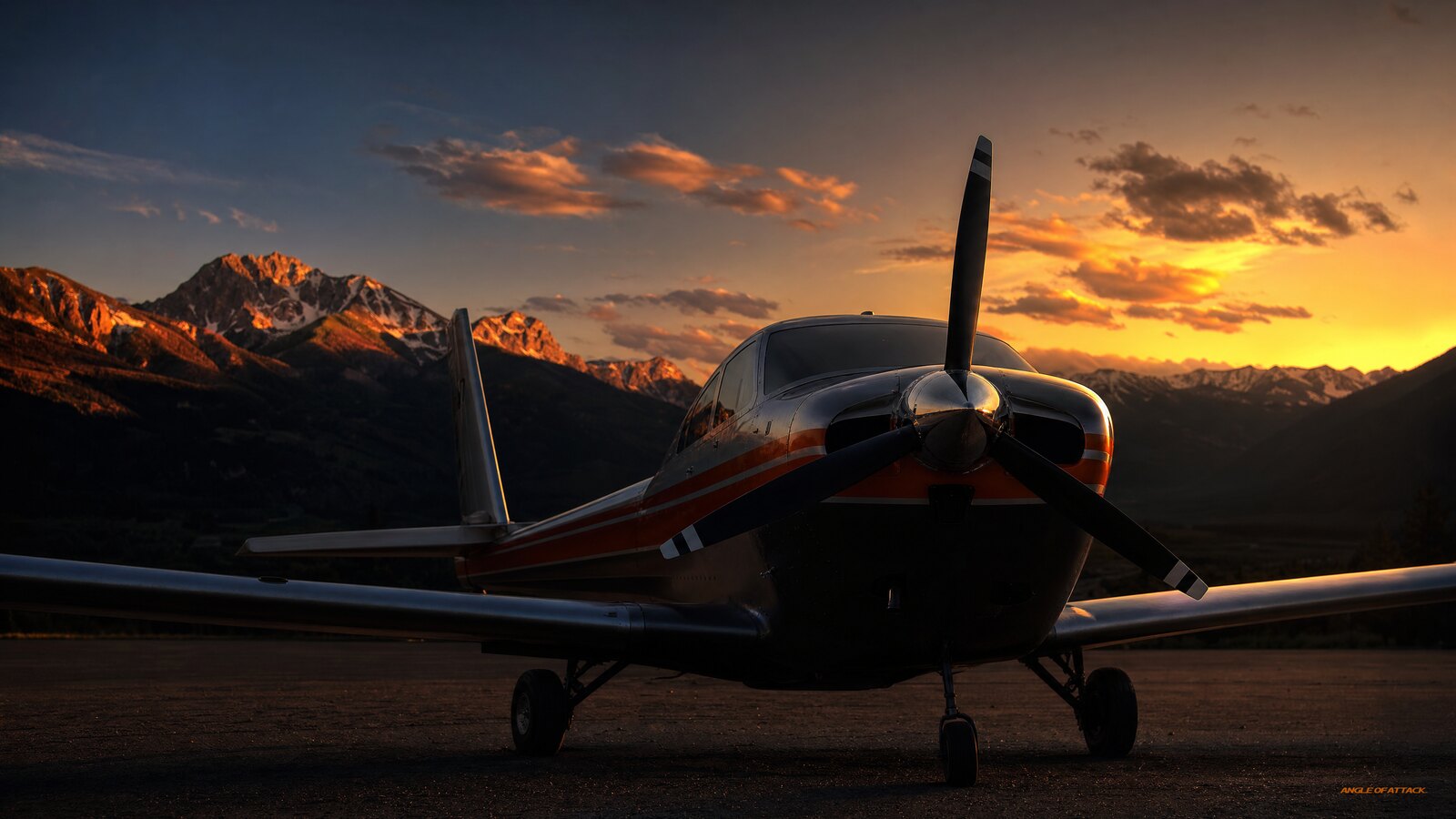
airplane in golden light" src="https://www.angleofattack.com/wp-content/uploads/2026/07/what-is-a-constant-speed-propeller-featured.jpg" style="margin-bottom: 0;">
- It holds a constant RPM. A constant-speed propeller automatically changes blade pitch to keep the engine spinning at the RPM you set, regardless of airspeed, power, or pitch attitude.
- Two controls, two jobs. The throttle sets manifold pressure (power); the propeller control sets RPM. You manage them together, not in isolation.
- A governor does the work. A propeller governor senses RPM and uses engine oil pressure to drive a piston that twists the blades to a finer or coarser angle.
- Pitch is the gear. Low (fine) pitch is a small bite of air and high RPM for takeoff and climb; high (coarse) pitch is a big bite and lower RPM for efficient cruise — exactly like shifting gears.
- Power-change order matters. When increasing power, prop forward then throttle up; when reducing, throttle back then prop back. It protects the engine from high manifold pressure at low RPM.
- It’s an efficiency tool, not just complexity. Holding the propeller at its most efficient angle of attack across the flight envelope is why high-performance airplanes use it.
- Know your airplane. Blue and yellow arcs, redlines, and procedures live in your Pilot’s Operating Handbook — read the powerplant section for the airplane you fly.
WHAT’S IN THIS GUIDE
- 1What is a constant-speed propeller?
- 2How does a constant-speed propeller work?
- 3What does the propeller governor do?
- 4What’s the difference between a constant-speed and a fixed-pitch propeller?
- 5How do you use the throttle and propeller controls together?
- 6Why does the power-change order matter?
- 7Picture a student on the first complex flight
- 8PLT Study Guide
- 9Frequently Asked Questions
What is a constant-speed propeller?
A constant-speed propeller is a variable-pitch propeller that automatically adjusts its blade angle to maintain a selected, constant engine RPM. You set the RPM with a cockpit propeller control, and a governor continuously changes the blade pitch so the engine holds that speed even as airspeed, power, and attitude change throughout the flight.
The FAA’s Pilot’s Handbook of Aeronautical Knowledge (PHAK, FAA-H-8083-25C) describes the constant-speed propeller as a controllable-pitch propeller whose blade angle is controlled automatically by a governor to keep engine RPM constant. It’s the standard on high-performance and complex single-engine airplanes — the Cessna 182, Piper Arrow, Cirrus SR22, and Beechcraft Bonanza all use one. You’ll also hear it called a “constant-speed prop” or, loosely, a “variable-pitch prop,” though variable-pitch is the broader category it belongs to.
For a student stepping up from a fixed-pitch trainer, the goal isn’t to rebuild the governor. It’s to understand that the propeller is now a second power-management tool, what the RPM you select actually does, and why the blades change angle on their own. Get that picture straight, and the second blue lever stops being intimidating and starts being useful.
How does a constant-speed propeller work?
A constant-speed propeller works by trading blade pitch against engine RPM. You select an RPM with the propeller control, and the governor changes the blade angle to hold it: if the engine tries to overspeed, the blades twist to a coarser (higher) pitch that takes a bigger bite of air and loads the engine down; if it tries to slow below your setting, the blades flatten to a finer (lower) pitch that unloads the engine and lets it speed back up.
Think of pitch as your gear selection. Low (fine) pitch is a small bite of air — low resistance, so the engine can spin fast. That’s your takeoff and climb setting, where you want high RPM and maximum power, just like a low gear on a bike for accelerating from a stop. High (coarse) pitch is a big bite of air — more resistance, so the engine turns slower while the airplane covers more distance per revolution. That’s your cruise setting, where a lower RPM is efficient and quieter, like a high gear for cruising down the road.
What makes it “constant-speed” is that the pitch changes happen automatically and continuously. You’re not adjusting the blades yourself in flight. You pick the RPM you want, the governor senses any deviation, and it nudges the pitch to erase it — many times a second. As you raise the nose, lower it, add power, or pull it back, the RPM stays put while the blade angle quietly shifts behind the spinner to keep it there.
What does the propeller governor do?
The propeller governor is the brain of the system: it senses engine RPM and meters engine oil pressure to the propeller hub to change blade pitch and hold your selected speed. Inside the governor, spinning flyweights respond to RPM. When the engine speeds up, the flyweights move out; when it slows, they move in. That movement positions a small pilot valve that directs pressurized oil to — or releases it from — a piston in the propeller hub.
That hub piston is what physically twists the blades. On a typical single-engine airplane, governor-boosted oil pressure drives the blades toward one pitch, while a combination of a spring and the blades’ own aerodynamic and centrifugal forces drives them the other way. The PHAK notes an important safety consequence of this design: on most single-engine airplanes, if oil pressure is lost, the propeller defaults toward low (fine) pitch and high RPM, so you keep thrust available rather than losing the propeller entirely.
Here’s the loop in plain terms. You move the propeller control to set a target RPM, which sets how hard the governor’s speeder spring pushes against the flyweights. The governor then constantly compares actual RPM to that target. Too fast, and it sends oil to coarsen the blades and slow the engine. Too slow, and it releases oil so the blades flatten and the engine speeds up. This is the closed loop running quietly every second the engine is turning — and it’s why the tachometer needle barely moves even as you pitch and maneuver.
What’s the difference between a constant-speed and a fixed-pitch propeller?
The core difference is control. A fixed-pitch propeller has its blade angle built in and unchangeable — it’s optimized as a compromise between climb and cruise, and your single throttle controls everything. A constant-speed propeller has adjustable blade pitch managed by a governor, so it can hold the most efficient angle across the whole flight, and you manage it with two controls: throttle for power and a propeller control for RPM.
That difference shows up in how the airplane flies and what you watch. With a fixed-pitch propeller, RPM rises and falls with airspeed and pitch attitude, and the tachometer is your main power gauge. With a constant-speed propeller, RPM stays where you set it, manifold pressure becomes your power reference, and the blades adapt so the engine always works near its sweet spot. The PHAK explains that this is exactly why high-performance airplanes use them — a fixed blade angle can be efficient at one airspeed, but a constant-speed propeller stays efficient across many. Here’s how the two line up:
| Factor | Fixed-pitch propeller | Constant-speed propeller |
|---|---|---|
| Blade angle | Fixed at one angle | Adjustable, set automatically by a governor |
| Cockpit controls | Throttle only | Throttle (power) + propeller control (RPM) |
| RPM behavior | Varies with airspeed and attitude | Held constant at the selected setting |
| Primary power gauge | Tachometer (RPM) | Manifold pressure gauge + tachometer |
| Efficiency | A compromise; best at one airspeed | Efficient across the flight envelope |
| Typical airplanes | Cessna 172, Piper Cherokee 140 | Cessna 182, Piper Arrow, Cirrus SR22 |
| Pilot workload | Lower; one lever | Higher; manage two levers together |
The practical takeaway is that the constant-speed propeller buys you performance and efficiency in exchange for a little more management. For a private pilot training in a fixed-pitch airplane, it’s the system you’ll meet when you step up to a complex or high-performance endorsement — and the picture worth getting straight before you do.
How do you use the throttle and propeller controls together?
You use the two controls as a team: the throttle (black knob) sets manifold pressure, which is your power, and the propeller control (blue knob) sets RPM. Together they define a power setting. The Pilot’s Operating Handbook gives you specific manifold-pressure-and-RPM combinations for takeoff, climb, and cruise, and your job is to set both to match the phase of flight.
A simple mental model helps. Manifold pressure is how hard the engine is working; RPM is how fast it’s turning. On takeoff you want both high — full throttle and high RPM (full forward, fine pitch) for maximum power. In cruise you pull both back to an efficient combination — a lower manifold pressure and a lower RPM (coarser pitch) that’s quieter and burns less fuel while the airplane covers ground efficiently. You’ll watch two gauges now instead of one: the manifold pressure gauge for power and the tachometer for RPM.
This is also where pilots learn to think in “square” settings as a starting habit — for example, 23 inches of manifold pressure with 2,300 RPM — though the real numbers always come from your specific POH, not a rule of thumb. The point isn’t to memorize a magic pair. It’s to understand that you’re now setting power with two coordinated levers, reading two gauges, and letting the governor handle the blade angle in between.
Why does the power-change order matter?
The order matters because you want to avoid putting high manifold pressure on the engine while it’s turning at a low RPM — a high-power, low-speed combination that stresses the engine. The standard rule keeps you out of that corner: when increasing power, move the propeller control forward (higher RPM) first, then advance the throttle. When reducing power, retard the throttle first, then pull the propeller control back.
The logic is straightforward once you see it. Adding throttle raises manifold pressure (more power), and raising the propeller control raises RPM. If you led with throttle before bringing the RPM up, you’d briefly have high power against a slow-turning engine. By bringing RPM up first on the way in and reducing power first on the way out, you always change them in the protective order. Many trainers and POHs are designed with enough margin that brief reversals aren’t damaging, but the disciplined sequence is the habit you build and the one a check pilot looks for.
There’s a calm-cockpit benefit, too. A consistent order means your hands learn one flow and run it the same way every time — prop, throttle, mixture as appropriate going up; throttle, prop, mixture coming down. “Calm as a skill” comes from procedures you’ve made automatic, so the second lever never becomes a scramble. Always confirm the exact sequence and any limitations in the POH for the airplane you fly, since some engines and propeller combinations have specific restrictions.
If you want this kind of systems knowledge taught step by step — the way it actually clicks before you ever touch the blue lever, instead of as a list to memorize — our Private Pilot Ground School walks through aircraft systems with cockpit visuals so you show up to lessons already understanding how the airplane works.
Picture a student on the first complex flight
Picture a student climbing into a Piper Arrow for the first time after a hundred hours behind a fixed-pitch trainer. The throttle is familiar. The blue lever next to it is not. On the run-up, the instructor has them cycle the propeller — pulling the control back and watching the RPM drop as the blades go coarse and the governor circulates warm oil through the hub, then pushing it forward and watching the RPM recover. The first time, the student is surprised the tach moves at all from a lever that isn’t the throttle.
On takeoff, both levers go full forward — full power, high RPM, fine pitch — and the airplane leaps off in a way the trainer never did. Then comes the moment that teaches the lesson. Leveling at cruise altitude, the student reaches to pull power back and instinctively grabs the throttle and prop together in a fumble. The instructor has them slow down and do it in order: throttle back to cruise manifold pressure first, then ease the propeller control back to cruise RPM. The engine note settles, the manifold pressure and tach show the target numbers, and the cockpit goes quiet and smooth.
Nothing dramatic happens — and that’s the point. Within a few power changes, the student’s hand has learned the flow, and the two levers stop feeling like a juggling act. What clicked wasn’t a memorized number. It was understanding that the throttle sets power, the propeller control sets RPM, the governor handles the blades, and the order protects the engine. Once that picture is in place, the constant-speed propeller is just a smarter way to fly — not a new thing to fear.
PLT Study Guide
The FAA tags knowledge-test questions with PLT (Pilot Learning Statement) codes. These are the codes whose official FAA wording actually maps to how a constant-speed propeller works, translated into plain study points. (Note: the code sometimes paired with this topic — PLT243, forces acting on aircraft: propeller / torque — is about the gyroscopic, P-factor, and torque effects a propeller creates, not how a constant-speed propeller is controlled. It’s a different subject, so don’t reach for it here.)
PLT350 — Recall propeller operations: constant / variable speed.
This is the core code for the topic. Know that a constant-speed propeller holds a selected RPM by automatically changing blade pitch, that low (fine) pitch and high RPM are used for takeoff and climb while high (coarse) pitch and lower RPM are used for cruise, and that the throttle sets manifold pressure while the propeller control sets RPM.
PLT351 — Recall propeller system: types, components, operating principles, and characteristics.
Understand the parts of the system and how they fit together — the variable-pitch blades, the hub piston that twists them, and the governor that meters engine oil pressure based on sensed RPM. Know that most single-engine constant-speed propellers default toward low pitch / high RPM if oil pressure is lost.
Frequently Asked Questions
What is a constant-speed propeller in simple terms?
A constant-speed propeller is a propeller whose blade angle changes automatically to hold the engine at a steady RPM you select. You set the RPM with a cockpit control, and a governor adjusts the blade pitch — finer or coarser — to keep the engine turning at that speed as airspeed and power change.
How does a constant-speed propeller change pitch?
A governor senses engine RPM with spinning flyweights and meters engine oil pressure to a piston inside the propeller hub. That piston twists the blades to a finer or coarser angle. If the engine overspeeds, the blades go coarse to slow it; if it slows, they flatten so it speeds back up to your setting.
Why use a constant-speed propeller instead of a fixed-pitch one?
A fixed-pitch propeller is a compromise that’s only efficient at one airspeed. A constant-speed propeller adjusts its blade angle to stay efficient across the whole flight — strong climb performance at high RPM and economical, quiet cruise at lower RPM. That’s why high-performance and complex airplanes use them, at the cost of a little more pilot workload.
What does the propeller control (blue lever) do?
The blue propeller control sets the RPM you want the engine to hold. Push it forward for higher RPM and finer blade pitch (takeoff and climb); pull it back for lower RPM and coarser pitch (cruise). It doesn’t change power directly — that’s the throttle’s job. The governor then keeps the engine at your selected RPM.
In what order do you move the throttle and propeller controls?
When increasing power, bring the propeller control forward (higher RPM) first, then advance the throttle. When reducing power, retard the throttle first, then pull the propeller control back. This avoids high manifold pressure against a slow-turning engine. Always confirm the exact sequence in your airplane’s POH.
What happens if the propeller governor or oil pressure fails?
On most single-engine airplanes, the propeller is designed to default toward low (fine) pitch and high RPM if oil pressure is lost, so you keep thrust available. Behavior varies by design, especially on twins with feathering propellers, so know your specific airplane’s failure characteristics from its POH and emergency procedures.
Is a variable-pitch propeller the same as a constant-speed propeller?
A constant-speed propeller is a type of variable-pitch propeller. “Variable-pitch” means the blade angle can change; “constant-speed” means a governor changes it automatically to hold a set RPM. Nearly all variable-pitch propellers on modern light airplanes are constant-speed, so the terms are often used interchangeably even though constant-speed is the more specific one.
Do I need a special endorsement to fly an airplane with a constant-speed propeller?
You’ll most often meet a constant-speed propeller in a complex airplane (which also has retractable gear and flaps) or a high-performance airplane (more than 200 horsepower), and those each require a logbook endorsement from an instructor. The propeller itself isn’t separately endorsed, but the airplanes that use it usually carry these training requirements.
Master every system on your checkride — and on day one.
The Private Pilot Ground School breaks down every FAA subject area in the same plain-English, real-world way you just read — with quizzes, scenarios, and the explanations that finally make it click.
Learn the constant-speed propeller so you become the pilot who knows what’s happening out front when you set climb power, ease into cruise, or hear the engine note change — not just the one who memorized which lever is blue. Understand that the throttle sets power, the propeller control sets RPM, and the governor handles the blades in between, then read the powerplant section of the airplane you actually fly, and the second lever becomes a tool you command instead of a complication you tolerate.


ON THE SAME TOPIC
IFR vs VFR: The Two Sets of Rules Every Pilot Flies By
IFR vs VFR: The Two Sets of Rules Every Pilot Flies By 19 min read Last updated June 2026 · Chris Palmer The difference between IFR and VFR is which set of rules you fly under. VFR — visual flight rules — lets you navigate by looking outside and staying clear of clouds in good […]
 Read more
ASOS vs AWOS vs ATIS: How to Pull the Right Weather Before You Fly
ASOS vs AWOS vs ATIS: How to Pull the Right Weather Before You Fly 13 min read Last updated June 2026 · Chris Palmer The difference comes down to who is talking and what the broadcast covers. ASOS and AWOS are automated, computer-generated weather observations of the conditions right at the field. ATIS is a […]
Read more 
What Is RNAV Navigation? Area Navigation for VFR Pilots
What Is RNAV Navigation? Area Navigation for VFR Pilots 17 min read Last updated June 2026 · Chris Palmer RNAV — Area Navigation — is a method that lets an aircraft fly any desired path within the coverage of ground- or space-based navigation aids, rather than being forced to fly directly to and from stations. […]
Read more 
NDB and ADF Explained: The Oldest Radio Nav System You Still Need to Understand
NDB and ADF Explained: The Oldest Radio Nav System You Still Need to Understand 16 min read Last updated June 2026 · Chris Palmer An NDB (non-directional beacon) is a ground-based radio transmitter that sends a signal in all directions, and an ADF (automatic direction finder) is the cockpit receiver whose needle points straight at […]
Read more 
Stay Connected
Be the very first to get notified when we publish new flying videos, free lessons, and special offers on our courses.
