
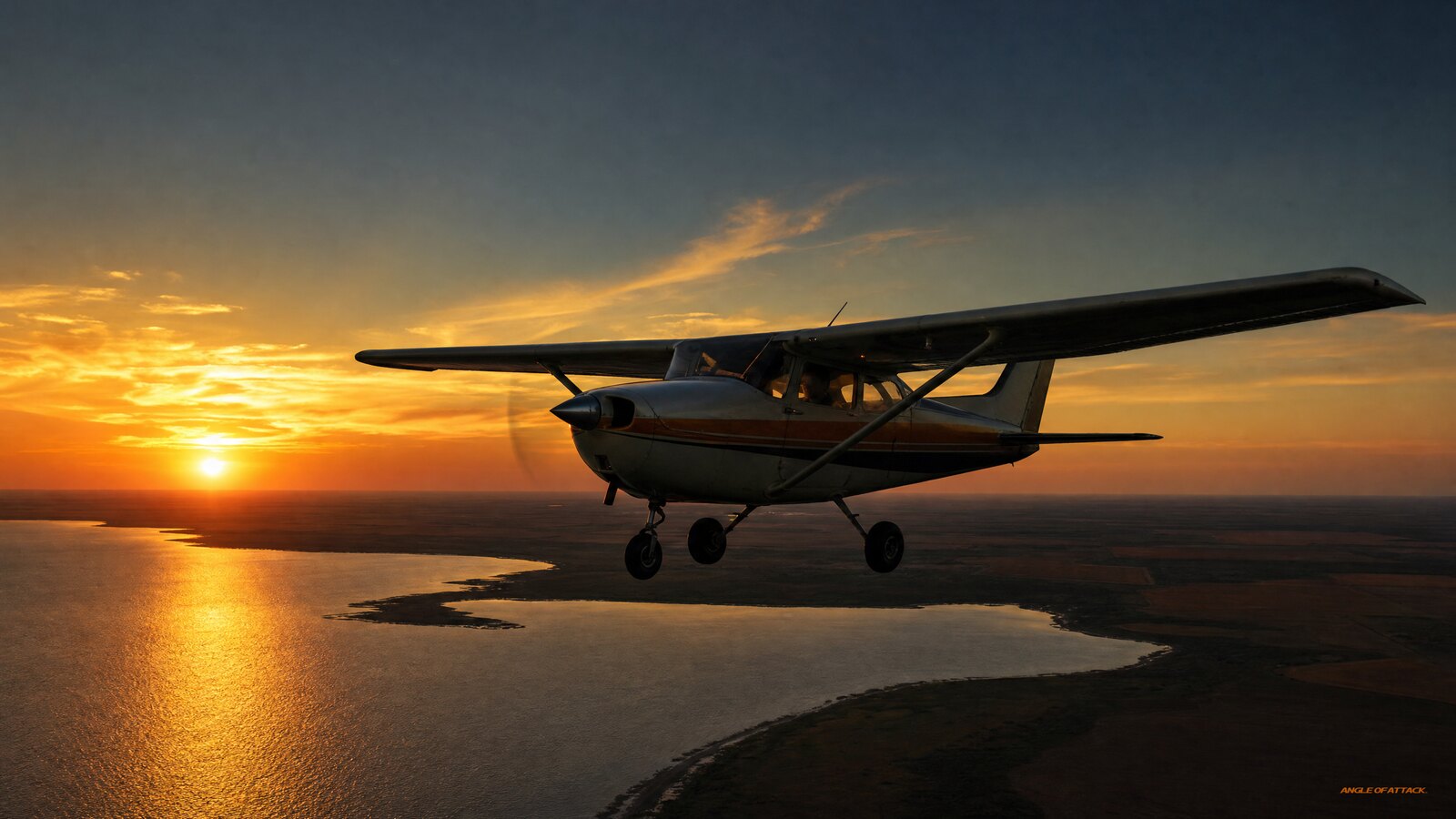
What Is Parasite Drag? The Resistance That Grows With Speed
Parasite drag is the resistance an airplane creates simply by pushing its shape through the air — the friction, the form, and the interference of every part that isn’t producing lift. Unlike induced drag, parasite drag rises sharply as you speed up, increasing roughly with the square of airspeed. That last part is the whole story in a nutshell. Double your speed and parasite drag roughly quadruples. It’s why your Cessna 172 burns so much fuel to squeeze out the last few knots of cruise, why retractable-gear airplanes tuck their wheels away, and why a clean, well-rigged airframe simply flies better. Understand parasite drag and the airplane’s behavior at high speed stops being a mystery.
- Parasite drag is the cost of moving through the air. It comes from the airplane’s shape and surfaces — not from the wing making lift. The Pilot’s Handbook of Aeronautical Knowledge (PHAK, FAA-H-8083-25C) groups it into form drag, skin friction, and interference drag.
- It increases with the square of airspeed. Speed up, and parasite drag climbs fast. That’s the defining behavior, and it’s the opposite of induced drag.
- It has three sources. Form drag (the shape), skin friction (the surface roughness), and interference drag (where parts meet), and the FAA folds all three under one heading.
- Induced drag is its mirror image. Induced drag is the price of making lift and is highest at low speed; parasite drag is highest at high speed. Add them together and you get total drag.
- Total drag is lowest in the middle. The two drag curves cross at the speed for best lift-to-drag ratio (L/D max) — your most efficient speed for gliding and range.
- You can reduce parasite drag. Clean airframes, retractable gear, flush rivets, fairings, and antenna placement all chip away at it. A dirty, dinged-up airplane pays for it in fuel and speed.
WHAT’S IN THIS GUIDE
- 1What is parasite drag?
- 2What are the three types of parasite drag?
- 3Why does parasite drag increase with airspeed?
- 4How is parasite drag different from induced drag?
- 5How do parasite and induced drag combine into total drag?
- 6How do pilots and designers reduce parasite drag?
- 7What does parasite drag mean for me as a student pilot?
- 8PLT Study Guide
- 9Frequently Asked Questions
What is parasite drag?
Parasite drag is the aerodynamic resistance produced by any part of the airplane that is moving through the air but not producing lift — the fuselage, landing gear, struts, antennas, rivets, and skin surfaces. The Pilot’s Handbook of Aeronautical Knowledge (PHAK, FAA-H-8083-25C) defines parasite drag as all drag not associated with the production of lift, and divides it into form drag, skin friction, and interference drag.
The name fits. Parasite drag is “parasitic” because it gives you nothing useful in return. Induced drag at least comes packaged with lift — it’s the unavoidable byproduct of making the wing work. Parasite drag is pure cost. Every bolt head, every gap between panels, every external antenna is out there grabbing at the air and slowing you down for no aerodynamic benefit.
Think about your Cessna 172 sitting on the ramp. The fixed landing gear, the wing struts, the step, the cowling, the tiedown rings — none of those make lift. But the moment you start moving, every one of them generates drag. That’s parasite drag, and it’s working against your thrust the entire flight.
Here’s the key relationship to lock in early: parasite drag grows as you go faster. The faster the air rushes past all those non-lifting surfaces, the harder it resists. We’ll dig into exactly why in a moment, but keep that headline in mind — high speed means high parasite drag.
What are the three types of parasite drag?
Parasite drag breaks down into three components: form drag, skin friction drag, and interference drag. The Pilot’s Handbook of Aeronautical Knowledge (PHAK, FAA-H-8083-25C) lists all three under the parasite drag heading. Each comes from a different way the airframe disturbs the air, and together they make up everything dragging on the airplane that isn’t tied to producing lift.
Form drag comes from the shape of the object and the separation of airflow behind it. A flat plate held against the wind creates enormous form drag because the air can’t flow smoothly around it — it tumbles into a turbulent wake. A streamlined teardrop shape creates far less, even though it might be the same size, because the air closes back in cleanly behind it. This is why fairings, wheel pants, and streamlined struts exist.
Skin friction drag is the resistance between the air and the airplane’s actual surface. Air right against the skin sticks to it and forms a thin layer called the boundary layer. The rougher the surface — bug splatter, dirt, peeling paint, exposed rivet heads — the more friction that layer creates. A clean, smooth, waxed airframe slips through the air with less skin friction than a grimy one.
Interference drag shows up where two surfaces meet and their individual airflows collide — the junction of the wing and the fuselage, the wing and a strut, or the tail and the fuselage. The mixing airflows create turbulence and extra drag beyond what each part would make alone. Designers add fillets and fairings at those junctions specifically to smooth the airflow and cut interference drag.
| Type of parasite drag | What causes it | Real example on a trainer |
|---|---|---|
| Form drag | The shape of a part and the wake behind it | Fixed landing gear, blunt cowling, flat antennas |
| Skin friction drag | Roughness of the surface meeting the air | Bug-splattered leading edges, dirt, exposed rivets |
| Interference drag | Airflows colliding where parts join | Wing-to-fuselage junction, strut-to-wing junction |
Why does parasite drag increase with airspeed?
Parasite drag increases with the square of airspeed: when you double your airspeed, parasite drag increases by roughly four times. This is the defining behavior of parasite drag and it comes straight from the physics of moving through a fluid — the force the air exerts on the airframe grows with the square of the relative velocity. The FAA addresses this under the forces-acting-on-aircraft learning statements covering airspeed and drag.
Picture sticking your hand out the window of a moving car. At 20 mph you feel a gentle push. At 40 mph — double the speed — you don’t feel twice the push, you feel about four times the push. At 60 mph you can barely hold your arm steady. That’s the square relationship in action, and it’s exactly what the airframe feels as you speed up.
This is why those last few knots of cruise speed are so expensive. Going from, say, 100 to 110 knots doesn’t cost you a little more power — it costs you a lot, because parasite drag is climbing steeply on that part of the curve. Engineers and pilots both run into this wall: at high speed, parasite drag dominates, and beating it takes disproportionately more thrust and fuel.
It also explains why high cruise speeds get so thirsty and why level-flight top speed is capped: eventually the airplane’s thrust can’t outpace the parasite drag piling up, and the airspeed simply stops climbing. The relationship between speed and parasite drag shapes the entire high-speed end of how your airplane performs.
How is parasite drag different from induced drag?
Parasite drag and induced drag are the two halves of total drag, and they behave in opposite ways. Parasite drag rises as airspeed increases, while induced drag — the drag created as a byproduct of producing lift — is greatest at low airspeed and decreases as you speed up. The Pilot’s Handbook of Aeronautical Knowledge (PHAK, FAA-H-8083-25C) presents them as the two categories that together make up total drag.
Induced drag is the toll the wing pays for making lift. At low speed and high angle of attack — think slow flight, the climb after takeoff, or the moment before a stall — the wing is working hard, throwing off strong wingtip vortices, and induced drag is high. Speed up, lower the angle of attack, and that induced drag falls away.
Parasite drag does the reverse. It’s nearly nothing at low speed and grows steeply as you accelerate. So at the slow end of the envelope, induced drag is your enemy; at the fast end, parasite drag takes over. Most students find it clicks once they see the two as mirror images.
| Characteristic | Parasite drag | Induced drag |
|---|---|---|
| Source | Airframe shape, surfaces, junctions (not lift) | A byproduct of the wing producing lift |
| Behavior with speed | Increases with the square of airspeed | Decreases as airspeed increases |
| Worst at | High airspeed | Low airspeed / high angle of attack |
| Tied to wingtip vortices? | No | Yes — vortices are the visible sign of it |
| How to reduce it | Clean airframe, fairings, retract gear | Higher airspeed, lower angle of attack, wingtip design |
Here’s a memory hook that sticks: parasite drag is the “going fast” drag, and induced drag is the “going slow” drag. When the airplane feels mushy and behind the power curve on a slow approach, that’s induced drag. When you’re firewalled in cruise and the airspeed just won’t climb any higher, that’s parasite drag.
How do parasite and induced drag combine into total drag?
Total drag is the sum of parasite drag and induced drag at any given airspeed, and because the two move in opposite directions, total drag forms a U-shaped curve. The lowest point on that curve — where the airplane creates the least total drag — is the speed for the maximum lift-to-drag ratio, called L/D max. The Pilot’s Handbook of Aeronautical Knowledge (PHAK, FAA-H-8083-25C) describes this crossover as the airplane’s most efficient point.
At L/D max, the parasite drag curve and the induced drag curve cross — the two are equal. Slower than that speed, induced drag dominates and total drag rises. Faster than that speed, parasite drag dominates and total drag rises again. Right in the middle, you’re getting the most lift for the least drag the airframe can manage.
This isn’t just chart trivia. L/D max is the speed that gives you your best glide distance if the engine quits, and it’s the foundation for your best-range performance. When your instructor has you pitch for best glide after pulling the power, you are flying to that bottom-of-the-bucket point on the total drag curve, where the airplane travels the farthest for each foot of altitude it gives up.
It’s also why “faster” and “more efficient” are not the same thing. Push past L/D max and you’re climbing the parasite drag side of the curve, trading fuel for speed at a worse and worse rate. Slow below it and induced drag punishes you instead. The most efficient flying lives at the bottom of that U.
If you want this to feel like intuition instead of memorized curves, our free Total Student Pilot course builds the fundamentals in plain language, and the full Private Pilot Ground School takes you deep on the aerodynamics behind every phase of flight — the kind of understanding that makes you day-one ready, not just checkride-ready.
How do pilots and designers reduce parasite drag?
Parasite drag is reduced by streamlining the airframe and cleaning up its surfaces: retracting the landing gear, adding fairings and wheel pants, using flush rivets, placing antennas thoughtfully, and keeping the airplane clean and waxed. Because parasite drag comes from the shape and surfaces of the airplane rather than from lift, almost every fix targets how smoothly air flows over and around the structure.
The single biggest lever on many airplanes is the landing gear. Fixed gear hangs in the wind the whole flight — great for simplicity and rugged backcountry work, but a steady source of form drag. Retractable gear tucks the wheels into the airframe in cruise, which is exactly why faster cross-country airplanes use it. On a fixed-gear trainer, wheel pants (fairings over the wheels) reclaim some of that loss.
Designers attack the rest of the curve in smaller pieces. Fillets and fairings at the wing-fuselage junction cut interference drag. Flush rivets and smooth skin reduce form and skin friction drag. Streamlined or internal antennas beat the blade antennas sticking up into the slipstream. None of it is dramatic on its own, but it adds up across the whole airframe.
You have a role here too, even in a basic trainer. A leading edge caked with bugs, a film of dirt and oil on the belly, mismatched non-flush patches, an inspection panel left slightly proud — all of it adds skin friction and form drag. Keeping the airplane clean genuinely earns you a bit of speed and fuel economy. It’s the cheapest performance upgrade there is.
What does parasite drag mean for me as a student pilot?
For a student pilot, parasite drag explains the high-speed end of everything your airplane does — why cruise speed plateaus no matter how much throttle you add, why a clean airframe matters, and why best glide isn’t your fastest speed. You don’t calculate it in the cockpit, but understanding it turns a lot of “that’s just how it is” into “of course it does that.” The FAA tests the concept under the forces-acting-on-aircraft learning statements.
I learned to respect parasite drag teaching cross-countries in a 172 out of a strip up here in Alaska. I had a student who was convinced our airplane was underperforming because the book cruise number just wouldn’t show up on the airspeed indicator. He kept easing the throttle forward expecting the needle to climb, and it barely budged — a knot here, a knot there, for a noticeable jump in fuel flow. He thought something was wrong with the engine.
Nothing was wrong with the engine. We were just high on the parasite drag curve, where every extra knot costs a disproportionate gulp of power. I had him pull the power back to a normal cruise setting and we lost maybe two knots while the fuel flow dropped meaningfully. Same airplane, same air — we’d just stopped fighting the square law. Aviation education since 2006 and a CFI since 2017, and that’s still one of my favorite teaching moments: the airplane wasn’t broken, the student was just paying a parasite drag tax he didn’t know existed.
The lesson stuck with him, and it’s the one I’ll leave you with. When the airspeed indicator stops rewarding more throttle, that’s parasite drag telling you you’ve reached the steep part of the curve. Respect it, fly your numbers, and let the airplane work efficiently instead of grinding against the air for a couple of knots you’ll burn extra fuel to keep.
PLT Study Guide
These are the FAA learning-statement codes that genuinely apply to parasite drag and how the drag forces behave. (Note: the FAA tests the relationships here — how drag changes with speed and how the four forces interact — not memorized numbers. Know how the pieces connect and you’ll handle the question stems.)
PLT237 — Recall forces acting on aircraft: airspeed / air density / lift / drag.
This is the core code for parasite drag. Know that parasite drag increases with the square of airspeed — double the speed, roughly four times the drag — and that air density also affects the drag a surface generates. Understand that parasite drag is the drag not associated with producing lift, and that it dominates at the high-speed end of the envelope. Expect question stems about how drag changes as airspeed changes.
PLT241 — Recall forces acting on aircraft: drag / gravity / thrust / lift.
Know how drag fits among the four forces. In steady, unaccelerated flight, thrust equals drag and lift equals weight. Total drag is parasite drag plus induced drag, and the two behave oppositely with airspeed. Understand that to overcome rising parasite drag at high speed, you need more thrust, which is why high cruise speeds cost disproportionate power and fuel.
PLT235 — Recall forces acting on aircraft: aerodynamics.
This broader code covers the aerodynamic picture parasite drag lives in. Know the three sources of parasite drag — form drag, skin friction, and interference drag — and that total drag is lowest at the speed for L/D max, where the parasite and induced drag curves cross. That crossover point is also your best-glide and best-range speed.
Frequently Asked Questions
What is parasite drag in simple terms?
Parasite drag is the resistance an airplane feels just from pushing its shape through the air — the fuselage, landing gear, struts, antennas, and skin surfaces that don’t make lift. It gives nothing useful in return, which is why it’s called “parasitic,” and it grows quickly as the airplane flies faster.
What are the three types of parasite drag?
The three types are form drag, skin friction drag, and interference drag. Form drag comes from an object’s shape and the wake behind it. Skin friction comes from air dragging across the surface. Interference drag comes from airflows colliding where parts join, such as the wing-fuselage junction. The FAA groups all three under parasite drag.
Does parasite drag increase or decrease with speed?
Parasite drag increases with speed — specifically, with the square of airspeed. Double your airspeed and parasite drag roughly quadruples. This is the opposite of induced drag, which decreases as you speed up. The square relationship is exactly why squeezing out the last few knots of cruise costs so much extra power and fuel.
What is the difference between parasite drag and induced drag?
Parasite drag comes from the airframe pushing through the air and is worst at high speed. Induced drag is a byproduct of the wing making lift and is worst at low speed and high angle of attack. They are mirror images: as one rises, the other falls. Added together, they form total drag.
At what speed is total drag the lowest?
Total drag is lowest at the speed for maximum lift-to-drag ratio, called L/D max — the point where the parasite drag and induced drag curves cross and are equal. That speed gives you the airplane’s best glide distance and is the foundation for best-range performance. It is not your fastest speed.
How do pilots reduce parasite drag?
Pilots and designers reduce parasite drag by streamlining and cleaning the airframe: retracting the landing gear, fitting wheel pants and fairings, using flush rivets, placing antennas thoughtfully, and keeping the airplane clean and waxed. Bug splatter, dirt, and exposed hardware all add drag, so a clean airframe is genuinely faster and more fuel efficient.
Why does cruise speed stop increasing even with more throttle?
Because at high speed you’re on the steep part of the parasite drag curve, where drag rises with the square of airspeed. Each additional knot demands disproportionately more thrust to overcome that rising drag. Eventually the engine can’t produce enough extra power, and the airspeed plateaus no matter how much throttle you add.
Is parasite drag the same as wind resistance?
It’s closely related. Parasite drag is the aviation term for the resistance the airframe creates moving through the air, which is similar to the everyday idea of wind resistance on a car or your hand out the window. The aviation definition specifically separates it from induced drag, which is the resistance tied to producing lift.
Master every system on your checkride — and on day one.
The Private Pilot Ground School breaks down every FAA subject area in the same plain-English, real-world way you just read — with quizzes, scenarios, and the explanations that finally make it click.
Parasite drag is just the everyday physics of moving a real machine through real air, and once you feel it on the airspeed indicator, you’ll never un-see it. The plateau in cruise, the cost of a dirty airframe, the reason best glide isn’t full speed: all the same idea, quietly shaping every flight you’ll ever make. Learn it once, and the high-speed end of your airplane finally makes sense.


ON THE SAME TOPIC

IFR vs VFR: The Two Sets of Rules Every Pilot Flies By
IFR vs VFR: The Two Sets of Rules Every Pilot Flies By 19 min read Last updated June 2026 · Chris Palmer The difference between IFR and VFR is which set of rules you fly under. VFR — visual flight rules — lets you navigate by looking outside and staying clear of clouds in good […]
 Read more
ASOS vs AWOS vs ATIS: How to Pull the Right Weather Before You Fly
ASOS vs AWOS vs ATIS: How to Pull the Right Weather Before You Fly 13 min read Last updated June 2026 · Chris Palmer The difference comes down to who is talking and what the broadcast covers. ASOS and AWOS are automated, computer-generated weather observations of the conditions right at the field. ATIS is a […]
Read more 
What Is RNAV Navigation? Area Navigation for VFR Pilots
What Is RNAV Navigation? Area Navigation for VFR Pilots 17 min read Last updated June 2026 · Chris Palmer RNAV — Area Navigation — is a method that lets an aircraft fly any desired path within the coverage of ground- or space-based navigation aids, rather than being forced to fly directly to and from stations. […]
Read more 
NDB and ADF Explained: The Oldest Radio Nav System You Still Need to Understand
NDB and ADF Explained: The Oldest Radio Nav System You Still Need to Understand 16 min read Last updated June 2026 · Chris Palmer An NDB (non-directional beacon) is a ground-based radio transmitter that sends a signal in all directions, and an ADF (automatic direction finder) is the cockpit receiver whose needle points straight at […]
Read more 
Stay Connected
Be the very first to get notified when we publish new flying videos, free lessons, and special offers on our courses.
