
What Is Wind Correction Angle? How Pilots Crab Into the Wind to Fly Straight
Wind correction angle (WCA) is the angle between the heading an airplane points and the course it actually flies over the ground, applied to offset wind drift. By turning the nose into the wind by this angle — called crabbing — a pilot keeps the airplane tracking a straight line over the ground instead of drifting downwind off course.
Here’s the thing that trips up almost every student: the airplane flies through the air, but you’re trying to get somewhere on the ground. And the air itself is moving. So if you point the nose straight at your destination and the wind is blowing from the side, you’ll quietly slide downwind and miss it — sometimes by miles on a long leg.
Wind correction angle is the fix. It’s one of those concepts that feels like math in the classroom and then clicks the first time you watch the ground slide sideways under you in cruise. Let me brief it the way I would before we launched on a windy cross-country.
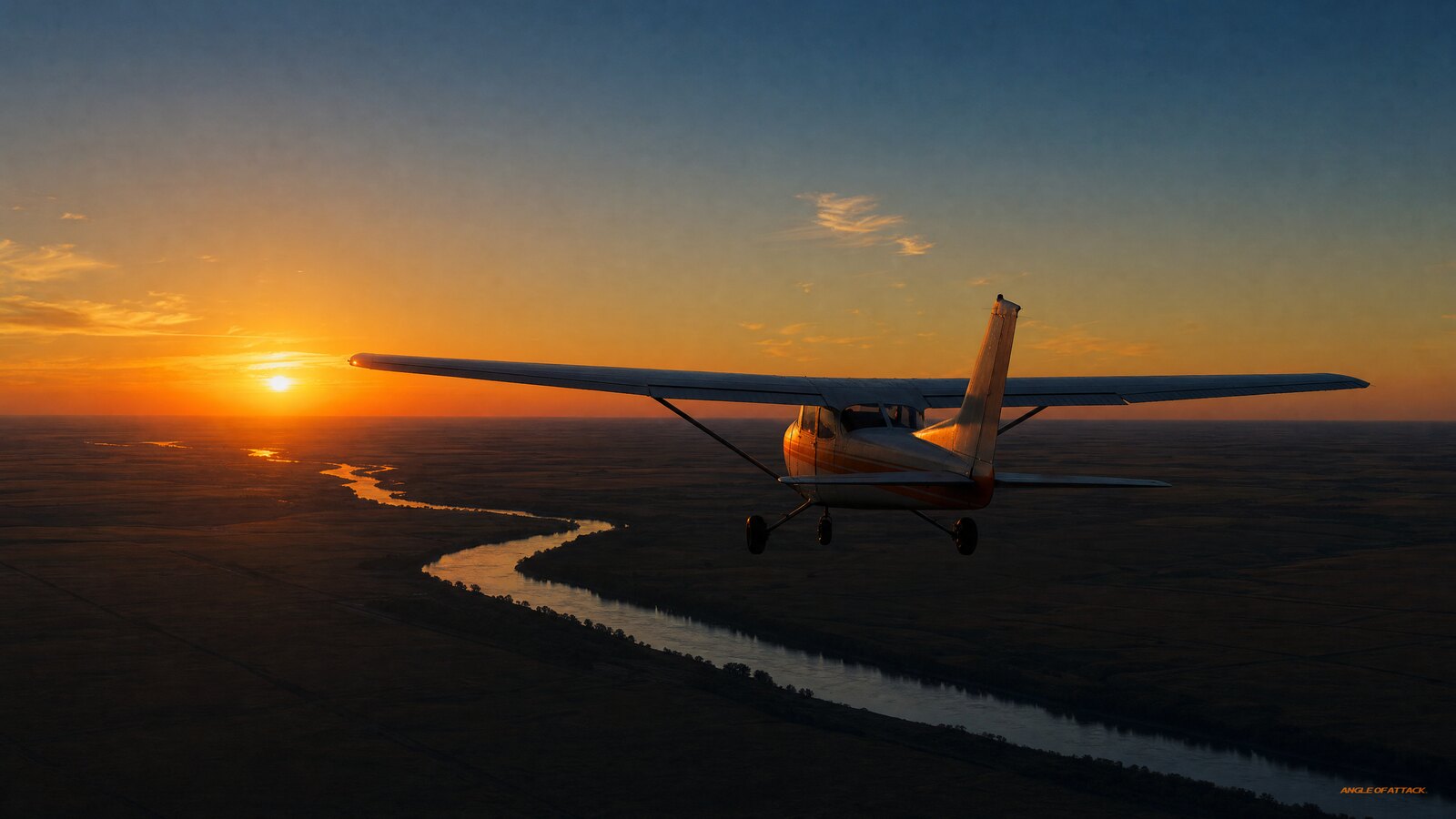
- WCA is heading minus course. It’s the angle you turn the nose into the wind so the airplane’s path over the ground stays on your intended course line.
- Crabbing is the technique. Pointing the nose into the wind while the airplane tracks straight is called a crab — your heading and your ground track are different on purpose.
- Wind from the side causes drift. A crosswind component pushes the airplane downwind; WCA cancels that drift so you don’t miss your checkpoint.
- Bigger wind, smaller airspeed, bigger angle. The stronger the crosswind component and the slower your true airspeed, the larger the wind correction angle you’ll need.
- You solve it on the ground first. WCA is calculated during flight planning with the wind triangle or an E6B, then refined in the air against the actual ground track.
- Heading and course are not the same thing. Heading is where the nose points; course is the line you’re trying to follow over the ground. WCA is the bridge between them.
- WCA is not crosswind landing technique. In cruise you crab; on short final you usually transition to a slip to touch down aligned with the runway.
WHAT’S IN THIS GUIDE
- 1What is wind correction angle?
- 2Why does an airplane drift off course in the wind?
- 3What is the difference between heading and course?
- 4How do you calculate wind correction angle?
- 5What is crabbing and how is it different from a slip?
- 6Reading the river: when the ground told the truth
- 7How does WCA fit into the rest of flight planning?
- 8PLT Study Guide
- 9Frequently Asked Questions
What is wind correction angle?
Wind correction angle is the number of degrees a pilot turns the airplane’s nose into the wind so the airplane’s track over the ground matches the intended course. It is the angular difference between heading (where the nose points) and course (the path over the ground). Apply the right WCA and the wind’s sideways push is exactly canceled.
Picture walking across a moving sidewalk that’s sliding to your right. If you walk straight ahead, you arrive far to the right of where you aimed. But if you angle your steps a little to the left, you can walk a straight line relative to the floor of the building. That left angle is your wind correction angle, and the moving sidewalk is the wind.
The Pilot’s Handbook of Aeronautical Knowledge (PHAK, FAA-H-8083-25C) walks through the wind triangle that produces this number in its navigation chapter. For a Private Pilot, the practical version is simple: figure the angle on the ground during planning, fly that corrected heading, then check your actual track and trim the angle until the ground slides straight beneath you.
The key insight is that the airplane never “feels” the wind once it’s airborne and out of the surface layer — it just flies through a moving block of air. Your instruments show normal airspeed and a steady heading. Only by looking at the ground (or your GPS track) do you see the drift. WCA is how you account for an effect you can’t feel.
Why does an airplane drift off course in the wind?
An airplane drifts off course in wind because it flies relative to the air mass, and the entire air mass is moving over the ground. When wind has any component from the side, that moving air carries the airplane downwind along with it, so the ground track angles away from where the nose is pointed. The stronger the crosswind component, the faster the drift.
Think of two motions stacked together. The airplane moves forward through the air at its true airspeed. At the same time, the whole parcel of air slides across the ground at the wind speed. Your path over the ground is the sum of those two — and if the wind is coming from your side, the sum points downwind of your heading.
This is exactly why a direct headwind or tailwind never causes drift. A headwind only slows your groundspeed; a tailwind only speeds it up. Neither pushes you sideways. It’s the crosswind component — the part of the wind blowing across your course — that causes drift and demands a wind correction angle.
So the windier and more crossing the wind, the more you’ll slide. On a short hop the error might be trivial. On a long cross-country leg, an uncorrected 20-knot crosswind can dump you miles off course and leave you hunting for a checkpoint that isn’t where you expected. Correcting for drift is a core navigation skill the FAA expects you to demonstrate.
What is the difference between heading and course?
Course is the path you intend to fly over the ground, measured as a line on your chart. Heading is the direction the airplane’s nose actually points, read off the heading indicator or compass. In calm air the two are equal, but whenever there’s a crosswind component, heading and course differ by exactly the wind correction angle.
Students blur these constantly, so let’s lock the labels down. Your course is what you draw and measure on the sectional with a plotter — it’s the straight line from departure to destination, the path you want the wheels to trace over the terrain. Course doesn’t care about wind. It’s geometry.
Your heading is where the nose is aimed. To make the airplane follow that course line through moving air, you usually have to point the nose somewhere other than straight down the line. That offset is the wind correction angle. Add WCA to (or subtract it from) your course and you get the heading to fly.
A clean way to remember it: course is the destination’s idea of where you should go; heading is the airplane’s idea of where it’s pointed. Wind correction angle reconciles the two. When the ground track finally matches the course line, you’ve found the right heading — even though the nose looks “off.”
How do you calculate wind correction angle?
You calculate wind correction angle with the wind triangle, usually solved on a manual E6B flight computer or an electronic equivalent during flight planning. You input the wind direction and speed, your true course, and your true airspeed; the computer returns the WCA and your groundspeed. Bigger crosswind component and slower true airspeed both produce a larger correction angle.
The wind triangle has three sides: the wind vector, the true airspeed vector (where the nose points), and the resulting ground vector (your course and groundspeed). The E6B just solves that triangle for you. You don’t have to love the trigonometry — you have to set the tool up correctly and trust the answer, then verify it against the ground.
Two relationships are worth carrying in your head, because the FAA loves to test the concept, not just the number:
| Factor | If it increases… | Effect on wind correction angle |
|---|---|---|
| Crosswind component (wind across your course) | Increases | WCA gets larger |
| Headwind/tailwind component (wind along your course) | Increases | WCA roughly unchanged (affects groundspeed, not drift) |
| True airspeed | Increases | WCA gets smaller |
| Total wind speed (more crossing) | Increases | WCA gets larger |
Notice what’s not in the angle: a pure headwind or tailwind. It changes how fast you cover the ground, but it doesn’t push you sideways, so it doesn’t change the correction angle. Many a student has over-thought a test question by trying to “correct” for a headwind. Don’t — correct for the cross, account for the head/tailwind in your groundspeed and time.
In the air, you finish the job by observation. Fly the planned heading, watch your GPS track or pick a distant landmark on your course, and adjust the crab a few degrees at a time until the ground stops sliding sideways. The E6B gets you close; your eyes close the gap.
What is crabbing and how is it different from a slip?
Crabbing is flying wings-level with the nose turned into the wind by the wind correction angle, so the airplane tracks straight while pointing slightly off-line. A slip is banking into the wind while holding opposite rudder to keep the nose aligned with your track. You crab for en-route navigation; you typically transition to a slip in the final moments of a crosswind landing.
In cruise, crabbing is the comfortable, efficient way to hold a course. The airplane stays coordinated, the wings stay level, passengers stay happy, and you simply accept that the nose is cocked into the wind. This is wind correction angle in its purest form — heading and ground track differing by a few degrees while you fly a perfectly straight line over the terrain.
The reason you can’t just crab all the way to touchdown is the landing gear. If you touch down crabbed, the wheels are pointed one way while the airplane is moving another, which sends a hard side load through the gear. So on short final many pilots transition from the crab to a slip — drop the upwind wing to stop the drift, push opposite rudder to swing the nose straight down the runway, and land aligned with the centerline.
Keep these in separate boxes. Wind correction angle and crabbing are navigation tools for the whole flight. The slip-to-land is a landing technique for the last few hundred feet. Both fight the same enemy — crosswind drift — but they solve it in different phases of flight and in different ways.
Reading the river: when the ground told the truth
Early on, flying cross-countries up here in Alaska, I learned to trust the ground over my gut. I was tracking a long, straight stretch of river toward a pass, the wind ripping across from the left, and everything inside the cockpit looked perfect — airspeed steady, heading rock-solid on the number I’d planned. And yet that river kept creeping to the right side of the windscreen.
For a few minutes I did the rookie thing: I turned to re-aim the nose straight at the river. Felt right. Was wrong. Every time I pointed the nose back at my target, I just bent my ground track and started drifting all over again, chasing the river instead of correcting for the wind that was moving me off it.
Then it clicked. I stopped flying the nose and started flying the track. I set a crab — turned the nose a healthy chunk into that left crosswind, left it there even though it looked weird — and watched. The river stopped sliding. The nose was cocked maybe fifteen degrees off the river, but the airplane was sliding dead straight down it. That was the wind correction angle doing its quiet work.
I’ve been in aviation education since 2006 and a CFI since 2017, and this is still the first thing I have students prove to themselves on a windy day: the nose can point one way while you fly another, and that’s not a mistake — that’s the whole skill. Pick a long, straight feature, set a crab, and let the ground tell you the truth. Your eyes outside the airplane are the final authority, not the heading bug.
How does WCA fit into the rest of flight planning?
Wind correction angle is one link in the chain that turns a line on a chart into a heading you actually fly. You start with a true course measured off the sectional, apply WCA for the wind to get a true heading, then correct for magnetic variation to get magnetic heading, and finally for compass deviation to get the compass heading you steer.
That full sequence is the heart of dead reckoning, and it’s exactly what the FAA wants you to understand for the written test and the checkride. Here’s the order it usually appears on a nav log: true course, then wind correction angle, then true heading, then variation, then magnetic heading, then deviation, then compass heading. WCA lives right at the front, because wind is the first thing standing between your course and your nose.
The same wind triangle that gives you the correction angle also hands you your groundspeed for the leg, which feeds your time en route and your fuel burn. So wind correction angle isn’t a stand-alone trick — it’s wired into your whole plan. Get the wind wrong and your headings, your times, and your fuel numbers all drift with it.
If you want to build this whole chain into real muscle memory before your checkride, our free Total Student Pilot course walks you through reading a sectional and setting up the E6B step by step, and the full Private Pilot Ground School drills the true-course-to-compass-heading sequence until WCA, variation, and deviation stop feeling like a shell game and start feeling automatic.
PLT Study Guide
The FAA tags written-test questions with PLT (Pilot Learning Statement) codes. For wind correction angle, the codes that genuinely match are below. Translate each into plain-English study points and you’ll recognize the question the moment it shows up.
PLT198 — Recall course / heading: effects of wind. This is the core code for everything on this page. Know that wind shifts your ground track away from your heading, that the crosswind component causes drift while a headwind or tailwind only changes groundspeed, and that wind correction angle is the difference between heading and course. Expect questions describing an airplane drifting downwind and asking which way to correct.
PLT012 — Calculate aircraft performance: time / speed / distance / course / fuel / wind. This is the calculation code. Expect a wind-triangle or E6B problem: given a true course, true airspeed, and a wind, solve for the wind correction angle, the resulting heading, the groundspeed, and often the time and fuel for the leg. The wind correction angle and groundspeed come out of the same wind-triangle setup.
PLT013 — Calculate crosswind / headwind components. Because only the crosswind portion of the wind drives your correction angle, you have to be able to split a wind into its crosswind and headwind components. Expect a problem giving wind direction and speed relative to your course (or a runway) and asking for the crosswind component — the bigger that number, the bigger the WCA or the harder the crosswind landing.
Study tip: if a question describes the effect of wind on your track and asks which way to turn, that’s PLT198. If it hands you numbers and asks you to solve for heading, groundspeed, time, or fuel, that’s PLT012. If it asks specifically for the crosswind component, that’s PLT013. (A closely related code, PLT200 — “dead reckoning calculations / charts” — covers the nav-log sequence WCA lives inside.)
Frequently Asked Questions
What is wind correction angle in simple terms?
Wind correction angle is how far you turn the airplane’s nose into the wind so it still flies straight toward your destination over the ground. The wind would otherwise push you sideways off course. By crabbing into it by the right number of degrees, your ground track matches the course line you planned.
What is the difference between heading and course?
Course is the path you want to fly over the ground, drawn and measured on your chart. Heading is the direction the nose actually points. In calm air they’re the same. With a crosswind, you point the nose off the course line — into the wind — and that offset is the wind correction angle.
Does a headwind cause a wind correction angle?
No. A pure headwind or tailwind blows straight along your course, so it only changes your groundspeed — slower with a headwind, faster with a tailwind. It doesn’t push you sideways, so it doesn’t create drift. Only the crosswind component, the part blowing across your course, requires a wind correction angle.
How do you calculate wind correction angle?
You solve the wind triangle, usually on an E6B flight computer or an electronic equivalent during flight planning. You enter the wind direction and speed, your true course, and your true airspeed, and it returns the wind correction angle and your groundspeed. Then you verify and fine-tune the crab against your actual ground track in flight.
What is crabbing in flying?
Crabbing is flying wings-level with the nose turned into the wind by the wind correction angle, so the airplane tracks straight over the ground while pointing slightly off-line. It’s the normal way to hold a course en route in a crosswind. The nose looks cocked, but your path over the terrain is perfectly straight.
Is wind correction angle the same as a crosswind landing?
Not quite. Wind correction angle and crabbing handle drift while you navigate en route. A crosswind landing handles drift in the last few hundred feet, usually by transitioning from a crab to a slip so the wheels touch down aligned with the runway. Both fight crosswind drift, but in different phases of flight.
Which way do you turn to correct for wind drift?
Turn toward the wind — into it. If the wind is from your left and pushing you right, turn the nose left until the airplane stops drifting and tracks straight down your course. How many degrees you need depends on the cross: a stiff crosswind and a slow airplane call for a bigger crab than a light breeze and a fast one.
Why does the airplane drift even when my heading is correct?
Because the airplane flies through the air, and the whole air mass is moving over the ground. Your heading can be exactly on the planned number while the moving air carries you sideways. You can’t feel it in cruise — your instruments look normal. Only the ground or your GPS track reveals the drift, which is why you correct against the track, not the heading bug.
Master every system on your checkride — and on day one.
The Private Pilot Ground School breaks down every FAA subject area in the same plain-English, real-world way you just read — with quizzes, scenarios, and the explanations that finally make it click.
Wind correction angle is one of those skills that separates a pilot who fights the airplane from one who works with the air. Learn to set a crab, trust the ground track over the look of the nose, and remember that only the crosswind component matters. Do that, and you’ll hold a straight line to your destination on the windiest day on the calendar.


ON THE SAME TOPIC
IFR vs VFR: The Two Sets of Rules Every Pilot Flies By
IFR vs VFR: The Two Sets of Rules Every Pilot Flies By 19 min read Last updated June 2026 · Chris Palmer The difference between IFR and VFR is which set of rules you fly under. VFR — visual flight rules — lets you navigate by looking outside and staying clear of clouds in good […]
 Read more
ASOS vs AWOS vs ATIS: How to Pull the Right Weather Before You Fly
ASOS vs AWOS vs ATIS: How to Pull the Right Weather Before You Fly 13 min read Last updated June 2026 · Chris Palmer The difference comes down to who is talking and what the broadcast covers. ASOS and AWOS are automated, computer-generated weather observations of the conditions right at the field. ATIS is a […]
Read more 
What Is RNAV Navigation? Area Navigation for VFR Pilots
What Is RNAV Navigation? Area Navigation for VFR Pilots 17 min read Last updated June 2026 · Chris Palmer RNAV — Area Navigation — is a method that lets an aircraft fly any desired path within the coverage of ground- or space-based navigation aids, rather than being forced to fly directly to and from stations. […]
Read more 
NDB and ADF Explained: The Oldest Radio Nav System You Still Need to Understand
NDB and ADF Explained: The Oldest Radio Nav System You Still Need to Understand 16 min read Last updated June 2026 · Chris Palmer An NDB (non-directional beacon) is a ground-based radio transmitter that sends a signal in all directions, and an ADF (automatic direction finder) is the cockpit receiver whose needle points straight at […]
Read more 
Stay Connected
Be the very first to get notified when we publish new flying videos, free lessons, and special offers on our courses.
