
AIM Text
- Destination signs have a yellow background with a black inscription indicating a taxi route to a destination on the airport. These signs supplement standard taxiway direction signs to optimize taxi paths to specific areas of the airport.
- Destination signs always have an arrow showing the direction of the taxi route to the destination indicated on the sign. Where the destination sign arrow indicates a turn, the sign location is prior to the intersection. The sign may reside on the opposite side of an intersection for straight ahead paths and for ending taxiway intersections.
- Inbound destination signs identify a taxi path to specific areas of the airport. Sign legends are typically short descriptions or abbreviations of the destination. FIG 2-3-38 shows examples of typical inbound destination signs. Common sign legends include:
- APRON. General parking, servicing, and loading areas
- FBO Apron. An apron where itinerant general aviation operators can park their aircraft and expect to have access to traditional Fixed Base Operator services subject to terms and conditions.
- GA Transient Apron. An apron where itinerant general aviation operators can park their aircraft without FBO services and subject to terms and conditions.
- GA Tenant Apron. An area designated for parking of based general aviation aircraft, e.g., tie down area.
- North/South/East/West Apron. An apron designation describing relative location on the airport.
- CARGO. Areas set aside for cargo handling.
- CIVIL. Areas set aside for civil aircraft.
- FUEL. Areas where aircraft receive fuel or related services.
- INTL. Areas set aside for handling international flights.
- MIL. Areas set aside for military aircraft.
- ANG. Area reserved for Air National Guard
- USN. Area reserved for U.S. Navy
- PARKING. Alternative name for apron area.
- PAX. Areas set aside for passenger handling.
- RAMP. Name synonymous with APRON.
- TERM. Gate positions at which aircraft load or unload passengers and cargo.
- APRON. General parking, servicing, and loading areas
- Outbound destination signs identify the general direction to departure runways. The sign legend consists of direction arrow(s) and the applicable runway designations. FIG 2-3-39 is an example of a typical outbound destination sign.
- When a sign indicates the inscription for two or more destinations having a common taxi route, a “dot” (•) separates the destinations and one arrow indicates the direction of the taxi path, as shown in FIG 2-3-39.
- When a sign shows the inscription for two or more destinations having different taxiing routes, each destination will have its own arrow to indicate the taxi direction. A vertical black message divider separates each destination, as shown in FIG 2-3-40.
FIG 2-3-38
Inbound Destination Sign Example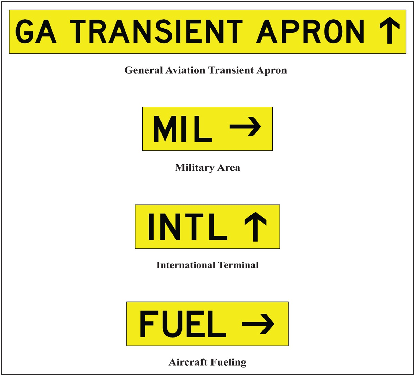
FIG 2-3-39
Outbound Destination Sign for Common Taxi Route to Two Separate Runways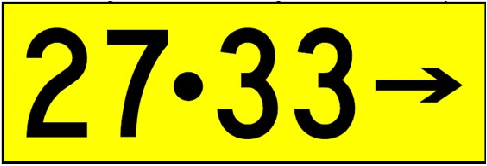
FIG 2-3-40
Destination Sign for Different Taxiing Routes to Two Runways
Source: FAA Aeronautical Information Manual · current edition · paragraph 2-3-11.
The short answer
This AIM section is FAA advisory guidance on destination signs, which have a yellow background with a black inscription and always include an arrow showing the taxi route to an airport destination. It distinguishes inbound destination signs (to areas like APRON, CARGO, FUEL, TERM) from outbound destination signs that point toward departure runways.
Research Notes
Common Questions
What does a yellow destination sign with an arrow mean?
What do legends like APRON, FBO, GA, CARGO, and TERM mean?
The AIM lists inbound legends: APRON is general parking/servicing/loading; FBO Apron offers Fixed Base Operator services; GA Transient/Tenant Aprons are general aviation parking; CARGO is cargo handling; TERM is gate positions where aircraft load or unload. RAMP is synonymous with APRON.
How are multiple destinations shown on one sign?
Per the AIM, when two or more destinations share a common taxi route, a “dot” (•) separates them with one arrow. When they have different taxiing routes, each destination gets its own arrow and a vertical black message divider separates them.