
AIM Text
- Certain airports are equipped with a means of rapidly stopping military aircraft on a runway. This equipment, normally referred to as EMERGENCY ARRESTING GEAR, generally consists of pendant cables supported over the runway surface by rubber “donuts.” Although most devices are located in the overrun areas, a few of these arresting systems have cables stretched over the operational areas near the ends of a runway.
- Arresting cables which cross over a runway require special markings on the runway to identify the cable location. These markings consist of 10 feet diameter solid circles painted “identification yellow,” 30 feet on center, perpendicular to the runway centerline across the entire runway width. Additional details are contained in AC 150/5220-9, Aircraft Arresting Systems for Joint Civil/Military Airports.
- Engineered Materials Arresting Systems (EMAS). EMAS, which is constructed of high energy-absorbing materials of selected strength, is located in the safety area beyond the end of the runway. EMAS will be marked with yellow chevrons. EMAS is designed to crush under the weight of commercial aircraft and will exert deceleration forces on the landing gear. These systems do not affect the normal landing and takeoff of airplanes. More information concerning EMAS is in AC 150/5220-22, Engineered Materials Arresting Systems (EMAS) for Aircraft Overruns.
FIG 2-3-42
Engineered Materials Arresting System (EMAS)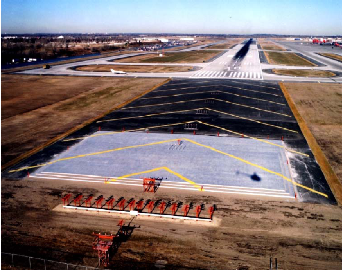
Source: FAA Aeronautical Information Manual · current edition · paragraph 2-3-14.
The short answer
This AIM section is FAA advisory guidance on aircraft arresting systems found at certain airports. It describes emergency arresting gear (pendant cables on rubber “donuts”), the 10-foot yellow circle runway markings that identify cable locations, and Engineered Materials Arresting Systems (EMAS) marked with yellow chevrons in the safety area beyond the runway end.
Research Notes
Common Questions
What do the yellow circles painted across a runway mean?
Per this AIM section, arresting cables crossing a runway require special markings: 10-foot diameter solid circles painted “identification yellow,” 30 feet on center, perpendicular to the runway centerline across the entire runway width, identifying the cable location.
Can I land on a runway that has aircraft arresting gear installed?
Yes. The AIM notes aircraft operations on the runway are not restricted by the installation of aircraft arresting devices, and EMAS does not affect the normal landing and takeoff of airplanes. Most pendant-cable devices are located in overrun areas.
What is EMAS and can I taxi over it?
EMAS is built of high energy-absorbing materials in the safety area beyond the runway end, marked with yellow chevrons, designed to crush under aircraft weight. The AIM warns EMAS may be as close as 35 feet beyond the runway end; aircraft and vehicles should never taxi or drive across it.