
AIM Text
- Controlled Airspace. A generic term that covers the different classification of airspace (Class A, Class B, Class C, Class D, and Class E airspace) and defined dimensions within which air traffic control service is provided to IFR flights and to VFR flights in accordance with the airspace classification. (See FIG 3-2-1.)
- IFR Requirements. IFR operations in any class of controlled airspace requires that a pilot must file an IFR flight plan and receive an appropriate ATC clearance.
- IFR Separation. Standard IFR separation is provided to all aircraft operating under IFR in controlled airspace.
- VFR Requirements. It is the responsibility of the pilot to ensure that ATC clearance or radio communication requirements are met prior to entry into Class B, Class C, or Class D airspace. The pilot retains this responsibility when receiving ATC radar advisories. (See 14 CFR part 91.)
- Traffic Advisories. Traffic advisories will be provided to all aircraft as the controller's work situation permits.
- Safety Alerts. Safety Alerts are mandatory services and are provided to ALL aircraft. There are two types of Safety Alerts:
- Terrain/Obstruction Alert. A Terrain/Obstruction Alert is issued when, in the controller's judgment, an aircraft's altitude places it in unsafe proximity to terrain and/or obstructions; and
- Aircraft Conflict/Mode C Intruder Alert. An Aircraft Conflict/Mode C Intruder Alert is issued if the controller observes another aircraft which places it in an unsafe proximity. When feasible, the controller will offer the pilot an alternative course of action.
FIG 3-2-1
Airspace Classes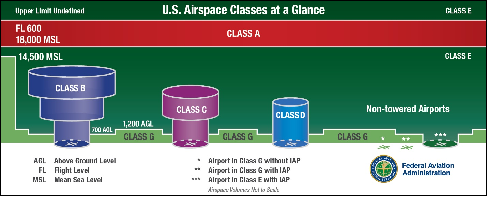
- Ultralight Vehicles. No person may operate an ultralight vehicle within Class A, Class B, Class C, or Class D airspace or within the lateral boundaries of the surface area of Class E airspace designated for an airport unless that person has prior authorization from the ATC facility having jurisdiction over that airspace. (See 14 CFR part 103.)
- Unmanned Free Balloons. Unless otherwise authorized by ATC, no person may operate an unmanned free balloon below 2,000 feet above the surface within the lateral boundaries of Class B, Class C, Class D, or Class E airspace designated for an airport. (See 14 CFR part 101.)
- Parachute Jumps. No person may make a parachute jump, and no pilot-in-command may allow a parachute jump to be made from that aircraft, in or into Class A, Class B, Class C, or Class D airspace without, or in violation of, the terms of an ATC authorization issued by the ATC facility having jurisdiction over the airspace. (See 14 CFR part 105.)
Source: FAA Aeronautical Information Manual · current edition · paragraph 3-2-1.
The short answer
This AIM section is the general overview of controlled airspace — the term covering Class A, B, C, D, and E — within which ATC service is provided to IFR and VFR flights per the classification. It outlines FAA advisory guidance on IFR/VFR requirements, traffic advisories, mandatory safety alerts, and operations by ultralights, balloons, and parachutists, supporting 14 CFR part 91.
Research Notes
Common Questions
What counts as controlled airspace?
Per this AIM section, controlled airspace is a generic term covering Class A, Class B, Class C, Class D, and Class E airspace — defined dimensions within which ATC service is provided to IFR flights and to VFR flights in accordance with the airspace classification.
Are safety alerts optional or mandatory from ATC?
The AIM states that safety alerts are mandatory services provided to ALL aircraft. There are two types: a Terrain/Obstruction Alert and an Aircraft Conflict/Mode C Intruder Alert.
Can an ultralight fly in Class B, C, or D airspace?
Not without prior authorization. The AIM states no person may operate an ultralight vehicle within Class A, B, C, or D airspace, or within the lateral boundaries of the surface area of Class E designated for an airport, without prior ATC authorization (see 14 CFR part 103).