
AIM Text
- Aircraft braking coefficient is dependent upon the surface friction between the tires on the aircraft wheels and the pavement surface. Less friction means less aircraft braking coefficient and less aircraft braking response.
- Runway condition code (RwyCC) values range from 1 (poor) to 6 (dry). For frozen contaminants on runway surfaces, a runway condition code reading of 4 indicates the level when braking deceleration or directional control is between good and medium.
- Airport management should conduct runway condition assessments on wet runways or runways covered with compacted snow and/or ice.
- Numerical readings may be obtained by using the Runway Condition Assessment Matrix (RCAM). The RCAM provides the airport operator with data to complete the report that includes the following:
- Runway(s) in use
- Time of the assessment
- Runway condition codes for each zone (touchdown, mid-point, roll-out)
- Pilot-reported braking action report (if available)
- The contaminant (for example, wet snow, dry snow, slush, ice, etc.)
- Assessments for each zone (see 4-3-9c1(c)) will be issued in the direction of takeoff and landing on the runway, ranging from “1” to “6” to describe contaminated surfaces.
- When any 1 or more runway condition codes are reported as less than 6, airport management must notify ATC for dissemination to pilots.
- Controllers will not issue runway condition codes when all 3 segments of a runway are reporting values of 6.
- Numerical readings may be obtained by using the Runway Condition Assessment Matrix (RCAM). The RCAM provides the airport operator with data to complete the report that includes the following:
- When runway condition code reports are provided by airport management, the ATC facility providing approach control or local airport advisory must provide the report to all pilots.
- Pilots should use runway condition code information with other knowledge including aircraft performance characteristics, type, and weight, previous experience, wind conditions, and aircraft tire type (such as bias ply vs. radial constructed) to determine runway suitability.
- The Runway Condition Assessment Matrix identifies the descriptive terms “good,” “good to medium,” “medium,” “medium to poor,” “poor,” and “nil” used in braking action reports.
FIG 4-3-7
Runway Condition Assessment Matrix (RCAM)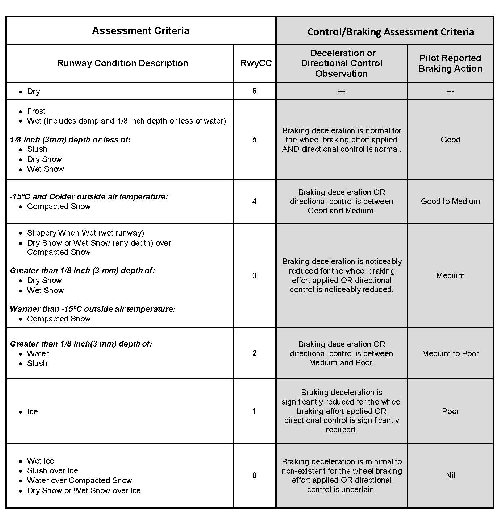
Source: FAA Aeronautical Information Manual · current edition · paragraph 4-3-9.
The short answer
This AIM section is FAA advisory guidance on runway condition reports. It explains runway condition codes (RwyCC) from 1 (poor) to 6 (dry), the Runway Condition Assessment Matrix (RCAM), how airport management assesses contaminated runways by zone, and how ATC disseminates these codes to pilots for runway-suitability decisions.
Research Notes
Common Questions
What do the runway condition code (RwyCC) numbers mean?
Runway condition code values range from 1 (poor) to 6 (dry). For frozen contaminants, a code of 4 indicates the level when braking deceleration or directional control is between good and medium. A RwyCC of “0” is used to delineate a braking action report of NIL and is prohibited from being reported in a FICON NOTAM.
When will ATC issue me runway condition codes?
When any one or more runway condition codes are reported as less than 6, airport management must notify ATC for dissemination to pilots. Controllers will not issue runway condition codes when all three segments of a runway are reporting values of 6. When reports are provided, the ATC facility providing approach control or local airport advisory must provide them to all pilots.
Which runway zones are assessed in a condition report?
Numerical readings come from the Runway Condition Assessment Matrix (RCAM), with runway condition codes reported for each zone—touchdown, mid-point, and roll-out—issued in the direction of takeoff and landing, ranging from 1 to 6. The report also includes the runway in use, time of assessment, any pilot-reported braking action, and the contaminant (wet snow, dry snow, slush, ice, etc.).