AIM DECODED

7-1-11. Weather Radar Services

AIM Text

  1. The National Weather Service operates a network of radar sites for detecting coverage, intensity, and movement of precipitation. The network is supplemented by FAA and DoD radar sites in the western sections of the country. Local warning radar sites augment the network by operating on an as needed basis to support warning and forecast programs.
  2. Scheduled radar observations are taken hourly and transmitted in alpha‐numeric format on weather telecommunications circuits for flight planning purposes. Under certain conditions, special radar reports are issued in addition to the hourly transmittals. Data contained in the reports are also collected by the National Center for Environmental Prediction and used to prepare national radar summary charts for dissemination on facsimile circuits.
  3. A clear radar display (no echoes) does not mean that there is no significant weather within the coverage of the radar site. Clouds and fog are not detected by the radar. However, when echoes are present, turbulence can be implied by the intensity of the precipitation, and icing is implied by the presence of the precipitation at temperatures at or below zero degrees Celsius. Used in conjunction with other weather products, radar provides invaluable information for weather avoidance and flight planning.

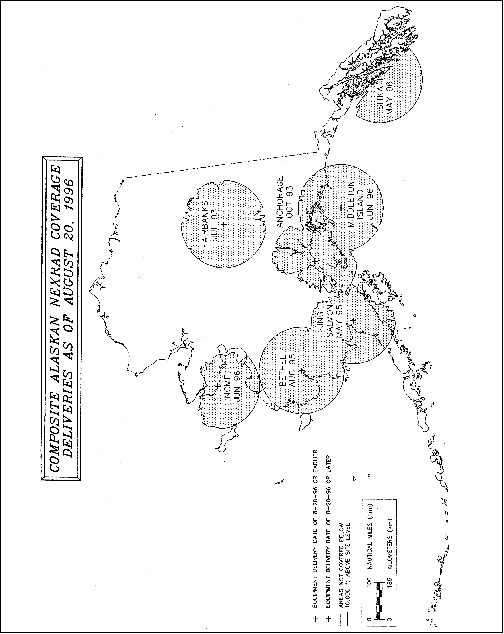
    FIG 7-1-10
    NEXRAD Coverage
    aim0701_AutoA

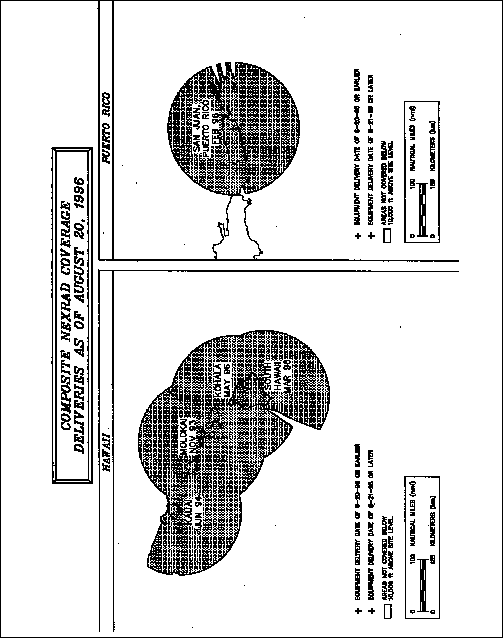
    FIG 7-1-11
    NEXRAD Coverage

    aim0701_Auto9

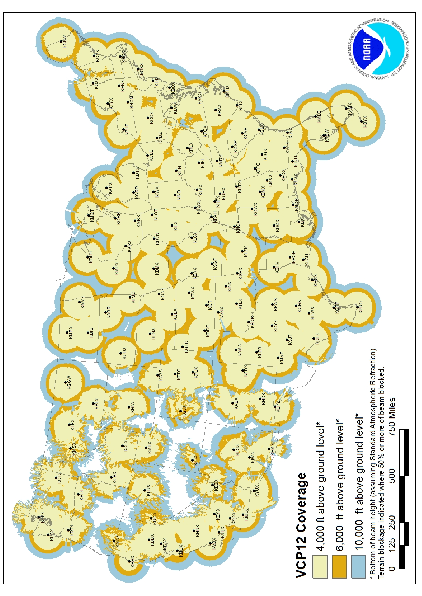
    FIG 7-1-12
    NEXRAD Coverage

    aim0701_Auto8

  4. All En Route Flight Advisory Service facilities and FSSs have equipment to directly access the radar displays from the individual weather radar sites. Specialists at these locations are trained to interpret the display for pilot briefing and inflight advisory services. The Center Weather Service Units located in ARTCCs also have access to weather radar displays and provide support to all air traffic facilities within their center's area.
  5. For more detailed information on PIREPS, users can refer to the current version of the Aviation Weather Handbook, FAA-H-8083-28.

7-1-12. ATC Inflight Weather Avoidance Assistance

  1. ATC Radar Weather Display.
    1. ATC radars are able to display areas of precipitation by sending out a beam of radio energy that is reflected back to the radar antenna when it strikes an object or moisture which may be in the form of rain drops, hail, or snow. The larger the object is, or the more dense its reflective surface, the stronger the return will be presented. Radar weather processors indicate the intensity of reflective returns in terms of decibels (dBZ). ATC systems cannot detect the presence or absence of clouds. The ATC systems can often determine the intensity of a precipitation area, but the specific character of that area (snow, rain, hail, VIRGA, etc.) cannot be determined. For this reason, ATC refers to all weather areas displayed on ATC radar scopes as “precipitation.”
    2. All ATC facilities using radar weather processors with the ability to determine precipitation intensity, will describe the intensity to pilots as:
      1. “LIGHT” (< 26 dBZ)
      2. “MODERATE” (26 to 40 dBZ)
      3. “HEAVY” (> 40 to 50 dBZ)
      4. “EXTREME” (> 50 dBZ)
    3. ATC facilities that, due to equipment limitations, cannot display the intensity levels of precipitation, will describe the location of the precipitation area by geographic position, or position relative to the aircraft. Since the intensity level is not available, the controller will state “INTENSITY UNKNOWN.”
    4. ARTCC facilities normally use a Weather and Radar Processor (WARP) to display a mosaic of data obtained from multiple NEXRAD sites. There is a time delay between actual conditions and those displayed to the controller. For example, the precipitation data on the ARTCC controller's display could be up to 6 minutes old. When the WARP is not available, a second system, the narrowband Air Route Surveillance Radar (ARSR) can display two distinct levels of precipitation intensity that will be described to pilots as “MODERATE” (30 to 40 dBZ) and “HEAVY TO EXTREME” ( > 40 dBZ ). The WARP processor is only used in ARTCC facilities.
    5. ATC radar is not able to detect turbulence. Generally, turbulence can be expected to occur as the rate of rainfall or intensity of precipitation increases. Turbulence associated with greater rates of rainfall/precipitation will normally be more severe than any associated with lesser rates of rainfall/precipitation. Turbulence should be expected to occur near convective activity, even in clear air. Thunderstorms are a form of convective activity that imply severe or greater turbulence. Operation within 20 miles of thunderstorms should be approached with great caution, as the severity of turbulence can be markedly greater than the precipitation intensity might indicate.
  2. Weather Avoidance Assistance.
    1. To the extent possible, controllers will issue pertinent information on weather or chaff areas and assist pilots in avoiding such areas when requested. Pilots should respond to a weather advisory by either acknowledging the advisory or by acknowledging the advisory and requesting an alternative course of action as follows:
      1. Request to deviate off course by statinga heading or degrees, direction of deviation, and approximate number of miles. In this case, when the requested deviation is approved, navigation is at the pilot's prerogative, but must maintain the altitude assigned, and remain within the lateral restrictions issued by ATC.
      2. An approval for lateral deviation authorizes the pilot to maneuver left or right within the lateral limits specified in the clearance.
      3. Request a new route to avoid the affected area.
      4. Request a change of altitude.
      5. Request radar vectors around the affected areas.
    2. For obvious reasons of safety, an IFR pilot must not deviate from the course or altitude or flight level without a proper ATC clearance. When weather conditions encountered are so severe that an immediate deviation is determined to be necessary and time will not permit approval by ATC, the pilot's emergency authority may be exercised.
    3. When the pilot requests clearance for a route deviation or for an ATC radar vector, the controller must evaluate the air traffic picture in the affected area, and coordinate with other controllers (if ATC jurisdictional boundaries may be crossed) before replying to the request.
    4. It should be remembered that the controller's primary function is to provide safe separation between aircraft. Any additional service, such as weather avoidance assistance, can only be provided to the extent that it does not derogate the primary function. It's also worth noting that the separation workload is generally greater than normal when weather disrupts the usual flow of traffic. ATC radar limitations and frequency congestion may also be a factor in limiting the controller's capability to provide additional service.
    5. It is very important, therefore, that the request for deviation or radar vector be forwarded to ATC as far in advance as possible. Delay in submitting it may delay or even preclude ATC approval or require that additional restrictions be placed on the clearance. Insofar as possible the following information should be furnished to ATC when requesting clearance to detour around weather activity:
      1. Proposed point where detour will commence.
      2. Proposed route and extent of detour (direction and distance).
      3. Point where original route will be resumed.
      4. Flight conditions (IFR or VFR).
      5. Any further deviation that may become necessary as the flight progresses.
      6. Advise if the aircraft is equipped with functioning airborne radar.
    6. To a large degree, the assistance that might be rendered by ATC will depend upon the weather information available to controllers. Due to the extremely transitory nature of severe weather situations, the controller's weather information may be of only limited value if based on weather observed on radar only. Frequent updates by pilots giving specific information as to the area affected, altitudes, intensity and nature of the severe weather can be of considerable value. Such reports are relayed by radio or phone to other pilots and controllers and also receive widespread teletypewriter dissemination.
    7. Obtaining IFR clearance or an ATC radar vector to circumnavigate severe weather can often be accommodated more readily in the en route areas away from terminals because there is usually less congestion and, therefore, offer greater freedom of action. In terminal areas, the problem is more acute because of traffic density, ATC coordination requirements, complex departure and arrival routes, adjacent airports, etc. As a consequence, controllers are less likely to be able to accommodate all requests for weather detours in a terminal area or be in a position to volunteer such routing to the pilot. Nevertheless, pilots should not hesitate to advise controllers of any observed severe weather and should specifically advise controllers if they desire circumnavigation of observed weather.

7-1-13. Runway Visual Range (RVR)

There are currently two configurations of RVR in the NAS commonly identified as Taskers and New Generation RVR. The Taskers are the existing configuration which uses transmissometer technology. The New Generation RVRs were deployed in November 1994 and use forward scatter technology. The New Generation RVRs are currently being deployed in the NAS to replace the existing Taskers.

  1. RVR values are measured by transmissometers mounted on 14-foot towers along the runway. A full RVR system consists of:
    1. Transmissometer projector and related items.
    2. Transmissometer receiver (detector) and related items.
    3. Analog recorder.
    4. Signal data converter and related items.
    5. Remote digital or remote display programmer.
  2. The transmissometer projector and receiver are mounted on towers 250 feet apart. A known intensity of light is emitted from the projector and is measured by the receiver. Any obscuring matter such as rain, snow, dust, fog, haze or smoke reduces the light intensity arriving at the receiver. The resultant intensity measurement is then converted to an RVR value by the signal data converter. These values are displayed by readout equipment in the associated air traffic facility and updated approximately once every minute for controller issuance to pilots.
  3. The signal data converter receives information on the high intensity runway edge light setting in use (step 3, 4, or 5); transmission values from the transmissometer and the sensing of day or night conditions. From the three data sources, the system will compute appropriate RVR values.
  4. An RVR transmissometer established on a 250 foot baseline provides digital readouts to a minimum of 600 feet, which are displayed in 200 foot increments to 3,000 feet and in 500 foot increments from 3,000 feet to a maximum value of 6,000 feet.
  5. RVR values for Category IIIa operations extend down to 700 feet RVR; however, only 600 and 800 feet are reportable RVR increments. The 800 RVR reportable value covers a range of 701 feet to 900 feet and is therefore a valid minimum indication of Category IIIa operations.
  6. Approach categories with the corresponding minimum RVR values. (See TBL 7-1-7.)

    TBL 7-1-7
    Approach Category/Minimum RVR Table

    Category

    Visibility (RVR)

    Nonprecision

    2,400 feet

    Category I

    1,800 feet*

    Category II

    1,000 feet

    Category IIIa

    700 feet

    Category IIIb

    150 feet

    Category IIIc

    0 feet

    * 1,400 feet with special equipment and authorization

  7. Ten minute maximum and minimum RVR values for the designated RVR runway are reported in the body of the aviation weather report when the prevailing visibility is less than one mile and/or the RVR is 6,000 feet or less. ATCTs report RVR when the prevailing visibility is 1 mile or less and/or the RVR is 6,000 feet or less.
  8. Details on the requirements for the operational use of RVR are contained in FAA AC 97-1, Runway Visual Range (RVR). Pilots are responsible for compliance with minimums prescribed for their class of operations in the appropriate CFRs and/or operations specifications.
  9. RVR values are also measured by forward scatter meters mounted on 14-foot frangible fiberglass poles. A full RVR system consists of:
    1. Forward scatter meter with a transmitter, receiver and associated items.
    2. A runway light intensity monitor (RLIM).
    3. An ambient light sensor (ALS).
    4. A data processor unit (DPU).
    5. Controller display (CD).
  10. The forward scatter meter is mounted on a 14-foot frangible pole. Infrared light is emitted from the transmitter and received by the receiver. Any obscuring matter such as rain, snow, dust, fog, haze or smoke increases the amount of scattered light reaching the receiver. The resulting measurement along with inputs from the runway light intensity monitor and the ambient light sensor are forwarded to the DPU which calculates the proper RVR value. The RVR values are displayed locally and remotely on controller displays.
  11. The runway light intensity monitors both the runway edge and centerline light step settings (steps 1 through 5). Centerline light step settings are used for CAT IIIb operations. Edge Light step settings are used for CAT I, II, and IIIa operations.
  12. New Generation RVRs can measure and display RVR values down to the lowest limits of Category IIIb operations (150 feet RVR). RVR values are displayed in 100 feet increments and are reported as follows:
    1. 100-feet increments for products below 800 feet.
    2. 200-feet increments for products between 800 feet and 3,000 feet.
    3. 500-feet increments for products between 3,000 feet and 6,500 feet.
    4. 25-meter increments for products below 150 meters.
    5. 50-meter increments for products between 150 meters and 800 meters.
    6. 100-meter increments for products between 800 meters and 1,200 meters.
    7. 200-meter increments for products between 1,200 meters and 2,000 meters.

Source: FAA Aeronautical Information Manual · current edition · paragraph 7-1-11.

Research Notes

AIM 7-1-11 covers METAR/SPECI Observations — the surface weather observations broadcast at airports.

METAR format breakdown: A standard METAR contains:

  • Type (METAR or SPECI)
  • Station ID (e.g., KSEA)
  • Time (UTC, day-hour-minute)
  • Wind (direction/speed/gusts)
  • Visibility
  • RVR (runway visual range) if applicable
  • Weather phenomena
  • Sky condition (clouds and ceilings)
  • Temperature/dewpoint
  • Altimeter setting
  • Remarks

METAR vs SPECI: METAR is the routine hourly observation. SPECI is a special observation triggered by significant changes (wind shift, visibility change, weather phenomenon onset, etc.).

Reading example: METAR KSEA 121753Z 23010KT 10SM FEW050 BKN150 OVC250 16/12 A3012 RMK AO2 SLP196 T01610122

  • KSEA observation at 17:53Z on the 12th
  • Wind 230° at 10 knots
  • Visibility 10 SM
  • Few clouds at 5,000 ft, broken at 15,000, overcast at 25,000
  • Temperature 16°C, dewpoint 12°C
  • Altimeter 30.12 inHg

Reference: AIM 7-1-11; AC 00-45 (Aviation Weather Services).