
AIM Text
- Temperature has an effect on the accuracy of barometric altimeters, indicated altitude, and true altitude. The standard temperature at sea level is 15 degrees Celsius (59 degrees Fahrenheit). The temperature gradient from sea level is minus 2 degrees Celsius (3.6 degrees Fahrenheit) per 1,000 feet. For example, at 5000 feet above sea level, the ambient temperature on a standard day would be 5 degrees Celsius. When the ambient (at altitude) temperature is colder than standard, the aircraft's true altitude is lower than the indicated barometric altitude. When the ambient temperature is warmer than the standard day, the aircraft's true altitude is higher than the indicated barometric altitude.
- TBL 7-3-1 indicates how much error may exist when operating in non-standard cold temperatures. To use the table, find the reported temperature in the left column, and read across the top row to locate the height above the airport (subtract the airport elevation from the flight altitude). Find the intersection of the temperature row and height above airport column. This number represents how far the aircraft may be below the indicated altitude due to possible cold temperature induced error.
TBL 7-3-1
ICAO Cold Temperature Error Table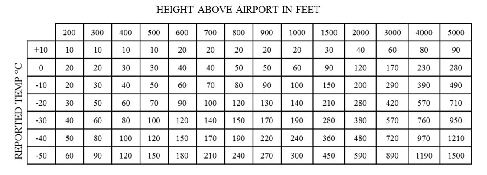
Source: FAA Aeronautical Information Manual · current edition · paragraph 7-3-1.
The short answer
This AIM section provides FAA advisory guidance on how cold temperature affects barometric altimeters. It explains that standard sea-level temperature is 15°C (59°F) with a minus 2°C per 1,000-foot gradient, and that when the air is colder than standard, the aircraft's true altitude is lower than indicated altitude. TBL 7-3-1 quantifies the error.
Research Notes
Common Questions
Is my true altitude higher or lower than indicated when it is cold?
What is the standard temperature and lapse rate used for altimetry?
Per the AIM, standard temperature at sea level is 15 degrees Celsius (59 degrees Fahrenheit), with a gradient of minus 2 degrees Celsius (3.6 degrees Fahrenheit) per 1,000 feet. At 5,000 feet on a standard day, the ambient temperature would be 5 degrees Celsius.
How do I use the ICAO Cold Temperature Error Table (TBL 7-3-1)?
The AIM advises finding the reported temperature in the left column and reading across the top row to the height above the airport (flight altitude minus airport elevation). Their intersection shows how far the aircraft may be below the indicated altitude due to cold-temperature error.