The Real CFI Pass Rate (And Why You Shouldn't Be Scared)
The CFI checkride pass rate in 2023 was 76.1% nationally (FAA Civil Airmen Statistics) — not the 50% the hangar rumor mill repeats. That breaks down to 76.0% with a Designated Pilot Examiner and 81.1% with an FAA Aviation Safety Inspector. Three out of four candidates pass on the first attempt. The 50% myth is wrong, has been wrong for two decades, and the candidates who walk in believing it walk in beaten before they start.

- The 2023 national CFI Initial pass rate was 76.1% per FAA Civil Airmen Statistics — three out of four candidates pass on the first attempt.
- DPE pass rate: 76.0%. FAA Inspector pass rate: 81.1%. Inspectors actually pass more candidates, not fewer.
- The 50% myth is a holdover from the 1990s when CFI pass rates were genuinely lower. It's been outdated for over twenty years.
- The 24% who don't pass first time aren't unlucky. They're almost always under-prepared in one specific area — usually lesson planning or the teaching demonstration.
- A "fail" on the CFI checkride is rarely a wholesale fail. You only retest the Area(s) of Operation you missed, often within a week.
- The single best predictor of a first-try pass isn't IQ, hours, or natural ability. It's whether you've practiced teaching — not just flown the maneuvers.
Walking into your first lesson with a 50-page binder won't help you.
Get my Anti-Binder One-Page Lesson Plan Template free — the lesson plan tool I built for CFI candidates who want to be ready Day 1.
Get the Anti-Binder Template Free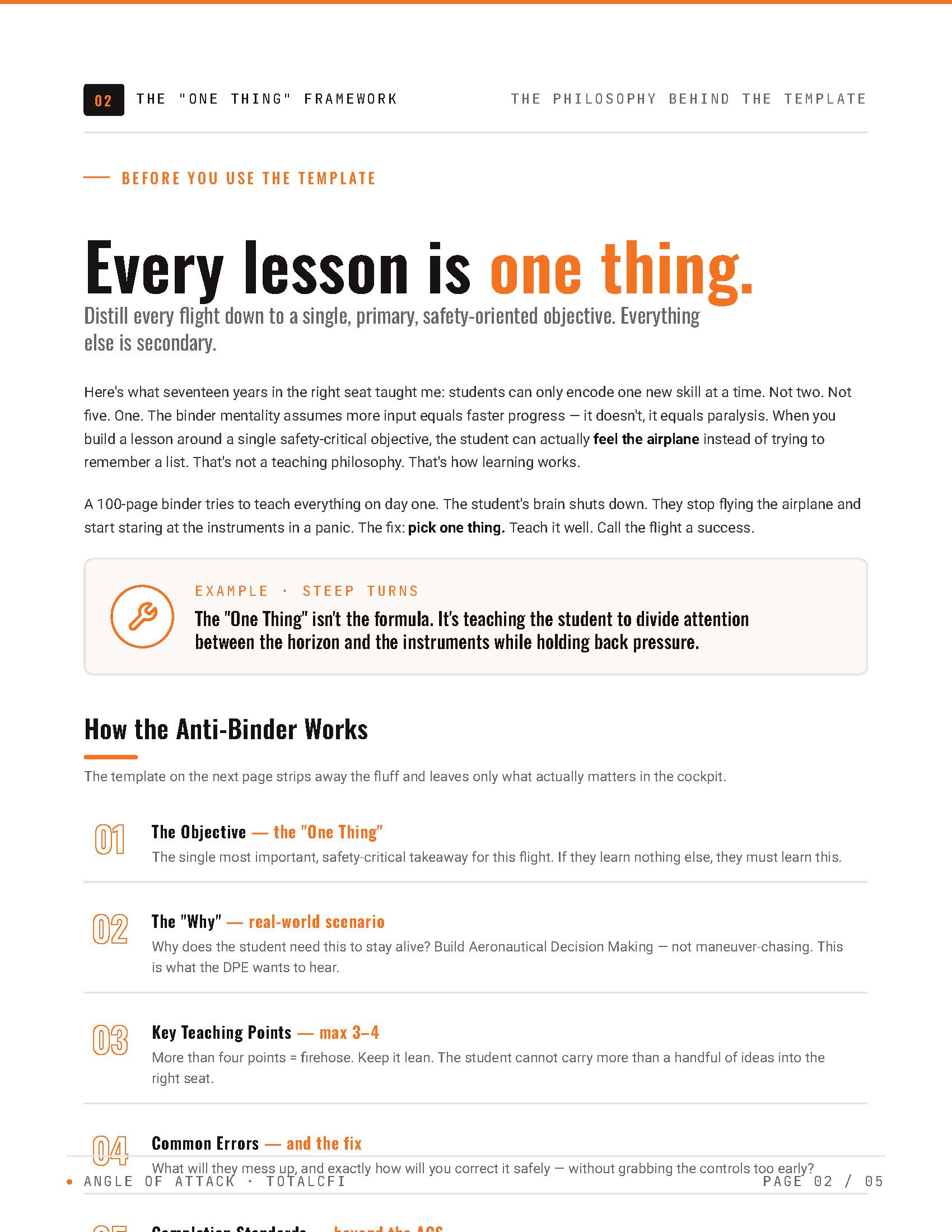

WHAT'S IN THIS GUIDE
- 1What's the CFI Pass Rate? (The Actual Number)
- 2DPE vs FAA Inspector — Who Passes More?
- 3Where the 50% Myth Comes From (And Why It Won't Die)
- 4What the 76.1% Pass Rate Tells You About Your Odds
- 5The Three Things That Predict a First-Try Pass
- 6What If You're in the 24%? (How a "Fail" Actually Works)
- 7How to Walk Into the Ride Calm
- 8Frequently Asked Questions
What's the CFI Pass Rate? (The Actual Number)

76.1%. Per the FAA Civil Airmen Statistics for 2023 — the most recently published full-year dataset as of mid-2026 — three of every four CFI Initial candidates pass on their first attempt.
That's the same ballpark as the Commercial Pilot checkride. It's higher than the rate for several add-on ratings. It is, statistically, a normal pilot certification practical test. Nothing about the number says "this one is the killer."
What confuses people is that the kind of failure is different. On a Private or Commercial ride, a fail is usually about your hands (you couldn't hold altitude on a steep turn, you blew a stall recovery, you lined up on the wrong runway). On a CFI ride, the fail is almost always about your teaching. Your hands were fine. You just couldn't teach what your hands were doing.
That distinction makes the test feel scarier than the number would suggest. But scary feeling and likely outcome are two different things. The data says: 76.1%.
DPE vs FAA Inspector — Who Passes More?

This is where the data gets interesting and the conventional wisdom gets it wrong.
| Examiner type | 2023 first-try pass rate |
|---|---|
| Designated Pilot Examiner (DPE) | 76.0% |
| FAA Aviation Safety Inspector (ASI) | 81.1% |
The "FAA Inspector is harder" myth is wrong. ASI checkrides actually pass more candidates than DPE rides — five percentage points higher.
Why? Probably selection bias, not skill bias. ASI checkrides are scheduled less often (FAA has fewer inspectors than DPEs in most regions), the slots are harder to book, and they're more expensive to discontinue. So they tend to attract candidates who are more thoroughly prepared — who don't want to risk the headache of a re-fly or the embarrassment of a re-test. The candidates self-select for readiness. The numbers reflect it.
The takeaway: don't dodge an ASI ride if one is offered. They're not stricter. They may, on the margin, be easier.
Where the 50% Myth Comes From (And Why It Won't Die)

The 50% number isn't made up out of thin air. It likely stems from genuine CFI pass rates in the 1990s and early 2000s, when the FAA was using the test as a quality filter to weed out unprepared candidates and the pass rate was, in some markets, genuinely close to 50%.
The data hasn't supported the myth in two decades. But three things keep it alive:
- Older instructors keep repeating what they remember. A senior CFI who got their certificate in 1998 and now mentors candidates is repeating the rate that was true for them, not the rate that's true now. They mean well. They're outdated.
- The internet calcifies bad data. A forum post from 2002 that said "the CFI fail rate is 50%" still ranks for that query in 2026. New candidates land on that post, internalize the number, and repeat it.
- Failure stories travel; pass stories don't. When a candidate fails, you hear about it. They tell three friends. When they pass, it's a one-day celebration and then back to teaching. The asymmetry creates the feeling that more candidates fail than actually do.
The reason it matters isn't pedantic. The candidate who walks in believing the pass rate is 50% walks in expecting failure. The candidate who walks in knowing it's 76.1% walks in expecting that if they did the work, they'll be fine.
Belief shapes performance. Get the belief right.
What the 76.1% Pass Rate Tells You About Your Odds

Three out of four. That's the ratio.
But "76.1%" is a national average, and you're not a national average. You're a specific person with a specific level of preparation walking into a specific examiner's room. Your individual odds depend on factors the national average can't see.
Here's the framing I use with candidates I'm prepping. The 76.1% national rate is composed of two very different populations:
- The well-prepared candidates — pass rate well above 90%. The candidates whose lesson plans are clean, who've done a full mock checkride with a senior CFI, who've practiced teaching from the right seat for at least 20 hours. These candidates almost always pass first try.
- The "I think I'm ready" candidates — pass rate well below 60%. The candidates whose preparation focused on flying the maneuvers but not on teaching them. Whose lesson plans look like binder dumps. Who've never role-played the oral with someone playing a confused student.
The national average is the weighted blend. If you're in the first group, your odds are far better than 76%. If you're in the second, they're far worse. Most candidates think they're in the first group when they're actually in the second.
The good news: it's not hard to get into the first group. It's just hard to honestly assess which group you're currently in.
The Three Things That Predict a First-Try Pass

Forget IQ. Forget total hours. Forget which flight school you went to. The variables that actually correlate with first-try pass — based on every candidate I've worked with — are these three:
1. Quality of your lesson plans. Not quantity. Quality. A one-page plan you can teach from beats a 50-page binder you can't navigate. Examiners can smell a binder dump from across the table. They want to see plans that look like teaching tools, not regulatory checkboxes.
2. Time spent practicing teaching (not flying). Most candidates spend 80% of their final-month prep flying maneuvers and 20% practicing teaching. The candidates who pass cleanly do the opposite. They've already proven they can fly. The marginal hour spent flying steep turns one more time isn't moving the needle. The marginal hour spent role-playing a stall lesson with a peer is.
3. Whether you've done a full mock checkride. A $300–$500 mock with a senior CFI mentor in the week before your ride is the highest-ROI dollar in the entire process. It surfaces the gaps you can't see in your own prep. It calibrates your timing. It exposes the weak spots a real DPE will probe.
If you can honestly check those three boxes — quality plans, more teaching practice than flying, a recent mock with a senior CFI — your individual pass rate is closer to 90% than 76%. If you can't, you're flying into the average.
That's the math behind why I built TotalCFI the way I did. The course isn't more flying drills. It's structured teaching practice — the same 24-lesson framework I use with the candidates I prep one-on-one. The candidates I've taken to their CFI rides (Riley, Annalynn, Myla, others) passed first try because we never spent more than the necessary hours on flying. We spent the rest on teaching.
What If You're in the 24%? (How a "Fail" Actually Works)

Here's the part that takes the edge off the entire question.
A "fail" on the CFI checkride is almost never a wholesale fail. Per 14 CFR 61.43, if you don't meet ACS standards in any single Area of Operation, the examiner issues a Notice of Disapproval that lists only the Areas you missed. Everything else stays passed. You don't redo the whole ride. You retest the missed Areas — sometimes within a week, sometimes the same day.
The retest pass rate is higher than the first-try pass rate. Not because retesting is easier (it isn't — you have to fly the same Areas to the same standard), but because:
- The diagnosis is precise. You know exactly what to fix.
- The pressure is off. You've already passed everything else.
- You go in better prepared on that one specific area than you were the first time.
A fail isn't the end. It's a precise, actionable list of one or two things to fix. Most candidates fix them in a week.
This is why TotalCFI's Day-One Ready Guarantee exists in the form it does. If you take the course, do the work, and fail your CFI oral on the first attempt anyway, we cover the retest fee plus a 1-on-1 coaching session with a Master CFI. We're putting our money behind the prep. The retest will go better than the first ride did.
How to Walk Into the Ride Calm — Knowing the Real Numbers

Here's how the numbers should land in your head on the morning of the ride:
- 3 in 4 candidates pass on the first try — and you've done the work to be in the upper half of that distribution.
- A fail isn't catastrophic — it's a precise list of fixes that most candidates close in a week.
- The examiner isn't your enemy — they're your student for the next four to eight hours. Their job is to evaluate your teaching, not to trip you up.
When I drove to Fond du Lac in 2017 for my own CFI ride, I knew the data. I knew my prep was solid. I knew the worst-case outcome wasn't catastrophic. None of that took the work away. I'd put in months of structured prep, but it took the fear away. I walked in calm because the numbers said "if you did the work, you'll be fine," and I'd done the work.
That's the mindset the candidates I prep walk in with. It's the mindset TotalCFI is built to produce. You can't manufacture calm — but you can earn it by getting the prep right.
Frequently Asked Questions
What's the CFI checkride pass rate?
The 2023 national pass rate for the Initial CFI checkride was 76.1%, per the FAA Civil Airmen Statistics. That breaks down to 76.0% for Designated Pilot Examiners and 81.1% for FAA Aviation Safety Inspectors.
Is the CFI checkride harder than the commercial?
Statistically, it's about the same — both run in the mid-70s nationally. Subjectively, the CFI is harder for most candidates because it's the first checkride that grades your teaching, not your flying. The skill being measured is different, even if the pass rate is similar.
Do most people fail the CFI checkride?
No. About three out of four pass on their first attempt. The 50% myth is outdated by two decades.
What's the most common reason for failing the CFI checkride?
In my experience, the two most common reasons are (1) a weak teaching demonstration on a single maneuver — usually a stall, a chandelle, or eights-on-pylons — and (2) a lesson plan that looks like a regulatory dump rather than a real teaching tool. Both are fixable in days, not weeks.
Can I retake the CFI checkride if I fail?
Yes. You retest only the specific Areas of Operation that earned you the Notice of Disapproval — not the whole ride. The retest fee is typically $400–$600, and most candidates retest within a week. The retest pass rate is higher than the first-try rate.
If the CFI checkride is keeping you up at night, you're prepping for the wrong thing.
TotalCFI teaches you to walk into the oral as a teacher, not a test-taker — the reframe most candidates only figure out after they've already failed once.
The number that should be in your head when you walk into your CFI checkride is 76.1, not 50. The candidates who carry the right number into the room don't get cocky — they get calm. The candidates who carry the wrong number in get rattled, and rattled candidates miss things they'd otherwise catch. Get the data right. Get the prep right. The pass takes care of itself.