CFI Lesson Plans: Why 50-Page Binders Fail in the Cockpit (And What to Use Instead)
A CFI lesson plan is the document a Certified Flight Instructor uses to organize and deliver a lesson on a specific maneuver or topic. The FAA requires CFIs to have written lesson plans (per the Aviation Instructor's Handbook (FAA-H-8083-9B), Chapter 8) and examiners want to see them on the CFI checkride. But here's the part nobody tells you: the FAA doesn't say it has to be 50 pages. They don't say it has to be in a binder. They don't say it has to look like the templates that get circulated on Reddit. The shorter, simpler, more useable plan beats the long one. Every time.
- A CFI lesson plan is a teaching tool — not a regulatory checkbox. Its only job is to help you teach the lesson.
- The FAA does not require a 50-page binder. The Aviation Instructor's Handbook describes lesson plans as brief, organized, and useable — not exhaustive.
- The 50-page binder template is a trap. It looks rigorous. It teaches you nothing. And it falls apart in the cockpit when you need it most.
- The candidates who pass cleanly use one-page plans they can teach from. The candidates who fail bring binders they can't navigate.
- A useful CFI lesson plan has six elements: objective, completion standard, the "one thing" the student must take away, common errors, the teaching sequence, and the post-lesson debrief prompt. That fits on a page.
- Lesson plans for the CFI checkride should look identical to the lesson plans you'd actually use with a real student tomorrow morning. If they don't, the examiner can tell — and they will.
Walking into your first lesson with a 50-page binder won't help you.
Get my Anti-Binder One-Page Lesson Plan Template free — the lesson plan tool I built for CFI candidates who want to be ready Day 1.
Get the Anti-Binder Template Free
WHAT'S IN THIS GUIDE
- 1What Is a CFI Lesson Plan, Really?
- 2Why Most CFI Lesson Plan Binders Fail in the Cockpit
- 3What the FAA Actually Requires
- 4The Anti-Binder Approach — Find the Simpleness
- 5How to Build a One-Page CFI Lesson Plan (The Six Boxes)
- 6Sample One-Page Lesson Plan: Power-Off Stalls
- 7How to Use a Lesson Plan in the Cockpit vs on the Ground
- 8The Lesson Plan Mistakes That Earn Candidates a Notice of Disapproval
- 9Initial Checkride Plans vs Real-Student Plans
- 10Frequently Asked Questions
What Is a CFI Lesson Plan, Really?

A CFI lesson plan is a teaching tool. Period. Its only job is to help you deliver a lesson — to organize what you're going to teach, in what order, with what completion standard, and how you'll know the student got it.
That definition matters because most candidates start with a different definition. Most candidates think a CFI lesson plan is a regulatory artifact — a document they have to produce because the FAA said so. They build the plan to satisfy a checkbox. The plan ends up bloated, overstuffed, and unusable, because they were optimizing for "looks complete" instead of "actually teaches."
The Aviation Instructor's Handbook (FAA-H-8083-9B, the canonical FAA reference for instructors) describes lesson plans as a tool for the instructor. They're written to help you, the CFI, organize and remember the structure of a lesson you're about to teach. They are not written to impress an examiner. They are not written to satisfy an FSDO inspector. They are not, fundamentally, written for anyone but you.
When you understand that, the rest of this article writes itself. A tool that helps you teach is short, focused, and useable in real time. A tool you can't read while you're actually teaching is no tool at all.
Why Most CFI Lesson Plan Binders Fail in the Cockpit

The conventional CFI lesson plan binder runs 30 to 60 pages per maneuver. It's typed, three-ring-bound, often with color-coded tabs. It looks impressive on the briefing table. It satisfies the part of your brain that wants to feel prepared.
It also fails — actually fails, breaks down, becomes useless — at three specific moments:
Moment 1: The oral. The DPE asks you to walk them through your lesson on power-on stalls. You flip to the power-on-stall tab. There are eight pages. You start reading. The DPE waits. You realize you're reading at them, not teaching them. You're trying to remember which sub-bullet to hit next. The DPE shifts in their chair. You're not teaching anymore. You're surviving.
Moment 2: The pre-flight brief before the maneuver. You're sitting in the airplane on the ramp, parking brake on, engine off, going through the brief with your "student." You're trying to find your stall lesson plan in a binder while wearing a kneeboard, with the chart and weight-and-balance and runway diagrams already on your lap. The binder is the third thing on top of the second thing on top of the first thing. You can't reach it. You start to skip the brief.
Moment 3: The in-flight teaching demonstration. You're in the right seat. You're about to demonstrate the maneuver. You haven't looked at your lesson plan in 20 minutes. You vaguely remember the eight key points but you can only summon four. You teach four. The DPE notices the missing four. The Notice of Disapproval references "incomplete coverage of the lesson elements."
The binder fails because it isn't a teaching tool. It's a reference document optimized for completeness, used in a context that demands brevity. It would be perfectly fine as a study aid. It is the wrong artifact for the cockpit.
What the FAA Actually Requires

Here's the part candidates don't realize: the FAA doesn't say what a CFI lesson plan has to look like.
The Aviation Instructor's Handbook (FAA-H-8083-9B), Chapter 8, describes the elements a good lesson plan typically contains:
- An objective
- A completion standard
- The schedule (sequence of activities)
- Equipment needed
- Instructor's actions
- Student's actions
- The completion standard
The Handbook then notes that lesson plans should be flexible, organized, and continuously revised. It does not say they must be 50 pages. It does not say they must be in a binder. It does not say they must include a verbatim recitation of the ACS standards or the Pilot's Operating Handbook.
The FAA Flight Instructor Airplane ACS (FAA-S-ACS-25) lists "Preflight Lesson on a Maneuver to be Performed in Flight" as an Area of Operation on the checkride. The standard says: the applicant must plan and deliver a lesson on the chosen maneuver. The standard says nothing about the document's length.
In other words: the FAA wants you to be able to teach a lesson. The format you use to organize that lesson is your call.
A one-page plan that lets you teach the lesson cleanly satisfies the FAA's requirement perfectly. A 50-page binder that prevents you from teaching the lesson cleanly fails the FAA's requirement, no matter how thick it is.
The Anti-Binder Approach — Find the Simpleness of the Lesson

There's a phrase I use with every candidate I prep, and it's the philosophical core of how I teach lesson planning: "Find the simpleness of the lesson."
It comes from the same place the Aviation Instructor's Handbook does — Chapter 7 of FAA-H-8083-9B describes effective teaching as the process of organizing complex material into the smallest set of clear ideas a student can absorb. Real teaching strips out the noise. Real teaching finds the one core idea that, if the student gets it, makes everything else fall into place. That is the simpleness.
For a power-off stall lesson, the simpleness is: a stall happens when the wing exceeds its critical angle of attack, regardless of speed or attitude. Every other detail in the lesson — the airspeeds, the configurations, the symptoms, the recovery procedure — radiates outward from that one idea. A student who internalizes the simpleness understands stalls. A student who memorizes the eight ACS bullet points without understanding the simpleness will fly the maneuver and not know why.
The Anti-Binder approach to lesson plans is to build each plan around its simpleness. The plan is short because the core is short. Everything else is layered context that you, the instructor, can speak to extemporaneously because you understand the maneuver — not because you wrote it down on page 14.
That's the philosophy. Now let me show you the format.
How to Build a One-Page CFI Lesson Plan (The Six Boxes)

A useable CFI lesson plan has six elements. They fit on one page. They're the only six things you actually need.
1. Objective. What will the student be able to do at the end of this lesson? One sentence. Active verb. Measurable. Example: "The student will demonstrate a power-off stall and recovery to ACS standards in a Cessna 172 in clean configuration."
2. Completion standard. How will you know they got it? Lift the bar from the ACS where applicable. Example: "Student recognizes the imminent stall, recovers within 100 feet of altitude loss, returns to assigned altitude and heading within ±100 ft, ±10°."
3. The one thing. The simpleness. The single idea that, if absorbed, makes the rest of the lesson stick. For power-off stalls: "The wing stalls because of angle of attack, not because of airspeed." This is the line you say twice. Once at the start, once at the debrief. Everything else hangs off it.
4. Common errors and corrections. What will the student likely get wrong? Pick three. For power-off stalls: rounding the recovery (push hard, then pitch up smoothly), pulling the nose up too aggressively in recovery (secondary stall risk), letting the airplane yaw at the break (uncoordinated). For each error, name the correction in one sentence.
5. Teaching sequence. The order in which you'll deliver the lesson. Brief on the ground, demonstrate in the air, student practices, debrief on the ground. Each phase gets one or two lines. Not a script — a roadmap.
6. Debrief prompt. The question you'll ask the student at the end. Example: "What was the single most important thing you noticed about the angle of attack during the recovery, and how does that change what you'll do next time?" This question forces the student to articulate the simpleness in their own words. If they can, they got it. If they can't, you teach again.
That's it. Six boxes. One page. A teaching tool you can actually use.
If you want the exact template I use with the candidates I prep, the Anti-Binder Template at the top of this article is it — fillable, free, lifetime use.
Sample One-Page Lesson Plan: Power-Off Stalls

Here's what a real one-page plan looks like when you fill in the boxes.
| Box | Content |
|---|---|
| Objective | Student will demonstrate a power-off stall and recovery to ACS standards in a Cessna 172, clean configuration, day VMC. |
| Completion standard | Recognize imminent stall by airspeed/buffet/break. Recover with minimum altitude loss (≤100 ft below entry). Return to assigned altitude/heading within ±100 ft, ±10°. Coordinated throughout. |
| The one thing | The wing stalls because of angle of attack — not airspeed. Speed and configuration determine when you reach critical AOA, not whether you stall at it. |
| Common errors | (1) Pulling nose up aggressively in recovery → secondary stall. Correction: smooth pitch to level, then climb attitude only after airflow restored. (2) Yawing at the break → uncoordinated stall, wing drop risk. Correction: positive rudder use throughout. (3) Recovering on airspeed instead of AOA → late recovery. Correction: lower nose on the break, not on a number. |
| Teaching sequence | Pre-flight brief (10 min) → demonstrate (1 cycle) → student demonstrates (2–3 cycles) → debrief (10 min). Use clearing turns. Above 1,500 AGL recovery floor. |
| Debrief prompt | "What did you notice about the angle of attack at the break, and how did your input on the yoke change before vs. after the airflow reattached?" |
The whole thing fits on a page in 10-point font. It's short because everything that isn't on the page lives in your head — because you understand power-off stalls, because you've flown them many times, because you can teach them off the cuff if you have to. The plan exists to remind you of the structure. Not to replace your understanding.
How to Use a Lesson Plan in the Cockpit vs on the Ground
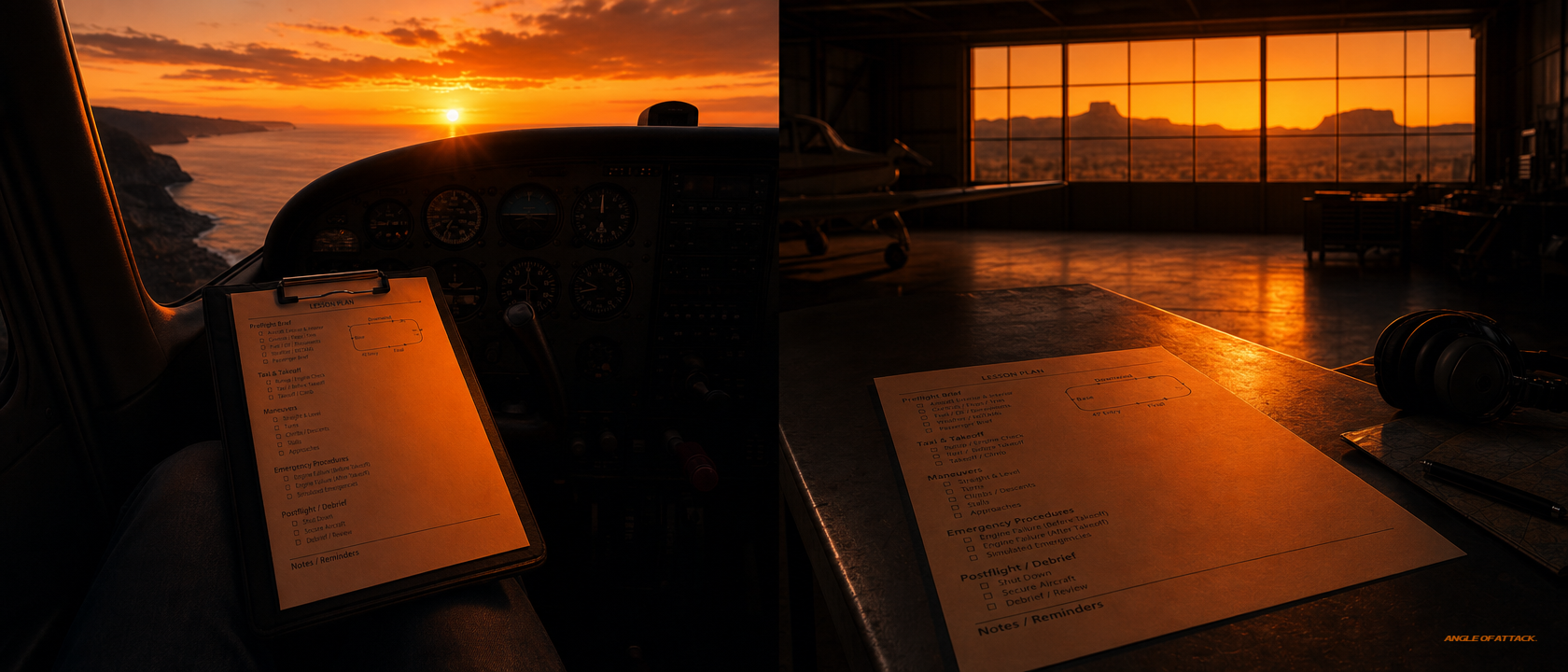
A binder doesn't fit in the cockpit. A one-page plan does. That's not the only difference.
On the ground, the lesson plan supports a full brief. You sit at a table, the student opens their notes, you walk through the objective and the simpleness and the common errors. You point to a diagram. You answer questions. The plan supports a 15-to-30-minute teaching exchange.
In the cockpit, the lesson plan does something different. It anchors a 60-second pre-maneuver reminder. "We're about to do a power-off stall. Remember: angle of attack causes the stall, not airspeed. Watch the break, lower the nose smoothly, recover coordinated. Three things to avoid: secondary stall, yaw at the break, recovering on airspeed." Done. You fly the maneuver.
The one-page format works in both contexts. The binder works in neither — too long for the cockpit, too dense for an actual ground brief.
I tell candidates to keep the one-page plan in a folder on their kneeboard, not in a binder. Quick visual reference. Quick scan. Then back to teaching. That's how a lesson plan is supposed to function.
The Lesson Plan Mistakes That Earn Candidates a Notice of Disapproval

The DPE has seen hundreds of lesson plans. They can identify a teaching tool in 10 seconds and a binder dump in 5. Here are the five specific mistakes that flip the binary the wrong way:
- Verbatim ACS quotes filling the page. The DPE has the ACS. They don't need yours. Cite the standard, don't restate it.
- No "common errors" section. This signals you've memorized what the maneuver is but not what students do wrong with it. That's a teaching gap.
- No "the one thing" or core idea. Without it, the plan reads like a checklist. Checklists aren't lessons. The DPE will probe.
- Eight pages instead of one. Eight pages says you don't trust your own understanding to teach without a script. The DPE will test that.
- Plans copied from another CFI's Drive folder. Examiners can spot this. The voice doesn't match yours. The structure doesn't match how you teach. The first follow-up question reveals you didn't write it.
If your binder has any of these, fix it before checkride day. Better: throw the binder out and rebuild from one-pagers.
This is the philosophy behind TotalCFI — the course I built around the Anti-Binder approach. It's not just a free template. It's the full framework: how to find the simpleness of every required CFI maneuver, how to build the one-page plans, how to use them in the cockpit, and how to teach from them when an examiner is watching. The candidates I've taken to their CFI rides — Riley, Annalynn, Myla, others — all carried one-page plans into their checkrides. All of them passed first try. That isn't coincidence.
Initial Checkride Plans vs Real-Student Plans
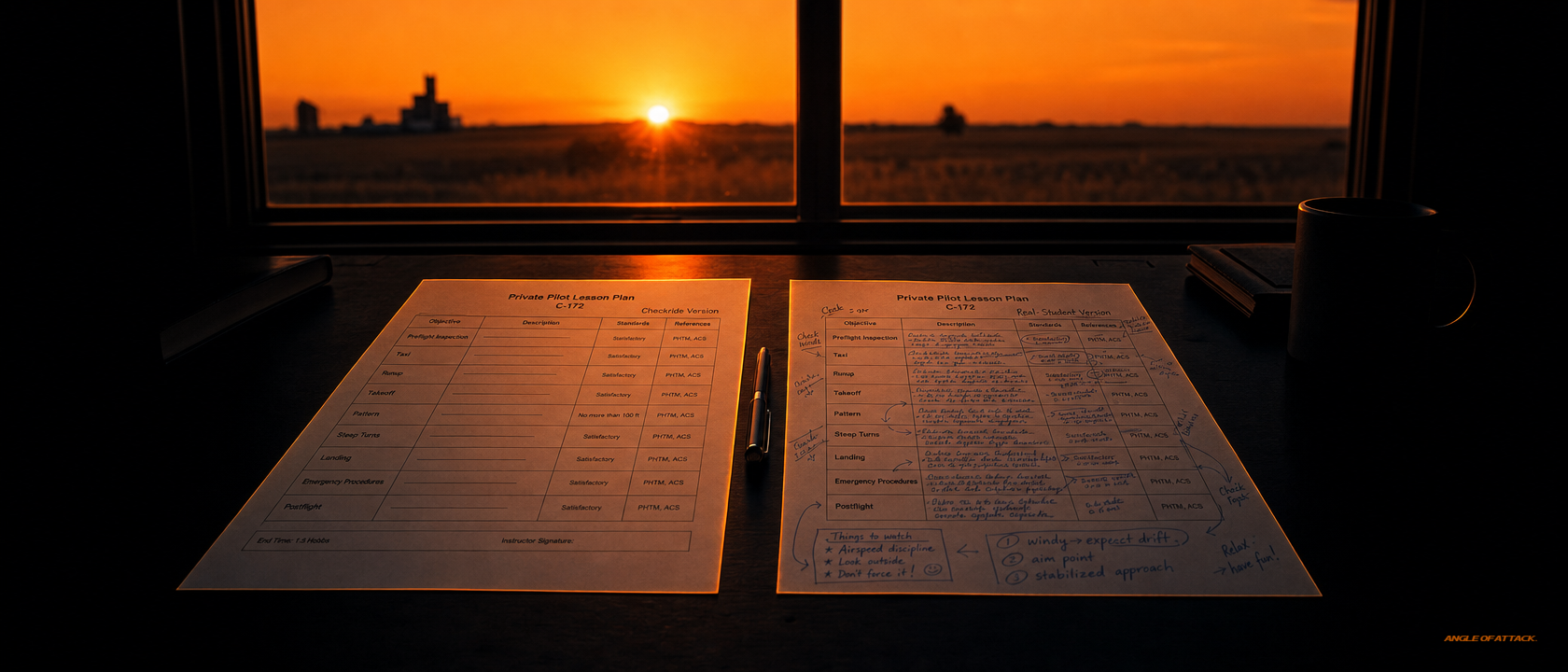
Here's a question candidates rarely ask, and they should: do the lesson plans for your CFI checkride have to look like the lesson plans you'll actually use with paying students?
Yes. And if they don't, the DPE will spot the gap.
The DPE isn't grading you on whether you can produce a binder. They're grading you on whether you'd be a competent instructor for a real student on Day 1. If your "checkride plans" are show-pieces and your "real plans" are something different, the DPE is going to notice that you don't actually use the documents you brought with you.
The Anti-Binder approach solves this elegantly: you build one set of plans — useable, teachable, real — and you bring those same plans to the checkride. They work on Day 1 because they worked when you wrote them. The DPE sees a candidate who's thinking about teaching, not about passing the test. That's the candidate who passes.
Frequently Asked Questions
Do CFIs need lesson plans for their checkride?
Yes. The FAA Flight Instructor Airplane ACS (FAA-S-ACS-25) lists "Preflight Lesson on a Maneuver to be Performed in Flight" as a required Area of Operation. The applicant plans and delivers the lesson. You'll be expected to bring written lesson plans to the checkride and to teach from them.
How long should a CFI lesson plan be?
As long as it needs to be to support your teaching — and no longer. A useable plan typically fits on one page. The FAA does not specify a length. Examiners care about whether you can use the plan to teach, not how many pages it runs.
Can I use someone else's CFI lesson plans?
You can use them as a reference to see how others structure their plans. You should not submit them as your own at the checkride. Examiners can spot copied plans because the voice doesn't match yours and the first probing question exposes the gap. Build your own. Keep them short. They'll be better.
What goes in a CFI lesson plan?
At minimum: an objective, a completion standard, the core idea (the "one thing" the student must take away), common errors and corrections, the teaching sequence, and a debrief prompt. Per the Aviation Instructor's Handbook (FAA-H-8083-9B), Chapter 8.
Can I keep my lesson plans on an iPad?
Yes. The FAA doesn't specify the medium. iPad is fine, paper is fine, kneeboard is fine. What matters is that the plan is with you in the cockpit and that you can find what you need quickly. Some DPEs prefer paper because it's faster to flip; others don't care. Ask your examiner before the ride.
Do I need a separate plan for every maneuver?
Generally yes — for the maneuvers explicitly required in the ACS. But each plan can be a single page. You're not building 50 binders; you're building 50 one-pagers, each anchored on its own simpleness.
Do my checkride lesson plans have to look like the plans I'll use with real students?
Yes. The DPE isn't grading you on your ability to produce a binder. They're grading you on whether you'd be a competent instructor on Day 1. If your "checkride plans" are show-pieces and your "real plans" are something different, the DPE will notice that you don't actually use the documents you brought. The Anti-Binder approach solves this: you build one set of plans — useable, teachable, real — and you bring those same plans to the checkride. They work on Day 1 because they worked when you wrote them.
If the CFI checkride is keeping you up at night, you're prepping for the wrong thing.
TotalCFI teaches you to walk into the oral as a teacher, not a test-taker — the reframe most candidates only figure out after they've already failed once.

Twenty years in aviation education has taught me one thing about lesson plans: the best instructors teach simply. They strip out the noise. They find the one core idea, name it, teach to it, and let everything else fall into place. The 50-page binder is a comfort blanket. It feels rigorous because it's heavy. But weight isn't readiness. Useability is. Build the plan you can actually use, and you'll teach better — at the checkride, on Day 1, and for every student who comes after.