CFI Oral Exam: 50+ Sample Questions (And How to Answer Them Like a Teacher)
The CFI oral exam runs 1.5 to 2.5 hours, structured around the eight Areas of Operation in the FAA Flight Instructor Airplane ACS (FAA-S-ACS-25). The Designated Pilot Examiner (DPE) selects questions from each area and asks them across the session — not as a quiz, but as prompts for you to teach. The questions you'll see are largely predictable; the candidates who pass aren't the ones who memorize the most answers but the ones who answer every question by teaching, the way they would with a confused 40-hour student. Below: 50+ sample questions organized by ACS area, plus the meta-skill that turns any question into a teaching moment.

- The CFI oral exam runs 1.5 to 2.5 hours and follows the structure of the eight Areas of Operation in the FAA-S-ACS-25.
- The DPE asks questions; you answer by teaching the DPE. Every question is a setup for a teaching demonstration.
- Memorizing the question bank without understanding the teaching frame is the #1 reason candidates fail the oral.
- The 50+ sample questions below are clustered by Area of Operation. They are representative, not a complete bank — DPEs draw from a much wider pool.
- The meta-skill matters more than the specific answer. A candidate who teaches an unfamiliar question outperforms a candidate who recites a memorized one.
- "I don't know" is an acceptable answer — followed by "let me look it up and teach you." Honest plus resourceful beats faked-confidence-then-wrong.
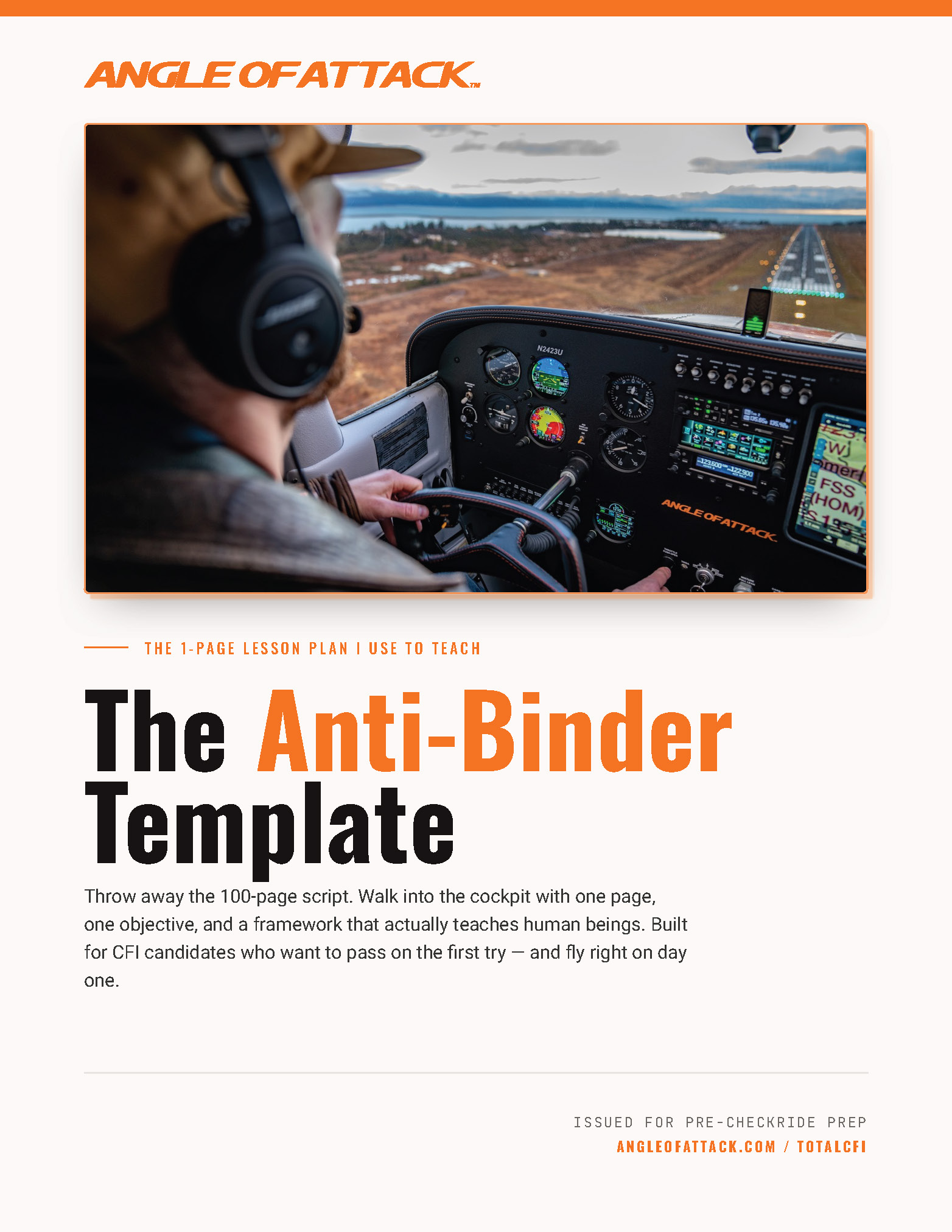
Walking into your first lesson with a 50-page binder won't help you.
Get my Anti-Binder One-Page Lesson Plan Template free — the lesson plan tool I built for CFI candidates who want to be ready Day 1.
Get the Anti-Binder Template Free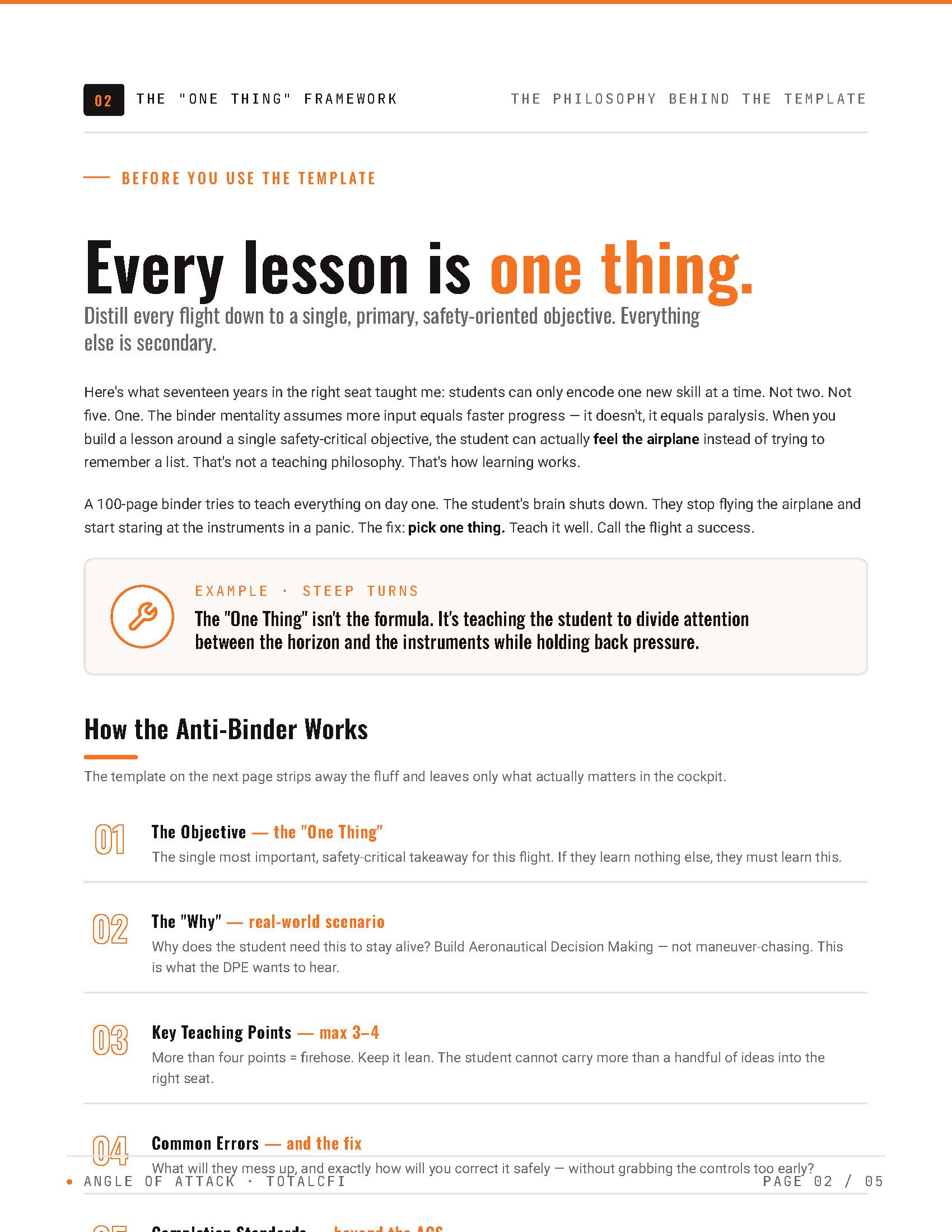
WHAT'S IN THIS GUIDE
What Is the CFI Oral Exam?

The CFI oral is the ground-based portion of the CFI practical test. It's conducted before the flight portion, usually at a flight school briefing room or DPE's office, and it covers all eight ACS Areas of Operation in some depth. Unlike the writtens (which are computer-graded multiple choice), the oral is a conversation — but a conversation with a structure.
The structure is defined by FAA-S-ACS-25, the Flight Instructor Airplane Airman Certification Standards. The DPE goes through each Area of Operation, picks tasks within it, and asks you questions that test both your knowledge and your ability to teach that knowledge to a student. A weak oral isn't usually a knowledge failure — it's a teaching failure. The candidate knew the answer but couldn't teach it.
The DPE is not your interrogator. They're playing the role of your student. If you internalize that one shift — the examiner is your student — the oral becomes a series of mini-lessons rather than a high-stakes interrogation. That reframe is the centerpiece of how I prep candidates, and it's the difference between candidates who walk in calm and candidates who walk in scared.
How Long Does the CFI Oral Take?

The CFI oral typically runs 1.5 to 2.5 hours for an Initial CFI, 1 to 1.5 hours for CFII or MEI add-ons. Some examiners go three hours on the initial if a candidate is verbose, unprepared, or both. There is no hard time limit — the DPE concludes when they've covered the required Areas of Operation to their satisfaction.
A clean oral moves quickly because the candidate teaches efficiently. A slow oral usually means the DPE is probing — asking follow-up questions because something in your initial answer wasn't quite there. The duration is partially under your control: prepare to teach, and the oral runs short.
How DPEs Choose Their Questions

DPEs aren't issued a question script. They draft their own questions, usually in advance for each candidate, drawing from:
- The eight Areas of Operation in the ACS — they must cover them all
- The candidate's logbook — they often pick a maneuver or aircraft from your records
- Recent FAA hot topics — runway incursion, weather hazards, ADS-B, anything FSDO has been pushing
- Their own pet topics — every DPE has a few subjects they always probe (one DPE I know always asks about wake turbulence; another always asks about Class B operations)
- The lesson plans you brought — anything in your one-page plans is fair game; they'll pick a maneuver from your stack
The good news: this is a finite set of inputs. The ACS is published, your logbook is your record, and the FAA's hot topics are tracked publicly. The "surprise" oral question is rare.
50+ Sample Questions by Area of Operation

Below are 50+ representative oral questions, organized by the eight ACS Areas of Operation. These are examples, not exhaustive — DPEs draw from a much wider pool. Use them to calibrate your prep, not to memorize answers.
Area I — Fundamentals of Instructing (FOI)
- What are the laws of learning and how do they apply to flight training?
- Walk me through the levels of learning. Where would you place a student practicing crosswind landings for the first time?
- What are the defense mechanisms students use, and how would you recognize one in the cockpit?
- Explain the demonstration-performance teaching method as you'd use it for steep turns.
- What's the difference between rote learning and correlation? Why does the difference matter?
- How do you critique a student effectively? What makes a critique constructive vs. destructive?
Area II — Technical Subject Areas
- Explain angle of attack to a 5-hour student.
- What's the difference between static stability and dynamic stability, and how would you demonstrate each?
- Walk me through load factor and how it relates to stall speed.
- What are the symptoms of carbon monoxide exposure, and what's the in-flight response?
- How do you teach runway incursion avoidance to a primary student? What are the most common scenarios?
- Explain ADM (aeronautical decision making) using the PAVE checklist.
- What's the difference between a TAF and a METAR, and which would you use to plan a 200 nm cross-country?
Area III — Preflight Preparation
- How do you teach weight and balance calculations? Walk me through your lesson.
- A student says "I don't understand the moment arm." How do you re-teach it?
- What documents must be on board the airplane to be airworthy? (AROW, supplements, etc.)
- How do you verify the airplane is legally airworthy before flight?
- Explain the pilot certification requirements for cross-country flight in plain English.
- What's a TFR? How do you teach a student to find them and avoid them?
Area IV — Preflight Lesson on a Maneuver to be Performed in Flight
- Pick any maneuver from your lesson plan stack and deliver the pre-flight brief as you'd give it to a real student.
- Walk me through how you'd introduce a power-on stall to a student doing them for the first time.
- What are the common errors you'd watch for on a chandelle? How would you correct each?
- How do you teach eights-on-pylons? What's the simpleness of the maneuver?
- Explain lazy eights to a student who's never seen one.
- How do you debrief a student after a poor stall recovery without crushing their confidence?
Area V — Preflight Procedures
- Walk me through your preflight inspection of a Cessna 172. What are you looking for at each station?
- Why do we sump fuel? What are we looking for?
- How do you teach engine starting procedures for a cold airplane vs. a hot start?
- Explain positive control transfers to a brand-new student. Why does it matter?
- What's your passenger briefing before any flight? What's required by regulation, what's added by good practice?
Area VI — Airport Operations
- How do you teach radio communications at a towered airport to a student who's never used a radio?
- What's a runway hold-short line vs. a runway boundary line? How do you teach the difference?
- How would you teach a student to enter a non-towered traffic pattern in unfamiliar territory?
- Walk me through wake turbulence avoidance on takeoff and landing.
- What's a LAHSO clearance? When can you accept one, when should you decline?
Area VII — Takeoffs, Landings, and Go-Arounds
- Teach me a normal takeoff and climb-out as you'd teach a 10-hour student.
- Walk me through a short-field takeoff. What are the teaching points?
- Explain soft-field takeoff vs. soft-field landing. Why does the technique differ?
- A student is consistently flaring too high. How do you diagnose and correct?
- What are the cues that you should go around rather than salvage a landing?
- Walk me through your rejected takeoff procedure. At what point is the abort decision made?
- How do you teach crosswind landings? What's the common student error and the correction?
Area VIII — Postflight Procedures
- What does a good post-flight inspection look like, and how do you teach it?
- How do you debrief a flight lesson to maximize learning?
- What's the role of the logbook entry as a teaching tool?
- How do you teach after-landing checklist discipline? Why does it matter?
- What should a student know about securing the aircraft before leaving it unattended?
Bonus — Questions That Have Appeared on Real CFI Orals (Cross-Area)
- Tell me about your most challenging student so far and what you learned from them.
- What would you do if a student froze on the controls on short final?
- Describe your emergency descent technique and how you'd teach it.
- How would you handle a student who is overconfident vs. one who is underconfident? Different approaches?
- What is your teaching philosophy, in one paragraph?
That's 50+. The pool is much wider in reality, but if you can answer these by teaching them — not by reciting — you're ready for the questions you haven't prepared for. The skill transfers.
How to Answer Like a Teacher (Not a Test-Taker)

Here's the meta-skill that separates passing candidates from failing ones.
When the DPE asks a question, don't recite the answer. Instead, deliver the answer the way you'd deliver it to a confused 40-hour student. That means:
1. Start with the simpleness. What's the one core idea behind this question? Name it first, in plain English. "A stall happens because of angle of attack — it's a wing thing, not a speed thing. Here's why that matters…"
2. Build the explanation layer by layer. Start with the simplest framing, then add nuance. Don't dump all the technical detail at once. A 40-hour student couldn't absorb it; the DPE doesn't need it; you don't need to prove you know everything.
3. Use props, gestures, or analogies. Hand-flying with your palm. A pen as a control surface. A coffee cup as the airplane. Visual or kinesthetic teaching beats verbal-only teaching every time.
4. Watch the "student" for understanding. The DPE will give you cues — a furrowed brow, a head-nod, a follow-up question. Read them. Adjust. If they look confused, re-teach. If they look like they're with you, move on.
5. Invite questions. "Does that make sense so far?" or "Want me to dig deeper into any of that?" These aren't filler — they're the teaching exchange. They show the DPE you're tracking the student's understanding.
6. End with the simpleness again. Land the answer where you started. "So bottom line, it's angle of attack. That's the thing the student walks away with."
This is the philosophy at the heart of TotalCFI — every lesson in the course is structured around teaching with the simpleness, layering, and student-feedback loop that makes the oral feel like a conversation rather than an interrogation. Reframing the checkride as a teaching demonstration is the single biggest unlock for most CFI candidates. It's the centerpiece of TotalCFI, and it's the reason the candidates who internalize it walk in calm.
The Five Most Common Reasons Candidates Fail the Oral

In my experience prepping candidates and talking to DPEs, the same five patterns produce most CFI oral failures:
- Reciting the ACS verbatim without teaching it. "Per ACS task such-and-such, completion standard is plus-or-minus..." — the DPE has the ACS. They want you to teach.
- No "the one thing" — no simpleness. Candidate gives a textbook-correct answer that's a bullet stack of facts with no organizing idea. The DPE can't tell if the candidate would actually be effective in front of a real student.
- Going silent when uncertain. Candidate hits a question they don't know cold, freezes, gives a wrong answer in a panic. The right answer is "I don't know — let me look it up and teach you." Resourcefulness is a teaching skill.
- Fighting the DPE's hypothetical. DPE asks "what if a student said X" — candidate responds with "well a student wouldn't say that" instead of answering. The DPE will mark it as inability to handle scenarios.
- Reading from the binder instead of teaching from it. The binder dump in real time. Demonstrates the candidate doesn't have the material internalized.
Fix all five and your oral runs an hour shorter and ends with a pass. Hit any of them and you'll see the DPE's pen come out for notes you don't want.
Frequently Asked Questions
What questions are asked on the CFI oral?
The DPE asks questions across all eight Areas of Operation in the FAA-S-ACS-25: Fundamentals of Instructing, Technical Subject Areas, Preflight Preparation, Preflight Lesson on a Maneuver, Preflight Procedures, Airport Operations, Takeoffs/Landings/Go-Arounds, and Postflight Procedures. See the 50+ sample questions above for representative examples.
How long is the CFI oral exam?
Typically 1.5 to 2.5 hours for an Initial CFI; 1 to 1.5 hours for CFII or MEI add-ons. Some DPEs go three hours on the initial. The duration depends on how cleanly the candidate teaches.
What's the hardest CFI oral question?
In aggregate, the hardest questions are the scenario-based ones ("a student does X — what do you do") because they require teaching judgment, not factual recall. A candidate who's only memorized facts will struggle. A candidate who has actually taught (in role-plays, in mock checkrides) handles them naturally.
What should I bring to the CFI oral?
Your pilot certificate, medical certificate, driver's license, logbook, AKTRs (FOI and FIA pass slips), the airplane's POH and logbooks, your one-page lesson plan stack, the FAR/AIM, and any current ACS reference. The DPE may ask to see any of these.
Can I retake the CFI oral if I fail?
Yes. Per 14 CFR 61.43, a fail in any single Area of Operation results in a Notice of Disapproval that lists the missed Areas. You retest only the missed Areas, often within a week. The retest fee is typically $400–$600.
How do I study for the CFI oral if I don't know what questions will be asked?
Don't memorize answers. Practice teaching every required topic — pre-brief, demonstrate, debrief — to a peer who plays a confused student. The teaching skill transfers to any question. The candidates I prep — Riley, Annalynn, Myla, others — passed because they could teach unfamiliar questions, not because they'd memorized familiar ones.
If the CFI checkride is keeping you up at night, you're prepping for the wrong thing.
TotalCFI teaches you to walk into the oral as a teacher, not a test-taker — the reframe most candidates only figure out after they've already failed once.
The CFI oral isn't a test. It's a teaching demonstration that happens to result in a certificate. The candidates who walk in expecting to be tested fail more often than the candidates who walk in expecting to teach. The questions are largely predictable. The skill that decides the outcome isn't memorization — it's whether you can take any question, find the simpleness behind it, and teach it the way you'd teach a real student. Build that skill. The questions stop mattering.