CFI Salary 2026: How Much Do Flight Instructors Actually Make?
CFI salary in 2026 ranges from about $25/hour for entry-level instructors to $80–$100+/hour for experienced CFIs in high-demand markets. Annual income for a working CFI runs $35,000–$95,000+ depending on hours flown, region, employment structure, and the rate the instructor commands. The pilot shortage that began in earnest in 2020 has pushed rates significantly higher than they were five years ago — and the high end of the range is far more accessible to new CFIs than most candidates realize. The variable that matters most isn't seniority. It's teaching quality.

- 2026 CFI hourly rates: $25–$40 entry-level, $40–$70 mid-career, $70–$100+ experienced/specialized.
- 2026 CFI annual income range: $35,000–$95,000+ depending on hours flown and rate.
- The pilot shortage drove CFI rates up roughly 30–50% from 2019 to 2026 in most U.S. markets.
- High-paying markets in 2026: Pacific Northwest, Northern California, Boston/NYC corridor, Phoenix, Dallas-Fort Worth. Lower-paying: Florida (oversupply), parts of the Midwest.
- Salaried CFI jobs ($55K–$80K) trade flexibility for predictability. Hourly independent CFIs can out-earn salaried at high utilization but have more income volatility.
- The single biggest variable in individual CFI earnings isn't experience or location — it's teaching quality. Better instructors fill their calendars, charge higher rates, retain students longer, and build referrals faster.
Walking into your first lesson with a 50-page binder won't help you.
Get my Anti-Binder One-Page Lesson Plan Template free — the lesson plan tool I built for CFI candidates who want to be ready Day 1.
Get the Anti-Binder Template Free

WHAT'S IN THIS GUIDE
- 1What's the Average CFI Salary in 2026?
- 2CFI Hourly Rates by Experience Level
- 3CFI Salary by Region
- 4How CFI Pay Has Changed Since 2020
- 5Salaried CFI Jobs vs Hourly Independent Work
- 6How to Earn the High End of the Range
- 7Building Hours Toward the Airlines as a CFI
- 8Total Career Income — CFI Path vs Other Pilot Paths
- 9Frequently Asked Questions
What's the Average CFI Salary in 2026?

The average U.S. CFI in 2026 earns roughly $55,000–$65,000 annually for full-time work, blending salaried and hourly positions. Per-hour averages from major aggregators (ZipRecruiter, PayScale, Indeed, Glassdoor) cluster around $45–$55/hour, but the spread is wide — the bottom 10% of CFIs earn under $30/hr and the top 10% earn over $90/hr.
Why such a wide spread? Three reasons. First, "CFI" describes everything from a 250-hour brand-new instructor at a small flight school to a 5,000-hour Master CFI running their own training operation. Second, region matters enormously — a CFI in Seattle commands rates a CFI in central Florida couldn't dream of. Third, employment structure varies — salaried CFIs at flight schools have predictable income but capped upside; independent CFIs can earn more but accept volatility.
The averages tell you where the middle of the market lives. They don't tell you where you will land. The next sections break that down.
CFI Hourly Rates by Experience Level

| Experience tier | Typical 2026 hourly rate | Notes |
|---|---|---|
| Entry-level (0–500 hrs given) | $25–$40/hr | Just earned the certificate; usually employed at a flight school that handles billing and student acquisition |
| Mid-career (500–2,000 hrs given) | $40–$70/hr | Built a reputation, has waiting list, may instruct independently part-time |
| Experienced (2,000+ hrs given) | $70–$100+/hr | Often Gold Seal or Master CFI; specialized in instrument, multi-engine, tailwheel, or seaplane; books out 60–90 days in advance |
| Specialized (multi-engine, tailwheel, seaplane, aerobatic, jet transition) | $100–$200/hr | Niche markets where the customer is paying for rare expertise |
The progression from $25 to $70+ isn't strictly time-based. I've seen new CFIs hit $50/hr within their first year by being demonstrably better teachers than their peers. I've also seen 3,000-hour CFIs stuck at $40/hr because they never built a referral pipeline or developed their teaching beyond the bare minimum. Time helps. Quality matters more.
CFI Salary by Region — Where the High-Paying Markets Are
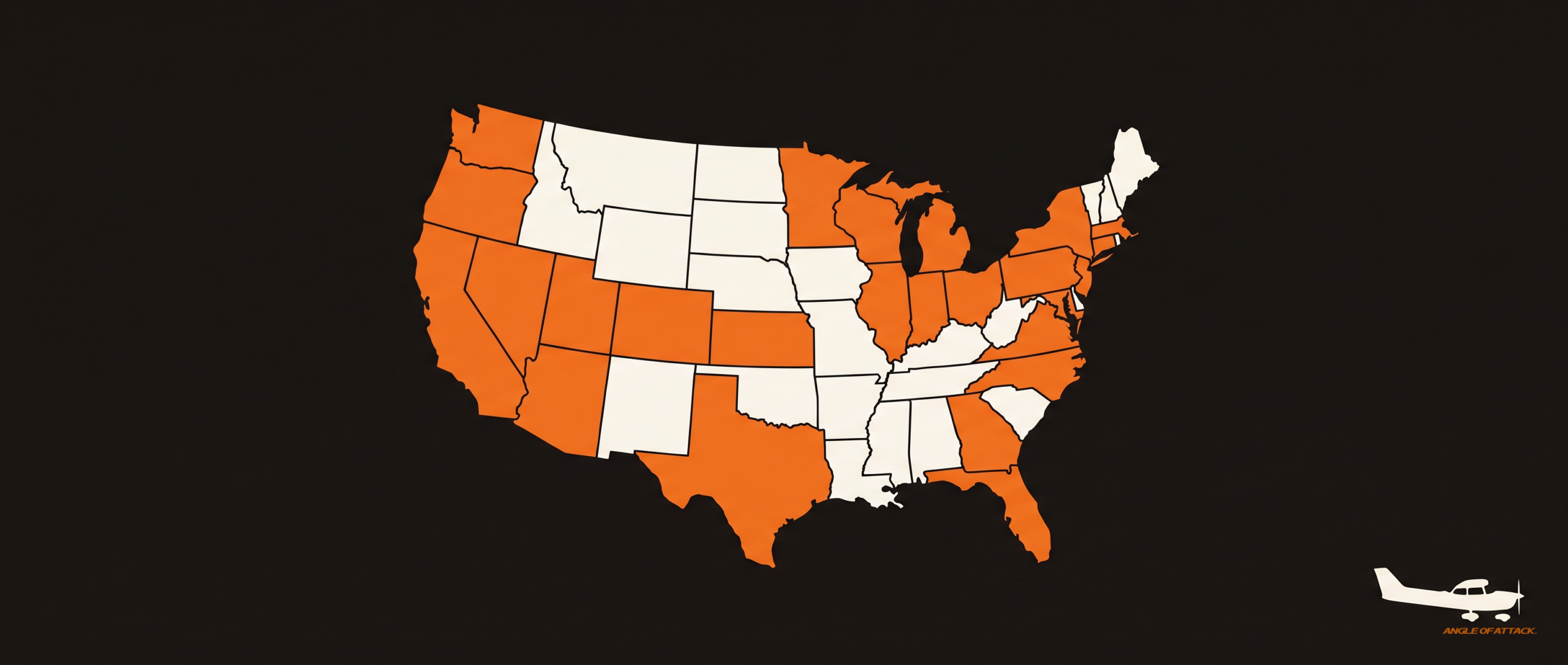
CFI rates correlate with three regional factors: DPE supply (more DPE shortage → higher CFI demand), flight school density (fewer schools → higher rates per CFI), and cost of living (higher COL → higher rates). The 2026 high-paying markets cluster in regions where all three factors align.
| Region | 2026 CFI hourly range | Why |
|---|---|---|
| Pacific Northwest (Seattle, Portland) | $65–$110+ | DPE shortage, high COL, strong demand from career-changer demographics |
| Northern California (Bay Area) | $70–$120+ | Highest COL adjustments, dense student demand |
| Boston / NYC corridor | $60–$100 | Limited airport supply drives rates up despite competition |
| Phoenix, Dallas–Fort Worth | $50–$85 | Strong year-round flying weather + growing flight school sector |
| Mountain West (Denver, Salt Lake) | $50–$80 | Tourism-driven student demand, fewer DPE seats |
| Alaska | $55–$90 | Specialized seaplane and bush flying markets pay premium rates for qualified CFIs |
| Florida | $35–$60 | Oversupply — every retired pilot snowbirded south to instruct part-time keeps rates suppressed |
| Most of the Midwest | $35–$55 | Lower COL, more flight schools per capita, more competition for students |
Don't confuse regional rates with regional income. A Seattle CFI earning $80/hr but flying 50 hours/month nets $48,000/year. A Florida CFI earning $45/hr but flying 110 hours/month nets $59,000/year. Utilization matters as much as rate.
How CFI Pay Has Changed Since 2020 (The Pilot Shortage Effect)

The pilot shortage that began with the 2020 retirements (and accelerated through 2024) has pushed CFI rates up sharply. Compared to 2019, 2026 CFI rates are typically 30–50% higher in real terms across most markets.
Why? Two compounding effects. First, demand for new pilots surged as airlines hired aggressively to replace retirees and grow capacity. More student pilots meant more demand for CFIs. Second, the supply of experienced CFIs dropped because experienced CFIs got hired by airlines as soon as they hit the 1,500-hour ATP threshold — leaving the instruction pipeline short of senior teachers.
The net effect: rates went up for everyone, but especially for experienced CFIs who stayed teaching by choice rather than transitioning to airlines. Master CFIs and specialized instructors saw the biggest bumps.
This is structural, not cyclical. As long as airline hiring stays elevated and CFIs continue to ladder up to ATP, the pricing pressure on flight instruction will persist. The window for new CFIs entering 2026 is favorable.
Salaried CFI Jobs vs Hourly Independent Work

There are two basic structures for working as a CFI: salaried at a flight school or independent contractor charging hourly rates. Most new CFIs start salaried, transition to hourly after 6–12 months, and split the difference in mid-career.
Salaried positions
- Pay: $55K–$80K annually for full-time at most schools; $80K–$110K at major academies (ATP, Phoenix East, etc.)
- Hours: Typically 25–40 instructional hours per week, plus office time
- Pros: Predictable income, benefits, students handed to you, no marketing or scheduling work
- Cons: Capped upside, fewer hours flown per week, less control over which students you teach
- Best for: New CFIs, pilots prioritizing time-building speed for airlines, anyone who values predictability
Hourly independent
- Pay: Whatever the market bears — $40–$120/hr depending on tier and region
- Hours: Whatever you can fill — often 60–100/month working part-time, more if you're full-time and well-known
- Pros: Higher upside, flexibility, can specialize, can charge premiums
- Cons: Income volatility, marketing/scheduling/billing on you, no benefits, weather-dependent income
- Best for: Mid-career and experienced CFIs, anyone with a referral pipeline, specialists
A common mid-career path: keep a part-time salaried role at a flight school (steady income, benefits) and instruct independently on the side (higher-rate students, specialized work). That blend often earns more than either alone.
How to Earn the High End of the Range (Not the Low End)

Two CFIs with the same hours, same airplanes, and same region can earn dramatically different rates. The difference isn't luck. It's mostly four things:
1. Teaching reputation. The CFI whose students pass first try, complete their ratings on time, and refer friends builds a waiting list. A waiting list lets you raise rates. The CFI whose students get frustrated and leave never builds one. Teaching quality compounds.
2. Specialization. Generalist CFIs compete on price. Specialists (tailwheel, seaplane, aerobatic, multi-engine, instrument-specific) command 30–80% premiums because the customer is paying for rare expertise. Pick a specialty, get good at it, market it.
3. Marketing presence. A CFI with a YouTube channel, a podcast presence, or even just a polished local website can charge $20–$30/hr above market because the student pre-trusts them. Angle of Attack's 191K YouTube subscriber base exists because that audience trusts the teaching they see — and that trust translates directly into pricing power for any CFI who has it.
4. The Anti-Binder approach. Students pay more for instructors who can teach clearly — who strip out the noise, find the simpleness of every lesson, and make hard concepts feel easy. The instructor whose student walks out understanding lift in 10 minutes is worth more than the instructor whose student walks out memorizing eight facts about Bernoulli. The market knows the difference. The market pays for it.
That last one is the philosophy I built TotalCFI around — teaching that compounds. The candidates I've prepped — Riley, Annalynn, Myla — didn't just pass first try. They graduated into instructor jobs where students requested them by name within months. That's the high end of the range. It's available to anyone who teaches well.
Building Hours Toward the Airlines as a CFI

For CFIs whose ultimate goal is the airlines, the math of flight instruction is about time-building speed. The faster you accumulate the 1,500 hours required for ATP eligibility (per the FAA's 2013 rule following Colgan 3407), the sooner you can transition to a regional airline first officer seat — typically a $90,000+ first-year salary in 2026.
Realistic time-building math:
| Hours flown per month | Months to 1,500 hrs (from 250) | Notes |
|---|---|---|
| 60 hrs/month | 21 months | Typical for a part-time CFI at a smaller school |
| 80 hrs/month | 16 months | Solid full-time CFI work |
| 100 hrs/month | 12.5 months | Aggressive — usually requires both a flight school job and side instruction |
| 120 hrs/month | 10.5 months | Burnout territory — sustainable for short bursts only |
Most CFIs at busy schools accumulate hours in the 18–24 month window from CFI initial to ATP eligibility. The candidates who hit the lower end of that range tend to be the ones whose students stay with them — every student lost to attrition is hours you have to rebuild.
This is another argument for teaching quality compounding. Better instruction → better student retention → faster hour accumulation → earlier airline transition → potentially $90K/year salary 6 months sooner.
Total Career Income — CFI Path vs Other Pilot Paths
Career-total income depends on the path:
| Path | First-year | 5-year cumulative | 10-year cumulative |
|---|---|---|---|
| CFI → Regional → Major | $50K → $90K → $250K+ | ~$700K | ~$2.5M+ |
| CFI career (lifelong instructor) | $50K → $80K → $110K+ | ~$400K | ~$900K+ |
| CFI + business owner (own flight school, online course, YouTube) | Variable | $200K+ possible | $500K–$1M+ possible |
| Direct corporate / charter / military pilot (skip CFI) | $60K–$120K | $150K–$300K | $300K–$500K+ |
The "CFI career" path (lifelong instructor) gets undersold in pilot circles because the airline path looks shinier. But CFI career pilots who reach Master CFI and develop a reputation often out-earn regional FOs and live more flexibly. The choice isn't purely financial. It's about what kind of work you want.
Frequently Asked Questions
How much do CFIs make per hour?
Typical 2026 CFI hourly rates run $25–$40 entry-level, $40–$70 mid-career, $70–$100+ experienced. Specialized CFIs (multi-engine, tailwheel, seaplane, aerobatic) often charge $100–$200/hour in their niches.
What's the average CFI salary?
Roughly $55,000–$65,000 annually for full-time U.S. CFIs in 2026, blending salaried and hourly positions. The bottom 10% earn under $35K; the top 10% earn over $95K.
Can you make a living as a CFI?
Yes. A full-time CFI flying 80–100 hours/month at $50/hr grosses $48K–$60K, before any salaried-position benefits. Many lifelong CFIs earn $75K–$110K+ with experience and specialization. The trade-off is volatility (especially in non-salaried roles) and weather dependence.
Where are the highest-paying CFI jobs?
The Pacific Northwest, Northern California, the Boston/NYC corridor, Phoenix, Dallas–Fort Worth, and Alaska's specialized seaplane/bush flying markets all pay above the national average. Florida and parts of the Midwest run lower due to oversupply.
How long until I can earn $70+/hour as a CFI?
Most CFIs reach the $70/hr tier in 2–4 years, typically through a combination of experience (~1,500 hours given), specialization, and a built referral pipeline. CFIs who teach exceptionally well or develop a marketing presence (YouTube, social, local reputation) can reach that tier faster.
Do salaried CFI jobs include benefits?
Most flight school salaried positions include health insurance, paid time off, and sometimes 401(k) matching. Independent contractor CFIs do not — you handle benefits yourself. This is a real cost to factor when comparing $65K salaried to $80K independent.
If the CFI checkride is keeping you up at night, you're prepping for the wrong thing.
TotalCFI teaches you to walk into the oral as a teacher, not a test-taker — the reframe most candidates only figure out after they've already failed once.

The CFI salary range is wider than almost any other professional pilot category — $25/hr at the bottom, $200/hr at the top — and the variable that determines where you land isn't time, it isn't seniority, and it isn't luck. It's how well you teach. The instructors at the top of the range have students who request them by name, who refer friends, who come back for the next rating. Build that reputation early. The income follows.