

VR/360 viewing tips at bottom of description:
Why is there such a huge emphasis on “stalls” in flight training? Stalls are something that happens when the wing looses it’s lift temporarily, usually only on part of the wing.
A stall occurs when the angle of attack reaches a critical angle. That can happen at any attitude and any airspeed.
Stalls are most common while near the ground. That is, while taking off and landing. If a stall were to occur close to the ground, there is very little time to react and recover.
So… pilots are taught to recognize a stall is coming, recover from a stall if it somehow occurs, and avoid spins by correctly reacting to those stalls.
In this video we’ll be doing a POWER ON / Climb-Departure Stall. This is emulating a takeoff, a higher angle of attack than normal on climb-out, and subsequent stall. What makes this stall more difficult (in my opinion) is the left turning tendencies of the engine (and thus propellor) and need for a whole lot of opposite rudder (in this case, to the right, most common in GA aircraft). If we get uncoordinated during this stall, it’s much more likely that it’ll pull us into a spin.
Recovery from this stall is quite simple. You simple stay coordinated with rudder, reduce the angle of attack with elevator (usually to the horizon) and arrest the descent.
This emulates the ability to recover from a stall while landing.
The ACS (Airmen Certification Standards) lays out, as of 2017, that the stall should be brought all the way to the buffet and developed stall. THEN you will recover.
Jump in the conversation and let us know what you learned, or if you had another thoughts and tips for the community.
–––––––––––––––––––––––––––––––––––––––––––––––
VR is best viewed in HD. You can use the mouse cursor to move the view, or your finger on mobile device. Mobile devices can be used with the accelerometer to look around the cockpit. Check it out!

ON THE SAME TOPIC

IFR vs VFR: The Two Sets of Rules Every Pilot Flies By
IFR vs VFR: The Two Sets of Rules Every Pilot Flies By 19 min read Last updated June 2026 · Chris Palmer The difference between IFR and VFR is which set of rules you fly under. VFR — visual flight rules — lets you navigate by looking outside and staying clear of clouds in good […]
 Read more
ASOS vs AWOS vs ATIS: How to Pull the Right Weather Before You Fly
ASOS vs AWOS vs ATIS: How to Pull the Right Weather Before You Fly 13 min read Last updated June 2026 · Chris Palmer The difference comes down to who is talking and what the broadcast covers. ASOS and AWOS are automated, computer-generated weather observations of the conditions right at the field. ATIS is a […]
Read more 
What Is RNAV Navigation? Area Navigation for VFR Pilots
What Is RNAV Navigation? Area Navigation for VFR Pilots 17 min read Last updated June 2026 · Chris Palmer RNAV — Area Navigation — is a method that lets an aircraft fly any desired path within the coverage of ground- or space-based navigation aids, rather than being forced to fly directly to and from stations. […]
Read more 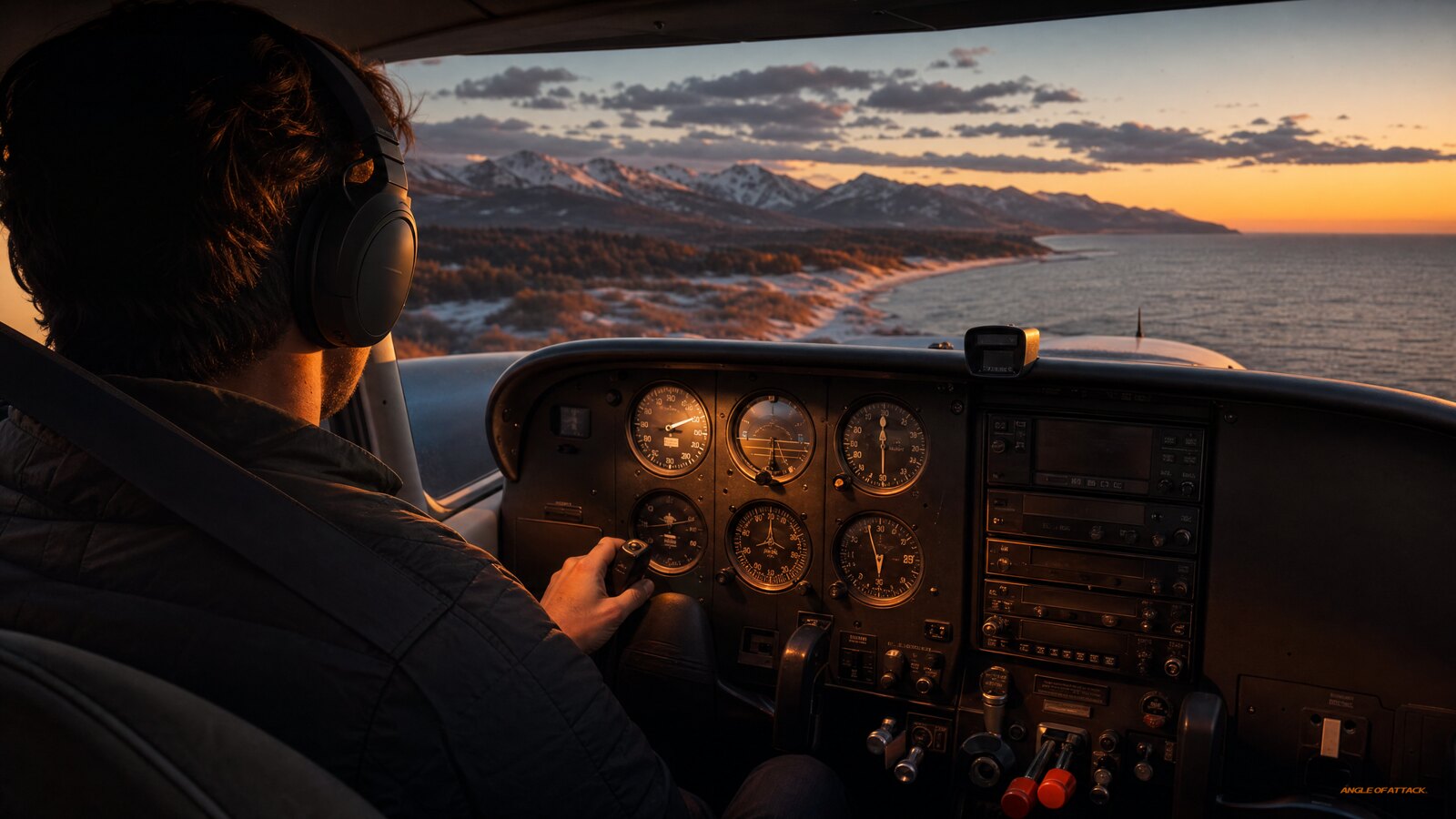
NDB and ADF Explained: The Oldest Radio Nav System You Still Need to Understand
NDB and ADF Explained: The Oldest Radio Nav System You Still Need to Understand 16 min read Last updated June 2026 · Chris Palmer An NDB (non-directional beacon) is a ground-based radio transmitter that sends a signal in all directions, and an ADF (automatic direction finder) is the cockpit receiver whose needle points straight at […]
Read more 
Stay Connected
Be the very first to get notified when we publish new flying videos, free lessons, and special offers on our courses.
