
AIM Text
- When departing from a location on a point-in-space (PinS) SID with a visual segment indicated and the departure instruction describes the visual segment the aircraft must cross the initial departure fix (IDF) outbound at-or-above the altitude depicted on the chart. The helicopter will initially establish a hover at or above the heliport crossing height (HCH) specified on the chart. The HCH specifies a minimum hover height to begin the climb to assist in avoiding obstacles. The helicopter will leave the departure location on the published outbound heading/course specified, climbing at least 400 ft/per NM (or as depicted on the chart), remaining clear of clouds, crossing at or above the IDF altitude specified, prior to proceeding outbound on the procedure. For example the chart may include these instructions: “Hover at 15 ft AGL, then climb on track 005, remaining clear of clouds, to cross PAWLY at or above 700.”
- When flying a PinS SID procedure containing a segment with instructions to “proceed VFR,” the pilot must keep the aircraft clear of the clouds and cross the IDF outbound at or above the altitude depicted. Departure procedures that support multiple departure locations will have a Proceed VFR segment leading to the IDF. The chart will provide a bearing and distance to the IDF from the heliport. That bearing and distance are for pilot orientation purposes only and are not a required procedure track. The helicopter will leave the departure location via pilot navigation in order to align with the departure route and comply with the altitude specified at the IDF. For example, the chart may include these instructions: “VFR Climb to WEBBB, Cross WEBBB at or above 800.”
- Once the aircraft reaches the IDF, the aircraft should proceed out the described route as specified on the chart, crossing each consecutive fix at or above the indicated altitude(s) until reaching the end of the departure or as directed by ATC.
FIG 10-1-1
Departure Charts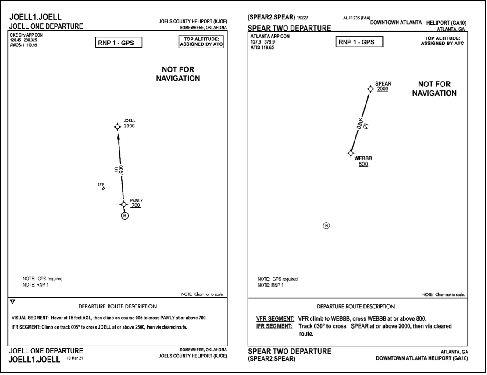
Source: FAA Aeronautical Information Manual · current edition · paragraph 10-1-5.
The short answer
This AIM section gives FAA advisory guidance for helicopters departing on a point-in-space (PinS) Standard Instrument Departure (SID). It explains crossing the initial departure fix (IDF) at or above the charted altitude, establishing a hover at or above the heliport crossing height (HCH), climbing at least 400 ft/NM, remaining clear of clouds, and handling “Proceed VFR” departure segments.
Research Notes
Common Questions
What climb gradient is required on a PinS helicopter departure?
The helicopter leaves the departure location on the published outbound heading/course, climbing at least 400 ft per NM (or as depicted on the chart), remaining clear of clouds, and crossing at or above the IDF altitude specified before proceeding outbound on the procedure.
What is the heliport crossing height (HCH) on a PinS SID?
The HCH specifies a minimum hover height to begin the climb to assist in avoiding obstacles. The helicopter initially establishes a hover at or above the HCH specified on the chart. For example, a chart may instruct: “Hover at 15 ft AGL, then climb on track 005, remaining clear of clouds, to cross PAWLY at or above 700.”
What does a “Proceed VFR” segment on a helicopter departure require?
When flying a PinS SID with a “proceed VFR” segment, the pilot must keep the aircraft clear of the clouds and cross the IDF outbound at or above the depicted altitude. The chart-provided bearing and distance to the IDF are for pilot orientation only and are not a required procedure track; the pilot navigates to align with the departure route.