CFI Checkride Prep: A Realistic 30-Day Study Plan
A realistic CFI checkride prep plan covers thirty days, broken into four weeks: Week 1 — Foundation (Fundamentals of Instructing, lesson plans, the mental reframe); Week 2 — Maneuvers and Teaching Demos (right-seat flying, in-flight teaching practice, recordings); Week 3 — Mock Checkride and Weak-Point Repair (full mock with a senior CFI, then targeted fixes); Week 4 — Polish, Sleep, and the Day Before (light review, no new material, sharp rest). The plan assumes you've already passed the FOI and FIA written exams. The plan inverts the common ratio — 80% teaching practice, 20% flying — because by 30 days out, more flying isn't the lever. Better teaching is.

- A well-structured 30-day CFI checkride prep plan has three phases: foundation (Week 1), practice (Weeks 2–3), and polish (Week 4).
- The single highest-leverage activity in the entire plan is the Week 3 mock checkride with a senior CFI mentor. Skip it and your pass rate drops noticeably.
- Most candidates spend 80% of their final-month prep flying and 20% practicing teaching. Flip that ratio. By the 30-day mark, more flying isn't the lever.
- Lesson plans should be one page each, anchored on the simpleness of the maneuver. If your lesson plans are still binder-style by Week 2, you're prepping for the wrong test.
- Week 4 is for polish, not new material. Don't try to learn anything new in the final seven days. Sleep matters more than another study session.
- Plan around what you already know the FAA tests — not your fears about what they might test. The ACS is finite. The FOI is finite. The maneuvers are finite. There's no surprise pile.
Walking into your first lesson with a 50-page binder won't help you.
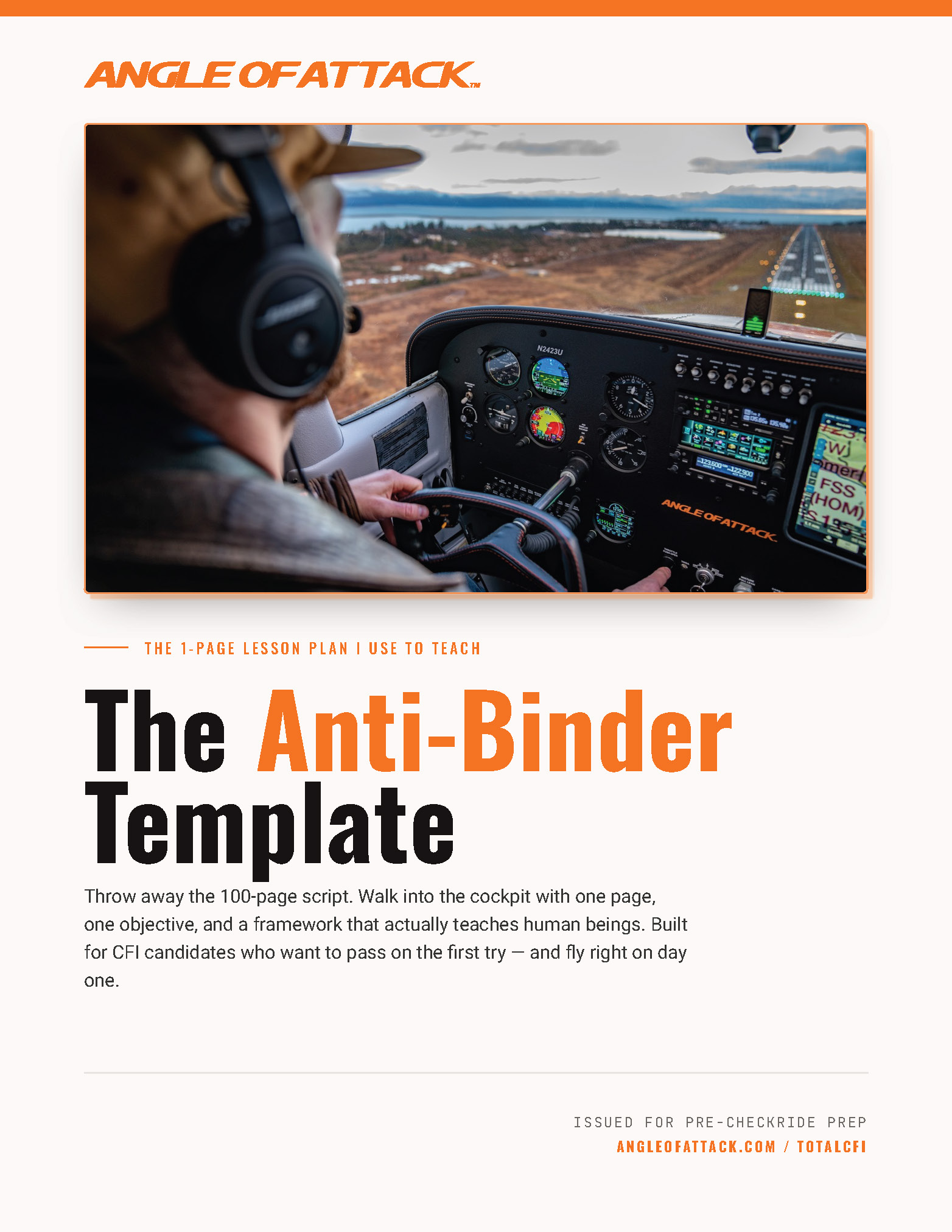
Get my Anti-Binder One-Page Lesson Plan Template free — the lesson plan tool I built for CFI candidates who want to be ready Day 1.
Get the Anti-Binder Template Free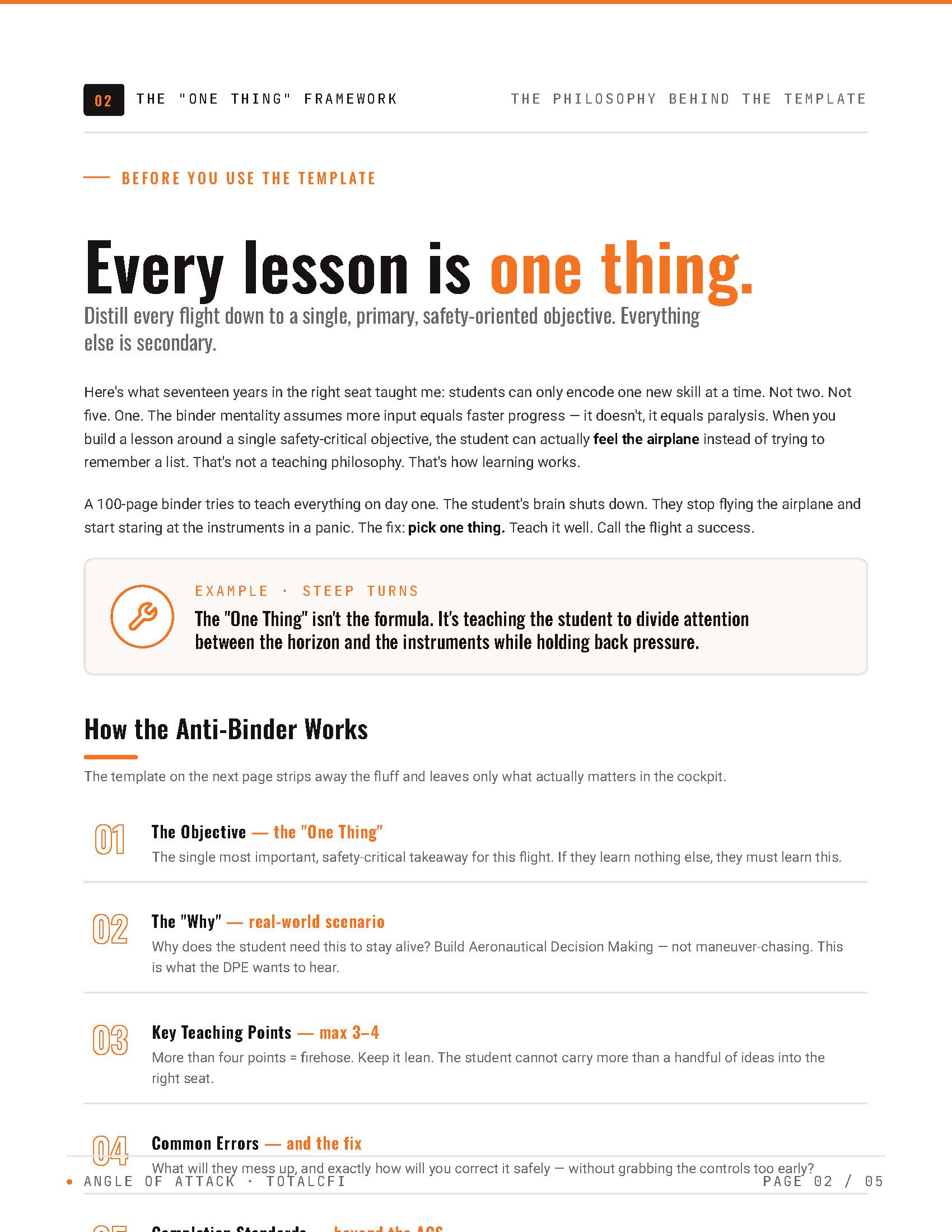
WHAT'S IN THIS GUIDE
- 1What "Ready" Actually Looks Like (Before You Plan a Single Day)
- 2The Three Phases of CFI Checkride Prep
- 3Week 1 — Foundation: FOI, Lesson Plans, Mental Reframe
- 4Week 2 — Maneuvers and Teaching Demos
- 5Week 3 — Mock Checkride and Weak-Point Repair
- 6Week 4 — Polish, Sleep, and the Day Before
- 7The 80/20 Rule — Teach More Than You Fly
- 8What to Skip (And What Not to Skip)
- 9The Five Most Common Prep Mistakes
- 10Frequently Asked Questions
What "Ready" Actually Looks Like (Before You Plan a Single Day)

Before you write a calendar, define the target.
A "ready" CFI candidate, 24 hours before their checkride, can do three things without a script:
- Teach any required maneuver from the right seat — pre-brief, in-flight narration, debrief — to a peer who plays the role of a confused 40-hour student.
- Walk through any of the eight ACS Areas of Operation in a 5–10 minute teaching exchange, with a single one-page lesson plan as their only reference.
- Catch a "student" mistake and correct it without losing flow — whether the mistake is a question framed wrong in the oral or a yaw at the break of a stall.
If you can do those three things consistently with a senior CFI watching, you're ready. The 30-day plan exists to get you there — and to surface the gaps before the DPE does.
If you can't do those three things on Day 30, the worst-case scenario isn't that you can't pass. It's that you don't yet know which area is weakest. The plan is structured to surface that early enough to fix.
The Three Phases of CFI Checkride Prep
The 30-day plan breaks into three phases, each with a different goal. The phases overlap slightly, but the dominant activity in each phase is different.
| Phase | Days | Dominant activity | Goal |
|---|---|---|---|
| Foundation | Days 1–7 | Knowledge reinforcement, lesson plans, mental reframe | Establish what you'll teach |
| Practice | Days 8–21 | Teaching demos, right-seat flying, recordings | Practice delivering it |
| Polish | Days 22–30 | Mock checkride, targeted fixes, light review | Smooth what's already there |
Most candidates skip phase 1 entirely (they assume they already know the FOI from the written exam) and over-invest in phase 2 (they fly maneuvers when they should be teaching them) and under-invest in phase 3 (they're still cramming the night before instead of polishing). The plan below corrects all three.
Week 1 — Foundation: FOI, Lesson Plans, Mental Reframe

Goal: walk out of Day 7 with one-page lesson plans for every required maneuver and the mental reframe locked in.
| Day | Focus |
|---|---|
| Day 1 | FOI re-read (Aviation Instructor's Handbook, Chapters 2–6). You passed the written test, but you're rebuilding the FOI as a teaching framework, not a test. |
| Day 2 | FOI review continued. Build a one-page summary of the laws of learning + levels of learning + teaching methods. This page goes in your kneeboard. |
| Day 3 | Build one-page lesson plan templates for the three "easy" maneuvers (steep turns, slow flight, ground reference). |
| Day 4 | Lesson plans for the three "hard" maneuvers (lazy eights, chandelles, eights-on-pylons). Spend the most time on these. |
| Day 5 | Lesson plans for emergency operations + takeoffs/landings. |
| Day 6 | The mental reframe — read the CFI Checkride pillar end to end. Internalize: the examiner is your student. Talk to a senior CFI about their checkride if you can. |
| Day 7 | Rest day. Light review of what you built this week. Don't fly. Sleep well. |
The Week 1 anti-pattern: spending the whole week flying and treating the FOI as already-conquered. Don't do that. The FOI as a teaching framework is different from the FOI as a 50-question multiple-choice test. Rebuild it from the teaching side.
Week 2 — Maneuvers and Teaching Demos

Goal: by Day 14, you can teach any required maneuver from the right seat to a peer who plays a 40-hour student.
| Day | Focus |
|---|---|
| Day 8 | Right-seat flight 1 (1.5 hrs). Steep turns + slow flight + stalls. Teach the maneuvers as you fly them. Self-record audio (phone in the cockpit) for review. |
| Day 9 | Audio review from Day 8. What did you say? What did you skip? Where did you go silent? |
| Day 10 | Right-seat flight 2 (1.5 hrs). Lazy eights + chandelles. Same drill — narrate the teaching. Record. |
| Day 11 | Ground exchange with a peer or mentor. Teach the FOI's laws of learning back to them in 10 minutes. They ask three questions. You answer them by teaching, not reciting. |
| Day 12 | Right-seat flight 3 (1.5 hrs). Eights-on-pylons + emergency ops. Record. |
| Day 13 | Ground exchange with a peer. They pick a maneuver from your stack. You deliver the full pre-flight brief from your one-page plan. They give honest feedback. |
| Day 14 | Rest. Light review. Identify the weakest maneuver from your three flights. That maneuver is Day 15's focus. |
The Week 2 anti-pattern: flying the maneuvers without the teaching. If you finish your flight and you didn't say anything for 30 minutes of it, the flight didn't count. The teaching is the practice.
Week 3 — Mock Checkride and Weak-Point Repair

Goal: complete a full mock checkride with a senior CFI mentor by Day 21, then close the gaps it surfaces.
| Day | Focus |
|---|---|
| Day 15 | Targeted re-fly of your weakest maneuver from Week 2. Teach it explicitly. Record. Compare to your Week 2 audio. |
| Day 16 | Build the FAQ defenses. List the 30 most likely DPE oral questions. Answer each in 30 seconds, teaching the answer. |
| Day 17 | Ground exchange — a peer or mentor plays "DPE." They ask 10 of your 30 FAQs randomly. You answer. They give feedback. |
| Day 18 | Schedule and complete the mock checkride with a senior CFI mentor. Full ride: 90-minute oral + 90-minute flight. Pay for it ($300–$600, depending on region and mentor rates). It's the highest-ROI dollar in the entire process. |
| Day 19 | Mock debrief day. The mentor gave you a list of fixes. Triage it: what's a 30-minute fix, what's a 3-hour fix, what's a re-fly fix. |
| Day 20 | Address the 30-minute and 3-hour fixes. |
| Day 21 | Rest. The mock is in your bones. Sleep well. |
The mock checkride is the single most important day in the plan. The candidates I prep — Riley, Annalynn, Myla — every one of them did a full mock with me before their actual ride. The mock surfaces gaps you can't see in your own prep. It calibrates your timing. It exposes the weak spots a real DPE will probe. Skip it and you're flying the actual checkride blind.
Week 4 — Polish, Sleep, and the Day Before

Goal: arrive at Day 30 (checkride day) sharp, calm, and rested.
| Day | Focus |
|---|---|
| Day 22 | Address any remaining mock-debrief items (the "re-fly" fixes from Day 19). |
| Day 23 | Polish flight (1 hr) — only the maneuvers that needed work. No new material. |
| Day 24 | One-page lesson plan refresh. Read each plan. Tighten anything that doesn't fit on a page anymore. |
| Day 25 | Light ground exchange — peer asks 5 random oral questions. Quick answers. Don't grind. |
| Day 26 | Logbook check. Endorsements check. Document check. Make sure all the paperwork is in order — the FAA can deny the checkride for paperwork issues alone. |
| Day 27 | Rest. No flying. Light review of the simplenesses. |
| Day 28 | Travel/logistics — confirm DPE, confirm aircraft, file weight & balance, gas up. |
| Day 29 | The day before. Stop studying by noon. Eat well. Walk. Sleep early. Trust the prep. |
| Day 30 | Checkride day. Arrive 30 min early. Coffee, not panic. Walk in calm. |
The Week 4 anti-pattern: cramming new material in the last 72 hours. Don't. New material this late doesn't go in. It just rattles the material that's already in. Polish what's there. Sleep.
The 80/20 Rule — Teach More Than You Fly

By the 30-day mark, the marginal hour spent flying isn't moving the needle. You can already fly. You proved that on your Commercial. The skill being tested on the CFI checkride is your teaching — and that's the skill most candidates under-practice.
I tell every candidate I prep to invert their default ratio. Most candidates spend 80% of final-month prep flying and 20% practicing teaching. The candidates who pass cleanly do the opposite: 80% teaching, 20% flying.
What does "practicing teaching" look like? Concretely:
- Teach to a peer. Record yourself delivering a lesson. Listen back. Notice what you said and what you skipped.
- Role-play the oral. Have a friend or mentor play "DPE." They ask. You answer by teaching.
- Pre-brief and debrief every flight. Even your solo flights. Talk to yourself like you're talking to a student. Out loud.
- Watch yourself teach. Set up a camera in the cockpit on your right-seat flights. Watch back. Catch the moments you went silent or read off a plan instead of teaching.
That's where the gains are at the 30-day mark. Not on the steep turn that's already 5° better than ACS standards. On the teaching of that steep turn.
This is the philosophy underneath TotalCFI — the course I built around teaching-first prep. The 24 lessons are structured around the same principle: every concept comes with a teaching exchange, not just a video lecture. The candidates I've prepped one-on-one — Riley, Annalynn, Myla — followed this ratio and passed first try. So have many others. The pattern is consistent.
What to Skip (And What Not to Skip)

Things you can skip without hurting your pass rate:
- Re-reading the FAR/AIM cover to cover. You won't be tested on volumes of regulation. You'll be tested on the specific subset that matters for CFI privileges (61.183, 61.197, 61.56, the endorsement subsections, etc.). Read those.
- Memorizing every single ACS task code. Know the eight Areas of Operation. Know which sub-tasks live in which area. The DPE will tell you which task they want; you don't need to recite the catalog.
- Studying for surprise topics. There are no surprise topics. The ACS is published. Study the ACS.
- Buying a competitor's $497 video course on top of whatever you've already bought. You don't need more material. You need more practice with the material you already have.
Things you must NOT skip:
- The mock checkride.
- Right-seat flying with audio recording and review.
- The FOI as a teaching framework (not as a test).
- Sleep in Week 4.
- Logbook + paperwork check by Day 26.
- The mental reframe — the examiner is your student.
If you only have 14 days instead of 30, compress Weeks 1–2 to a week and keep Weeks 3–4 intact. Don't cut the mock or the rest week.
The Five Most Common Prep Mistakes

The candidates who don't pass on first try almost always made one or more of these:
- Treated the FOI as already-conquered. They passed the written, so they stopped thinking about it. The FOI as a teaching framework is different. Rebuild it.
- Spent 80% of prep flying. They got really good at the steep turn. They never got better at teaching the steep turn. The DPE noticed.
- Skipped the mock checkride. Whether for cost reasons ($300–$600, depending on region) or scheduling reasons. The mock is non-negotiable.
- Brought a 50-page binder to the ride. They thought it would impress the DPE. It didn't. It made them look like a checkbox-checker, not a teacher. (For the full case against binders, see our Anti-Binder article.)
- Crammed in Week 4. They tried to learn something new in the final 72 hours. It didn't go in. It just rattled the material that was already in. Don't do this.
Avoid all five and your pass rate will be significantly better than the national average (CFI checkride pass rates hover around 75–80%, with variation by region and examiner). Hit any of them and you're flying into the average.
Frequently Asked Questions
How long should I study for the CFI checkride?
Most candidates need 30 days of structured prep after passing the FOI and FIA written tests. Some accelerated candidates compress it to 14 days; some stretched-out candidates run 60. Quality of prep matters more than total time — 30 days of structured, teaching-focused prep beats 90 days of unstructured flying.
What's the most important day in the prep plan?
Day 18 — the mock checkride. A full mock with a senior CFI surfaces gaps you can't see in your own prep, calibrates your timing, and exposes weak spots a real DPE will probe. Skip it and you're flying blind into the actual ride.
Can I prep for the CFI checkride alone?
You can do most of the work alone. But the mock checkride and the role-played oral exchanges require a peer or mentor. If you're prepping in isolation with no other CFIs available, find someone online or pay for a remote mock. Don't skip the human-feedback step.
Should I take time off work the week of the checkride?
If you can, yes — at least the last three days. Not because you need that time to study (you shouldn't be studying in Week 4) but because the mental load of work plus the mental load of an upcoming checkride compounds. Light schedule. Walk. Sleep.
How much should the prep cost?
Outside of any course you've bought: roughly $500–$1,800 in mock checkride fees, right-seat flight time, and incidental costs (varies by region). Subtract any of these you already have access to (a friendly CFI mentor, your own airplane). The mock checkride alone is the highest-ROI line item — don't economize on that.
If the CFI checkride is keeping you up at night, you're prepping for the wrong thing.
TotalCFI teaches you to walk into the oral as a teacher, not a test-taker — the reframe most candidates only figure out after they've already failed once.

The candidates who walk into their CFI checkride calm aren't the ones who studied longer. They're the ones who studied differently. They prepped to teach, not to pass. They mocked the ride before the real one. They polished in Week 4 instead of cramming. And they slept the night before. That's the difference. Build the plan. Run the plan. Trust the plan. The pass takes care of itself.