
CFI Requirements: The FAA Eligibility Checklist (14 CFR 61.183)
To be eligible for the initial Certified Flight Instructor (CFI) certificate, the FAA requires you to be at least 18 years old, able to read, speak, write, and understand English, hold a Commercial Pilot Certificate with an instrument rating, have logged at least 250 total flight hours (including 100 in powered aircraft and 50 in airplanes), have 15 hours of PIC instrument time in the category and class you're applying for, hold at least a third-class medical certificate, pass the FOI and FIA knowledge tests, receive a spin endorsement from a CFI, and pass the practical (checkride). The full regulatory citation lives at 14 CFR 61.183. The requirements list is shorter than most candidates expect — and the things that aren't required (a college degree, U.S. citizenship, a maximum age) often surprise people who've internalized airline-pilot myths. 14 CFR Part 61 reference sheet — Angle of Attack 2026 CFI eligibility checklist" />
KEY TAKEAWAYS
- The CFI initial requires: age 18+, English proficiency, Commercial Pilot + instrument rating, 250 total hours, 15 hours PIC instrument, third-class medical (or higher), passing the FOI and FIA knowledge tests, a spin endorsement, and passing the practical test.
- The full regulatory authority is 14 CFR 61.183. Bookmark it.
- The most-missed requirement: 15 hours of PIC instrument time in the category/class. Many commercial candidates finish with the bare minimum and need extra hours before their CFI ride.
- The spin endorsement is unique to the initial CFI — neither CFII nor MEI add-ons require it.
- A third-class medical is the minimum to exercise CFI privileges; many candidates already hold a second-class from their commercial training.
- What's NOT required: a college degree, U.S. citizenship (for foreign-trained pilots, a TSA Alien Flight Training endorsement applies), a maximum age, or any prior teaching experience.
Free Template
Walking into your first lesson with a 50-page binder won't help you.
Get my Anti-Binder One-Page Lesson Plan Template free — the lesson plan tool I built for CFI candidates who want to be ready Day 1.
Get the Anti-Binder Template Free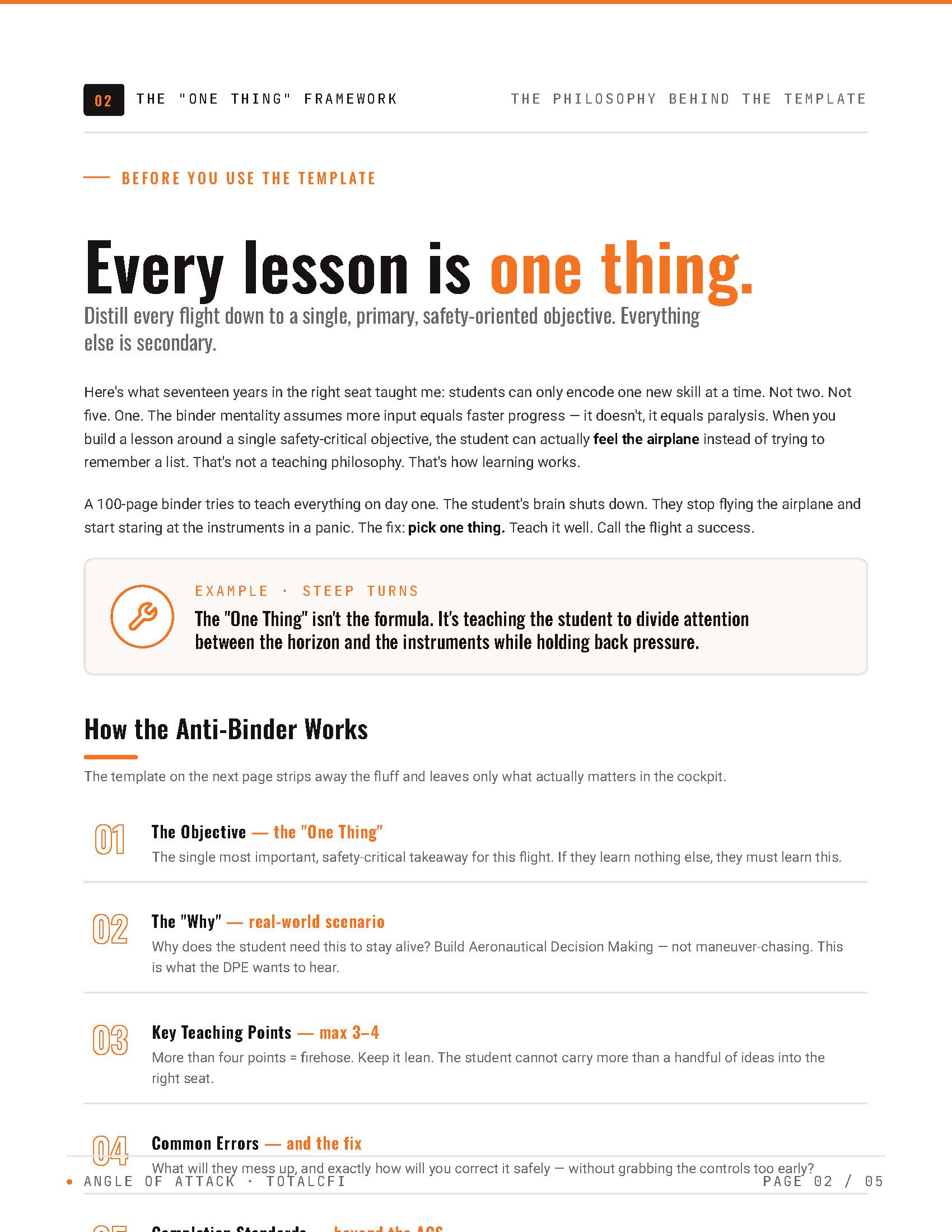
WHAT'S IN THIS GUIDE
- 1What Are the FAA's CFI Eligibility Requirements?
- 2The 250-Hour Total Time Requirement
- 3The Commercial + Instrument Prerequisite
- 4The 15 Hours of PIC Instrument (Often-Missed Requirement)
- 5The Spin Endorsement
- 6The Two Knowledge Tests (FOI + FIA)
- 7The Medical Certificate Requirement
- 8What's NOT Required (Despite Common Myths)
- 9After You Meet the Requirements: What Comes Next
- 10Frequently Asked Questions
What Are the FAA's CFI Eligibility Requirements?
The complete list, per 14 CFR 61.183:CFI INITIAL — 11-ITEM ELIGIBILITY CHECKLIST
| # | Requirement | Citation |
|---|---|---|
| 1 | At least 18 years old | 61.183(a) |
| 2 | Read, speak, write, understand English | 61.183(b) |
| 3 | Hold a Commercial Pilot Certificate (or ATP) with the appropriate aircraft category and class ratings | 61.183(c) |
| 4 | Hold an instrument rating on your pilot certificate | 61.183(c) |
| 5 | Logged at least 250 total flight hours (100 powered, 50 in airplanes) | 61.183(d) (via Commercial) |
| 6 | Logged at least 15 hours PIC in the category and class | 61.183(d) |
| 7 | Pass the Fundamentals of Instructing (FOI) knowledge test | 61.183(e) |
| 8 | Pass the Flight Instructor Airplane (FIA) knowledge test | 61.183(e) |
| 9 | Receive a logbook endorsement for spin training and competency | 61.183(i) |
| 10 | Pass the practical test (oral + flight) with a DPE or FAA Inspector | 61.183(j) |
| 11 | Hold at least a third-class medical to exercise CFI privileges | 14 CFR 61.23 |
The 250-Hour Total Time Requirement
 You need 250 total flight hours before you can sit for the CFI checkride. This is the same number required for the Commercial Pilot Certificate, so most candidates already have it by the time they're CFI-eligible.
The 250 hours break down structurally per 14 CFR 61.129(a):
You need 250 total flight hours before you can sit for the CFI checkride. This is the same number required for the Commercial Pilot Certificate, so most candidates already have it by the time they're CFI-eligible.
The 250 hours break down structurally per 14 CFR 61.129(a):
- 100 hours in powered aircraft
- 50 hours in airplanes (single-engine for the standard CFI-A)
- 100 hours of pilot-in-command time
- 50 hours of cross-country PIC time
- 10 hours of complex/turbine/TAA dual instruction (Commercial requirement, carries forward)
- 20 hours of dual instruction (specific maneuvers)
- 10 hours of solo or PIC training in the maneuvers and procedures of the CFI
The Commercial + Instrument Prerequisite
 Two pilot certificates are prerequisites:
- Commercial Pilot Certificate — single-engine airplane (or whatever category/class you're seeking the CFI in)
- Instrument Rating — added to your pilot certificate
The 15 Hours of PIC Instrument (Often-Missed Requirement)
 This is the one that catches people. You need 15 hours of pilot-in-command instrument time in the category and class you're applying for the CFI in. This is separate from the 50 hours of instrument time required for the instrument rating (most of which is dual-given, not PIC).
Per 14 CFR 61.183(d), the 15 hours must be:
This is the one that catches people. You need 15 hours of pilot-in-command instrument time in the category and class you're applying for the CFI in. This is separate from the 50 hours of instrument time required for the instrument rating (most of which is dual-given, not PIC).
Per 14 CFR 61.183(d), the 15 hours must be:
- PIC — you logged it as pilot-in-command, which (for instrument time) means the airplane was in actual or simulated IMC, you were sole manipulator of the controls, and you were rated and current to act as PIC.
- In the category and class of the CFI you're applying for. So for CFI-A (single-engine airplane), you need 15 PIC instrument hours in single-engine airplanes specifically.
The Spin Endorsement (Unique to CFI Initial)
 The initial CFI is the only flight instructor certificate that requires a logbook endorsement for spin training and competency (14 CFR 61.183(i)). CFII and MEI add-ons skip this requirement because you've already received it during your initial CFI.
The spin endorsement requires:
The initial CFI is the only flight instructor certificate that requires a logbook endorsement for spin training and competency (14 CFR 61.183(i)). CFII and MEI add-ons skip this requirement because you've already received it during your initial CFI.
The spin endorsement requires:
- Spin training in an aircraft certificated for intentional spins (Cessna 152 with the right paperwork, Cessna 172 with the right paperwork, Decathlon, Pitts, Citabria, etc.)
- Demonstrated competency in spin entries, spin recoveries, and the related stall/spin awareness teaching
- A logbook endorsement from a CFI authorized to give spin training
The Two Knowledge Tests (FOI + FIA)
 Two separate FAA knowledge tests are required:
- FOI (Fundamentals of Instructing) — 50 questions, 1.5 hours, 70% to pass. Tests teaching theory.
- FIA (Flight Instructor Airplane) — 100 questions, 2.5 hours, 70% to pass. Tests airplane content with an instructional frame.
The Medical Certificate Requirement
 To exercise the privileges of a CFI certificate, you must hold at least a third-class medical certificate (14 CFR 61.23). Most candidates carry a second-class from their Commercial training; that's fine — second class meets the third-class requirement.
A subtle point worth flagging: the medical is required to exercise CFI privileges, not necessarily to hold the certificate. If your medical lapses, you don't lose the CFI certificate — you just can't actively instruct until you renew. That distinction matters at career inflection points (a pilot with a medical issue can keep their CFI on file while they sort out the medical).
BasicMed is not sufficient for CFI privileges. CFIs flying with BasicMed under 14 CFR 61.113(i) can act as PIC for personal flights, but the CFI privileges (giving instruction for compensation) require a third-class or higher medical.
To exercise the privileges of a CFI certificate, you must hold at least a third-class medical certificate (14 CFR 61.23). Most candidates carry a second-class from their Commercial training; that's fine — second class meets the third-class requirement.
A subtle point worth flagging: the medical is required to exercise CFI privileges, not necessarily to hold the certificate. If your medical lapses, you don't lose the CFI certificate — you just can't actively instruct until you renew. That distinction matters at career inflection points (a pilot with a medical issue can keep their CFI on file while they sort out the medical).
BasicMed is not sufficient for CFI privileges. CFIs flying with BasicMed under 14 CFR 61.113(i) can act as PIC for personal flights, but the CFI privileges (giving instruction for compensation) require a third-class or higher medical.
What's NOT Required (Despite Common Myths)
 Things candidates often think they need but actually don't:
- A college degree. The FAA does not require any specific education level beyond English proficiency. Many career CFIs do not hold college degrees.
- U.S. citizenship. Foreign-trained pilots can earn a U.S. CFI certificate, though they need a TSA Alien Flight Training approval before any FAA-regulated flight training in the U.S.
- A maximum age. There is no upper age limit for CFI eligibility. Many CFIs continue instructing into their 70s and 80s, provided they hold a current medical and remain medically able.
- Prior teaching experience. Zero teaching experience required. The FOI test introduces the framework; the practical demonstrates competency.
- A specific number of cross-country hours beyond Commercial requirements. The Commercial XC requirements carry forward. No additional XC time required for the CFI.
- A specific number of complex aircraft hours. Since the FAA removed the complex airplane requirement from the Initial CFI checkride, you don't need complex hours specifically for the CFI. (You probably already have them from Commercial.)
- Multi-engine experience. Not required for CFI-A (single-engine airplane). Required separately for the MEI add-on.
- Membership in a professional organization (NAFI, AOPA, etc.). Not required by the FAA, but often a smart career move.
After You Meet the Requirements: What Comes Next
 The eligibility checklist is a legal threshold, not a readiness threshold. The FAA certifies you to teach. They don't make you ready to teach. There's a meaningful gap between those two things.
The candidates who walk into their first paying student already comfortable, already calm, already knowing how to find the simpleness of every lesson — those candidates didn't get there by checking the FAA boxes. They got there by practicing teaching during their CFI prep, not just flying maneuvers.
This is the work TotalCFI was built around: closing the gap between meeting the FAA requirements and actually being ready to instruct. The candidates I prep — Riley, Annalynn, Myla, others — pass first try because they've done both halves of the work. The legal half (the requirements above) and the teaching half (the work the FAA can't certify directly).
Once you've checked the boxes on this page, you're cleared to start the real work. That's the prep work for your CFI checkride — the prep that makes the certificate matter.
The eligibility checklist is a legal threshold, not a readiness threshold. The FAA certifies you to teach. They don't make you ready to teach. There's a meaningful gap between those two things.
The candidates who walk into their first paying student already comfortable, already calm, already knowing how to find the simpleness of every lesson — those candidates didn't get there by checking the FAA boxes. They got there by practicing teaching during their CFI prep, not just flying maneuvers.
This is the work TotalCFI was built around: closing the gap between meeting the FAA requirements and actually being ready to instruct. The candidates I prep — Riley, Annalynn, Myla, others — pass first try because they've done both halves of the work. The legal half (the requirements above) and the teaching half (the work the FAA can't certify directly).
Once you've checked the boxes on this page, you're cleared to start the real work. That's the prep work for your CFI checkride — the prep that makes the certificate matter.
Frequently Asked Questions
What are the requirements to become a CFI?
Per 14 CFR 61.183: age 18+, English proficiency, Commercial Pilot Certificate with instrument rating, 250 total flight hours (100 powered, 50 airplane), 15 hours PIC instrument in category/class, third-class medical, passing the FOI and FIA knowledge tests, a spin endorsement, and passing the practical test.
How many hours do you need to be a CFI?
250 total flight hours, including 100 in powered aircraft and 50 in airplanes. Within those, you need at least 15 hours of PIC instrument time in the category and class. These are the same hour requirements as the Commercial Pilot Certificate, so most candidates already have them.
Do you need a college degree to be a CFI?
No. The FAA does not require any specific education level for CFI eligibility. The only formal-education-related requirement is English proficiency.
How old do you have to be to be a CFI?
18 years old minimum. There is no maximum age — many CFIs continue instructing into their 70s and 80s with current medicals.
What medical do you need for a CFI?
At least a third-class medical to exercise CFI privileges, per 14 CFR 61.23. Most candidates carry a second-class from their Commercial training, which satisfies the third-class requirement. BasicMed is not sufficient for CFI privileges.
Do I need a Commercial Pilot Certificate to become a CFI?
Yes. You must hold a Commercial Pilot Certificate (or ATP) with an instrument rating in the appropriate category and class before you can earn the initial CFI. There is no path that skips the Commercial.
Do I need to be a U.S. citizen to be a CFI?
No. Foreign-trained pilots can earn a U.S. CFI certificate. Non-citizens need a TSA Alien Flight Training approval before any FAA-regulated flight training in the U.S., per the TSA's general aviation requirements.
What hours don't count toward the 15 PIC instrument requirement?
Dual-given instrument hours (where an instructor is acting as PIC) don't count. The 15 hours must be PIC time in actual or simulated IMC. Use a safety pilot for simulated-IMC time when you don't have an instructor.
cta-card cta-d">
Day-One Ready
If the CFI checkride is keeping you up at night, you're prepping for the wrong thing.
TotalCFI teaches you to walk into the oral as a teacher, not a test-taker — the reframe most candidates only figure out after they've already failed once.
Founder's Rate$279$497
Get TotalCFIDay-One Ready Guarantee: If you do the work and fail your CFI oral on the first attempt, we cover the retest fee plus a 1-on-1 coaching session with a Master CFI.
FROM CHRIS
Eligibility is not readiness. The FAA gives you a piece of paper. The paper makes you legal. The work between meeting the requirements and walking into your first lesson with a calm voice and a one-page plan — that's the work the certificate doesn't do for you. Check the boxes on this page. Then start the real work.

Throttle On!
Chris Palmer
Founder & Chief CFI, Angle of Attack — Two-Time Master Aviation Educator and Gold Seal CFI