
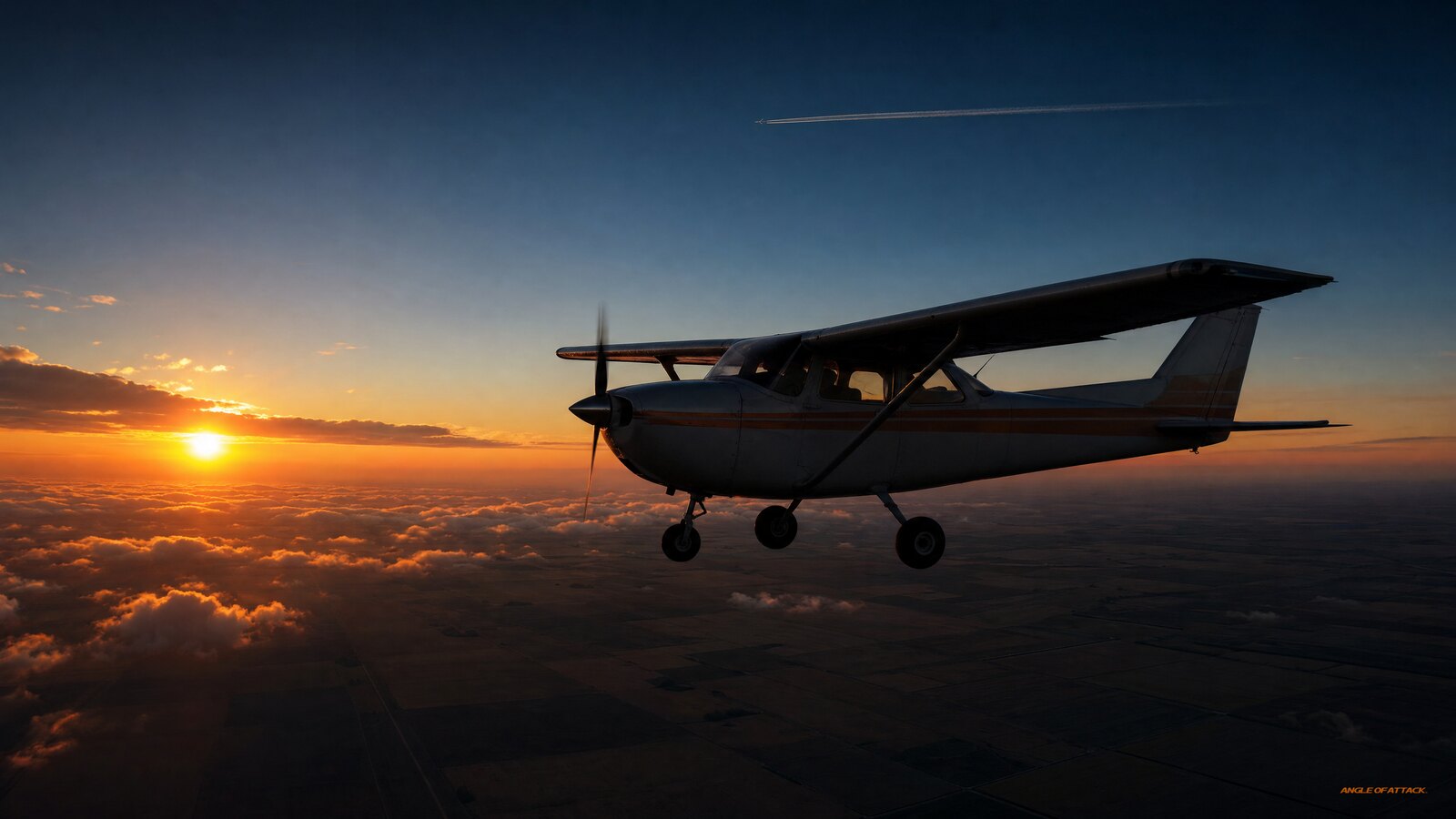
How High Can a Plane Fly? Altitude Limits From Cessnas to Jets
How high a plane can fly depends on the airplane: a typical Cessna 172 tops out near 13,000–14,000 feet, jet airliners cruise at 35,000–42,000 feet, and the highest a civil jet is certified to fly is around 51,000 feet. Every airplane eventually runs out of “up” as the air thins. Specialized aircraft like the U-2 spy plane reach roughly 70,000 feet, but above a certain height the wing can’t make enough lift and the engine can’t make enough power, and the climb simply dies.
Most people picture altitude as open and unlimited — you just keep pulling back and going higher. It isn’t. Every airplane hits a wall where the air gets too thin to fly, and that wall sits at wildly different heights depending on the machine. Let’s walk through how high different aircraft actually go, then unpack the physics that decides the number. That’s the part that matters for your checkride and your day-one flying.
- There’s no single answer. A Cessna 172 maxes out near 13,000–14,000 feet; airliners cruise around 35,000–42,000 feet; the highest-certified civil jet reaches about 51,000 feet.
- Thin air is the limiter. As you climb, the wing needs more speed to make lift while a normally aspirated engine makes less power. The gap between power available and power required closes until the climb stops.
- Service ceiling vs. absolute ceiling. Service ceiling is where the airplane can still climb 100 feet per minute; the absolute ceiling is where climb rate hits zero. Manufacturers publish the service ceiling because the absolute ceiling is impractical to reach.
- Density altitude moves the wall. Hot, high, and humid air thins the atmosphere and lowers how high you can actually climb on a given day — the book number assumes a standard atmosphere.
- Above ~12,500 feet, the pilot becomes the limit. FAA oxygen rules under 14 CFR § 91.211 kick in before most light airplanes hit their service ceiling — the body needs help breathing before the engine quits climbing.
- The FAA defines all of this. Ceilings, density altitude, and atmospheric effects live in the Pilot’s Handbook of Aeronautical Knowledge (PHAK, FAA-H-8083-25C); oxygen requirements live in 14 CFR § 91.211.
WHAT’S IN THIS GUIDE
- 1How High Can a Small Plane Like a Cessna 172 Fly?
- 2How High Do Commercial Jet Airliners Fly?
- 3What Is the Highest a Plane Has Ever Flown?
- 4Why Can’t an Airplane Just Keep Climbing?
- 5What’s the Difference Between Service Ceiling and Absolute Ceiling?
- 6How Does Weather Change How High a Plane Can Fly?
- 7How High Can You Fly Before You Need Oxygen?
- 8A Story From Alaska: Where My 172 Ran Out of Up
- 9Aircraft Altitude Limits Compared
- 10PLT Study Guide
- 11Frequently Asked Questions
How High Can a Small Plane Like a Cessna 172 Fly?
A typical Cessna 172 has a service ceiling around 13,000–14,000 feet — that’s the highest density altitude where it can still climb at a useful rate. Most light training airplanes land somewhere in the low-to-mid teens of thousands of feet. You can nudge a little higher in the right conditions, but the climb becomes a crawl long before you get there, and for practical flying you’ll almost never go that high.
The reason is the engine. A 172 has a normally aspirated piston engine — no turbocharger — so it breathes whatever air is around it. The higher you climb, the fewer oxygen molecules reach the cylinders, and the less power it makes. By the low teens, the engine is producing far less than its sea-level horsepower, with barely any surplus left to climb on. That’s why most cross-country trainers cruise far below their ceiling, usually between 3,000 and 9,500 feet, where the airplane still climbs well and the air is comfortable to breathe. The ceiling is a limit you respect, not a target you chase.
The other thing to know about that number: it assumes a standard day at gross weight. Load the airplane up on a hot afternoon and the real ceiling drops well below the book figure, which is the density-altitude story we’ll get to in a minute.
How High Do Commercial Jet Airliners Fly?
Commercial jet airliners cruise between roughly 35,000 and 42,000 feet. A Boeing 737 or Airbus A320 typically cruises near 35,000–39,000 feet, while longer-range jets like the Boeing 787 climb to around 40,000–43,000 feet. They fly that high on purpose: the thin air cuts drag dramatically, which lets them go fast on far less fuel, and it puts them above most weather and turbulence.
Two things let a jet do what a Cessna can’t. Turbine engines keep feeding the combustion chamber compressed air, so they keep making useful power where a piston single would be gasping. And the cabin is pressurized — the airplane carries its own breathable atmosphere — so the people inside stay comfortable while the outside air is far too thin to survive in. The highest a civil jet is certified to fly is about 51,000 feet, reached by business jets like the Gulfstream G650 and the Bombardier Global series. That ceiling is set by the airplane’s structure, its pressurization system, and aerodynamic limits near the speed of sound — not by how high the engines can push.
What Is the Highest a Plane Has Ever Flown?
The highest-flying operational airplane is generally the Lockheed U-2 reconnaissance aircraft, which cruises above 70,000 feet — high enough that its pilots wear full pressure suits like astronauts. The retired SR-71 Blackbird flew even higher, sustaining flight around 85,000 feet at over three times the speed of sound. These are extreme, purpose-built machines, not anything you’ll ever fly, and at those heights the atmosphere is so thin that conventional wings and air-breathing engines are near the edge of working at all.
The takeaway for a student pilot is the spread. From a Cessna at 14,000 feet to a U-2 at 70,000, the difference isn’t magic — it’s engineering against the same enemy. Every one of these airplanes is fighting the same problem you’ll learn about in ground school: as you climb, the air runs out, and eventually the wing and engine can’t keep up.
Why Can’t an Airplane Just Keep Climbing?
An airplane can’t keep climbing because climb depends on having spare power, and altitude steadily eats that spare power away. As you climb, the air thins, so the engine makes less power while the wing must fly faster to produce the same lift. When the power the airplane needs just to stay level finally equals the power it has available, there’s nothing left to trade for altitude — and the climb stops.
Think of it as a budget. Down low, your engine and wing produce far more thrust than you need to hold altitude, and that surplus — engineers call it excess power — is what you spend to climb. As you go up, the surplus shrinks on both ends: the engine’s output falls and the wing’s demand rises. For a normally aspirated piston engine the loss is steep, which is why a turbocharged or turbine engine, forcing compressed air into the cylinders, climbs so much higher before running out.
When the “power available” and “power required” curves finally meet, the climb rate is zero — that’s the absolute ceiling. This is the steady-state climb relationship the FAA describes in the Pilot’s Handbook of Aeronautical Knowledge (PHAK, FAA-H-8083-25C): climb performance is all about excess power, and thin air is what steals it.
What’s the Difference Between Service Ceiling and Absolute Ceiling?
The difference is the climb rate that defines each one. The service ceiling is the density altitude where the airplane can still climb at 100 feet per minute at maximum gross weight — slow, but useful. The absolute ceiling is higher: the altitude where climb rate finally reaches zero and the airplane simply cannot go up anymore. Service ceiling is the practical limit; absolute ceiling is the theoretical dead end.
Manufacturers publish the service ceiling, not the absolute ceiling, for a good reason. Getting an airplane to its absolute ceiling takes forever — the closer you get, the slower you climb, so those last few hundred feet drag on while you burn fuel for almost no gain. The 100-fpm service ceiling is the honest, usable figure: it marks the altitude where the airplane is still doing something productive on the way up. That’s why your Pilot’s Operating Handbook lists a service ceiling. When people ask “how high can this airplane fly,” it’s almost always the number they actually want.
How Does Weather Change How High a Plane Can Fly?
Weather changes how high a plane can fly through density altitude — the altitude the airplane’s wing and engine actually “feel.” On a hot, humid day, the air is thinner than standard, so the airplane behaves as if it’s already higher than the altimeter says. That pushes the real-world ceiling down. On a cold, dry day, the denser air lets the engine and wing perform better, and you can climb higher before the climb quits.
This is the link most students miss. A service ceiling isn’t a fixed altitude stenciled on the airframe — it’s a density-altitude limit. Temperature, humidity, field elevation, and weight all shove density altitude around, and the ceiling follows.
Weight matters just as much as the weather. A heavier airplane needs more lift, which means more power for the climb, which means the climb sags to 100 feet per minute at a lower altitude. That’s why the published service ceiling is quoted at maximum gross weight — it’s the conservative number. Fly light on a cold morning and you’ll beat it; fly heavy on a hot afternoon and that ceiling comes down to meet you faster than you’d expect.
How High Can You Fly Before You Need Oxygen?
For most light airplanes, you — the pilot — become the altitude limit before the airplane does. Under 14 CFR § 91.211, the required crew must use supplemental oxygen on any portion of a flight above 12,500 feet that lasts longer than 30 minutes, and continuously above 14,000 feet. Above 15,000 feet, oxygen must be available to every occupant. Those altitudes sit right around a typical trainer’s service ceiling.
The reason is hypoxia — your body being starved of oxygen as the air thins. It sneaks up quietly: judgment, vision, and reaction time degrade before you feel anything is wrong, which is exactly what makes it dangerous. The FAA covers the physiological effects of altitude in the PHAK and the Aeronautical Information Manual (AIM), and it’s a heavily tested concept on the knowledge exam. So when someone asks “how high can a plane fly,” there are really two ceilings stacked on top of each other: a performance ceiling for the airplane and a physiological ceiling for the human inside — both set by the same thin air. In a typical Cessna, the oxygen rules will often govern your altitude before the airplane ever runs out of climb.
If you want this to click — turning fuzzy rules about ceilings, density altitude, and oxygen into confident go/no-go and altitude decisions — that’s exactly the kind of practical performance thinking we drill inside the free Total Student Pilot course and the Private Pilot Ground School. Understanding why the limits exist beats memorizing the numbers every time.
A Story From Alaska: Where My 172 Ran Out of Up
Flying around the mountains here in Alaska, I’ve felt an airplane’s ceiling long before I’d ever think to look it up — not as a number, but as a feeling in the seat. I remember climbing toward higher terrain in a loaded 172 on a warm afternoon, power all in, nose where it should be, watching my climb rate fade from a healthy several hundred feet per minute down toward almost nothing. Nothing was broken. The engine sounded fine. The airplane was simply telling me — in the only language it has — that for this weight, this temperature, and this altitude, I was near the top of what it had left to give. So I quit fighting it: I turned toward lower ground, let the airplane accelerate, and went around the ridge instead of over it.
The lesson I teach from that is simple: your airplane warns you before it hits its ceiling, not at it. The climb gets lazy. The controls feel mushy. The VSI sags and won’t come back. Respect that warning, because thin air doesn’t negotiate — and on a hot, high, heavy day, your airplane’s “up” can run out a lot lower than the book number suggests.
Aircraft Altitude Limits Compared
Here’s how the major categories actually stack up. These are typical figures — the exact number for any specific airplane comes from its Pilot’s Operating Handbook or type certificate, and it shifts with weight and the day’s air.
| Aircraft Type | Typical Service/Cruise Ceiling | What Sets the Limit |
|---|---|---|
| Cessna 172 (piston trainer) | ~13,000–14,000 ft | Normally aspirated engine losing power in thin air |
| Turbocharged piston single (e.g., Cessna T206) | ~20,000–27,000 ft | Turbo restores power; pilot oxygen/pressurization limits |
| Regional turboprop | ~25,000–31,000 ft | Turbine power vs. wing/airframe limits |
| Jet airliner (737 / A320) | ~37,000–39,000 ft | Aerodynamic + pressurization + economic cruise |
| Long-range airliner (787) | ~40,000–43,000 ft | Same, optimized for long-haul efficiency |
| Business jet (G650) | ~51,000 ft | Highest civil certification; structure + aerodynamics |
| Lockheed U-2 (reconnaissance) | ~70,000+ ft | Specialized wing, pressure suits, near edge of usable air |
The pattern is consistent top to bottom: the higher an airplane flies, the more engineering it takes to keep an engine making power and a wing making lift in air that’s running out. Your Cessna and a Gulfstream are fighting the exact same physics — they just bring very different tools to the fight.
PLT Study Guide
The FAA tags every knowledge-test question with a PLT (Pilot Learning Statement) code. If you miss a question in one of these areas, the code on your test report points you straight back to the topic to review. (Heads-up: a couple of commonly attached hint codes — PLT004, “Calculate aircraft performance – climb/descent,” and PLT123, “Recall aircraft performance – airspeed” — touch this topic only at the edges. PLT004 is a calculation code and PLT123 is about airspeed, while “how high can a plane fly” is really about ceilings, atmosphere, and altitude effects. The codes below are the ones whose FAA wording actually matches.)
| PLT Code | Official FAA Learning Statement | What to study |
|---|---|---|
| PLT026 | Define ceiling | The aircraft-performance meaning of service ceiling and absolute ceiling — and why it’s different from a weather (cloud) ceiling. |
| PLT124 | Recall aircraft performance – atmospheric effects | How thinning air at altitude reduces engine power and lift, and why that sets a hard limit on how high an airplane can climb. |
| PLT127 | Recall aircraft performance – density altitude | How temperature, humidity, and elevation shift density altitude and move the real-world ceiling up or down on any given day. |
| PLT023 | Define altitude – absolute / true / indicated / density / pressure | The vocabulary of altitude — especially density altitude — that explains why a published ceiling isn’t a fixed number on the altimeter. |
| PLT330 | Recall physiological factors – cause / effects of hypoxia | Why the pilot often becomes the altitude limit before the airplane does, and how oxygen starvation degrades performance. |
Study these against the Pilot’s Handbook of Aeronautical Knowledge (PHAK, FAA-H-8083-25C), especially the aircraft-performance and aeromedical-factors chapters, and pair the oxygen rules with 14 CFR § 91.211. Don’t just memorize the altitudes — understand the relationships, because that’s what makes you a thinking pilot instead of a test-taker.
Frequently Asked Questions
How high can a Cessna 172 fly?
A Cessna 172 has a service ceiling around 13,000–14,000 feet — the highest altitude where it can still climb at a useful rate at gross weight. In practice, most 172 cross-countries cruise far lower, between about 3,000 and 9,500 feet, where the engine still climbs well and the air is comfortable to breathe.
How high do commercial planes fly?
Commercial jet airliners cruise between roughly 35,000 and 42,000 feet. A Boeing 737 or Airbus A320 cruises near 35,000–39,000 feet, while long-range jets like the 787 climb closer to 40,000–43,000 feet. They fly that high because the thin air cuts drag, saves fuel, and keeps them above most weather.
What is the highest altitude a plane can fly?
The highest civil jet certification is about 51,000 feet, reached by business jets like the Gulfstream G650. Specialized aircraft go much higher — the U-2 cruises above 70,000 feet and the retired SR-71 flew around 85,000 — but those are purpose-built machines near the edge of usable air.
Why can’t airplanes fly higher and higher?
Climbing requires spare power, and thin air steals it. As you climb, a normally aspirated engine makes less power while the wing needs more speed to make lift. When the power required to hold altitude equals the power available, the climb stops — that’s the absolute ceiling.
What is the difference between service ceiling and absolute ceiling?
Service ceiling is the density altitude where the airplane can still climb 100 feet per minute at gross weight. Absolute ceiling, which is higher, is where the climb rate finally reaches zero. Manufacturers publish the service ceiling because the absolute ceiling takes impractically long to reach.
Does temperature affect how high a plane can fly?
Yes. Hot, humid air is thinner than standard, which raises density altitude and lowers how high an airplane can actually climb that day. Cold, dry, dense air does the opposite. That’s why a published ceiling assumes a standard atmosphere and gets worse on a hot afternoon.
At what altitude do pilots need oxygen?
Under 14 CFR § 91.211, the required crew must use supplemental oxygen above 12,500 feet for any time longer than 30 minutes, and continuously above 14,000 feet. Above 15,000 feet, oxygen must be available to all occupants — often limiting your altitude before the airplane runs out of climb.
How high can a plane fly without pressurization?
Without a pressurized cabin, occupants depend on the outside air, so supplemental oxygen becomes mandatory in the mid-teens of thousands of feet. Unpressurized light airplanes are therefore practically limited to around 12,500–14,000 feet on most flights — right where a typical trainer’s performance ceiling already sits.
Altitude is one of the first things that fascinates people about flying — but the deeper you go, the more you see it’s really a story about thin air, spare power, and respecting limits you can’t see. The good news is that none of it is out of reach. It starts with a few concepts and the physics behind them, and it builds from there, one flight at a time.
Master every system on your checkride — and on day one.
The Private Pilot Ground School breaks down every FAA subject area in the same plain-English, real-world way you just read — with quizzes, scenarios, and the explanations that finally make it click.
If you’re standing at the start of that journey, that’s exactly where I love meeting people. Get the fundamentals right, learn to read what the airplane is telling you, and the rest follows.


ON THE SAME TOPIC
IFR vs VFR: The Two Sets of Rules Every Pilot Flies By
IFR vs VFR: The Two Sets of Rules Every Pilot Flies By 19 min read Last updated June 2026 · Chris Palmer The difference between IFR and VFR is which set of rules you fly under. VFR — visual flight rules — lets you navigate by looking outside and staying clear of clouds in good […]
 Read more
ASOS vs AWOS vs ATIS: How to Pull the Right Weather Before You Fly
ASOS vs AWOS vs ATIS: How to Pull the Right Weather Before You Fly 13 min read Last updated June 2026 · Chris Palmer The difference comes down to who is talking and what the broadcast covers. ASOS and AWOS are automated, computer-generated weather observations of the conditions right at the field. ATIS is a […]
Read more 
What Is RNAV Navigation? Area Navigation for VFR Pilots
What Is RNAV Navigation? Area Navigation for VFR Pilots 17 min read Last updated June 2026 · Chris Palmer RNAV — Area Navigation — is a method that lets an aircraft fly any desired path within the coverage of ground- or space-based navigation aids, rather than being forced to fly directly to and from stations. […]
Read more 
NDB and ADF Explained: The Oldest Radio Nav System You Still Need to Understand
NDB and ADF Explained: The Oldest Radio Nav System You Still Need to Understand 16 min read Last updated June 2026 · Chris Palmer An NDB (non-directional beacon) is a ground-based radio transmitter that sends a signal in all directions, and an ADF (automatic direction finder) is the cockpit receiver whose needle points straight at […]
Read more 
Stay Connected
Be the very first to get notified when we publish new flying videos, free lessons, and special offers on our courses.
