
What Are Ground Reference Maneuvers? The Wind-Drift Skills Every Pilot Learns First
Ground reference maneuvers are low-altitude training maneuvers — the rectangular course, S-turns across a road, and turns around a point — in which a pilot flies a precise path over the ground while constantly adjusting bank and heading to correct for wind drift. They teach you to divide attention between the airplane and the terrain and to fly the airplane by what’s happening outside.
Here’s the thing every student figures out the first time the wind is honest with them: the airplane doesn’t care about the road on the ground. It flies through a block of air, and that block is sliding sideways. Ground reference maneuvers are where you learn to win that fight — to make the airplane trace exactly the path you want over the ground even though the wind is trying to drag you off it.
I teach these early, and I teach them hard, because almost everything that comes later — the traffic pattern, a soft-field approach, an emergency to a field — is just a ground reference maneuver wearing a different hat. Let me brief them the way I would before we dropped down to maneuvering altitude.
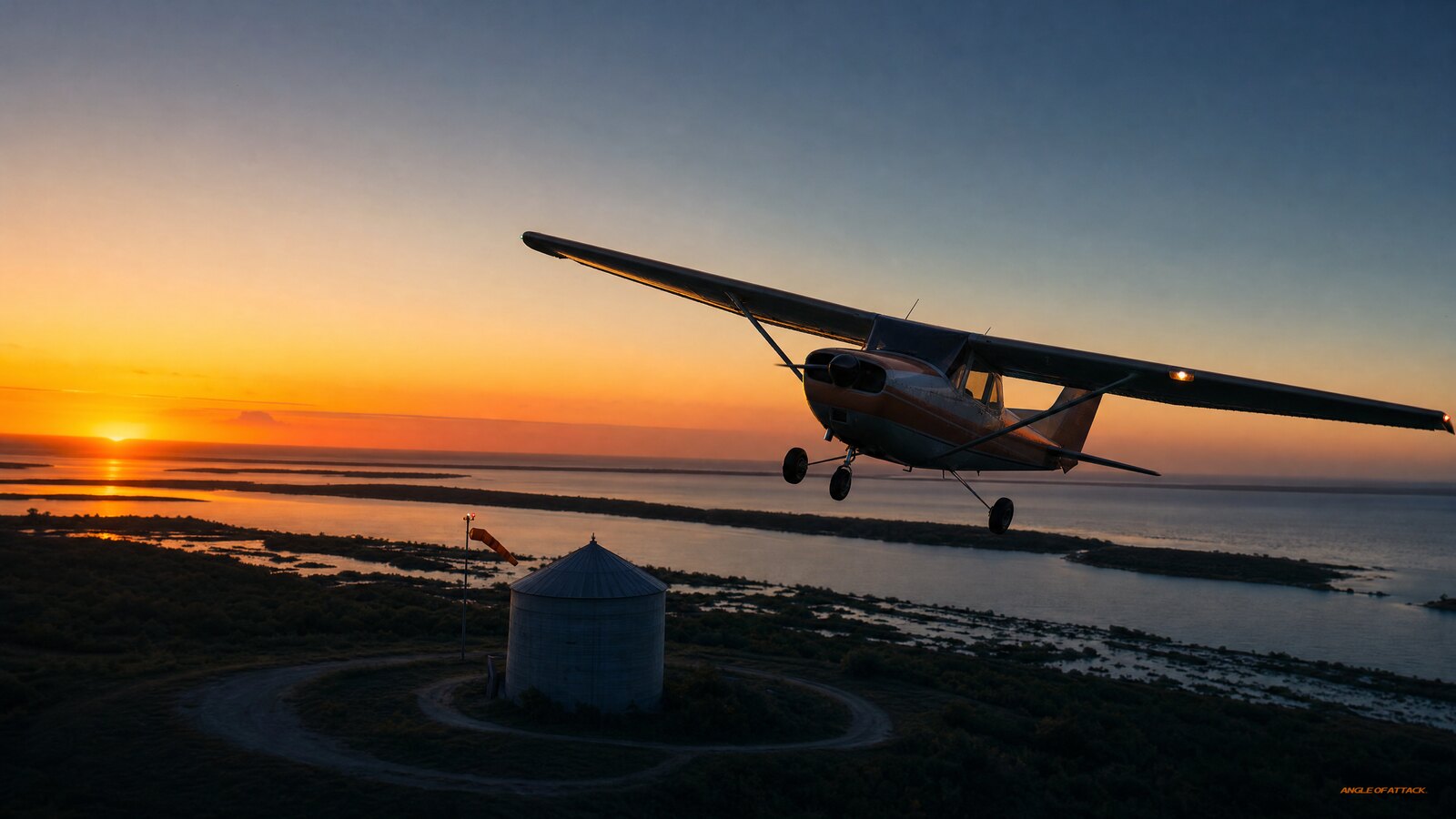
- Three core maneuvers. For the Private Pilot, ground reference maneuvers means the rectangular course, S-turns across a road, and turns around a point.
- Wind drift is the whole point. Each maneuver forces you to vary bank angle continuously so the airplane’s track over the ground stays correct despite the wind pushing it downwind.
- Steepest bank is downwind. Your bank is steepest where your groundspeed is highest (the downwind side) and shallowest where groundspeed is lowest (into the wind).
- Flown low, but not too low. The Airplane Flying Handbook puts the practice altitude at roughly 600 to 1,000 feet AGL — low enough to judge drift, high enough to recover safely.
- Divided attention is the real lesson. You’re learning to scan outside for your track while still flying altitude, airspeed, and coordination.
- The pattern is a ground reference maneuver. Every traffic pattern you’ll ever fly is a rectangular course around a runway.
- Tested on the checkride. Ground reference maneuvers are an FAA Private Pilot ACS area of operation you must demonstrate to standard.
WHAT’S IN THIS GUIDE
- 1What are ground reference maneuvers?
- 2Why do pilots learn ground reference maneuvers?
- 3Why does the wind force you to change your bank angle?
- 4What are the three ground reference maneuvers?
- 5How high and how fast do you fly them?
- 6Chasing the river bend: where the wind taught me
- 7How do ground reference maneuvers connect to real flying?
- 8PLT Study Guide
- 9Frequently Asked Questions
What are ground reference maneuvers?
Ground reference maneuvers are flight-training maneuvers in which a pilot flies a precise, predetermined path over the ground — a rectangle, a series of S-shapes, or a circle — while constantly correcting for wind drift. The Airplane Flying Handbook (AFH, FAA-H-8083-3C, Chapter 7) covers them as the rectangular course, S-turns across a road, and turns around a point.
The objective isn’t the shape for its own sake. The shape is just a target the wind keeps trying to ruin. To hold that target, you have to constantly read the ground, sense how the wind is moving you, and feed in the right bank angle and heading to cancel the drift. Do it well and your ground track looks geometric and clean. Do it poorly and the wind smears your circle into an egg.
Because you’re flying low and looking outside, ground reference maneuvers also build the single most important habit in visual flying: dividing your attention. You’re managing altitude, airspeed, and coordination on the panel while simultaneously judging your path against a road, a field, or a point on the ground. That split focus is the real product of the exercise.
Why do pilots learn ground reference maneuvers?
Pilots learn ground reference maneuvers to develop wind-drift correction, precise aircraft control at low altitude, and divided attention between the cockpit and the outside world. The FAA treats them as foundational because the same skills directly transfer to the traffic pattern, takeoffs, and landings — the phases of flight where most accidents happen.
Think about what’s actually being trained. You can’t feel wind drift once you’re airborne; the airplane just slides quietly downwind and the instruments look perfectly normal. The only way to catch it is to look outside and compare your path to the ground. Ground reference maneuvers force you to build that outside scan until it’s automatic.
There’s also a control-precision payoff. Rolling into and out of varying bank angles while holding altitude within tight tolerances, staying coordinated on the rudder, and managing your track all at once is genuinely hard at first. By the time you can fly a clean turn around a point in a stiff wind, your hands and feet have learned a smoothness that shows up everywhere else.
And there’s the safety angle. These are practiced low, around 600 to 1,000 feet AGL, which is exactly the altitude band of the traffic pattern. Learning to maneuver precisely and stay coordinated down low — without fixating, without skidding a turn — is how you build the instincts that keep a base-to-final turn from becoming a stall-spin.
Why does the wind force you to change your bank angle?
The wind forces you to change bank angle because your groundspeed changes continuously as you turn. To hold a constant radius over the ground, you bank steepest where groundspeed is highest — on the downwind side — and shallowest where groundspeed is lowest — heading into the wind. A constant bank in wind would warp your circle into a lopsided shape.
Here’s the logic. When you’re flying downwind, the wind adds to your airspeed, so you’re covering ground fast. Going fast around a fixed-radius turn demands more bank. When you turn back into the wind, the wind subtracts from your speed over the ground, you’re crawling, and you need much less bank to hold the same radius.
The result is a continuously varying bank throughout the maneuver — never a fixed angle. On the rectangular course and S-turns, the same principle shows up as crab angles on the straight legs and changing rates of roll-in. Your job is to keep adjusting so the track stays right, not to hold any one pretty bank picture.
This is the conceptual heart of every ground reference maneuver, and it’s exactly what the FAA tests on the knowledge exam under the ground-track learning statement. Memorize one rule and you’ll never blank on it: steepest bank downwind, shallowest bank upwind.
What are the three ground reference maneuvers?
The three ground reference maneuvers a Private Pilot learns are the rectangular course, S-turns across a road, and turns around a point. Each isolates a different piece of wind-drift correction: the rectangular course mirrors a traffic pattern, S-turns demand equal half-circles on both sides of a line, and turns around a point require a continuously changing bank to hold a constant radius.
Here’s how the three compare:
| Maneuver | Ground track | What it builds | Real-world cousin |
|---|---|---|---|
| Rectangular course | A rectangle around a field | Crab angles on straight legs, turns timed for wind | The traffic pattern |
| S-turns across a road | Equal half-circles on each side of a straight road | Varying bank to make both loops symmetric | Correcting drift on any curving track |
| Turns around a point | A constant-radius circle around a fixed point | Continuously changing bank through 360° | A circling approach or holding over a feature |
The rectangular course is the most directly useful. You fly a rectangle around a field, crabbing on the straight legs and adjusting where you start and stop each turn so the wind doesn’t blow you wide or tight. It is, quite literally, a traffic pattern without a runway.
S-turns across a road make you fly a series of half-circles of equal size on opposite sides of a straight road, crossing the road with wings level each time. Because the wind is helping on one half and hurting on the other, you have to vary your bank constantly to keep both loops the same size.
Turns around a point are the purest test. You fly a complete circle around a single ground reference at a constant radius, which means your bank angle is changing literally all the way around — steepest downwind, shallowest upwind. Fly it well and the FAA examiner watches a clean, round circle appear over the ground.
How high and how fast do you fly them?
Ground reference maneuvers are flown low so you can actually judge wind drift against the ground. The Airplane Flying Handbook puts the altitude at roughly 600 to 1,000 feet AGL — low enough to clearly see your track, high enough to recover safely — and notes the exact number depends on the airplane’s speed and type. Airspeed is a normal cruise or maneuvering speed at or below the airplane’s design maneuvering speed, V_A.
The altitude matters more than students expect. Fly too high and the ground slides by so slowly you can barely perceive drift, which defeats the purpose. Fly too low and you’ve eaten into your safety margin for a stall or a distraction. That 600-to-1,000-foot band is the sweet spot the FAA settled on for clear drift cues with a reasonable buffer.
Speed is about staying within safe structural and stall limits while you bank and maneuver. You’ll typically set a stable power and trim before you start, then leave the throttle alone so airspeed and altitude become products of your pitch and bank discipline. Keeping the airplane coordinated — ball centered — matters here as much as anywhere, because skidding a low-altitude turn is how good days go bad.
If you’re brand-new to all of this, the free Total Student Pilot course walks you through the four forces, slow flight, and basic maneuvering so these low-altitude exercises don’t feel like a firehose when your instructor first demonstrates one.
Chasing the river bend: where the wind taught me
I learned more about ground reference maneuvers from one windy afternoon over a braided Alaska river than from any chalkboard. I had a student who could draw a perfect turn-around-a-point on paper and explain the theory cold — steepest bank downwind, shallowest upwind — and then flew an egg every single time we tried it for real.
The problem was that he was flying the bank angle instead of flying the ground. He’d set what he thought was the “right” bank and then stop adjusting, eyes locked on the wingtip. Meanwhile a good Alaska wind was quietly stretching his circle out on the upwind side because he wasn’t shallowing the bank when his groundspeed dropped.
So we threw out the abstraction. I picked a sharp bend in the river as our point and told him to forget about degrees of bank entirely — just keep the wingtip the same distance from that bend the whole way around, and adjust whatever you have to adjust to make that happen. One lap later he got it. He felt the airplane wanting to drift wide heading into the wind, rolled the bank out to hold the radius, then steepened it again rolling downwind. The circle came out round.
That’s the whole lesson in ground reference maneuvers. You don’t fly a number off the attitude indicator down low — you fly the picture out the window and let your hands chase the track. Once that clicks, the traffic pattern stops being a sequence of memorized headings and becomes something you just fly, wind and all.
How do ground reference maneuvers connect to real flying?
Ground reference maneuvers connect to real flying because nearly every visual phase of flight is one in disguise. The traffic pattern is a rectangular course around a runway. A base-to-final turn is a drift-corrected turn. Following a road off a soft field, flying a circling approach, tracking a shoreline for a photo pass — they all demand the same wind-aware, eyes-outside track control you build here.
The traffic pattern connection is the big one. When you fly a downwind, base, and final, you’re flying three sides of a rectangular course, crabbing into the wind on each leg and timing your turns so you don’t blow through the centerline. A pilot who has internalized the rectangular course flies tidy, repeatable patterns. One who hasn’t gets blown wide on a windy base and chases the runway.
There’s a safety thread running through all of it too. The base-to-final turn kills pilots every year — usually someone who lets the airplane drift past the centerline, then racks in bank and adds bottom rudder to salvage it, and skids into a low-altitude stall-spin. The coordination and drift awareness you drill in turns around a point are exactly the antidote. You learn to correct with a planned bank, not a panicked one.
If you want this stuff to genuinely click before your instructor straps you in, our Private Pilot Ground School breaks down each maneuver with the wind diagrams, the bank-angle logic, and the test questions so you show up to the airplane already understanding what the wind is doing to you — day-one ready, not just checkride ready.
PLT Study Guide
The FAA tags knowledge-test questions with PLT (Pilot Learning Statement) codes. For ground reference maneuvers, the code that actually matches this content is:
PLT258 — Recall ground reference maneuvers / ground track diagram. This is the one to know cold. Test questions under this code show you a wind arrow and a ground track and ask where the bank should be steepest, where you start a turn, or how the wind distorts the path. The plain-English study point: in any ground reference maneuver, your bank is steepest on the downwind side (highest groundspeed) and shallowest into the wind (lowest groundspeed), and you must vary it continuously to hold a constant ground track. Be ready to read a ground-track diagram and identify the wind direction from the shape of the path or the changing bank.
A note on the hint that came with this topic: PLT245 — “Recall forces acting on aircraft / stalls / spins” — is not the correct code for ground reference maneuvers. That code covers aerodynamic stalls and spins, a different subject. The verified, on-target code for this article is PLT258. Study the ground-track diagram logic and you’ve covered what the FAA actually tests here.
Frequently Asked Questions
What are the three ground reference maneuvers for the Private Pilot?
The three are the rectangular course, S-turns across a road, and turns around a point. The Airplane Flying Handbook (AFH, FAA-H-8083-3C) covers all three in Chapter 7. Each isolates a different aspect of correcting for wind drift while flying a precise path over the ground at low altitude.
Why do you bank steeper on the downwind side?
Because your groundspeed is highest when the wind is behind you. Holding a constant radius over the ground at a higher groundspeed requires a steeper bank. Heading into the wind your groundspeed drops, so you shallow the bank. The rule to memorize: steepest bank downwind, shallowest bank upwind.
At what altitude are ground reference maneuvers flown?
The Airplane Flying Handbook puts it at roughly 600 to 1,000 feet AGL. That band is low enough to clearly perceive wind drift against the ground but high enough to leave a safe margin for recovery if you get distracted or the airplane gets slow. Your instructor will set a specific altitude for each maneuver.
Are ground reference maneuvers on the checkride?
Yes. Ground reference maneuvers are a required area of operation in the FAA Private Pilot Airman Certification Standards (ACS). You must demonstrate them to specific tolerances for altitude, airspeed, and ground track, while staying coordinated and maintaining a proper division of attention between the airplane and the ground.
How is a turn around a point different from S-turns?
A turn around a point is one continuous circle around a single ground reference, so the bank changes constantly through a full 360 degrees. S-turns are a series of half-circles of equal size on opposite sides of a straight road, crossing the road wings-level each time. Both train varying bank for wind, in different geometries.
Do ground reference maneuvers relate to the traffic pattern?
Directly. The standard rectangular traffic pattern is a rectangular course flown around a runway. The crabbing on each leg and the timing of your turns to avoid being blown wide or tight are the exact skills the rectangular course teaches. Mastering ground reference maneuvers makes you a much tidier pattern flyer.
What does V_A have to do with ground reference maneuvers?
You fly ground reference maneuvers at or below the airplane’s design maneuvering speed, V_A, so the airframe stays within safe structural limits while you bank and maneuver. In practice you’ll set a stable cruise or maneuvering power and trim, then hold altitude and airspeed through pitch and bank discipline rather than chasing the throttle.
Why do pilots fly these maneuvers low instead of high?
Because at altitude the ground slides by too slowly to perceive wind drift, which defeats the purpose. Flying at 600 to 1,000 feet AGL gives you clear, immediate visual cues about how the wind is moving the airplane over the ground, so you can practice correcting for it the same way you will down low in the traffic pattern.
Master every system on your checkride — and on day one.
The Private Pilot Ground School breaks down every FAA subject area in the same plain-English, real-world way you just read — with quizzes, scenarios, and the explanations that finally make it click.
Ground reference maneuvers look simple from the back of the room — fly a circle, fly a rectangle, how hard can it be? Then the wind shows up and you discover they’re really a lesson in humility and attention. Stick with them. The day the circle comes out round and you barely noticed you were correcting, you’ve crossed into real stick-and-rudder flying.


ON THE SAME TOPIC
IFR vs VFR: The Two Sets of Rules Every Pilot Flies By
IFR vs VFR: The Two Sets of Rules Every Pilot Flies By 19 min read Last updated June 2026 · Chris Palmer The difference between IFR and VFR is which set of rules you fly under. VFR — visual flight rules — lets you navigate by looking outside and staying clear of clouds in good […]
 Read more
ASOS vs AWOS vs ATIS: How to Pull the Right Weather Before You Fly
ASOS vs AWOS vs ATIS: How to Pull the Right Weather Before You Fly 13 min read Last updated June 2026 · Chris Palmer The difference comes down to who is talking and what the broadcast covers. ASOS and AWOS are automated, computer-generated weather observations of the conditions right at the field. ATIS is a […]
Read more 
What Is RNAV Navigation? Area Navigation for VFR Pilots
What Is RNAV Navigation? Area Navigation for VFR Pilots 17 min read Last updated June 2026 · Chris Palmer RNAV — Area Navigation — is a method that lets an aircraft fly any desired path within the coverage of ground- or space-based navigation aids, rather than being forced to fly directly to and from stations. […]
Read more 
NDB and ADF Explained: The Oldest Radio Nav System You Still Need to Understand
NDB and ADF Explained: The Oldest Radio Nav System You Still Need to Understand 16 min read Last updated June 2026 · Chris Palmer An NDB (non-directional beacon) is a ground-based radio transmitter that sends a signal in all directions, and an ADF (automatic direction finder) is the cockpit receiver whose needle points straight at […]
Read more 
Stay Connected
Be the very first to get notified when we publish new flying videos, free lessons, and special offers on our courses.
