
The Four Forces of Flight: How Lift, Weight, Thrust, and Drag Keep Your Airplane in the Air
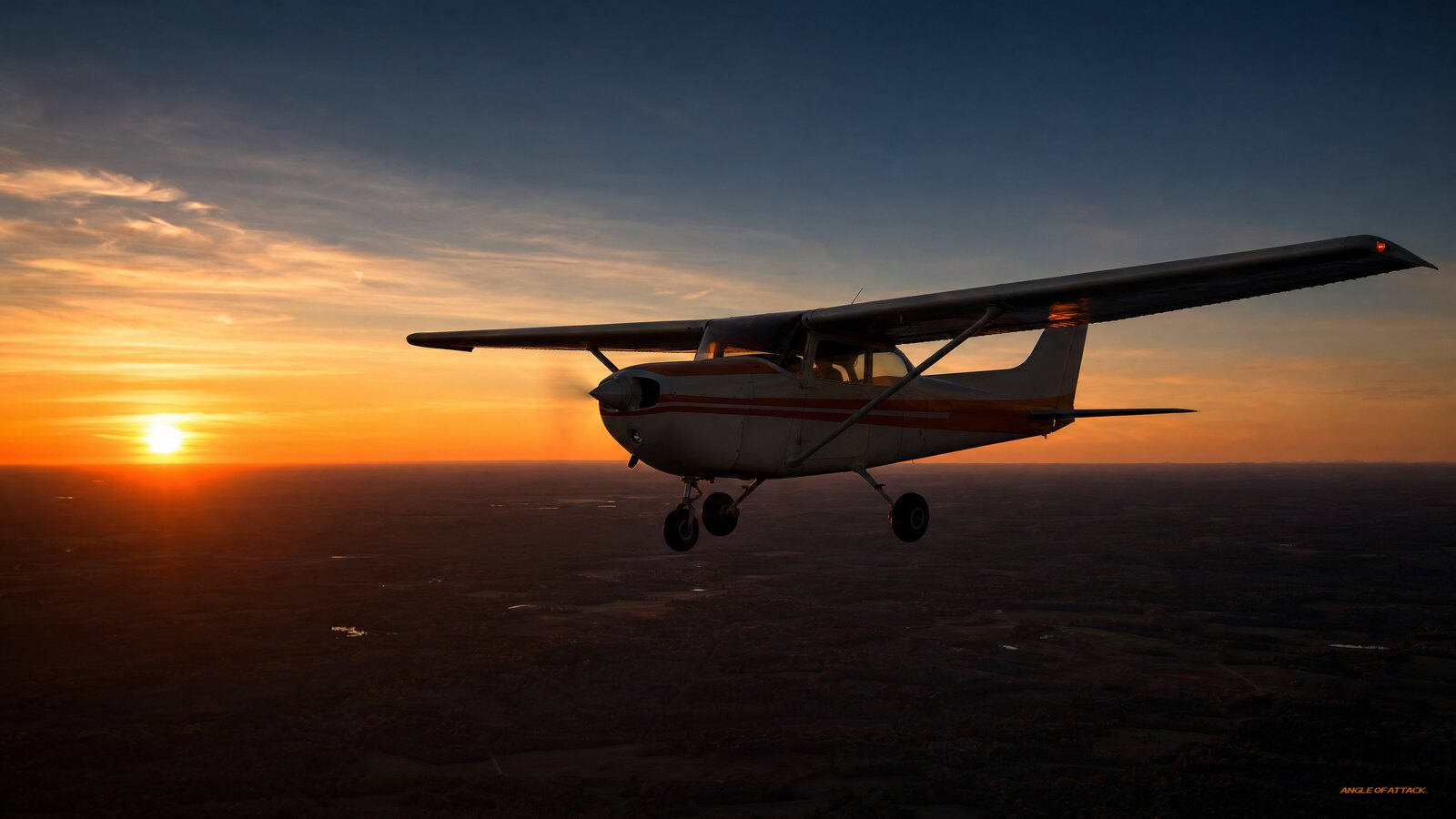
The Four Forces of Flight: How Lift, Weight, Thrust, and Drag Keep Your Airplane in the Air
The four forces of flight are lift, weight, thrust, and drag — the four aerodynamic and gravitational forces that act on every airplane the moment it leaves the ground. Lift opposes weight, and thrust opposes drag. When these two pairs are in balance, the airplane flies in steady, unaccelerated flight, holding its speed, altitude, and direction. Change any one of them and the airplane responds.
Every airplane you’ll ever fly, from a Cessna 172 to an airliner, is governed by these same four forces. They’re the first real aerodynamics concept the FAA expects you to understand, and they show up on your knowledge test, in your oral exam, and on every single flight you make. Let’s break them down the way I’d walk you through it on the ramp after a lesson — what each force is, where it comes from, and how they trade off against each other to fly the airplane.
cruise, the balanced state where all four forces of flight are in equilibrium" src="https://www.angleofattack.com/wp-content/uploads/2026/07/what-are-the-four-forces-of-flight-featured.jpg" style="margin-bottom: 0;">
- There are four forces of flight: lift, weight, thrust, and drag. They act on every aircraft in flight, and they pair off — lift versus weight, thrust versus drag.
- Lift opposes weight; thrust opposes drag. Lift acts upward from the wings, weight acts downward from gravity, thrust acts forward from the powerplant, and drag acts rearward from air resistance.
- In steady, unaccelerated flight, the forces are in balance. Lift equals weight and thrust equals drag, so the airplane holds a constant airspeed, altitude, and heading.
- Lift is produced by the wing, explained by both Bernoulli’s principle (pressure differences) and Newton’s third law (the wing deflecting air downward).
- Angle of attack is the master control of lift. Raise the angle of attack and lift increases — until you exceed the critical angle and the wing stalls.
- Excess thrust drives the climb, not extra lift. A common student misconception is that lift makes an airplane climb; it’s actually the thrust left over after overcoming drag.
- The four-force model is core FAA knowledge from the Pilot’s Handbook of Aeronautical Knowledge, and it’s tested under several PLT codes on the Private Pilot written exam.
WHAT’S IN THIS GUIDE
- 1What are the four forces of flight?
- 2What is lift and how does a wing make it?
- 3What is weight in the four forces of flight?
- 4What is thrust and where does it come from?
- 5What is drag and what are its two types?
- 6How do the four forces balance in steady flight?
- 7How do the four forces change in a climb, cruise, and descent?
- 8A real lesson: feeling the four forces out of a short Alaska strip
- 9PLT Study Guide
- 10Frequently Asked Questions
What are the four forces of flight?
The four forces of flight are lift, weight, thrust, and drag. Lift acts upward and is produced by the wings; weight acts downward and is produced by gravity pulling on the airplane’s mass; thrust acts forward and is produced by the engine and propeller; and drag acts rearward and comes from air resistance. They work as two opposing pairs.
The Pilot’s Handbook of Aeronautical Knowledge (PHAK, FAA-H-8083-25C, Chapter 5, Aerodynamics of Flight) defines these four forces as the foundation of how an airplane flies. The genius of the model is that it pairs them up: lift fights weight, and thrust fights drag. You don’t have to track four independent variables — you have to understand two tug-of-wars happening at the same time.
Here’s the mental picture I give students. Imagine the airplane suspended in the middle of those two tug-of-wars. Lift pulling up, weight pulling down, thrust pulling forward, drag pulling back. When both ropes are evenly matched, nothing changes — the airplane cruises straight and level. Tug on one rope and the airplane moves: more lift and it climbs or turns, more thrust and it accelerates, more drag and it slows.
The PHAK is careful to note that in the real world these forces don’t always line up as cleanly as a textbook arrow diagram suggests. The thrust line is tilted slightly, lift acts a bit ahead of the center of gravity, and so on. But for learning the concept and for passing your checkride, the four-force model is exactly the right place to start.
What is lift and how does a wing make it?
Lift is the upward-acting force produced by the wings that opposes weight and holds the airplane in the air. It acts perpendicular to the relative wind — the direction of the oncoming air — and is generated as the wing moves through the air at an angle. The amount of lift depends mostly on airspeed and angle of attack.
How does a wing actually make lift? The FAA explains it two ways, and both are correct. First, Bernoulli’s principle: air flowing faster over the curved top of the wing has lower pressure than the slower air beneath it, and that pressure difference produces an upward force. Second, Newton’s third law: the wing deflects a mass of air downward, and the equal and opposite reaction pushes the wing upward. The PHAK (Chapter 5) uses both explanations together, because lift is the product of both pressure differences and the airflow being turned.
The single most important control of lift is angle of attack — the angle between the wing’s chord line and the relative wind. As you raise the nose and increase the angle of attack, lift increases. But there’s a hard limit: exceed the critical angle of attack (around 15 to 20 degrees for a typical trainer wing) and the smooth airflow separates from the top of the wing. Lift drops sharply, and the wing stalls. That’s why a stall is about angle of attack, not airspeed — you can stall at any airspeed and any attitude if you exceed the critical angle.
This is the force you’ll spend your whole training life learning to manage. Every time you flare for landing, bank into a turn, or hold altitude in slow flight, you’re managing lift through angle of attack and airspeed. Our company is even named after it — angle of attack is that central to flying.
What is weight in the four forces of flight?
Weight is the downward-acting force produced by gravity pulling on the total mass of the airplane — the airframe, fuel, occupants, and baggage. It acts straight down toward the center of the earth, through the airplane’s center of gravity, and it directly opposes lift. To fly level, the wings must produce enough lift to equal the airplane’s weight.
Weight is the one force on this list that gravity hands you for free, whether you want it or not. The heavier the airplane, the more lift the wings must produce to balance it — which means a higher angle of attack, a higher stall speed, and worse climb performance. This is why weight-and-balance planning matters before every flight: an overloaded airplane needs more lift than the wing may be able to safely provide.
Weight also shifts in flight. As you burn fuel, the airplane gets lighter, so it needs less lift to hold altitude. And weight isn’t always a fixed number relative to lift — in a steep turn or a pull-up, the load factor multiplies the effective weight the wings must support. Pull 2 Gs in a 60-degree bank and the wing has to make twice the lift it makes in level flight, which is exactly why stall speed climbs in a turn (a relationship captured in the load-factor and stall-speed math behind PLT018).
What is thrust and where does it come from?
Thrust is the forward-acting force produced by the airplane’s powerplant — the engine and propeller working together — that moves the aircraft through the air and directly opposes drag. In a piston trainer, the engine spins the propeller, the propeller pulls a large mass of air rearward, and by Newton’s third law the reaction drives the airplane forward.
The PHAK defines thrust as the forward force produced by the powerplant. The important word is powerplant — thrust isn’t made by the engine alone or the propeller alone. The engine generates the power; the propeller converts it into a forward pull. Each propeller blade is actually a small rotating wing, producing an aerodynamic force that points forward because the propeller disc faces forward. That forward “lift” is what we call thrust.
Thrust is the force you control most directly, with your right hand on the throttle. Push the throttle forward and the engine makes more power, spinning the propeller faster and producing more thrust. When thrust exceeds drag, the airplane accelerates; when drag catches up and equals thrust, the airplane settles into a steady speed. One thing to keep in mind: thrust available shrinks as the air gets thinner and hotter. A normally aspirated engine makes less power at high density altitude, so it produces less thrust — something I’ll come back to with a story from an Alaska gravel strip.
What is drag and what are its two types?
Drag is the rearward-acting force of air resistance that opposes thrust and resists the airplane’s motion through the air. It comes in two forms: parasite drag, caused by the airplane’s shape and surfaces pushing through the air, and induced drag, the unavoidable byproduct of the wing producing lift. Total drag is the sum of the two.
Parasite drag is everything that resists motion that isn’t about making lift — the friction of air over the skin, the form drag of the fuselage and fixed landing gear, and the interference where components meet. Parasite drag grows rapidly with airspeed; the faster you go, the harder the air pushes back. Induced drag is the price you pay for lift. Whenever a wing generates lift, it leaves swirling wingtip vortices behind it, and the energy in those vortices shows up as drag. Induced drag is highest at low airspeed and high angle of attack — which is exactly why it dominates during slow flight and the landing approach.
Add the two together and you get the total drag curve, a U-shaped curve with a low point in the middle. That low point is the airplane’s most efficient speed — the speed where total drag is least and the airplane gives you the best lift-to-drag ratio. The PHAK (Chapter 5) walks through this curve in detail. For a student pilot, the headline is simple: go too slow and induced drag punishes you; go too fast and parasite drag punishes you. There’s a sweet spot in between, and a sharp pilot learns to find it.
| Type of drag | Cause | When it dominates |
|---|---|---|
| Parasite drag | Shape, skin friction, fixed gear, antennas — pushing the airframe through the air | High airspeed |
| Induced drag | The byproduct of making lift — wingtip vortices | Low airspeed, high angle of attack |
| Total drag | The sum of parasite + induced | Lowest at the airplane’s best L/D speed |
How do the four forces balance in steady flight?
In steady, unaccelerated flight — straight-and-level cruise at a constant airspeed — the four forces are in equilibrium. Lift equals weight, and thrust equals drag. Because the opposing pairs cancel out, there’s no net force on the airplane, so it neither accelerates nor decelerates, neither climbs nor descends. It just flies.
This balance is the equilibrium the FAA tests you on, and it’s the heart of the four-force model. The pairs match up cleanly: thrust acts forward and opposes drag acting rearward; lift acts upward and opposes weight acting downward. Here’s how they line up.
| Force | Direction | Opposes | Source |
|---|---|---|---|
| Lift | Upward (perpendicular to the relative wind) | Weight | The wings |
| Weight | Downward (toward the center of the earth) | Lift | Gravity acting on the airplane’s mass |
| Thrust | Forward (roughly along the flight path) | Drag | Engine and propeller (powerplant) |
| Drag | Rearward (opposite the flight path) | Thrust | Air resistance (parasite + induced) |
Now change one force and watch what happens. Add thrust and the airplane accelerates — until the faster airspeed produces more drag, and a new balance is struck at a higher speed. Increase angle of attack and lift rises, so the airplane climbs or turns. Reduce power and drag wins, so the airplane slows. Every maneuver you fly is really just a managed imbalance among these four forces, settling toward a new equilibrium.
If you want this drilled in with real cockpit visuals and the kind of “now I finally get it” explanations that make the four forces actually stick, that’s exactly what we build step by step inside the Private Pilot Ground School. And if you’re brand new and not sure where to start, the free Student Pilot Course is a no-cost way to get your feet wet.
How do the four forces change in a climb, cruise, and descent?
The balance of the four forces shifts depending on whether you’re climbing, cruising, or descending. In steady cruise, all four are balanced — thrust equals drag and lift equals weight. In a climb, you need excess thrust, because part of your thrust must help support the weight along the inclined flight path. In a descent, gravity supplies part of the forward force, so you need less thrust.
Here’s a misconception worth killing early: lift does not make an airplane climb. Students assume that because lift points up, more lift equals more climb. But in a steady climb, lift is actually slightly less than weight, because the flight path is tilted and a component of weight now acts along it. What buys you altitude is excess thrust — the thrust left over after overcoming drag. (The FAA gets precise here: climb angle tracks excess thrust and climb rate tracks excess power, but for a student pilot the headline is the same — it’s the surplus your powerplant has left over.) That’s why a heavy airplane on a hot day climbs so poorly: less power means less surplus to convert into altitude.
| Flight condition | Force relationship | What’s happening |
|---|---|---|
| Steady climb | Thrust greater than drag (excess thrust); lift slightly less than weight | The surplus thrust supports weight along the inclined path and buys altitude |
| Steady cruise | Thrust equals drag; lift equals weight | The airplane holds a constant airspeed and altitude |
| Steady descent | Thrust less than drag; gravity assists | Reduced power; a component of gravity supplies part of the forward force |
You’ll hear instructors say “pitch controls airspeed, power controls altitude,” at least in the typical approach regime. It’s a simplification your CFI will refine, but it captures how tightly the four forces are linked — you almost never change one without the others responding. Learning to feel that, rather than just read about it, is what separates a day-one-ready pilot from one who only passed a test.
A real lesson: feeling the four forces out of a short Alaska strip
I learned what the four forces really mean — not as arrows on a whiteboard, but in my hands — on a warm afternoon at a short gravel strip in the Alaska bush. I was in a loaded 172: gear in the back, two of us up front, full fuel. The density altitude was far higher than the cool morning numbers I’d been spoiled by. On the ramp, full power felt strong. On the takeoff roll, the airplane felt sluggish, and the trees at the end of that strip got interesting in a hurry.
What I felt that day was all four forces arguing at once. Weight was high — we were near gross. Thrust was down, because the hot, thin air meant the engine couldn’t make the power it made on a cold sea-level morning. To get the lift I needed off that short roll, I was holding a higher angle of attack, which piled on induced drag right when I had the least thrust to spare. Less excess thrust meant a flatter climb and a longer ground roll. The airplane was telling me, in the only language it has, that I’d asked for more than the day could give.
We cleared the trees with margin because I’d run the performance numbers before I ever pushed the throttle up. But that strip taught me to feel the relationship between the four forces, not just recite it. I’ve been in aviation education since 2006 and flying as a CFI since 2017, and I still think about that afternoon every time a student waves off density altitude or treats the four forces like a flashcard. The lesson for you: lift, weight, thrust, and drag aren’t four numbers in a textbook. They’re four forces you’ll feel through the seat and the yoke, and a sharp pilot respects how they trade off long before the trees do.
PLT Study Guide
The FAA tags written-test questions with PLT (Pilot Learning Statement) codes. For the four forces of flight, these are the codes whose official FAA learning-statement wording actually matches this article’s content. Translate each into plain-English study points and you’ll be ready for the aerodynamics questions on the Private Pilot knowledge test.
| PLT code | FAA learning statement | What to study for the four forces |
|---|---|---|
| PLT247 | Recall forces acting on aircraft — thrust / drag / weight / lift | The core four-force model. Thrust opposes drag; lift opposes weight. In steady cruise, thrust equals drag and lift equals weight. |
| PLT242 | Recall forces acting on aircraft — lift / drag / thrust / weight / stall / limitations | How the four forces interact, including how angle of attack drives lift, what causes a stall, and how changing one force changes the airplane’s flight path and limits. |
| PLT241 | Recall forces acting on aircraft — drag / gravity / thrust / lift | How thrust balances drag and how gravity (weight) factors into climbs and descents — excess thrust, not lift, drives the climb. |
| PLT237 | Recall forces acting on aircraft — airspeed / air density / lift / drag | Why lift and drag depend on airspeed and air density, and why thrust available falls as density altitude rises (altitude, heat, humidity). |
| PLT025 | Define Bernoulli’s principle | How faster airflow over the curved top of the wing creates lower pressure and contributes to lift — one of the two explanations the FAA uses for how a wing works. |
| PLT168 | Recall angle of attack — characteristics / forces / principles | How angle of attack controls lift, and why exceeding the critical angle of attack stalls the wing regardless of airspeed or attitude. |
Study tip: most four-forces questions come down to two ideas — the balance of the opposing pairs in steady flight (lift/weight, thrust/drag), and the fact that angle of attack, not airspeed, ultimately controls lift and stall. Nail those two and the aerodynamics questions become easy points.
Frequently Asked Questions
What are the four forces of flight?
The four forces of flight are lift, weight, thrust, and drag. Lift acts upward from the wings, weight acts downward from gravity, thrust acts forward from the engine and propeller, and drag acts rearward from air resistance. They work as two opposing pairs: lift versus weight, and thrust versus drag.
Which forces oppose each other in the four forces of flight?
Lift opposes weight, and thrust opposes drag. Lift acts upward and weight acts downward, so they fight along the vertical axis. Thrust acts forward and drag acts rearward, so they fight along the flight path. In steady, unaccelerated flight, each pair is balanced and the airplane holds its speed and altitude.
What happens when the four forces are balanced?
When the four forces are balanced — lift equals weight and thrust equals drag — the airplane is in steady, unaccelerated flight. There’s no net force, so it neither speeds up nor slows down, and it neither climbs nor descends. It flies straight and level at a constant airspeed, altitude, and heading.
Does lift make an airplane climb?
No, and this trips up most students. An airplane climbs because of excess thrust — the thrust left over after overcoming drag. In a steady climb, lift is actually slightly less than weight because the flight path is tilted. The surplus thrust is what supports weight along that inclined path and buys you altitude.
What is the difference between parasite drag and induced drag?
Parasite drag comes from the airplane’s shape, skin friction, and fixed gear pushing through the air, and it grows with airspeed. Induced drag is the byproduct of making lift — the wingtip vortices a lifting wing leaves behind — and it’s highest at low airspeed and high angle of attack. Total drag is the sum of both.
How does angle of attack relate to the four forces?
Angle of attack is the master control of lift. Raising the angle of attack increases lift up to the critical angle of attack — around 15 to 20 degrees — beyond which the airflow separates and the wing stalls. Because lift is one of the four forces, controlling angle of attack is how a pilot manages the balance.
Are the four forces of flight the same for jets and airliners?
Yes. Lift, weight, thrust, and drag act on every airplane, from a Cessna 172 to a jet airliner. Jets produce thrust differently — accelerating air or gas through a turbine engine instead of a propeller — but the four-force model and the balance between the opposing pairs is identical no matter what’s flying.
Why do the four forces matter for the checkride?
The four forces are foundational FAA knowledge from the Pilot’s Handbook of Aeronautical Knowledge, tested under several PLT codes on the written exam and discussed in the oral. Understanding how lift, weight, thrust, and drag balance — and how angle of attack and excess thrust drive lift and climb — anchors most of the aerodynamics questions you’ll face.
Master every system on your checkride — and on day one.
The Private Pilot Ground School breaks down every FAA subject area in the same plain-English, real-world way you just read — with quizzes, scenarios, and the explanations that finally make it click.
Get comfortable with these four forces and how they trade off against each other, and you’ll understand flying better than a lot of pilots who only ever memorized them as four arrows. Lift versus weight, thrust versus drag — two tug-of-wars, one airplane. Once you can feel that balance through the seat and the yoke, the airplane stops being a mystery and starts being a machine you understand.


ON THE SAME TOPIC
IFR vs VFR: The Two Sets of Rules Every Pilot Flies By
IFR vs VFR: The Two Sets of Rules Every Pilot Flies By 19 min read Last updated June 2026 · Chris Palmer The difference between IFR and VFR is which set of rules you fly under. VFR — visual flight rules — lets you navigate by looking outside and staying clear of clouds in good […]
 Read more
ASOS vs AWOS vs ATIS: How to Pull the Right Weather Before You Fly
ASOS vs AWOS vs ATIS: How to Pull the Right Weather Before You Fly 13 min read Last updated June 2026 · Chris Palmer The difference comes down to who is talking and what the broadcast covers. ASOS and AWOS are automated, computer-generated weather observations of the conditions right at the field. ATIS is a […]
Read more 
What Is RNAV Navigation? Area Navigation for VFR Pilots
What Is RNAV Navigation? Area Navigation for VFR Pilots 17 min read Last updated June 2026 · Chris Palmer RNAV — Area Navigation — is a method that lets an aircraft fly any desired path within the coverage of ground- or space-based navigation aids, rather than being forced to fly directly to and from stations. […]
Read more 
NDB and ADF Explained: The Oldest Radio Nav System You Still Need to Understand
NDB and ADF Explained: The Oldest Radio Nav System You Still Need to Understand 16 min read Last updated June 2026 · Chris Palmer An NDB (non-directional beacon) is a ground-based radio transmitter that sends a signal in all directions, and an ADF (automatic direction finder) is the cockpit receiver whose needle points straight at […]
Read more 
Stay Connected
Be the very first to get notified when we publish new flying videos, free lessons, and special offers on our courses.
