
What Are the Largest Airplanes in the World? The Giants That Bend the Sky
The largest airplanes in the world are measured by wingspan, length, and maximum takeoff weight — and no single jet wins all three. The Antonov An-225 Mriya held the records for size and weight until it was destroyed in 2022; today the Stratolaunch Roc owns the widest wingspan at 385 feet, while the Boeing 747-8 and Airbus A380 are the largest in regular service. “Largest” sounds simple until you ask largest by what? — and the answer teaches you more about flight than any single number ever could.
Most lists pick one measurement, crown a winner, and move on. But a giant cargo hauler, a six-engine launch platform, and a double-decker airliner are “largest” in completely different ways. So let’s break the giants down by the three numbers that matter, and unpack why an airplane can only get so big before physics pushes back.
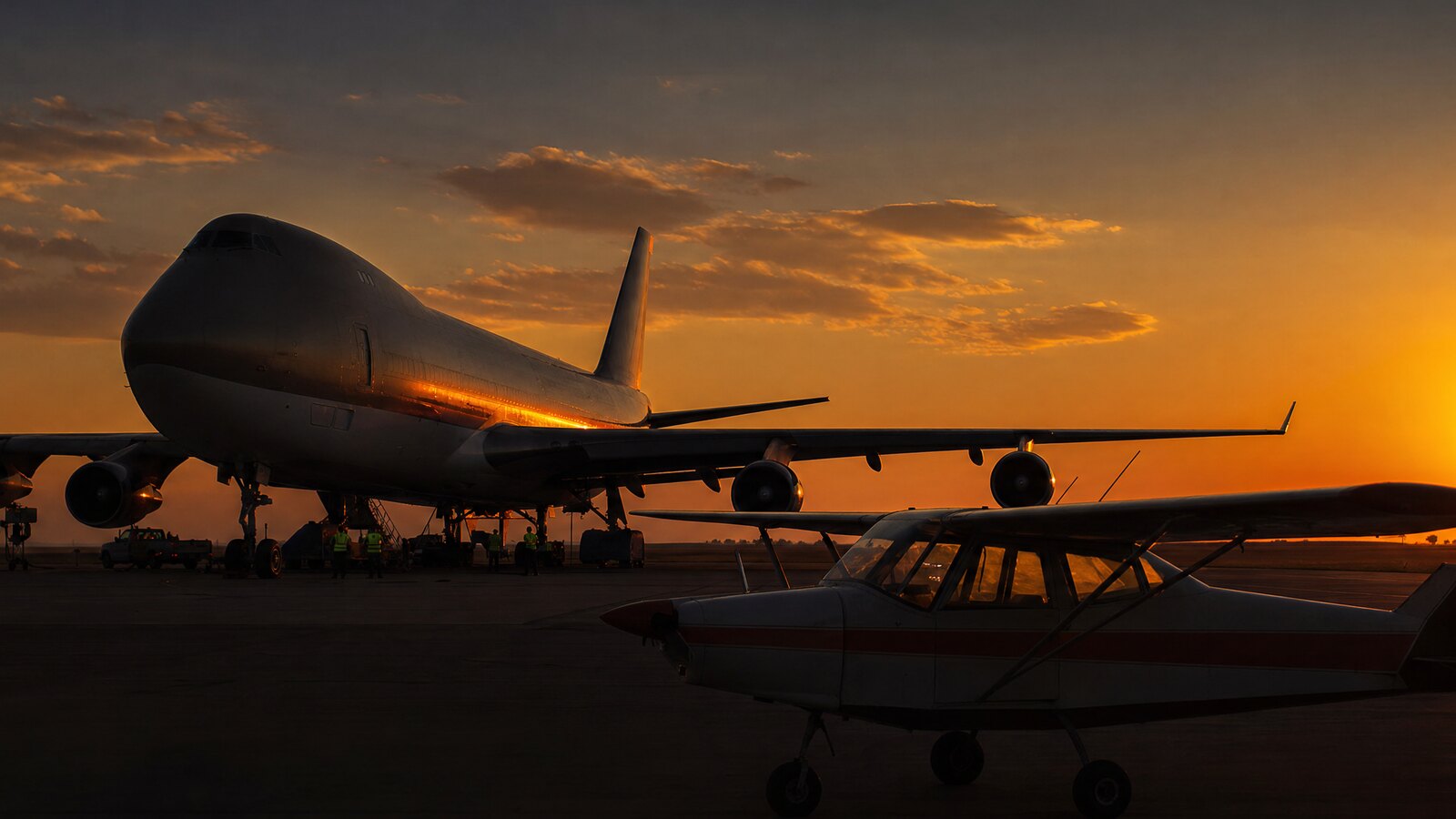
aircraft on a ramp dwarfing the people and vehicles beside it" src="https://www.angleofattack.com/wp-content/uploads/2026/07/what-are-the-largest-airplanes-in-the-world-featured.jpg" style="margin-bottom: 0;">
- “Largest” depends on the yardstick. Wingspan, length, and maximum takeoff weight (MTOW) each crown a different airplane. There is no single biggest plane.
- The Antonov An-225 was the heavyweight champ — the largest and heaviest airplane ever to fly, with a roughly 640-ton maximum takeoff weight — until it was destroyed in Ukraine in 2022.
- The Stratolaunch Roc has the widest wingspan ever flown at about 385 feet — wider than a U.S. football field is long.
- The Boeing 747-8 and Airbus A380 are the largest airplanes in regular service: the A380 carries the most passengers as a full double-decker; the 747-8 is the longest airliner.
- Bigger wings mean bigger physics. Long-span aircraft experience pronounced ground effect near the runway and rely on high aspect-ratio wings to stay efficient.
- Size has a hard ceiling. Structural weight, runway strength, and the square-cube law mean airplanes can’t simply scale up forever.
WHAT’S IN THIS GUIDE
- 1What Counts as the “Largest” Airplane?
- 2What Was the Antonov An-225 Mriya?
- 3What Is the Largest Airplane Flying Today?
- 4What Are the Largest Passenger Airplanes?
- 5Why Can’t Airplanes Just Keep Getting Bigger?
- 6What Does a Giant Wing Teach a Student Pilot?
- 7Largest Airplanes Compared: Size by the Numbers
- 8PLT Study Guide
- 9Frequently Asked Questions
What Counts as the “Largest” Airplane?
There are three honest ways to measure an airplane’s size, and they rarely point to the same aircraft. Wingspan is the tip-to-tip distance across the wings. Length is nose to tail. Maximum takeoff weight (MTOW) is the heaviest the airplane is certified to weigh at the start of its takeoff roll — fuel, cargo, passengers, and all. Crown a “largest plane” and the first question any honest engineer asks is: largest by which of these?
That distinction isn’t trivia. Wingspan drives how much lift a wing can generate and how the airplane behaves near the ground. Length affects stability and how the airplane fits on a ramp. MTOW determines how much runway, thrust, and structure the design needs. A record in one column says almost nothing about the other two. So when you see a “biggest airplane” headline that throws out one figure, ask the follow-up question: biggest by what?
What Was the Antonov An-225 Mriya?
The Antonov An-225 Mriya was the largest and heaviest airplane ever built, with six engines, a roughly 290-foot wingspan, and a maximum takeoff weight near 640 metric tons. Built by the Soviet Union in the 1980s to carry the Buran space shuttle, the single An-225 ever completed spent its later life hauling outsized cargo no other aircraft could lift. It was destroyed on the ground in Ukraine in early 2022.
For decades the Mriya (“Dream” in Ukrainian) held the title on the two measurements that capture raw scale: heaviest takeoff weight and greatest payload. Its cargo hold could swallow loads that would never fit in a 747 — locomotives, generators, even other aircraft fuselages. Only one was ever finished, which made every flight a global event.
Its loss in 2022 left an open question in the record books. No airplane currently flying matches the An-225’s combination of weight and payload, which is part of why “largest airplane in the world” no longer has a single, tidy answer.
What Is the Largest Airplane Flying Today?
By wingspan, the largest airplane flying today is the Stratolaunch Roc — a twin-fuselage, six-engine aircraft with a wingspan of about 385 feet, built as a flying launch platform for rockets. That span is wider than a regulation American football field measured goal line to goal line. It first flew in 2019 and remains the widest aircraft ever to leave the ground.
The Roc trades the An-225’s brute payload for sheer span. Its job is to carry a rocket up to high altitude and release it, so the design priority was a long, strong wing rather than a cavernous cargo hold. By maximum takeoff weight it’s heavy, but it doesn’t approach the An-225’s record — another reminder that “largest” splits into different winners depending on the yardstick.
For everyday aviation, though, the giants you’re far more likely to see are the Boeing 747-8 and the Airbus A380. Those are the largest aircraft in routine commercial service, and they’re the ones that shaped how modern airports, runways, and gates are built.
What Are the Largest Passenger Airplanes?
The largest passenger airplane in service is the Airbus A380, a full-length double-decker with a wingspan of about 262 feet and typical seating for roughly 500–550 passengers — and certified for over 850 in an all-economy layout. The Boeing 747-8 is the longest airliner ever built at about 250 feet nose to tail, with its iconic partial upper deck. Between them they define the top of the commercial size class.
These airplanes exist because of a simple economic idea: on the busiest long-haul routes, one very large airplane can move more people per flight than several smaller ones. That logic drove the A380’s four engines and two full decks. The market later shifted toward efficient twin-engine wide-bodies, so production of both giants has wound down — but the airplanes themselves still fly the world’s densest routes.
And here’s the part that matters for you: these airliners cruise on the same four forces of flight — lift, weight, thrust, and drag — that act on the smallest trainer. They’re just scaled up, with enormous high-lift devices to fly slow on approach and wings engineered to carry staggering weight. Same physics, very different numbers.
Why Can’t Airplanes Just Keep Getting Bigger?
Airplanes can’t scale up indefinitely because of the square-cube law: as you make an airplane bigger, its weight grows roughly with the cube of its size while the wing area that lifts it grows only with the square. Double the dimensions and the structure gets eight times heavier but the wing only gets four times bigger — so the design has to fight ever harder just to carry its own weight.
There are practical walls too. Runways and taxiways have load and width limits; airport gates are sized to standard wingspans; and the engines, landing gear, and structure needed for a heavier airplane add weight that demands still more lift and thrust. At some point the math stops closing — every extra ton of capacity costs more than a ton of structure and fuel to support.
This is why the true giants are rare and purpose-built. The An-225 and the Stratolaunch Roc exist because someone needed one specific, extreme capability badly enough to pay the penalty. For ordinary transport, efficiency beats raw size — which is exactly why the airline world drifted away from the four-engine behemoths.
What Does a Giant Wing Teach a Student Pilot?
Two ideas that govern these giants are tested on your Private Pilot knowledge exam — and you’ll feel them in a trainer. The first is ground effect: when any wing flies within roughly one wingspan of the surface, the ground interrupts the wingtip vortices and downwash, temporarily reducing induced drag. The longer the wingspan, the more pronounced and the higher above the runway this effect reaches — which is why the FAA ties ground effect directly to wingspan.
Picture a student on short final in a Cessna 172. As the airplane settles into the last few feet over the runway, drag drops, the airplane wants to float, and a touch too much speed turns into a long, frustrating glide down the centerline. That’s ground effect — the same phenomenon, just gentler than what a 262-foot A380 wing produces. Now imagine the giant: it enters ground effect dozens of feet up, and pilots manage that float deliberately on every landing. The student and the airline captain are reading the exact same page of physics.
The second idea is aspect ratio — the ratio of wingspan to wing width (chord). Long, slender high-aspect-ratio wings, like a glider’s or the Stratolaunch Roc’s, produce less induced drag and fly more efficiently; short, stubby wings trade efficiency for strength and maneuverability. When you study why one wing is shaped differently from another, you’re studying the same trade-off that decided how every giant on this list was built.
If you’re ready to actually start learning these fundamentals the right way, our free Total Student Pilot course walks you through ground effect, aspect ratio, and the four forces before your first lesson — and the Private Pilot Ground School takes you all the way to checkride-ready and day-one ready.
Largest Airplanes Compared: Size by the Numbers
The figures below are approximate and rounded — exact published numbers vary slightly by source and variant. Use them to see the relationships, not as certified specifications.
| Aircraft | Wingspan (approx.) | Length (approx.) | Max Takeoff Weight (approx.) | Claim to “Largest” |
|---|---|---|---|---|
| Antonov An-225 Mriya | ~290 ft | ~275 ft | ~640 t | Heaviest & largest ever built (destroyed 2022) |
| Stratolaunch Roc | ~385 ft | ~238 ft | ~590 t | Widest wingspan ever flown |
| Airbus A380 | ~262 ft | ~239 ft | ~575 t | Most passengers; largest airliner by capacity |
| Boeing 747-8 | ~225 ft | ~250 ft | ~448 t | Longest airliner |
| Antonov An-124 | ~240 ft | ~226 ft | ~405 t | Largest mass-produced cargo aircraft |
| Hughes H-4 Hercules (“Spruce Goose”) | ~320 ft | ~219 ft | ~180 t | Largest flying boat; longest WWII-era wingspan (flew once, 1947) |
Notice the pattern: no single airplane tops every column. The An-225 wins weight, the Roc wins span, the A380 wins passengers, the 747-8 wins length. “Largest in the world” is really a family of titles — and knowing which one a claim refers to is the whole game.
PLT Study Guide
These are the FAA Learning Statement (PLT) codes tied to the size-and-design concepts in this article. If you miss a knowledge-test question in one of these areas, the code printed on your Airman Knowledge Test Report points you straight back to the topic to review.
| PLT Code | Official FAA Learning Statement | What to study |
|---|---|---|
| PLT131 | Recall aircraft performance – ground effect | What ground effect is, why it appears within about one wingspan of the surface, and why a longer wingspan produces a more pronounced effect — exactly why giant aircraft float on landing. |
| PLT238 | Recall forces acting on aircraft – aspect ratio | How wingspan-to-chord ratio drives induced drag and efficiency; why long high-aspect-ratio wings (gliders, launch aircraft) differ from short stubby ones. |
| PLT113 | Recall aircraft design – categories / limitation factors | How aircraft are categorized and what physical and structural limits constrain a design — the backdrop to why airplanes can’t scale up forever. |
| PLT114 | Recall aircraft design – construction / function | How wing and airframe construction supports loads, and how structural weight grows with size (the square-cube reality). |
Study these against the Pilot’s Handbook of Aeronautical Knowledge (PHAK, FAA-H-8083-25C), especially the chapters on aerodynamics of flight and aircraft structures. Don’t just memorize that “ground effect happens near the ground” — understand why wingspan sets its reach. That depth is what separates a thinking pilot from a test-taker.
Frequently Asked Questions
What is the largest airplane in the world?
It depends on the measurement. The Antonov An-225 Mriya was the largest and heaviest airplane ever built before it was destroyed in 2022. Today the Stratolaunch Roc has the widest wingspan ever flown at about 385 feet, and the Airbus A380 is the largest airliner in passenger service.
What was the largest airplane ever built?
The Antonov An-225 Mriya held that title — a six-engine cargo aircraft with a maximum takeoff weight near 640 metric tons and the greatest payload capacity of any airplane ever flown. Only one was ever completed. It was destroyed on the ground in Ukraine in early 2022.
What is the largest passenger airplane?
The Airbus A380 is the largest passenger airplane in service. As a full-length double-decker it typically seats around 500–550 people and is certified for over 850 in an all-economy configuration. The Boeing 747-8 is the longest airliner but carries fewer passengers than the A380.
Which airplane has the longest wingspan?
The Stratolaunch Roc has the longest wingspan of any aircraft ever flown, at roughly 385 feet — wider than an American football field is long. It’s a twin-fuselage launch platform designed to carry rockets to high altitude before releasing them, so its priority is a long, strong wing.
Why are bigger airplanes harder to make?
Because of the square-cube law: as an airplane scales up, its weight grows faster than the wing area that lifts it. Add runway strength limits, gate-size constraints, and the heavier engines and structure a bigger airplane needs, and the engineering math eventually stops working in the design’s favor.
Do large airplanes experience ground effect?
Yes, and far more than small ones. Ground effect reaches up to about one wingspan above the surface, so an airplane with a 262-foot wing enters it dozens of feet higher than a Cessna does. Pilots of large aircraft manage that float deliberately on every landing.
Is the An-225 still flying?
No. The single An-225 ever completed was destroyed on the ground in Hostomel, Ukraine, in early 2022. There has long been talk of finishing a second partially built airframe, but as of now no An-225 is flying, which is why the “largest airplane” question no longer has one clear answer.
How big is the Airbus A380 compared to a Boeing 747?
The A380 has a wider wingspan (about 262 ft vs. roughly 225 ft) and carries more passengers thanks to its full double deck. The Boeing 747-8 is actually slightly longer nose to tail. Each is “bigger” depending on whether you measure span, length, or capacity.
The giants are fun to marvel at, but the real lesson hides in the question itself: “largest” only means something once you pin down the yardstick. Asking which number, and why is the same habit that turns a curious reader into a sharp, safe pilot. The four forces and the wing physics that govern a 385-foot launch platform are the same ones waiting for you in a two-seat trainer.
Master every system on your checkride — and on day one.
The Private Pilot Ground School breaks down every FAA subject area in the same plain-English, real-world way you just read — with quizzes, scenarios, and the explanations that finally make it click.
You don’t have to fly something enormous to understand what makes it fly. Master ground effect, aspect ratio, and the four forces in a Cessna, and the giants stop being mysterious — they start making sense.


ON THE SAME TOPIC
IFR vs VFR: The Two Sets of Rules Every Pilot Flies By
IFR vs VFR: The Two Sets of Rules Every Pilot Flies By 19 min read Last updated June 2026 · Chris Palmer The difference between IFR and VFR is which set of rules you fly under. VFR — visual flight rules — lets you navigate by looking outside and staying clear of clouds in good […]
 Read more
ASOS vs AWOS vs ATIS: How to Pull the Right Weather Before You Fly
ASOS vs AWOS vs ATIS: How to Pull the Right Weather Before You Fly 13 min read Last updated June 2026 · Chris Palmer The difference comes down to who is talking and what the broadcast covers. ASOS and AWOS are automated, computer-generated weather observations of the conditions right at the field. ATIS is a […]
Read more 
What Is RNAV Navigation? Area Navigation for VFR Pilots
What Is RNAV Navigation? Area Navigation for VFR Pilots 17 min read Last updated June 2026 · Chris Palmer RNAV — Area Navigation — is a method that lets an aircraft fly any desired path within the coverage of ground- or space-based navigation aids, rather than being forced to fly directly to and from stations. […]
Read more 
NDB and ADF Explained: The Oldest Radio Nav System You Still Need to Understand
NDB and ADF Explained: The Oldest Radio Nav System You Still Need to Understand 16 min read Last updated June 2026 · Chris Palmer An NDB (non-directional beacon) is a ground-based radio transmitter that sends a signal in all directions, and an ADF (automatic direction finder) is the cockpit receiver whose needle points straight at […]
Read more 
Stay Connected
Be the very first to get notified when we publish new flying videos, free lessons, and special offers on our courses.
