
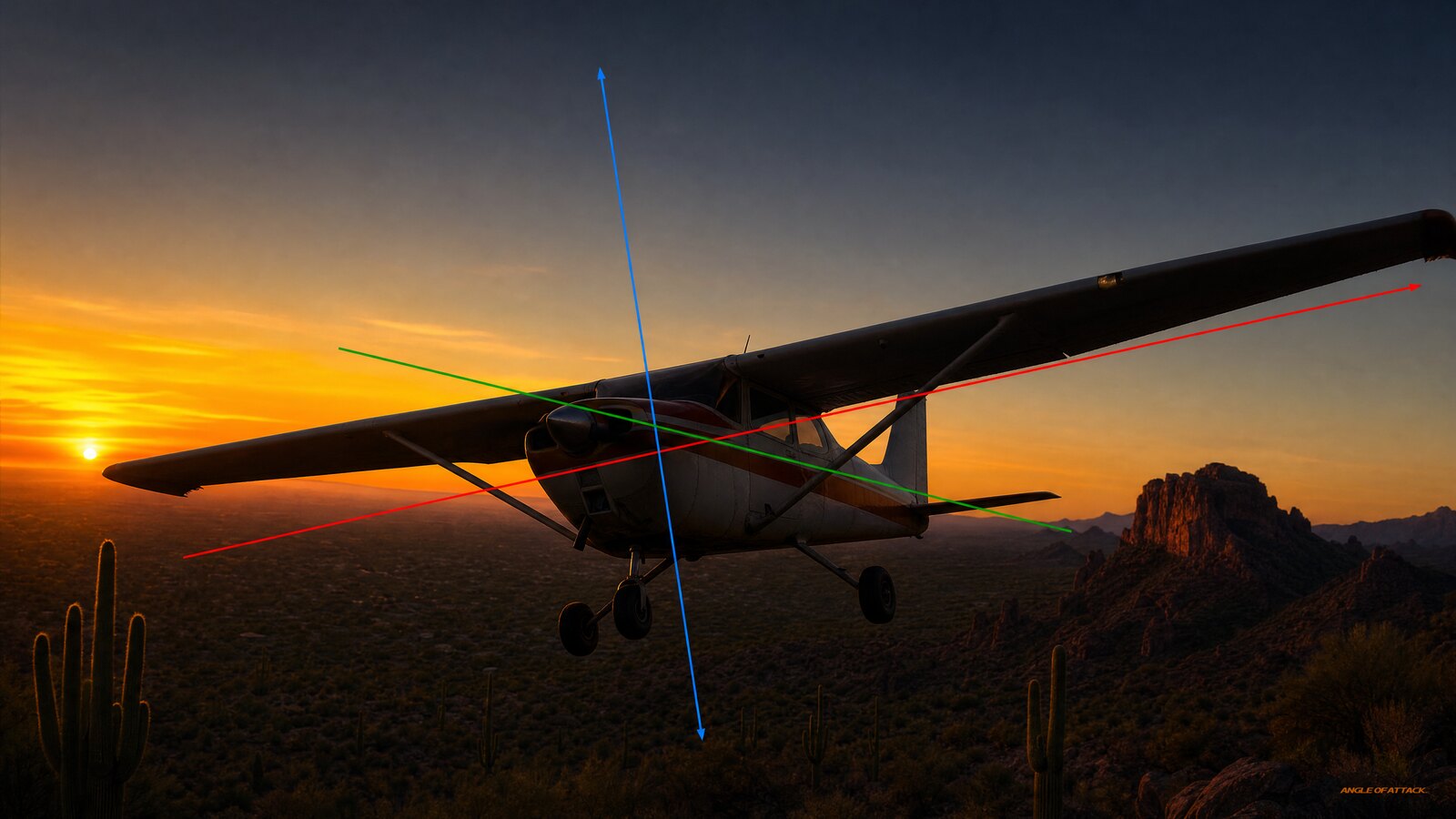
The Three Axes of an Aircraft: How Your Airplane Moves Through the Sky
An aircraft moves about three axes that all pass through its center of gravity: the longitudinal axis (running nose to tail, controlled in roll by the ailerons), the lateral axis (running wingtip to wingtip, controlled in pitch by the elevator), and the vertical axis (running top to bottom, controlled in yaw by the rudder). Master these three and you understand how every flight control works.
Most ground-school websites get this wrong. They hand you three names and three definitions, then move on. But the three axes aren’t trivia to memorize for the written test. They’re the mental model that makes every other thing you learn about flying — turns, stalls, adverse yaw, stability, even crosswind landings — finally click into place.
So let’s break it down the way I’d walk you through it on the ramp, standing next to the airplane with my hand on the wing. By the time we’re done, you’ll never confuse pitch, roll, and yaw again.
airframe" src="https://www.angleofattack.com/wp-content/uploads/2026/07/what-are-the-three-axes-of-an-aircraft-featured.jpg" style="margin-bottom: 0;">
- An aircraft rotates about three axes — longitudinal (roll), lateral (pitch), and vertical (yaw) — and all three intersect at the center of gravity.
- The longitudinal axis runs from nose to tail; rolling about it is controlled by the ailerons and felt as a bank.
- The lateral axis runs from wingtip to wingtip; pitching about it is controlled by the elevator and changes angle of attack.
- The vertical axis runs straight up and down through the CG; yawing about it is controlled by the rudder.
- One control surface, one axis, one motion — ailerons/roll, elevator/pitch, rudder/yaw — is the cleanest way to lock the relationship in your head.
- The three axes all pass through the center of gravity, which is why CG location and loading directly affect how the airplane rotates and how stable it feels.
- Real flying is coordinated — you almost never move about just one axis at a time, which is why turns blend aileron, elevator, and rudder together.
WHAT’S IN THIS GUIDE
- 1What are the three axes of an aircraft?
- 2What is the longitudinal axis and what controls it?
- 3What is the lateral axis and what controls it?
- 4What is the vertical axis and what controls it?
- 5Why do all three axes pass through the center of gravity?
- 6How do the three axes work together in a turn?
- 7A real lesson: the day three axes saved a student’s first crosswind landing
- 8PLT Study Guide
- 9Frequently Asked Questions
What are the three axes of an aircraft?
The three axes of an aircraft are the longitudinal axis, the lateral axis, and the vertical axis — three imaginary lines that all intersect at the airplane’s center of gravity (CG). The airplane rotates about these axes, and each rotation has its own name: roll, pitch, and yaw. This is straight out of the Pilot’s Handbook of Aeronautical Knowledge (PHAK, FAA-H-8083-25C) — the three axes and their intersection at the CG live in Chapter 5 (Aerodynamics of Flight), and the flight control surfaces that move the airplane about them are covered in Chapter 6 (Flight Controls).
Think of the center of gravity as the balance point of the airplane — the spot where, if you could suspend the whole machine from a string, it would hang level. All three axes pierce through that single point. That’s not a coincidence; it’s the reason the airplane pivots the way it does.
Each axis pairs with one motion and one primary flight control:
| Axis | Runs | Rotation (motion) | Primary control |
|---|---|---|---|
| Longitudinal | Nose to tail | Roll (bank) | Ailerons |
| Lateral | Wingtip to wingtip | Pitch (nose up/down) | Elevator |
| Vertical | Top to bottom (through CG) | Yaw (nose left/right) | Rudder |
If you remember nothing else, remember that table. One axis, one motion, one control. Everything else in this article is just building intuition on top of that simple skeleton.
What is the longitudinal axis and what controls it?
The longitudinal axis is the imaginary line that runs lengthwise through the airplane from the nose to the tail, passing through the center of gravity. Rotation about this axis is called roll, and it’s controlled by the ailerons — the movable panels near the outboard trailing edge of each wing. When the airplane rolls, one wing goes down and the other comes up, putting you into a bank.
Picture a hot dog on a skewer, with the skewer running the length of the bun. Spin the hot dog and it rolls around that long axis. Your airplane does the same thing when you turn the yoke or move the stick left or right.
The ailerons work as a pair, moving in opposite directions. Turn the yoke right and the right aileron deflects up (reducing lift on the right wing) while the left aileron deflects down (increasing lift on the left wing). The left wing rises, the right wing drops, and you roll into a right bank. Per the PHAK, this differential lift is what produces roll about the longitudinal axis.
There’s a catch every student feels on day one. The wing producing more lift also produces more drag, so the nose wants to swing away from the turn at first. That’s adverse yaw, and it’s the reason you learn to add rudder in the same direction as your turn. Notice that adverse yaw is already a second axis sneaking into the picture — a preview of how connected this all is.
What is the lateral axis and what controls it?
The lateral axis is the imaginary line that runs from one wingtip to the other, crossing the center of gravity. Rotation about this axis is called pitch, and it’s controlled by the elevator — the movable surface on the horizontal tail. Pitch is the nose moving up or down, and it directly changes the wing’s angle of attack.
Go back to that hot dog. The lateral axis is like sticking a second skewer crosswise through the middle of the bun, wingtip to wingtip. Push the nose down or pull it up, and the airplane teeters about that crosswise line.
When you pull back on the yoke, the elevator deflects up. That pushes the tail down, which raises the nose, which increases the angle of attack — the angle between the wing and the oncoming air. More angle of attack means more lift, up to a point. Push too far and the wing exceeds its critical angle of attack and stalls. That entire relationship lives on the lateral axis, which is why understanding this one is so important for stall awareness.
One distinction trips people up: pitch attitude is not the same as climbing. You can pitch the nose up and still descend if you’re slow on power. Pitch about the lateral axis controls angle of attack; whether you climb, cruise, or descend depends on how pitch and power work together. Keep those separate in your head and you’ll fly far more precisely.
What is the vertical axis and what controls it?
The vertical axis is the imaginary line that runs straight up and down through the airplane, passing through the center of gravity perpendicular to the other two. Rotation about this axis is called yaw, and it’s controlled by the rudder — the movable surface on the vertical tail. Yaw is the nose swinging left or right, like a weather vane pivoting.
For the hot dog, the vertical axis is a skewer pushed straight down through the top of the bun into the table. Spin the bun flat on the table and it yaws about that vertical line.
Step on the right rudder pedal and the rudder deflects right, pushing the tail left, which swings the nose right. Most beginners misunderstand the rudder’s job: it is not the airplane’s steering wheel in the air. The ailerons start a turn by banking the airplane; the rudder’s job is to keep the turn coordinated — to cancel out adverse yaw and keep the airplane from skidding or slipping.
The clearest place you’ll use the rudder all by itself is a crosswind landing. You bank slightly into the wind with aileron to stop drifting, and you use opposite rudder to keep the nose pointed straight down the runway. That’s yaw about the vertical axis doing exactly what you ask, decoupled from roll. It feels strange at first and natural within a few lessons.
Why do all three axes pass through the center of gravity?
All three axes intersect at the center of gravity because the CG is the airplane’s balance point — the single point about which the aircraft naturally rotates when a force is applied. Move the CG, and you change how the airplane pitches, rolls, and yaws, which is why weight and balance is a safety-of-flight issue, not just paperwork.
Think about a playground seesaw. It pivots about its center support. Load one end heavier and the whole thing tilts and behaves differently. Your airplane is the same — the CG is its pivot point, and where you place passengers, baggage, and fuel shifts that point fore and aft.
A CG that’s too far aft makes the airplane less stable in pitch and harder to recover from a stall. A CG too far forward makes the nose heavy and can rob you of elevator authority in the flare. The airplane is certificated to fly within a specific CG range for exactly this reason. The three axes meeting at the CG is the geometric fact underneath every weight-and-balance calculation you’ll run before a flight.
This is also why the FAA ties the longitudinal axis directly to center of gravity and direction of motion in its testing — the relationship between the axes and the CG is foundational, not academic.
How do the three axes work together in a turn?
In real flying you almost never move about just one axis at a time. A simple coordinated turn blends all three: you roll about the longitudinal axis with aileron to establish the bank, add rudder to manage yaw about the vertical axis, and add a little back-pressure on the elevator to control pitch about the lateral axis so the nose doesn’t drop as lift tilts.
That back-pressure matters for a reason. When you bank, the wing’s lift no longer points straight up — part of it now pulls the airplane around the turn (that’s good, it’s what curves your path) but the vertical part shrinks, so the nose tends to drop. A touch of elevator restores the lift you need to hold altitude. Three axes, three controls, one smooth maneuver.
| Control input | Axis affected | What you feel |
|---|---|---|
| Aileron (roll into bank) | Longitudinal | The airplane banks; turn begins |
| Rudder (coordinate) | Vertical | Nose stays on the turn, no skid or slip |
| Elevator (back-pressure) | Lateral | Nose held up, altitude maintained |
This is the whole reason instructors harp on “coordinated flight.” The ball in your inclinometer is just telling you whether your yaw axis is playing nicely with your roll axis. When that ball stays centered, you’re balancing all three axes against each other in real time. That coordination is the heart of stick-and-rudder flying, and it’s exactly the kind of fundamentals-first approach we drill in the Private Pilot Ground School so the controls feel like second nature long before your checkride.
If you’re just starting out and want to build this foundation the right way from lesson one, our free Student Pilot Course walks you through the basics of how the airplane moves before you ever touch the yoke.
A real lesson: the day three axes saved a student’s first crosswind landing
I do most of my flying out of Alaska, where the wind doesn’t ask permission and a “calm” day is more rumor than forecast. Years back I had a student who could fly beautiful turns in smooth air but completely fell apart the first time we tried a real crosswind landing. He kept trying to “steer” the airplane down the runway with the yoke alone, and we’d drift sideways toward the edge every time.
So we stopped chasing the landing and went back to the three axes. I had him hold altitude and, one at a time, feel each axis: roll the wings with aileron, swing the nose with rudder, and notice that those were two completely different motions about two completely different axes. That was the moment it landed for him. Roll is not yaw. The wheel banks; the pedals point.
On the next approach it clicked. He used aileron to bank slightly into the wind and stop the drift — roll about the longitudinal axis — and held opposite rudder to keep the nose straight down the centerline — yaw about the vertical axis. Two axes, two controls, working independently. The airplane settled onto the gravel tracking straight down the runway, and he let out a breath he’d been holding the whole way down final.
That’s the lesson I want you to take from all of this. The three axes aren’t a written-test definition you forget after the exam. They’re the framework that turns “I don’t know what the airplane is doing” into “I know exactly which control fixes this.” Aviation education has been my world since 2006, and I’ve been a CFI since 2017 — and if there’s one mental model I’d burn into every new pilot, it’s this one.
PLT Study Guide
The FAA writes test questions against learning statement codes (PLT codes). For the three axes of an aircraft, these are the codes whose official FAA wording actually matches the content:
PLT234 — Recall forces acting on aircraft: 3 axis intersect. This is the core code for this topic. Know that the longitudinal, lateral, and vertical axes all intersect at the center of gravity, and that the airplane rotates about these three axes. Be ready to match each axis to its rotation (roll, pitch, yaw) and its primary control surface.
PLT095 — Recall aerodynamics: longitudinal axis / lateral axis. Know that the longitudinal axis runs nose to tail (controlled in roll by the ailerons) and the lateral axis runs wingtip to wingtip (controlled in pitch by the elevator). Understand which motion belongs to which axis without hesitation.
PLT314 — Recall longitudinal axis: aerodynamics / center of gravity / direction of motion. Understand the relationship between the longitudinal axis, the center of gravity, and the airplane’s direction of motion — and why the CG (where the axes intersect) determines how the airplane rotates and how stable it is.
PLT244 — Recall forces acting on aircraft: stability / controllability. Understand that control about each axis (roll, pitch, yaw) is how a pilot controls the aircraft, and that CG location relative to those axes directly affects stability and controllability.
Study these against the real FAA source material — primarily the PHAK (FAA-H-8083-25C), Chapter 6 (Flight Controls) and Chapter 5 (Aerodynamics of Flight) — rather than memorizing answer letters. If you understand why the airplane moves about three axes through the CG, the written questions answer themselves.
Frequently Asked Questions
What are the three axes of an aircraft?
The three axes are the longitudinal axis (nose to tail), the lateral axis (wingtip to wingtip), and the vertical axis (top to bottom). They all intersect at the center of gravity. The airplane rotates about these axes in roll, pitch, and yaw, controlled by the ailerons, elevator, and rudder respectively.
Which control surface controls each axis?
The ailerons control roll about the longitudinal axis, the elevator controls pitch about the lateral axis, and the rudder controls yaw about the vertical axis. The simplest way to remember it: ailerons/roll, elevator/pitch, rudder/yaw. One control, one axis, one motion — that pairing never changes.
What is the difference between roll, pitch, and yaw?
Roll is the airplane banking left or right about the nose-to-tail longitudinal axis. Pitch is the nose moving up or down about the wingtip-to-wingtip lateral axis. Yaw is the nose swinging left or right about the vertical axis. Each is a separate motion about a separate axis with its own control.
Why do all three axes pass through the center of gravity?
The center of gravity is the airplane’s balance point — the single point about which it naturally rotates when a force is applied. Because all three axes intersect there, where you load weight shifts the CG and changes how the airplane pitches, rolls, and yaws. That’s why weight and balance affects handling and stability.
Is the rudder used to turn the airplane?
Not by itself. You start a turn by banking with the ailerons (roll about the longitudinal axis). The rudder’s job is to coordinate the turn — to cancel adverse yaw and keep the nose tracking properly about the vertical axis. Think of the rudder as the coordinator, not the steering wheel of the sky.
What happens if the center of gravity is out of limits?
An aft CG makes the airplane less stable in pitch and harder to recover from a stall; a forward CG makes the nose heavy and can reduce elevator authority in the flare. Because the axes meet at the CG, flying outside the certificated CG range degrades how the airplane rotates and how safely it handles.
Do you ever move about just one axis at a time?
Rarely in normal flight. Even a basic turn blends roll, yaw, and pitch together. You bank with aileron, coordinate with rudder, and add elevator back-pressure to hold altitude. The skill of “coordinated flight” is really just managing all three axes against each other smoothly and at the same time.
Why are the three axes important for a student pilot?
They’re the mental model behind every flight control and maneuver. Once you can instantly map a motion to its axis and its control, concepts like adverse yaw, stalls, stability, and crosswind landings stop feeling like separate lessons and start feeling like one connected system. It’s the foundation everything else is built on.
Master every system on your checkride — and on day one.
The Private Pilot Ground School breaks down every FAA subject area in the same plain-English, real-world way you just read — with quizzes, scenarios, and the explanations that finally make it click.
Get the three axes truly comfortable in your head, and you’ll feel the difference the next time you fly — you’ll stop reacting to what the airplane does and start commanding what you want it to do. Roll, pitch, yaw. Aileron, elevator, rudder. One axis, one motion, one control. That’s the framework that turns a passenger into a pilot.


ON THE SAME TOPIC

IFR vs VFR: The Two Sets of Rules Every Pilot Flies By
IFR vs VFR: The Two Sets of Rules Every Pilot Flies By 19 min read Last updated June 2026 · Chris Palmer The difference between IFR and VFR is which set of rules you fly under. VFR — visual flight rules — lets you navigate by looking outside and staying clear of clouds in good […]
 Read more
ASOS vs AWOS vs ATIS: How to Pull the Right Weather Before You Fly
ASOS vs AWOS vs ATIS: How to Pull the Right Weather Before You Fly 13 min read Last updated June 2026 · Chris Palmer The difference comes down to who is talking and what the broadcast covers. ASOS and AWOS are automated, computer-generated weather observations of the conditions right at the field. ATIS is a […]
Read more 
What Is RNAV Navigation? Area Navigation for VFR Pilots
What Is RNAV Navigation? Area Navigation for VFR Pilots 17 min read Last updated June 2026 · Chris Palmer RNAV — Area Navigation — is a method that lets an aircraft fly any desired path within the coverage of ground- or space-based navigation aids, rather than being forced to fly directly to and from stations. […]
Read more 
NDB and ADF Explained: The Oldest Radio Nav System You Still Need to Understand
NDB and ADF Explained: The Oldest Radio Nav System You Still Need to Understand 16 min read Last updated June 2026 · Chris Palmer An NDB (non-directional beacon) is a ground-based radio transmitter that sends a signal in all directions, and an ADF (automatic direction finder) is the cockpit receiver whose needle points straight at […]
Read more 
Stay Connected
Be the very first to get notified when we publish new flying videos, free lessons, and special offers on our courses.
