
What Is a Forward Slip? How to Lose Altitude Without Gaining Speed
A forward slip is a maneuver where you bank the airplane in one direction with aileron and hold opposite rudder, deliberately flying the fuselage at an angle to your flight path so the side of the airplane acts as a giant air brake. This lets you steepen your descent and lose altitude fast without picking up airspeed. Pilots use it to salvage a too-high approach and get back down onto the runway.
That last part is why it earns its keep. You find yourself high over the numbers, and instead of going around you cross the controls, slip it down, and land. It is one of the oldest tricks in the book, and it still works in a glass-panel trainer exactly the way it worked in a J-3 Cub in 1940.
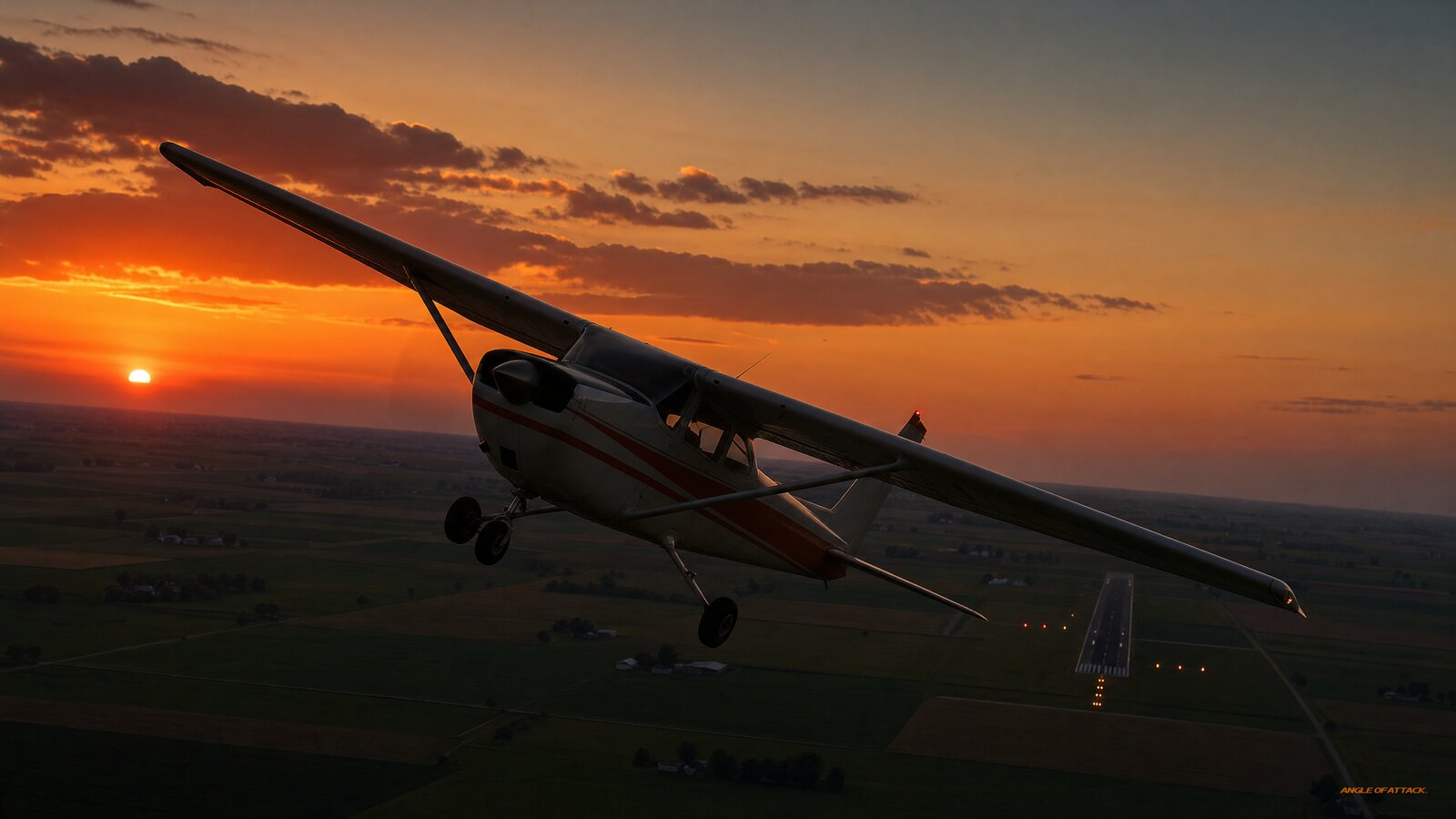
- A forward slip trades altitude for nothing but drag. You point the fuselage sideways into the relative wind so the airplane’s side creates drag, steepening your descent without speeding up.
- It is a cross-control maneuver. Aileron banks the wing one way; opposite rudder holds the nose the other way. The two controls work against each other on purpose.
- The forward slip and the sideslip are the same physics with different jobs. A forward slip is for losing altitude on final; a sideslip is for staying lined up in a crosswind landing.
- Your ground track stays roughly the same; your heading does not. In a forward slip the airplane keeps tracking toward the runway while the nose points off to the side.
- Airspeed indications get unreliable in a slip. With the relative wind hitting the pitot tube and static port at an angle, the airspeed indicator can read low or erratically, so you fly attitude and feel.
- Slips and full flaps don’t always mix. Some airplanes (notably certain Cessnas) carry a placard or POH note cautioning against slips with full flaps, so you always check your own POH.
- You recover by releasing the rudder first. Smoothly neutralize the rudder, then level the wings — never snap out of a slip close to the ground.
WHAT’S IN THIS GUIDE
- 1What is a forward slip?
- 2Why do pilots use a forward slip?
- 3How do you perform a forward slip step by step?
- 4What is the difference between a forward slip and a sideslip?
- 5Can you slip an airplane with full flaps?
- 6What are the most common forward slip mistakes?
- 7The day a slip saved my approach in Alaska
- 8PLT Study Guide
- 9Frequently Asked Questions
What is a forward slip?
A forward slip is a maneuver in which you lower one wing with aileron and apply opposite rudder so the airplane flies with its longitudinal axis at an angle to the flight path. The Airplane Flying Handbook (AFH, FAA-H-8083-3C) describes the slip as a controlled flight condition that increases drag and steepens the descent without increasing airspeed. The side of the fuselage becomes a brake.
Picture the airplane from above. Normally the nose points exactly where you are going. In a forward slip, the nose points off to one side while the airplane keeps traveling along its original path. That misalignment is the whole point — it shoves the broad side of the airplane into the air, and the resulting drag pulls you down steeply.
Here is the key idea most students need to hear twice: a slip steepens your descent path, not your airspeed. In a normal dive, lowering the nose makes you go faster. In a forward slip, the extra drag from the sideways fuselage soaks up the energy that would otherwise become speed, so you come down fast while the airspeed stays roughly where you put it. It is also one of the few times you will deliberately fly the airplane “uncoordinated” — the controlled exception to the ball-centered rule that teaches you what your rudder and ailerons actually do.
Why do pilots use a forward slip?
Pilots use a forward slip to lose excess altitude on an approach when they are too high to land normally, especially when they want a steep descent without gaining airspeed. It is the go-to fix for a high, hot approach, for clearing an obstacle and then getting down quickly onto a short runway, and for airplanes with weak or no flaps that need another way to steepen the glide.
The classic case is the salvaged approach. You are high over the threshold, the runway is sliding under you, and you have two choices: go around, or get rid of the altitude. A go-around is always a valid answer. But when the slip is the cleaner call — plenty of runway ahead and you just need to come down — a forward slip lets you drop several hundred feet quickly and still touch down on speed.
Forward slips matter even more in airplanes without flaps. A lot of taildraggers, classic airplanes, and some gliders have no flaps at all, so the slip is their primary tool for steepening the approach. If you ever fly a Cub, a Champ, or a Citabria, the forward slip stops being a checkride item and becomes a daily-use skill. And learning it teaches you, in your hands and feet, that altitude is energy you can spend deliberately — exactly the kind of day-one-ready judgment that keeps new pilots out of trouble.
How do you perform a forward slip step by step?
You perform a forward slip by smoothly lowering one wing with aileron, applying opposite rudder to keep the airplane tracking toward your aim point, and using pitch to hold a safe airspeed while the increased drag steepens your descent. The AFH (FAA-H-8083-3C) frames it as a coordinated application of crossed controls — deliberate, smooth, and fully under your command from entry to recovery.
Here is the flow, broken into the moments that matter:
- Reduce power and pick your aim point. Slips are usually flown with the throttle at or near idle. Set up your descent and decide where on the runway you are trying to land.
- Lower a wing with aileron. Bank into the wind if there is a crosswind; otherwise pick the side that gives you the best view of your aim point. The amount of bank controls how aggressive the slip is.
- Apply opposite rudder. As the wing drops, feed in rudder the other way to swing the nose off to the side and keep the airplane tracking toward your aim point instead of turning.
- Hold airspeed with pitch. The slip will try to change your pitch attitude and your airspeed reading. Use elevator to hold the descent at a safe, normal approach speed — fly the attitude and the feel of the airplane, not just the indicator.
- Adjust the slip to manage the descent. More bank with more opposite rudder equals more drag and a steeper descent. Ease off both to flatten it back out. You are constantly trimming the maneuver to put yourself on your aim point.
- Recover before the flare. As you get down to where you want to be, smoothly release the rudder first, then level the wings, and transition into a normal landing. Never carry an aggressive slip into the flare close to the ground.
The mental model that helps most students: your hands and feet are doing two opposite jobs at once. The aileron banks you; the rudder fights the turn that bank wants to create. Hold both, and the airplane settles into a stable sideways “fall” — a fast, controlled descent you steer with how hard you push.
What is the difference between a forward slip and a sideslip?
A forward slip and a sideslip use the exact same crossed-control inputs — aileron one way, opposite rudder — but they have different goals. A forward slip is used to lose altitude on final approach, so the nose points off to the side while the airplane tracks down its path. A sideslip is used for crosswind landings, so the nose stays aligned with the runway while the airplane tracks straight despite the wind.
The physics are identical; the geometry relative to the runway is what changes. In a forward slip, you do not care where the nose points — you care about steepening the descent, so the heading swings off. In a sideslip, you care intensely about keeping the nose straight down the runway, so you bank just enough into the crosswind to stop drifting and use rudder to hold the nose aligned for touchdown.
The table below lays the two side by side:
| Element | Forward Slip | Sideslip |
|---|---|---|
| Primary purpose | Lose altitude / steepen descent | Stay aligned in a crosswind |
| Controls used | Aileron + opposite rudder | Aileron + opposite rudder |
| Nose (heading) | Points off to one side | Points straight down the runway |
| Ground track | Stays on the approach path | Stays straight down the centerline |
| When you use it | Too high on final, no-flap airplanes | Crosswind landing, touchdown |
| What you adjust to | Aim point / descent rate | Drift / centerline |
Notice the controls column is the same in both. That is the part students should burn in: there is really one slip, and you point it at whatever problem you have. Aim it at altitude and it is a forward slip. Aim it at a crosswind and it is a sideslip. The crosswind sideslip is the one you will use on real landings constantly, which is exactly why the FAA wants you fluent in crosswind technique (the AFH covers it in its crosswind approach and landing section).
Can you slip an airplane with full flaps?
Whether you can slip with full flaps depends on your specific airplane, so the answer always lives in your POH, not in a rule of thumb. Some airplanes — notably certain Cessna models — carry a placard or a POH note cautioning against, or warning of effects from, slips with full flaps. Other airplanes have no such restriction. You check your own aircraft’s documentation before you slip on flaps.
Why does the caution exist at all? On some airplanes, in a steep slip with full flaps, the disturbed airflow over the tail can cause a mild pitch oscillation or a momentary “burble” — nothing catastrophic, but enough that the manufacturer wants you aware of it. It is a handling caution, not necessarily a hard prohibition, and the exact wording varies by model and year. That is precisely why you read your book rather than trusting a hangar rumor.
The practical takeaway for a student: know what your trainer’s POH actually says before your instructor has you slip with the flaps down. If it cautions against it, a common technique is to slip with partial or no flaps to lose the altitude, then add the rest of the flaps once the slip is recovered. The general principle outranks any single airplane — a slip changes the airflow over your tail and static system, and full flaps change it again, so when you are unsure of the limitation for your model, fly conservatively and ask your instructor rather than guessing a number.
If you want to build this kind of airplane-specific judgment from the ground up, our free Total Student Pilot course gets you fluent in the language of the POH and the approach-and-landing phase, and the full Private Pilot Ground School digs into the aerodynamics of slips, flaps, and stability so the cautions in your book actually make sense.
What are the most common forward slip mistakes?
The most common forward slip mistakes are watching the airspeed indicator instead of flying attitude, getting the controls coordinated by accident and losing the slip, carrying the slip too aggressively too low to the ground, and recovering by leveling the wings before releasing the rudder. Each one comes from forgetting that a slip is a deliberate, controlled cross-control condition, not a normal coordinated descent.
Chasing the airspeed indicator. In a slip, the relative wind hits your pitot tube and static port at an angle, so the airspeed indicator can read low or wander. Students see the low reading, panic, and shove the nose down. The fix is to fly attitude and feel — set a normal nose-down pitch and trust it, rather than chasing a needle that is lying to you.
Letting the slip “uncross.” A slip only works while the controls stay crossed. If you relax your feet and let the airplane coordinate itself, the drag vanishes and your steep descent flattens out right when you needed it. Hold the rudder firmly all the way down.
Slipping too aggressively, too low. A big, dramatic slip is great at 500 feet and dangerous at 30. Plan the slip so you finish high enough to settle into a normal landing attitude with time to stabilize before the flare.
Recovering in the wrong order. If you snap the wings level while still holding rudder, the airplane yaws hard. Recover the other way around: release the rudder first and let the nose come back, then smoothly level the wings. Sequenced, never abrupt.
Forgetting the go-around exists. A slip is a tool to fix a too-high approach, but it is not the only one. If you are high and fast, or the runway is short, or anything feels rushed, full power and go around. The slip earns its place when it is the calm, deliberate choice — not a desperate save.
The day a slip saved my approach in Alaska
I learned to respect the forward slip on a clear afternoon flying a Cessna 172 into a strip up in Alaska, where the terrain on the approach end rose up enough that I crossed the high ground still carrying a pile of altitude I did not want. I came over the threshold high — embarrassingly high — and the runway ahead was the kind that does not leave you room to float halfway down it.
For a half-second I almost firewalled it for a go-around, which would have been completely fine. But I had runway ahead, the air was smooth, and a forward slip was clearly the cleaner answer. So I dropped the left wing, fed in right rudder, and the 172 settled into that familiar sideways “fall.” The airspeed indicator did its usual slip trick and read low, and the years of training paid off: I ignored it, flew the attitude, and watched my aim point climb back up into the windscreen where it belonged.
I held the slip down to a few hundred feet, then released the rudder, leveled the wings, and the airplane rolled out onto a normal approach right on speed. Touched down with room to spare. Nothing heroic — just a maneuver doing exactly what it was designed to do.
What stuck with me was how calm it felt once I committed. The slip is not a panic move. It is a deliberate, almost old-fashioned tool, and when you understand it, a too-high approach stops being a problem and becomes a choice: slip it in, or go around. I have been in aviation education since 2006 and a CFI since 2017, and I still teach the slip the same way I flew it that day — slow hands, firm feet, eyes on the aim point, and zero faith in the airspeed needle.
PLT Study Guide
The forward slip shows up on the FAA Private Pilot knowledge test under the learning statement codes for flight maneuvers and approach/landing technique. The hint code originally attached to this topic (PLT245, “forces acting on aircraft – stalls / spins”) does not match a forward slip article — a slip is a controlled maneuver, not a stall or spin — so we have replaced it with the codes whose official FAA wording actually fits. Here are the correct ones, in plain English:
| PLT Code | Official FAA Learning Statement | What it means for the forward slip |
|---|---|---|
| PLT219 | Recall flight operations – maneuvers | The forward slip is a flight maneuver. Know what it is, how it is entered with crossed controls, and how it is recovered. |
| PLT170 | Recall approach / landing / taxiing techniques | The most common use of a forward slip is steepening an approach. Know it as an approach-and-landing technique for losing altitude. |
| PLT221 | Recall flight operations – takeoff / landing maneuvers | The slip and the crosswind sideslip are landing-phase maneuvers. Know how each is used as you set up to land. |
| PLT485 | Recall taxiing / crosswind / techniques | The sideslip (same controls as the forward slip) is the crosswind landing technique — wing low, nose straight down the runway. |
| PLT346 | Recall primary / secondary flight controls – types / purpose / functionality / operation | A slip is a deliberate cross-control of the ailerons (primary, roll) and rudder (primary, yaw). Know what each control does and why they oppose each other in a slip. |
Study tip: if a test question describes “lowering a wing and applying opposite rudder to lose altitude without gaining airspeed,” that is the forward slip, and the answer almost always turns on the crossed-control inputs and the increased drag. If the question is about staying lined up in a crosswind, that is the sideslip — same controls, different goal.
Frequently Asked Questions
What is a forward slip used for?
A forward slip is used to lose altitude quickly on an approach without gaining airspeed. Pilots reach for it when they are too high on final, when they need a steep descent over an obstacle onto a short runway, or when flying an airplane with little or no flap authority that needs another way to steepen its glide.
Is a forward slip dangerous?
A forward slip is a normal, approved maneuver that the FAA’s Airplane Flying Handbook teaches all student pilots. It is safe when flown deliberately at a safe airspeed and recovered before the flare. The risks come from doing it sloppily — too low, too aggressive, or chasing a misleading airspeed indicator — not from the maneuver itself.
Why does the airspeed indicator read wrong in a slip?
In a slip, the relative wind strikes your pitot tube and static port at an angle instead of straight on. That angled airflow disturbs the pressure your airspeed indicator depends on, so it can read low or fluctuate. The fix is to fly a known pitch attitude and the feel of the airplane rather than trusting the indicated number.
What is the difference between a slip and a skid?
A slip is intentional and controlled — you cross the controls on purpose to lose altitude or hold a crosswind. A skid is usually an uncoordinated error, often in a turn, where the tail swings out and the ball slides to the outside. A skidding turn near the ground is dangerous; a deliberate slip is a useful tool.
Can you slip an airplane with full flaps?
It depends entirely on your specific airplane. Some models, including certain Cessnas, carry a placard or POH note cautioning against slips with full flaps because of airflow effects over the tail. Always check your own aircraft’s POH before slipping with flaps extended, and ask your instructor if the wording is unclear.
How do you recover from a forward slip?
Recover by releasing the rudder first and letting the nose swing back toward the flight path, then smoothly leveling the wings with aileron and returning to a normal coordinated approach. Do this well before the flare. Never reverse the order or snap the controls — a smooth, sequenced recovery keeps the airplane stable close to the ground.
Do you slip into the wind or away from it?
In a crosswind, you lower the wing into the wind so the bank stops your sideways drift, then hold the nose straight with opposite rudder. In a no-wind forward slip flown purely to lose altitude, either direction works, so most pilots pick the side that gives the best view of the runway and aim point.
Is a forward slip on the private pilot checkride?
Yes. The Private Pilot Airman Certification Standards expect you to demonstrate a forward slip to a landing, flying a stabilized approach, controlling the descent, and recovering to a normal landing. Your examiner wants to see crossed controls applied smoothly, a safe airspeed held throughout, and a touchdown on or near your selected point.
Master every system on your checkride — and on day one.
The Private Pilot Ground School breaks down every FAA subject area in the same plain-English, real-world way you just read — with quizzes, scenarios, and the explanations that finally make it click.
Master the forward slip and you have taken a real step toward day-one-ready flying. A too-high approach stops being a small crisis and becomes a calm decision — slip it in or go around — and that quiet confidence is exactly what separates a pilot who reacts from a pilot who flies the airplane.


ON THE SAME TOPIC
IFR vs VFR: The Two Sets of Rules Every Pilot Flies By
IFR vs VFR: The Two Sets of Rules Every Pilot Flies By 19 min read Last updated June 2026 · Chris Palmer The difference between IFR and VFR is which set of rules you fly under. VFR — visual flight rules — lets you navigate by looking outside and staying clear of clouds in good […]
 Read more
ASOS vs AWOS vs ATIS: How to Pull the Right Weather Before You Fly
ASOS vs AWOS vs ATIS: How to Pull the Right Weather Before You Fly 13 min read Last updated June 2026 · Chris Palmer The difference comes down to who is talking and what the broadcast covers. ASOS and AWOS are automated, computer-generated weather observations of the conditions right at the field. ATIS is a […]
Read more 
What Is RNAV Navigation? Area Navigation for VFR Pilots
What Is RNAV Navigation? Area Navigation for VFR Pilots 17 min read Last updated June 2026 · Chris Palmer RNAV — Area Navigation — is a method that lets an aircraft fly any desired path within the coverage of ground- or space-based navigation aids, rather than being forced to fly directly to and from stations. […]
Read more 
NDB and ADF Explained: The Oldest Radio Nav System You Still Need to Understand
NDB and ADF Explained: The Oldest Radio Nav System You Still Need to Understand 16 min read Last updated June 2026 · Chris Palmer An NDB (non-directional beacon) is a ground-based radio transmitter that sends a signal in all directions, and an ADF (automatic direction finder) is the cockpit receiver whose needle points straight at […]
Read more 
Stay Connected
Be the very first to get notified when we publish new flying videos, free lessons, and special offers on our courses.
