
What Is a Preflight Inspection? The Walk-Around That Keeps You Alive
A preflight inspection is the systematic check a pilot performs before every flight to confirm the aircraft is airworthy and safe to fly. Working from the airplane’s checklist, you verify the airframe, controls, fuel, oil, tires, and required documents — catching problems on the ground, where a mistake costs you minutes, not your life.
It’s the most ordinary thing you’ll do as a pilot, and one of the most important. You’ll do it before your first lesson, before your checkride, and before every single flight for the rest of your flying life. The pilots who skip it, rush it, or treat it like a box to tick are the ones who end up in the accident reports. Let’s make sure that’s never you.
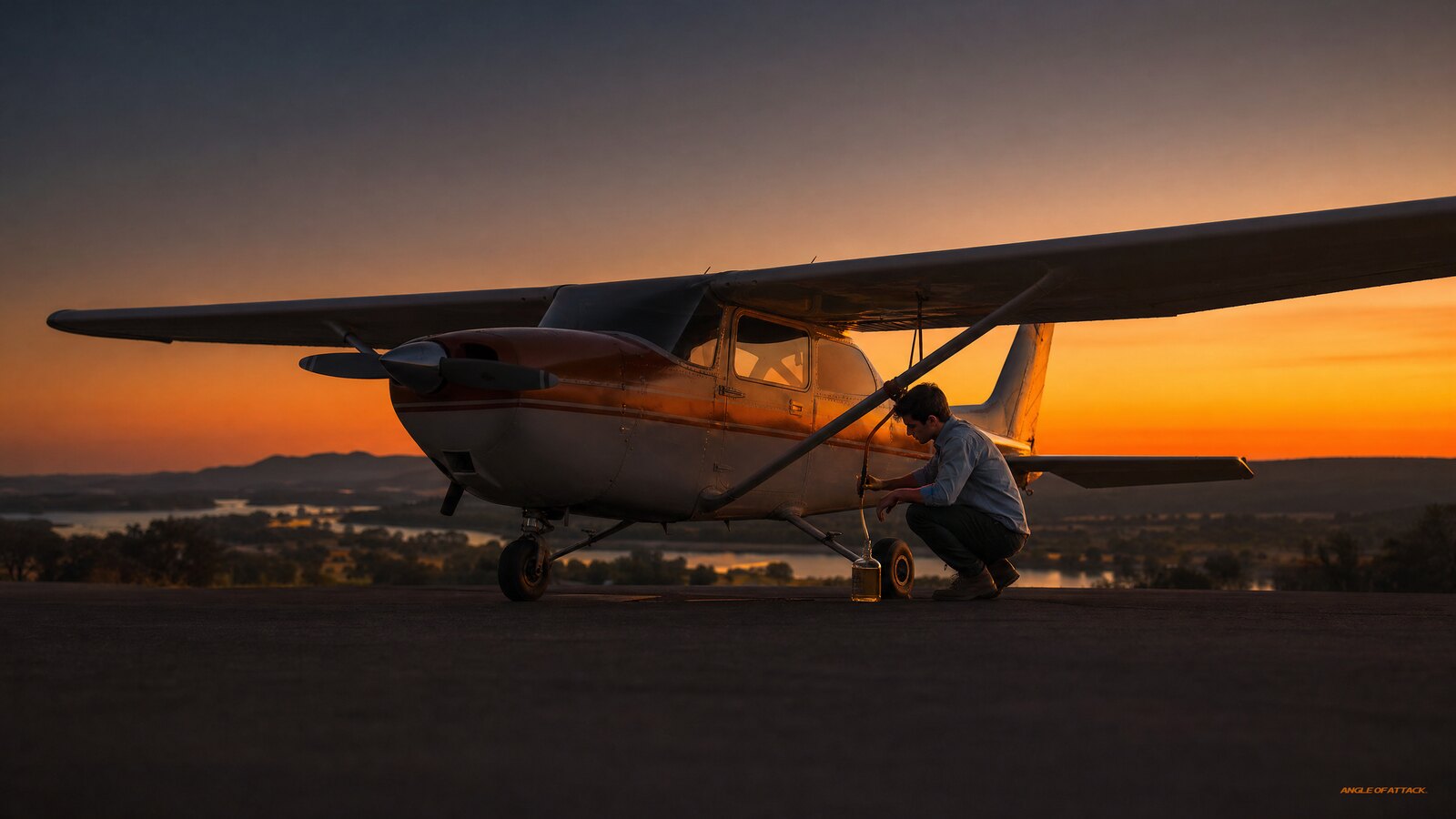
- A preflight inspection is a legal duty, not a courtesy. Under 14 CFR § 91.103, the pilot in command must become familiar with all available information before a flight — and under 14 CFR § 91.7, you may not fly an aircraft that isn’t in an airworthy condition.
- Always use the checklist. Your aircraft’s POH/AFM has a specific preflight checklist. Memory is not a substitute, and skipping items is how accidents start.
- Fuel and oil get special attention. You sample fuel from every drain to check for water and contamination, confirm the correct grade and color, and verify quantity by looking in the tanks — not just trusting a gauge.
- The flight controls must be “free and correct.” Move them to the stops and confirm the surfaces respond in the right direction.
- Documents must be aboard and current. Remember ARROW: Airworthiness certificate, Registration, Radio license (international only), Operating limitations, and Weight and balance data.
- A preflight is also a go/no-go decision point. If something isn’t right, the correct answer is sometimes “we don’t fly today.”
- It builds the habit that keeps you alive. The walk-around trains the discipline that carries into every phase of flight.
WHAT’S IN THIS GUIDE
- 1What Is a Preflight Inspection?
- 2Why Is a Preflight Inspection Required by Law?
- 3What Are the Steps of a Preflight Inspection?
- 4How Do You Check Fuel and Oil During Preflight?
- 5What Documents Must Be in the Aircraft?
- 6How Long Should a Preflight Inspection Take?
- 7A Lesson From the Ramp in Alaska
- 8PLT Study Guide
- 9Frequently Asked Questions
What Is a Preflight Inspection?
A preflight inspection is a structured, checklist-driven examination of an aircraft and its required documents that the pilot performs before flight to determine that the airplane is airworthy and ready to operate safely. It covers the airframe, flight controls, powerplant, fuel and oil, tires and brakes, and the paperwork that must legally be aboard.
Think of it as the bridge between “this airplane is sitting on the ramp” and “I am responsible for everything that happens once those wheels leave the ground.” The Federal Aviation Administration’s guidance — including the Airplane Flying Handbook (FAA-H-8083-3C) and the Pilot’s Handbook of Aeronautical Knowledge (PHAK, FAA-H-8083-25C) — treats the preflight as a foundational pilot skill, not an optional warm-up.
Here’s the mindset shift for a new student: you are not looking for a reason to fly. You are confirming there is no reason not to. Those are different jobs, and the second one makes you a safer pilot.
Why Is a Preflight Inspection Required by Law?
A preflight inspection is required because federal regulation makes the pilot in command directly responsible for the aircraft’s airworthiness and for gathering all available information before flight. Under 14 CFR § 91.7, no person may operate a civil aircraft unless it is in an airworthy condition, and the pilot in command is responsible for determining whether the aircraft is safe for flight — and must discontinue the flight if unairworthy conditions occur.
The second pillar is 14 CFR § 91.103, “Preflight action.” It requires the pilot in command to become familiar with all available information concerning that flight — weather, runway lengths, takeoff and landing performance, and fuel requirements. The walk-around is how you satisfy the airworthiness side of that responsibility before you ever touch the throttle.
This is also why “the mechanic signed it off” is not a complete answer. The annual inspection and the airworthiness certificate matter — but on the day you fly, the regulation puts the determination on you. The pilot in command is the final check. Own it.
What Are the Steps of a Preflight Inspection?
The steps of a preflight inspection follow your aircraft’s specific checklist, but nearly every light airplane uses the same logical flow: a cabin and document check, then a methodical walk around the airplane in one direction, inspecting each station before moving to the next. You start inside, then work the exterior so you never miss a surface.
A typical Cessna 172 preflight, drawn from the Pilot’s Operating Handbook, runs roughly like this:
| Station | What you’re checking | Why it matters |
|---|---|---|
| Cabin | Documents aboard, control lock removed, master on, fuel quantity, flaps | Confirms paperwork, electrical, and fuel before you go outside |
| Empennage (tail) | Elevator, rudder, trim tab, tiedown removed, antennas | Control surfaces move freely; nothing is bent or loose |
| Right wing | Flap, aileron, fuel drain, tank quantity, tiedown | Fuel is clean and full; control surface is secure |
| Nose | Oil quantity, prop, spinner, cowling, air intake, alternator belt | Powerplant health before start |
| Left wing | Pitot tube cover removed, fuel drain, tank, stall warning, lights | Pitot-static is clear; fuel sampled; stall horn works |
| Landing gear / tires | Tire condition, brakes, struts, chocks removed | The parts that take the landing loads |
Two rules make this work. First, always move in the same direction every time so the routine becomes a habit you can’t accidentally skip. Second, touch and move things, don’t just look. Run your hand along the prop checking for nicks and security, move the controls to the stops, push on the stall warning vane to confirm the horn sounds. Treat the propeller as if the magnetos are always hot — never move it carelessly. The Airplane Flying Handbook is blunt about this: a glance is not an inspection.
How Do You Check Fuel and Oil During Preflight?
You check fuel by draining a sample from every fuel drain into a clear sampler cup, then inspecting it for water, sediment, and the correct color and grade. You check oil by pulling the dipstick, reading the quantity against the marked minimum and maximum, and confirming it’s within the range your POH allows for flight.
Fuel deserves real attention because contamination is a known killer. Water is heavier than fuel and settles to the bottom of the tank and into the drains, so you sample low points — and you keep sampling until the fuel comes out clean. For most training airplanes the fuel is 100LL avgas, which is dyed blue. Jet-A is straw-colored or clear; if your “avgas” looks wrong, stop and ask. Misfueling and water contamination have ended flights that never should have left the ramp.
A few field habits worth building now:
- Sample after every fueling and after the airplane has sat, especially overnight when temperature swings can condense water in the tanks.
- Confirm the fuel cap is secure and the tank is the quantity you expect by looking in the tank, not just reading the gauge.
- For oil, know your airplane’s minimum for flight — many Cessna 172s want at least 5 quarts — and don’t launch below it. Note the exact figure for your specific airplane in its POH.
When you understand exactly what you’re looking at on the ramp, the regulations and the systems start to click together. That’s the whole idea behind our free Total Student Pilot course — it walks you through the airplane, the regs, and the habits so your first preflight isn’t a guessing game.
What Documents Must Be in the Aircraft?
Certain documents must be aboard the aircraft before flight, and the classic memory aid is ARROW: Airworthiness certificate, Registration, Radio station license (required only for international operations), Operating limitations (the POH/AFM and any placards), and Weight and balance data. These satisfy the documentation requirements found in 14 CFR § 91.9 and § 91.203.
The airworthiness certificate must be displayed at the cabin or cockpit entrance so it’s legible to passengers and crew, and a standard certificate has no expiration date as long as the aircraft is maintained and inspected per regulation — that’s why your inspections matter. The registration does expire and has to be renewed. The operating limitations include the placards and markings in the cockpit, which is a detail a lot of students miss.
You should also confirm the aircraft’s required inspections are current — the annual inspection under 14 CFR § 91.409, and where applicable the 100-hour, transponder, and ELT checks. You verify those in the maintenance logbooks, not on the airframe, but knowing they’re current is part of declaring the airplane airworthy.
How Long Should a Preflight Inspection Take?
A thorough preflight inspection on a light single like a Cessna 172 typically takes a new student 15 to 30 minutes, and an experienced pilot around 10 to 15 — but there is no regulatory minimum, and faster is not better. The right amount of time is however long it takes to honestly complete every checklist item.
The pressure to rush is real and it’s dangerous. You’ll feel it when the weather window is closing, when passengers are waiting, when the airplane behind you wants the fuel pump. None of that changes the airplane. A wing doesn’t care that you’re late. Build the discipline now, as a student, to let the checklist set the pace.
One trick that helps: do the same flow, the same direction, every time. When the routine is identical on flight one and flight five hundred, your brain flags the thing that’s different — the puddle under the cowling, the loose fastener, the soft tire. Consistency is what turns a walk-around into a real inspection.
A Lesson From the Ramp in Alaska
I learned the “sample until it’s clean” rule the hard way on a cold morning in Alaska. We’d had a hard freeze overnight, then a warm-up, and the 172 had been tied down on the ramp for a few days. My student drained the left tank, got a clean cup, and was ready to call it. I asked him to pull one more.
That second sample came out with a clear bead of water sitting in the bottom of the cup — water that the first draw hadn’t reached. Temperature swings had pulled moisture into the tank, and it had settled overnight. We drained until it ran clean blue, every time, then sumped both tanks again to be sure. Nothing dramatic happened that day, and that’s exactly the point. The drama is what didn’t happen at 800 feet on climbout.
In Alaska you learn fast that the airplane doesn’t owe you anything. The weather is honest, the terrain is unforgiving, and the airplane is exactly as ready as you made it on the ramp. I’ve been in aviation education since 2006 and flying as a CFI since 2017, and the preflight is still the part of every flight I refuse to hurry. Slow is smooth, and on a cold ramp, smooth is what gets you home.
PLT Study Guide
The FAA tags knowledge-test questions with PLT (learning-statement) codes. These are the codes that genuinely map to preflight-inspection content. Study the concept behind each — the test rephrases, but the underlying knowledge is fixed.
| PLT Code | FAA Learning Statement | What to Know for Preflight |
|---|---|---|
| PLT445 | Recall regulations — preflight requirements | The PIC’s duties under 14 CFR § 91.103: become familiar with all available information for the flight, including weather, runway data, performance, and fuel. |
| PLT372 | Recall regulations — aircraft inspection / records / expiration | Required inspections and their intervals: annual (§ 91.409), 100-hour where it applies, plus transponder and ELT checks; where each is recorded and when each expires. |
| PLT377 | Recall regulations — airworthiness certificates / requirements / responsibilities | The airworthiness certificate must be aboard and displayed; it stays valid as long as the aircraft is maintained per regulation. The PIC is responsible for determining airworthiness under § 91.7. |
| PLT405 | Recall regulations — equipment / instrument / certificate requirements | Which instruments and equipment must be working for flight (the day-VFR minimums under § 91.205) and which documents must be aboard. |
| PLT250 | Recall fuel — types / characteristics / contamination / fueling / defueling / precautions | How to sample fuel for water and sediment, recognize the correct grade and color (100LL is blue), and the precautions that prevent misfueling and contamination. |
How to study these: Don’t memorize the code numbers — the test never shows them. Learn the regulation or system behind each one. If you can explain why you sample fuel, who is responsible for airworthiness, and what documents live in the airplane, these questions answer themselves.
If you want every PLT code for the Private Pilot written test broken down this way — with the exact reg and a plain-English explanation — that’s the spine of our Private Pilot Ground School. It’s built to make you day-one ready, not just checkride ready.
Frequently Asked Questions
Is a preflight inspection legally required?
Yes. While no single regulation says “perform a preflight,” 14 CFR § 91.7 makes the pilot in command responsible for determining the aircraft is airworthy, and 14 CFR § 91.103 requires becoming familiar with all available flight information. The walk-around is how you meet those duties before flight.
Who is responsible for the preflight inspection?
The pilot in command. Even if a mechanic, instructor, or another pilot has looked at the airplane, the regulations place the final airworthiness determination on the PIC for that flight. You can delegate the looking, but you cannot delegate the responsibility.
What does ARROW stand for?
ARROW is the memory aid for documents that must be aboard the aircraft: Airworthiness certificate, Registration, Radio station license (required only for international flights), Operating limitations (POH/AFM and placards), and Weight and balance data. These tie to 14 CFR § 91.9 and § 91.203.
Why do you sample the fuel during preflight?
You sample fuel to check for water, sediment, and the correct grade. Water settles to the low points in the tank and the fuel drains, so you draw samples there and keep drawing until the fuel runs clean. You also confirm the color — 100LL avgas is dyed blue — to catch misfueling before it becomes an engine failure.
How long does a preflight inspection take?
For a light single like a Cessna 172, expect 15 to 30 minutes as a new student and 10 to 15 with experience. There is no regulatory minimum time. The correct duration is however long it takes to honestly complete every item on your aircraft’s checklist — never rush it.
Can I do a preflight from memory instead of a checklist?
No. Always use your aircraft’s published preflight checklist. The Airplane Flying Handbook (FAA-H-8083-3C) treats the checklist as the standard, and the items vary by aircraft. Memory is where steps quietly disappear under time pressure — exactly when you most need them.
What should I do if I find a problem during preflight?
Stop and evaluate before you fly. A minor, clearly placardable item may be handled per the regulations and your aircraft’s equipment list; anything affecting airworthiness means the airplane doesn’t fly until it’s resolved by a qualified mechanic. The preflight is a go/no-go decision point, and “no-go” is always an acceptable answer.
Do I need to check the maintenance logbooks before every flight?
Not before every flight, but you must know the required inspections are current — the annual under 14 CFR § 91.409 and any applicable 100-hour, transponder, and ELT checks. For a rental or club airplane, confirm currency periodically and trust the operator’s tracking, but the PIC still owns the airworthiness call.
Master every system on your checkride — and on day one.
The Private Pilot Ground School breaks down every FAA subject area in the same plain-English, real-world way you just read — with quizzes, scenarios, and the explanations that finally make it click.
The preflight inspection is the first real responsibility you take on as a pilot, and it never stops mattering. Master it as a student and it becomes the quiet, unhurried ritual that opens every flight — the few minutes on the ramp where you decide, deliberately, that today the airplane is ready and so are you.


ON THE SAME TOPIC
IFR vs VFR: The Two Sets of Rules Every Pilot Flies By
IFR vs VFR: The Two Sets of Rules Every Pilot Flies By 19 min read Last updated June 2026 · Chris Palmer The difference between IFR and VFR is which set of rules you fly under. VFR — visual flight rules — lets you navigate by looking outside and staying clear of clouds in good […]
 Read more
ASOS vs AWOS vs ATIS: How to Pull the Right Weather Before You Fly
ASOS vs AWOS vs ATIS: How to Pull the Right Weather Before You Fly 13 min read Last updated June 2026 · Chris Palmer The difference comes down to who is talking and what the broadcast covers. ASOS and AWOS are automated, computer-generated weather observations of the conditions right at the field. ATIS is a […]
Read more 
What Is RNAV Navigation? Area Navigation for VFR Pilots
What Is RNAV Navigation? Area Navigation for VFR Pilots 17 min read Last updated June 2026 · Chris Palmer RNAV — Area Navigation — is a method that lets an aircraft fly any desired path within the coverage of ground- or space-based navigation aids, rather than being forced to fly directly to and from stations. […]
Read more 
NDB and ADF Explained: The Oldest Radio Nav System You Still Need to Understand
NDB and ADF Explained: The Oldest Radio Nav System You Still Need to Understand 16 min read Last updated June 2026 · Chris Palmer An NDB (non-directional beacon) is a ground-based radio transmitter that sends a signal in all directions, and an ADF (automatic direction finder) is the cockpit receiver whose needle points straight at […]
Read more 
Stay Connected
Be the very first to get notified when we publish new flying videos, free lessons, and special offers on our courses.
