
What Is a Spin in an Airplane? The Aerodynamics, the Danger, and How to Recover
A spin is an aggravated stall in which an airplane descends in a corkscrew path while rotating about its vertical axis, because the two wings are stalled by different amounts — one wing more deeply than the other. That uneven, “autorotating” stall is what separates a spin from an ordinary stall or a steep spiral, and it is why a spin must be flown out of deliberately.
If you picture an airplane falling straight down while spinning like a maple seed, you have the right mental image. The nose points low, the airframe yaws and rolls together, and the airspeed sits surprisingly low while the ground comes up fast. Spins frightened a lot of student pilots out of aviation for the first sixty years of flight — and for good reason, because they were poorly understood and often fatal. Today we understand them well, and that understanding is the single best insurance policy you can carry in your head. Let’s break it down so a spin becomes something you recognize, respect, and can prevent.
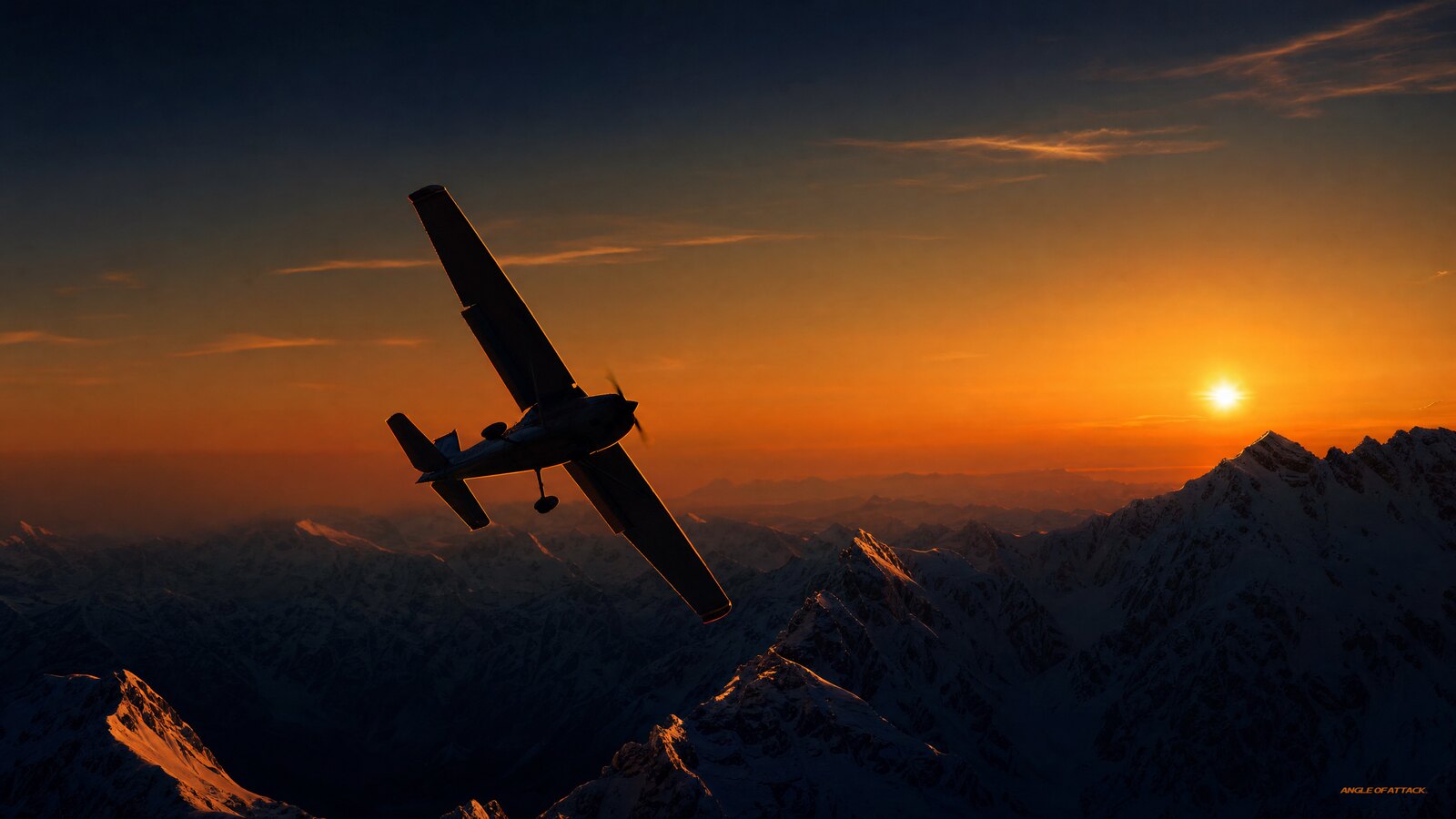
- A spin is an autorotating stall. Both wings are stalled, but unequally — the more deeply stalled wing produces less lift and more drag, driving the rotation.
- Every spin requires two ingredients: a stall plus yaw. No stall, no spin. A stall without yaw is just a stall.
- The classic killer is the cross-control stall in the base-to-final turn, where uncoordinated rudder at low altitude can flick the airplane into a spin with no room to recover.
- The standard recovery is the PARE acronym: Power idle, Ailerons neutral, Rudder full opposite the spin, Elevator forward to break the stall.
- The FAA breaks a spin into four phases: entry, incipient (the first turn or two as it develops), fully developed (steady-state rotation), and recovery.
- Spin recovery training is required for CFI applicants, not Private Pilot applicants — but spin awareness and avoidance are tested on every Private checkride.
- A coordinated airplane is extremely hard to spin. Keep the ball centered, respect angle of attack, and you remove the conditions a spin needs.
WHAT’S IN THIS GUIDE
- 1What exactly is a spin in an airplane?
- 2What’s the difference between a spin and a stall?
- 3What causes an airplane to spin?
- 4What are the phases of a spin?
- 5How do you recover from a spin?
- 6What is a cross-control stall and why is it so deadly?
- 7What’s the difference between a spin and a spiral dive?
- 8Do Private Pilots have to do spin training?
- 9What are the different types of spins?
- 10How does your airplane’s certification category affect spin training?
- 11How do you prevent a spin in the first place?
- 12PLT Study Guide
- 13Frequently Asked Questions
What exactly is a spin in an airplane?
A spin is a stall that has started to autorotate — the airplane descends in a steep, corkscrewing path while rotating about its vertical axis, with both wings stalled but one stalled more than the other. The FAA defines it in the Airplane Flying Handbook (AFH, FAA-H-8083-3C, Chapter 5, “Stalls and Spins”) as an aggravated stall that results in autorotation. The key word is autorotation: the rotation feeds itself.
Here’s why it sustains itself. When one wing drops, its angle of attack increases and the other wing’s decreases. Past the critical angle of attack, that’s backwards from what you’d expect — the more deeply stalled (lower) wing makes less lift and more drag, while the higher, less-stalled wing makes more lift and less drag. The lift difference rolls the airplane; the drag difference yaws it. Roll plus yaw in the same direction is exactly what a spin is.
So a spinning airplane is doing four things at once: it is stalled, it is rolling, it is yawing, and it is descending nearly straight down. Airspeed stays low and roughly constant — often near stall speed — which surprises pilots who expect a screaming dive. That low, stable airspeed is actually a fingerprint that tells you you’re spinning and not in a spiral.
Spins are an angle-of-attack problem, not an airspeed problem. The wing stalls at its critical angle of attack no matter the airspeed, attitude, or weight. That’s the foundation of everything else on this page (PLT168).
What’s the difference between a spin and a stall?
A stall is the loss of lift when the wing exceeds its critical angle of attack; a spin is what a stall becomes when yaw is added to it. Put simply: every spin contains a stall, but most stalls never become spins. The thing that turns one into the other is yaw — a skid, a slip, a boot of rudder, or asymmetric thrust at the moment of the stall.
In a wings-level stall with the ball centered, both wings reach the critical angle of attack at about the same time. Lift drops symmetrically, the nose pitches down, and recovery is simple: reduce angle of attack and the wing flies again. Nothing rotates because nothing is yawing.
Add yaw and the symmetry breaks. One wing stalls deeper than the other, autorotation begins, and now you have a spin — a fundamentally different animal that requires a different recovery (PLT245, PLT477).
| Characteristic | Stall (coordinated) | Spin | Spiral Dive |
|---|---|---|---|
| Wings stalled? | Yes (both, roughly equally) | Yes (both, unequally) | No |
| Yaw present? | No | Yes (the trigger) | No (bank, not yaw) |
| Autorotation? | No | Yes | No |
| Airspeed | Low, then increases in recovery | Low and roughly constant | High and increasing rapidly |
| Load factor (G) | Low (~1G) | Low | High and building |
| Flight path | Nose drops, roughly straight | Steep corkscrew descent | Spiral descent, tight radius |
| First recovery step | Reduce angle of attack | Stop yaw (opposite rudder) | Reduce power, level wings |
| Danger if wrong recovery | Minimal | Elevator before rudder can worsen spin | Pulling without leveling tightens spiral |
What causes an airplane to spin?
A spin is caused by a stall combined with yaw — there are no other ingredients. The airplane must be at or beyond the critical angle of attack (stalled), and it must be yawing at that moment. Remove either one and a spin cannot start. This is the most important single sentence in this article.
Where does the yaw come from? The usual suspects are uncoordinated flight (the ball not centered — too much or too little rudder for the bank), a wing dropping at the stall that the pilot tries to pick up with aileron instead of rudder, or asymmetric thrust on takeoff and go-around. P-factor, torque, and slipstream all yaw a single-engine airplane left at high power and low airspeed — the exact regime of a botched go-around.
The aileron mistake deserves special attention. When a wing drops at the stall, instinct says to raise it with opposite aileron. But deflecting that aileron down increases the angle of attack on an already-stalled wing, deepening its stall and accelerating the spin entry. The correct tool to keep wings level near the stall is the rudder, not the ailerons.
This is why the FAA hammers coordination so hard. A coordinated airplane — ball centered — is genuinely difficult to spin, because you’ve removed the yaw the spin needs. Most training airplanes will simply mush and break straight ahead in a coordinated stall.
What are the phases of a spin?
The Airplane Flying Handbook breaks a spin into four phases: entry, incipient, fully developed, and recovery. The FAA divides it this way so pilots can recognize where they are and act accordingly, because the earlier you catch it, the less it takes to stop it.
The entry phase is where it starts — the pilot (or a gust, or a botched maneuver) supplies the two ingredients a spin needs: a stall plus yaw. This is the moment the wing breaks and the nose starts to swing.
The incipient spin runs from the moment autorotation begins until the spin is fully developed. The AFH notes this phase takes approximately two to four turns in most airplanes before the forces balance out — that’s the training window. Airspeed, attitude, and rotation are still changing here, and it’s the easiest place to recover, often with little more than relaxing back-pressure and neutralizing the controls. That’s exactly why prompt recognition matters.
The fully developed spin is the steady state: airspeed, vertical speed, and rate of rotation have all stabilized. The airplane has settled into a repeatable corkscrew. From here the full, deliberate spin recovery procedure is required.
The recovery phase is the transition from spinning back to normal flight. The wing un-stalls, rotation stops, and you ease out of the resulting nose-low dive — carefully, so you don’t snap the wing back into a secondary stall or overstress the airframe pulling out too hard.
| Phase | What’s happening | Recognition cues | Recommended action | Recovery difficulty |
|---|---|---|---|---|
| Entry | Pilot supplies stall + yaw; wing about to break | Ball out, controls mushy, wing buffet starting | Catch it here — reduce AOA, center ball | Easiest — stop it before it starts |
| Incipient | Autorotation beginning; first 2–4 turns (AFH Ch. 5) | Nose dropping, rotation beginning, airspeed still low | Relax back-pressure, neutralize controls — often stops quickly | Easy if caught in first turn |
| Fully developed | Steady airspeed, attitude, rotation rate | Consistent corkscrew, airspeed near stall and stable | Full PARE procedure in order | Requires deliberate procedure |
| Recovery | Rotation stops, wing un-stalls | Rotation decelerating, nose pitching toward dive | Neutralize rudder, smoothly ease out of dive | Smooth pull required — secondary stall / overload risk |
How do you recover from a spin?
The standard light-airplane spin recovery is the PARE procedure: Power to idle, Ailerons neutral, Rudder full opposite the direction of rotation, then Elevator briskly forward to break the stall — and once rotation stops, neutralize the rudder and recover from the dive. This sequence works because it attacks the two things keeping you in the spin: the rotation and the stall.
Walk through the logic. Pulling power to idle removes the yawing effect of the slipstream and reduces the nose-up pitching that deepens the stall. Neutralizing the ailerons stops them from aggravating the autorotation. Full opposite rudder kills the yaw that drives the rotation. Then forward elevator reduces the angle of attack below critical so the wings fly again.
Why is “Rudder before Elevator” non-negotiable? This is the most commonly misunderstood part of the recovery. If you push the elevator forward before stopping the yaw with rudder, you can un-stall one wing before the other — which means the autorotation asymmetry is still active on one wing. The result is that you can continue or even worsen the spin, or snap into a rotation on the other wing entirely. Rudder kills the yaw mechanism first; then elevator reduces angle of attack on both wings roughly symmetrically so the airplane flies straight again. Pilots who “just push forward” as their first spin recovery input, without first identifying the rotation direction and applying opposite rudder, are fighting the airplane at the wrong step. The order is aerodynamically mandatory, not a mnemonic convenience (PLT245, AC 61-67C).
The single most important caveat: always fly the recovery your airplane’s POH/AFM specifies. The certificated procedure for your make and model lives in the Pilot’s Operating Handbook, and it takes priority over any acronym. Some airplanes have specific control inputs, configuration requirements, or are placarded against intentional spins entirely. PARE is the generic template; the POH is the law.
After rotation stops, the recovery isn’t over yet. When the spin breaks, the airplane is in a steep, accelerating dive. This is where a second mistake can hurt you. Pull too aggressively and you can: (a) trigger an accelerated secondary stall — hauling the nose up quickly at high airspeed can drive the wing right back through critical angle of attack; or (b) exceed the airplane’s structural limit. Normal-category airplanes are certified to +3.8G, and a sharp pull-out at high airspeed can exceed that. “Smoothly ease out of the dive” is not a style preference — it’s a structural and aerodynamic requirement. Manage your angle of attack during the pull-out with the same discipline you manage it everywhere else. The whole sequence — PARE plus a smooth pull-out — is brisk, positive, and in order (PLT245, PLT477).
What is a cross-control stall and why is it so deadly?
A cross-control stall happens when the ailerons and rudder are deflected in opposite directions during a stall — most dangerously in the base-to-final turn — and it’s deadly because it produces a sudden, low-altitude spin entry with almost no warning and no room to recover. This single scenario accounts for a large share of stall/spin fatalities in general aviation (NTSB SA-019, December 2015).
Picture the classic setup. You overshoot the runway centerline on the turn from base to final. You don’t want to bank more (it feels uncomfortable that low), so instead you press inside rudder to pull the nose around, while holding opposite aileron to keep the bank shallow. Now you’re skidding — bottom rudder, top aileron, cross-controlled. Add a little back-pressure to hold the nose up, get slow on the approach, and the inside wing reaches critical angle of attack first. It drops, the airplane snaps toward the ground, and at 400 feet there is no recovery.
Here’s the actual math on why there’s no recovery: a developed spin in a light trainer typically loses 500–700 feet per turn. From entry through even one developed turn plus a pull-out, you need roughly 1,200 feet on average. Most base-to-final turns happen at 400–800 feet AGL. The geometry is simply wrong. This is the real reason the base-to-final spin kills — not because the spin is violent, but because you started one where the recovery altitude doesn’t exist.
The statistics confirm it. Less than 4% of all stall/spin crashes occur specifically in the base-to-final scenario — but approximately 80% of those result in death. The airplane snaps, the ground is right there, and it’s over. Contrast that with 80% of all stall/spin accidents occurring below 1,000 ft AGL generally, which is why you practice spins from 6,000 ft AGL minimum — not to be conservative, but because a spin entry, two turns, recovery, and pull-out can cost 1,500 feet or more.
There’s also the stall speed trap lurking in that turn. Your published POH stall speed is a 1G wings-level number. In a 45° bank, the actual stall speed is about 19% higher (load factor 1.41G; stall speed multiplies by √1.41 = 1.19). A pilot flying the base-to-final turn at 70 knots with a “normal” stall speed of 65 knots isn’t 5 knots above stall — they may already be below it for that bank and cross-control condition.
The defense is pre-committed, not reactive: fly coordinated, and if you overshoot final, go around. That decision needs to be made on the ground, in your preflight brief, before the distraction and pressure of the overshooting turn are on you. In the moment, at 500 feet AGL, the wrong instinct is to skid the nose around. The pre-committed answer is already running: power in, climb, try again. Keep the ball centered on every turn near the ground and this scenario never starts (PLT245).
What’s the difference between a spin and a spiral dive?
A spin and a spiral dive look similar from outside — both are descending, turning, nose-low — but they are opposites aerodynamically: a spin is stalled with low, constant airspeed, while a spiral dive is not stalled with rapidly increasing airspeed. Confusing the two is dangerous, because the recoveries are nearly opposite and the wrong one makes things worse.
In a spin, the wing is stalled, airspeed sits near the stall and stays roughly constant, and the rate of rotation is steady. In a spiral dive, the wing is flying, the bank is steep, and the airplane is accelerating — airspeed builds fast and the engine often winds up loud. The instruments tell the story: a pegged-low, steady airspeed says spin; a rapidly rising airspeed says spiral.
Why does the distinction matter? In a spin you must reduce angle of attack (elevator forward) to un-stall the wing. In a spiral dive doing that adds airspeed toward the redline — instead you must reduce power, roll the wings level, then gently ease out of the dive. Pull hard in a spiral dive without leveling the wings first and you tighten it, overspeed, and risk overstressing the airframe.
| Characteristic | Spin | Spiral Dive |
|---|---|---|
| Wing stalled? | Yes | No |
| Airspeed | Low and constant (near stall) | High and increasing rapidly toward redline |
| Load factor (G) | Low | High and building fast |
| Engine sound | Quiet (power idle or low) | Loud and winding up |
| First recovery step | Stop the yaw (opposite rudder, then elevator) | Reduce power, roll wings level, then ease out |
| Instrument clue | Airspeed pegged low, steady | Airspeed needle rising quickly |
| Danger if mistaken | Treating spin as spiral keeps you stalled longer | Pulling on a spiral overstresses / overspeeds |
Do Private Pilots have to do spin training?
No — actual spin training (entering and recovering from a spin) is not required for the Private Pilot certificate; it is required only for the flight instructor (CFI) certificate. Private Pilot applicants are required to demonstrate stall recognition and recovery, plus spin awareness and avoidance, but they are not required to perform a full developed spin with an instructor.
This catches a lot of students off guard. Under 14 CFR § 61.183(i)(1), an applicant for a flight instructor certificate must have a logbook endorsement from an authorized instructor certifying competency in stall awareness, spin entry, spins, and spin recovery in an airplane or glider certificated for spins. There’s no parallel requirement at the Private level — your training focuses on staying out of spins rather than getting out of them.
Why did the FAA make that decision — and does it work? This is one of the most interesting regulatory history questions in general aviation. In June 1949, the CAA removed the spin training requirement from the private pilot certificate with Amendment CAR 20-3. At the time, a staggering 48% of all general aviation accidents were stall/spin accidents — even with spin training mandatory. The CAA’s bet: prevent the stall rather than teach the spin, and incentivize the industry to design more spin-resistant aircraft.
That bet worked. By the late 1960s, the stall/spin accident share had fallen to roughly 25%. By 2003 it was down to approximately 10% of fatal GA accidents (AOPA Air Safety Institute data). The current training philosophy — stall avoidance, coordination discipline, AOA awareness — is not arbitrary tradition. It’s a data-backed decision that has outperformed the alternative. The tragedy is that when these accidents still do happen, they kill people at roughly twice the average rate: stall/spin accidents are fatal approximately 39% of the time, compared to 18% for GA accidents overall (MDPI fixed-wing stall study, 2022).
The CFI spin requirement (14 CFR § 61.183(i)) is competency-based, not count-based. The regulation doesn’t mandate a specific number of spins — it requires that the instructor who endorses you certify that you are “competent and possess instructional proficiency.” That’s the standard. Everything else is proficiency development.
That said, plenty of instructors offer spin training as an elective, and many pilots seek it out for confidence and skill. There’s real value in feeling a spin develop and recover with a qualified instructor in a properly placarded, spin-approved airplane. If you want to do it, do it deliberately — right airplane, right CFI, 6,000 feet AGL minimum.
The takeaway for a Private student: your job is prevention. Know the conditions that cause a spin, keep the airplane coordinated, respect angle of attack, and you’ll never need a recovery you weren’t trained to fly.
What are the different types of spins?
The four commonly described spin modes are the upright (erect) spin, the inverted spin, the flat spin, and the accelerated spin — and they differ mainly in attitude, rotation rate, and how hard they are to recover. The garden-variety spin you’d see in a training airplane is the upright spin, and it’s the one the PARE recovery is built around.
An upright spin is the normal one: positive G, nose well below the horizon, the pilot’s head pointed roughly toward the sky relative to the airplane.
A flat spin is far more dangerous — and the mechanism is worth understanding because it connects directly to weight and balance. In a normal upright spin, the nose points steeply down and the elevator remains effective because airflow is still hitting the horizontal tail. Move the CG aft and the airplane’s natural nose-down pitching moment weakens. The nose can’t rotate to a steep axis; instead the airplane spins closer to the horizon with the angle of attack climbing toward 65–90°. At that extreme angle of attack, the elevator becomes aerodynamically ineffective — there’s insufficient airflow over the tail to push the nose through. Rotation accelerates. The controls may feel pinned. Normal PARE recovery inputs may produce no useful result. This is what AC 61-67C means when it says flat spins can be “generally unrecoverable” in some aircraft configurations.
This is not academic. The Cessna 172, for example, is approved for intentional spins only in utility-category configuration: front seats only, no rear passengers, no baggage, at or below 1,950 lb. Those restrictions exist specifically because rear-seat loading and baggage shift the CG aft and can produce a flat spin mode that exceeds the airplane’s recovery certification standard. Weight and balance isn’t just about performance — it’s about whether your spin recovery procedure will work at all.
An inverted spin occurs with negative angle of attack and negative G — you’re hanging in the straps. It’s an aerobatic regime that ordinary trainers aren’t certified for.
An accelerated spin is entered from an accelerated stall — one that occurs at higher than 1G, typically from an abrupt pull in a steep turn. The entry airspeed is higher, the stall AOA is reached more abruptly, and the resulting spin rotates faster than a normal 1G spin. It’s less commonly covered in Private Pilot training but relevant to understand if you’re ever practicing steep turns aggressively.
For a Private student, the practical point is this: the airplane you train in is certificated for normal-category operations and is not approved for intentional spins beyond what its POH allows. Loading it aft of limits, or trying maneuvers it wasn’t built for, can put you into a spin mode your standard recovery won’t fix (AC 61-67C; PHAK Ch. 10).
How does your airplane’s certification category affect spin training?
Not every airplane is created equal when it comes to spins, and the FAA’s category system tells you exactly what ground has been tested and what hasn’t. Understanding this is practical knowledge for anyone who wants to do spin training — and it explains why your instructor will be particular about which airplane and which configuration you use.
| Category | Spin test standard (legacy 14 CFR Part 23 § 23.221) | Intentional spins? | Examples |
|---|---|---|---|
| Normal | 14 CFR Part 23 § 23.221)">Recover from 1-turn or 3-second spin in ≤1 additional turn | Placarded PROHIBITED | C172 (standard loading) |
| Utility | 14 CFR Part 23 § 23.221)">Recover from 6-turn spin with reliable, positive recovery | APPROVED (within published limits) | C172 (front seats only, no baggage, ≤1,950 lb) |
| Acrobatic | 14 CFR Part 23 § 23.221)">Recover within 1.5 turns after a 6-turn entry; all axes tested | APPROVED (full aerobatics) | Decathlon, Citabria, Pitts S-2 |
| Multi-engine | 14 CFR Part 23 § 23.221)">Not tested for spins | PROHIBITED | Cessna 310, Piper Seneca |
A few things this table tells you that most articles get wrong. Normal-category airplanes are not un-spinnable. They ARE tested for spin recovery during type certification — the manufacturer has to demonstrate that the design can recover from a one-turn spin. But they’re placarded against intentional spins because the test standard is minimal and the designer hasn’t guaranteed recovery from multi-turn or loaded configurations.
The Cessna 172 is a good illustration. Under its normal category loading, it’s placarded against intentional spins. Move it into utility-category configuration — front seats only, no rear passengers, no baggage, at or below the utility-category max gross — and it’s spin-approved. The airplane hasn’t changed; the CG envelope has. That’s why your instructor will carefully verify configuration before any spin work.
Acrobatic-category airplanes are tested to a much higher standard: six developed turns, recovery within 1.5 additional turns, tested in all entry attitudes. If you eventually do spin training, this is the category where the testing was thorough.
Multi-engine airplanes aren’t spin-approved for a fundamental reason: an engine-out asymmetry makes the spin dynamics unpredictable and the recovery unreliable. They stay in the “avoid at all costs” column.
How do you prevent a spin in the first place?
You prevent a spin by attacking its two ingredients: never let the wing reach the critical angle of attack unexpectedly, and never let the airplane yaw while it’s near a stall. Do both and a spin is essentially off the table — which is exactly why the FAA frames Private Pilot training around avoidance rather than recovery.
In day-to-day flying that comes down to a few habits. Keep the ball centered, especially during climbs, go-arounds, and every turn in the pattern. Fly the correct approach speed and resist the temptation to stretch a glide by hauling the nose up — that’s how you get slow and high on the angle of attack at the same time. And when you do practice stalls, recover at the first indication: reduce angle of attack, then add power, and use rudder to keep things straight.
The load-factor trap in turns. The published stall speed in your POH is a 1G straight-and-level number. It goes up in a turn because banking increases load factor, and stall speed = POH stall speed × √(load factor). Here’s what that means in practice:
| Bank Angle | Load Factor | Stall Speed Multiplier | Example: 65 KIAS stall at 1G |
|---|---|---|---|
| 0° (straight-and-level) | 1.0 G | ×1.00 | 65 KIAS |
| 30° | 1.15 G | ×1.07 | ~70 KIAS |
| 45° | 1.41 G | ×1.19 | ~77 KIAS |
| 60° | 2.0 G | ×1.41 | ~92 KIAS |
(Source: PHAK Ch. 5; formula = stall speed × √load factor)
The pilot flying a 60° base-to-final turn at 92 knots and thinking “I’m 27 knots above stall” is actually right at stall speed for that bank angle and load factor. Add cross-controls and you’re not 27 knots safe — you’re on the edge. This is the math behind why “I was well above stall speed” is never the whole story in pattern accidents. A spin is an angle-of-attack event, not an airspeed event (PLT168).
What it feels like before a spin entry. This is the knowledge no table can give you — and it’s what separates the pilot who catches it from the one who doesn’t. In a skidding turn near the stall, the warning signs arrive together: the ball slides toward the lowered wing, the controls feel mushy (reduced effectiveness — the rudder and elevator aren’t responding the way they should), and the airframe may buffet slightly as the inside wing approaches critical angle of attack. If you hold it, the inside wing starts to drop despite aileron input. That’s the edge.
The correct response is immediate: unload the back-pressure (reduce AOA), center the ball with rudder, stop feeding the bank. Up high with a CFI beside you, this sequence takes less than two seconds and the airplane flies like nothing happened. At 500 feet AGL on base-to-final, you’ve already run out of options. The student who learns to feel that mush — and respond before the wing breaks — has learned the most important stall/spin skill there is. You can practice it on every steep turn and every turn in the traffic pattern. The warning comes first. The question is whether you act on it.
Modern AOA indicators address the root cause. The core problem in stall/spin accidents is flying close to the critical angle of attack without knowing it — a problem that airspeed indicators can’t reliably solve (because stall speed changes with bank, weight, configuration, and G-load). An angle-of-attack indicator reads the actual aerodynamic margin directly. The U.S. Navy adopted AOA indicators in 1957 and saw a 50% reduction in fatality rates (GAJSC/uAvionix data). Modern affordable GA options from Garmin, Aspen, and uAvionix make this technology accessible. An AOA indicator doesn’t replace coordination and airmanship — but it addresses the precise root cause that spin accidents exploit. It’s worth serious consideration, especially for trainers used in the traffic pattern.
The wing stalls at the same angle of attack every time regardless of speed, weight, or altitude. The pilot who manages angle of attack and coordination has already won (PLT168, PLT245).
If you want to build this instinct from day one — not just memorize it for the test — our free Total Student Pilot course walks you through stalls, coordination, and angle of attack with real cockpit video, and our Private Pilot Ground School goes deep on the aerodynamics so the whole picture clicks before you ever sit in the airplane.
PLT Study Guide
Spins show up on the Private Pilot knowledge test under a small cluster of learning statement codes. The three the FAA actually maps to this material are the stall/spin force code, the stalls code, and the angle-of-attack code — not the instrument-procedures or night/high-altitude codes that sometimes get mistakenly attached. Here’s what each one really asks you to know.
PLT245 — Recall forces acting on aircraft: stalls / spins. This is the core code for this topic. Know that a spin is an aggravated, autorotating stall with both wings stalled unequally (FAA-H-8083-3C, Ch. 5); that it requires a stall plus yaw; and that recovery means stopping the yaw and reducing the angle of attack (the PARE logic, in that order). Expect questions on what causes a spin, what stops one, and the difference between a spin and a spiral dive.
PLT477 — Recall stalls: characteristics / factors / recovery / precautions. Because every spin begins as a stall, this code covers the foundation: the wing stalls at the critical angle of attack regardless of airspeed, attitude, or weight, and recovery always starts with reducing angle of attack. Know stall warning signs and the role of coordination.
PLT168 — Recall angle of attack: characteristics / forces / principles. Spins are fundamentally an angle-of-attack phenomenon. Be able to state that the critical angle of attack is fixed for a given wing and that exceeding it — at any airspeed — is what stalls the wing and sets up a spin. This is also the code behind the load-factor trap: stall speed rises with bank because load factor rises, but the critical angle of attack never changes.
Frequently Asked Questions
Can any airplane spin?
Almost any fixed-wing airplane can be made to spin if stalled with yaw present, but not every airplane is approved for intentional spins. Normal-category trainers are tested for one-turn recovery during certification but are placarded against deliberate spinning. Utility-category certification (for example, a Cessna 172 with front seats only, no baggage, below 1,950 lb) is required for intentional spin training. Always check the POH and placards — the configuration matters as much as the model.
How much altitude does a spin recovery take?
More than most students realize. A developed spin in a light trainer typically loses 500–700 feet per turn. A full spin sequence — entry, one or two developed turns, recovery, and pull-out — can easily consume 1,200–1,500 feet, and that doesn’t include any dive-recovery altitude. Approximately 80% of all stall/spin accidents occur below 1,000 feet AGL, which is why they’re so often fatal. Practice spins from 6,000 feet AGL minimum — not to be conservative, but because the math demands it.
What is autorotation in a spin?
Autorotation is the self-sustaining rotation that defines a spin. The more deeply stalled wing produces less lift and more drag than the less-stalled wing. The lift difference rolls the airplane; the drag difference yaws it. Both happen in the same direction and reinforce each other. The rotation runs on its own — no additional control input required — until the pilot stops it by killing the yaw and breaking the stall.
Is a spin the same as a stall?
No. A stall is the loss of lift past the critical angle of attack; a spin is a stall plus yaw that has begun to autorotate. Every spin contains a stall, but a coordinated stall with no yaw will not become a spin. The added ingredient is always yaw.
What does PARE stand for in spin recovery?
PARE is the generic light-airplane spin recovery: Power to idle, Ailerons neutral, Rudder full opposite the rotation, Elevator briskly forward to break the stall, then recover from the dive. It’s a memory aid — your airplane’s POH/AFM recovery procedure always takes priority. The sequence matters aerodynamically: rudder before elevator is not a stylistic choice. Applying elevator before stopping the yaw can continue or worsen the spin by un-stalling one wing before the other.
Why do spins happen on the turn to final?
Because all the risk factors stack up simultaneously: the airplane is slow (high angle of attack), the pilot is distracted, and the natural instinct when overshooting final is to skid the nose around with inside rudder rather than bank more steeply. Cross-controlled at low speed and low altitude, the inside wing stalls first and the airplane snaps toward the ground. At 400–800 ft AGL there is no recovery. The data: fewer than 4% of all stall accidents happen in this scenario, but approximately 80% of those are fatal.
Can you spin a plane in coordinated flight?
It’s very difficult. Coordinated flight means no yaw, and without yaw a stall breaks straight ahead instead of rotating. Keeping the ball centered removes the ingredient a spin needs. This is the single most powerful prevention habit you can build — and it’s why instructors are so focused on coordination, not just in stall practice but in every turn in the pattern.
Do I need spin training for my Private Pilot certificate?
No. Spin entry and recovery training is required for the flight instructor certificate under 14 CFR § 61.183(i)(1), not the Private Pilot. Private applicants must demonstrate stall recognition and recovery plus spin awareness and avoidance. The FAA removed the private-pilot spin requirement in 1949, betting on prevention over recovery — and stall/spin accident rates have fallen significantly since. Many pilots take spin training as a valuable elective, and there’s real confidence to be gained.
What’s the difference between a spin and a spiral dive?
In a spin the wing is stalled and airspeed stays low and constant; in a spiral dive the wing is flying and airspeed builds rapidly. The instruments tell you which: a pegged-low, steady airspeed says spin; a rising airspeed says spiral. The recoveries are nearly opposite — forward elevator un-stalls a spin, while a spiral needs reduced power and wings leveled before any elevator input. Confusing the two and applying the wrong recovery makes things worse.
What causes a flat spin?
A flat spin — nose near the horizon, fast rotation, elevator becoming ineffective — is caused by an aft center of gravity. With CG moved aft, the airplane’s nose-down pitching moment weakens, the spin axis flattens, the angle of attack climbs toward 65–90°, and the airflow over the horizontal tail (which you need to push the nose through) decreases. Normal PARE recovery may produce little or no response. This is not a theoretical risk — it’s the reason the Cessna 172 has explicit CG restrictions for spin operations. Never load an airplane behind its aft CG limit (AC 61-67C; PHAK Ch. 10).
What should I actually feel before a spin entry?
In a skidding turn near the stall: the ball slides toward the lowered wing, the controls feel mushy (reduced effectiveness), the airframe may buffet slightly, and the inside wing starts to drop despite aileron input. This is the pre-spin edge. The correct response — unload the back-pressure, center the ball, stop feeding the bank — can be drilled on every steep turn you fly. The moment you learn to feel that mush and respond to it is the moment you become genuinely hard to spin inadvertently.
What is an accelerated spin?
An accelerated spin is entered from an accelerated stall — a stall that occurs at higher than 1G, typically from an abrupt pull during a steep turn. The entry airspeed is higher, the stall AOA is reached more abruptly, and the resulting spin rotates faster than a standard 1G spin. It’s less common in basic training but worth knowing about if you’re practicing steep turns aggressively.
Spins earned their fearsome reputation when nobody understood them. The first pilot to survive and document an accidental spin was Lieutenant Wilfred Parke, Royal Navy, who entered one at 700 feet AGL in 1912, tried everything that felt right — pulling back, turning into the spin, adding power — and nothing worked. He inadvertently applied full opposite rudder. The spin stopped. He noted “ghastly experience” in his logbook, explained what worked to observers, and “Parke’s technique” was born. He was killed in a separate accident four months later. The technique he discovered wasn’t widely taught until well into World War I.
You don’t have to discover it by accident. You now know that a spin is just a stall with yaw, that it lives and dies by angle of attack and coordination, and that the airplane will fly again the moment you stop the rotation and lower the nose. Carry that understanding into every pattern, every climb, and every steep turn, and the most dangerous maneuver in light aviation becomes one you simply never let start.
Master every system on your checkride — and on day one.
The Private Pilot Ground School breaks down every FAA subject area in the same plain-English, real-world way you just read — with quizzes, scenarios, and the explanations that finally make it click.
Keep the ball centered, fly the angle of attack, and never skid a turn close to the ground. That’s not a checkride trick — that’s how you stay a pilot for forty more years.


ON THE SAME TOPIC
IFR vs VFR: The Two Sets of Rules Every Pilot Flies By
IFR vs VFR: The Two Sets of Rules Every Pilot Flies By 19 min read Last updated June 2026 · Chris Palmer The difference between IFR and VFR is which set of rules you fly under. VFR — visual flight rules — lets you navigate by looking outside and staying clear of clouds in good […]
 Read more
ASOS vs AWOS vs ATIS: How to Pull the Right Weather Before You Fly
ASOS vs AWOS vs ATIS: How to Pull the Right Weather Before You Fly 13 min read Last updated June 2026 · Chris Palmer The difference comes down to who is talking and what the broadcast covers. ASOS and AWOS are automated, computer-generated weather observations of the conditions right at the field. ATIS is a […]
Read more 
What Is RNAV Navigation? Area Navigation for VFR Pilots
What Is RNAV Navigation? Area Navigation for VFR Pilots 17 min read Last updated June 2026 · Chris Palmer RNAV — Area Navigation — is a method that lets an aircraft fly any desired path within the coverage of ground- or space-based navigation aids, rather than being forced to fly directly to and from stations. […]
Read more 
NDB and ADF Explained: The Oldest Radio Nav System You Still Need to Understand
NDB and ADF Explained: The Oldest Radio Nav System You Still Need to Understand 16 min read Last updated June 2026 · Chris Palmer An NDB (non-directional beacon) is a ground-based radio transmitter that sends a signal in all directions, and an ADF (automatic direction finder) is the cockpit receiver whose needle points straight at […]
Read more 
Stay Connected
Be the very first to get notified when we publish new flying videos, free lessons, and special offers on our courses.
