
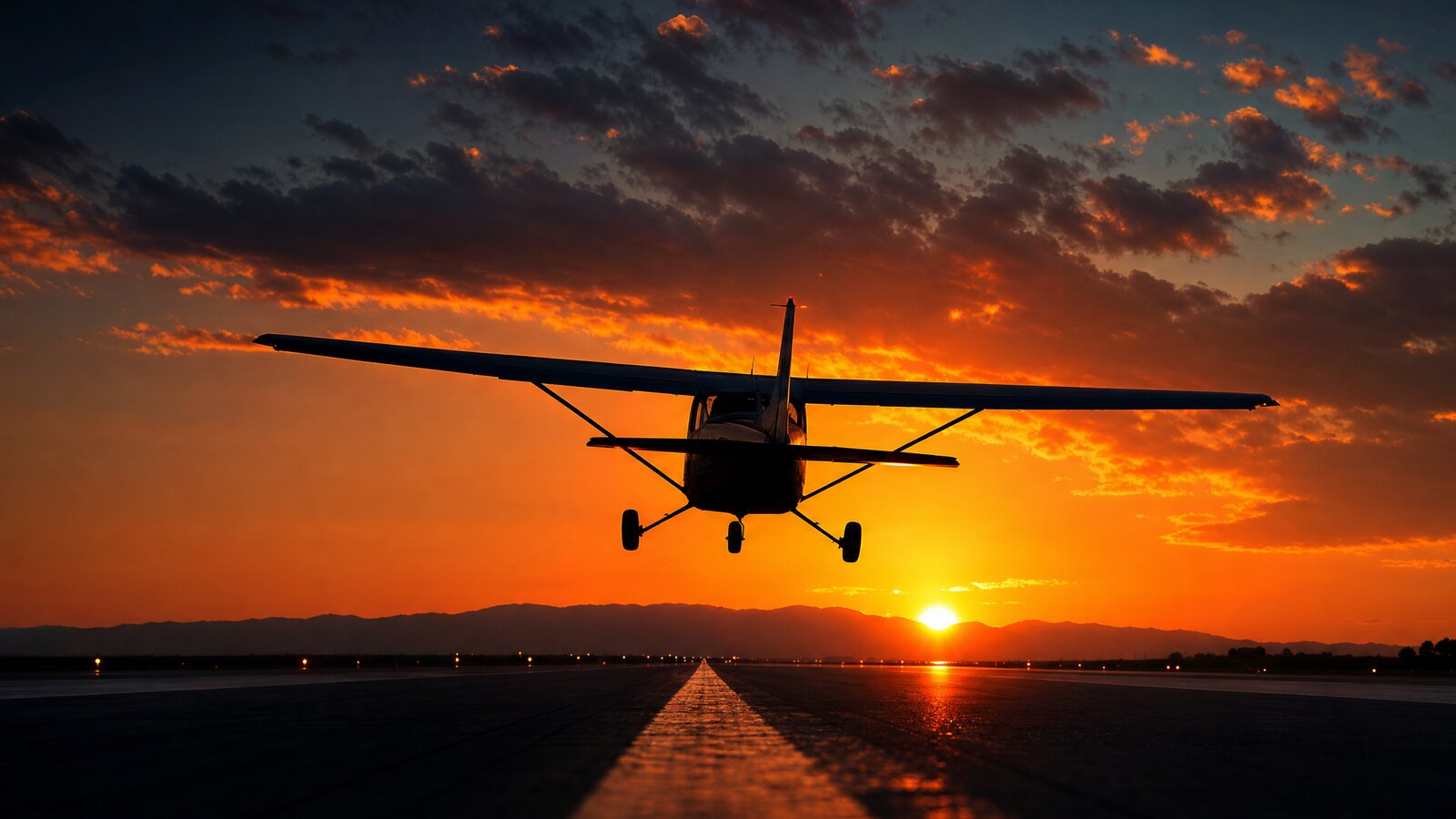
What Is Ground Effect? Why Your Airplane Floats on Landing
Ground effect is the temporary increase in lift and decrease in induced drag an airplane experiences when it flies within about one wingspan of the surface, because the ground interrupts the wingtip vortices and downwash that normally rob the wing of efficiency. That efficiency boost is exactly why your trainer seems to refuse to quit flying in the last few feet over the runway. You round out, you wait for the wheels, and the airplane just… hangs there. That hang is ground effect, and once you understand it, the landing flare stops feeling like luck.
- Ground effect is real and predictable. It appears when the wing is within roughly one wingspan of the ground, and it gets stronger the lower you go.
- The cause is reduced induced drag. The surface disrupts the wingtip vortices and flattens the downwash, so the wing produces the same lift for less drag.
- It explains the float on landing. Excess speed plus ground effect equals a long, floaty touchdown — and a long landing distance if you let it.
- It can hurt you on takeoff. An airplane can lift off in ground effect before it has the airspeed to climb out of it, then settle back down.
- A high-wing 172 and a low-wing Cherokee both feel it. Wing height changes the magnitude, not the existence, of the effect.
- Speed control is the fix. Cross the threshold at the right approach speed and the float shrinks to a comfortable, manageable settle.
WHAT’S IN THIS GUIDE
- 1What exactly is ground effect?
- 2Why does ground effect happen aerodynamically?
- 3How high does ground effect reach?
- 4Why does my airplane float on landing?
- 5Why is ground effect dangerous on takeoff?
- 6Does ground effect feel different in a high-wing vs. low-wing airplane?
- 7How do I fly the flare with ground effect in mind?
- 8PLT Study Guide
- 9Frequently Asked Questions
What exactly is ground effect?
Ground effect is the change in an airplane’s aerodynamics that occurs when the wing flies close to the surface — generally within one wingspan. In this zone the wing produces lift more efficiently because induced drag drops sharply. The Pilot’s Handbook of Aeronautical Knowledge (PHAK, FAA-H-8083-25C) describes it as the interference of the surface with the airflow patterns around the wing.
Think of it as a cushion, though that word oversells it a little. The air isn’t piling up underneath the wing like a hovercraft. What’s actually happening is that the ground keeps the wing from leaking energy out the wingtips and down behind it the way it normally would up high.
The key word is temporary. Ground effect is a low-altitude phenomenon. Climb a couple hundred feet and it’s gone entirely — your airplane behaves exactly the way the performance charts say it should. It only shows up at the two moments when you are closest to the runway: the takeoff roll and the landing flare. Those happen to be two of the busiest moments in the whole flight, which is why this matters so much for a student pilot.
Why does ground effect happen aerodynamically?
Ground effect happens because the surface disrupts the wingtip vortices and the downwash behind the wing, which reduces induced drag. A wing makes lift by creating lower pressure on top and higher pressure on the bottom. Near the wingtips, that high-pressure air spills around to the low-pressure side and rolls up into spinning wingtip vortices. Those vortices are the source of induced drag.
Up high, the wing also pushes the oncoming air downward — that’s called downwash — which tilts the lift vector slightly aft. That rearward tilt is drag you have to pay for. PHAK (FAA-H-8083-25C) ties both of these together: when the wing gets close to the ground, the surface physically interferes with the vortices and reduces the downwash angle.
Less downwash means the lift vector points more straight up and less backward. The wingtip vortices can’t fully form. Induced drag can drop substantially within about one wingspan of the surface — by a large fraction as the wing gets very close. The result: the wing needs less power and less angle of attack to hold the same lift. Same airplane, same weight, but suddenly it’s flying like it’s lighter than it is.
This is why ground effect is fundamentally a drag story, not a lift story. The wing isn’t making dramatically more lift — it’s making the same lift for a lot less drag. That free ride is what you feel as the float.
How high does ground effect reach?
Ground effect becomes noticeable when the wing is within about one wingspan of the surface, and it grows stronger as the airplane descends closer to the ground. It is strongest in the last fraction of a wingspan — the final few feet of the flare. By the time the wing is a full wingspan up, the effect is weak; below about half a wingspan, it’s pronounced.
For a Cessna 172, with a wingspan around 36 feet, you can feel things start to change somewhere in the last 30-some feet, but the real magic happens in the final 10 to 15 feet. That lines up perfectly with where you start your roundout.
Here’s a rough way to picture the relationship between height and the strength of the effect:
| Height above surface (in wingspans) | Induced drag reduction | What you feel |
|---|---|---|
| One full wingspan | Small | Barely noticeable |
| About half a wingspan | Moderate | Airplane starts to feel slick |
| About one-tenth of a wingspan | Large | Strong float; reluctant to land |
The exact percentages vary with wing design and configuration, so treat the table as the shape of the curve rather than gospel numbers. The takeaway that matters: the closer you get to the runway, the stronger ground effect becomes, and it ramps up fast right where you’re trying to land.
Why does my airplane float on landing?
Your airplane floats on landing because as you descend into ground effect, induced drag drops away, so the airplane decelerates more slowly than your instincts expect — any extra airspeed you carried over the threshold now has to bleed off with much less drag to help. That excess energy translates directly into distance down the runway.
Float is almost always a speed problem, not a ground-effect problem. Ground effect just exposes the speed problem. If you cross the threshold five or ten knots fast, ground effect hands you a long, lazy float while the airplane refuses to settle. Cross it at the right speed and the float is short and controllable — exactly what you want.
This is also why “flat” or fast approaches lead to long landings and runway overruns. The airplane that won’t quit flying in the flare is telling you something: it still has energy to burn. The fix isn’t to force it down onto the wheels — that invites a bounce or a porpoise. The fix is upstream, on final, where you set your airspeed.
If you’re working toward your certificate and want to make landings click instead of feeling like a coin flip, our free Total Student Pilot course walks through the approach-and-landing sequence step by step, and the full Private Pilot Ground School goes deep on the aerodynamics behind every phase of flight.
Why is ground effect dangerous on takeoff?
Ground effect is dangerous on takeoff because the reduced induced drag can let an airplane lift off and accelerate while still in ground effect, before it has reached a speed that will sustain a climb out of ground effect — so it leaves the surface, climbs a few feet, then mushes or settles back down as it exits the cushion.
This is the classic warm-day, high-density-altitude, fully-loaded trap. The airplane staggers into the air feeling like it’s flying, you pull it off early, and the moment you climb out of ground effect the induced drag comes roaring back. Now you’re at a speed that worked at one foot but doesn’t work at twenty. PHAK (FAA-H-8083-25C) specifically warns that an airplane leaving ground effect needs additional power and a higher angle of attack to maintain climb — and pulling the nose up to chase that climb without the speed to back it up is how you end up in a settle, or worse.
The discipline is simple to state and harder to hold: let the airplane accelerate to a safe climb speed before you ask it to leave the ground, and don’t try to force a premature liftoff just because the wheels feel light. On a soft or short field you do use ground effect deliberately — lifting off early and accelerating in the cushion — but that’s a precise technique flown to specific numbers, not a license to yank it off and hope.
Does ground effect feel different in a high-wing vs. low-wing airplane?
Both high-wing and low-wing airplanes experience ground effect, but the wing’s height above the ground affects how strong the effect feels. A low-wing airplane sits its wing closer to the surface in the flare, so pilots often report a more pronounced, longer float; a high-wing Cessna 172 holds its wing farther up, so the cushion can feel a touch milder. The physics is identical — only the geometry shifts.
What this means in practice: if you trained in a high-wing 172 and then transition to a low-wing Cherokee or Warrior, expect the airplane to float a little more eagerly when everything else is equal. Plenty of newly transitioned pilots overshoot their first few landings in a low-wing simply because they didn’t respect that extra float and carried their usual approach speed.
Either way, the lesson is the same one ground effect always teaches: respect your airspeed on short final, and the airplane in the flare becomes predictable instead of surprising.
How do I fly the flare with ground effect in mind?
Fly the flare by nailing your approach speed first, then letting ground effect do its job: as you enter the cushion in the last 10 to 15 feet, smoothly reduce your rate of descent, hold the airplane just off the runway, and let it decelerate and settle onto the mains in a slightly nose-high attitude. Ground effect is your ally here — it gives you those extra seconds to fine-tune the attitude before touchdown.
Years ago, flying a 172 out of a gravel strip up in Alaska, I had a student who treated every flare like an emergency — the second the airplane started to float, he’d shove it onto the runway, and we’d bounce. I covered the airspeed indicator on one approach and just had him fly the picture and feel the airplane in the cushion. No numbers to fixate on, no panic. He held it off, waited, and the airplane greased on by itself. The float wasn’t the enemy. His reaction to it was. I’ve been in aviation education since 2006 and teaching as a CFI since 2017, and that lesson still comes up almost every week on the ramp: ground effect isn’t something to fight, it’s something to ride down to the runway.
The mistakes to watch for are the two opposite overreactions. Force it down and you bounce, because the wing is still flying and the airplane springs back into its cushion. Hold it off too long with too much speed and you float halfway down the runway and run out of pavement. The middle path is patience with discipline: right speed on final, smooth roundout, then let the airplane tell you when it’s done flying.
PLT Study Guide
These are the FAA Airman Certification Standards learning-statement codes that genuinely apply to ground effect. (Note: the precise figures for induced-drag reduction vary by source and configuration — know the rule the FAA tests, not a memorized percentage.)
PLT131 — Recall aircraft performance: ground effect.
This is the core code for the topic. Know that ground effect is the temporary improvement in performance from flying within about one wingspan of the surface, that it is caused by reduced induced drag, and that it produces float on landing and the risk of premature liftoff on takeoff. Expect questions on both the cause and the practical consequences.
PLT237 — Recall forces acting on aircraft: airspeed / air density / lift / drag.
Ground effect is fundamentally about the relationship between lift and drag. Understand that the wing produces the same lift for less induced drag in ground effect, why excess airspeed therefore extends the float, and how lift, drag, and airspeed interact during the approach and flare.
PLT094 — Recall aerodynamics: airfoil design / pressure distribution / effects of altitude.
Ground effect comes from the surface disrupting wingtip vortices and downwash — a pressure-distribution and proximity story. Know how the pressure difference between the upper and lower surfaces creates wingtip vortices, and how flying near the ground alters that pattern.
Frequently Asked Questions
Does ground effect actually make the airplane lighter?
No. The airplane weighs exactly the same in ground effect. What changes is efficiency — induced drag drops, so the wing holds the same lift with less drag and less power. It only feels lighter because the airplane decelerates slowly and seems reluctant to stop flying as you descend into the cushion.
At what height does ground effect start?
Ground effect becomes noticeable within about one wingspan of the surface and strengthens as the airplane gets lower. For a Cessna 172 with roughly a 36-foot span, expect to start feeling it in the last 30-some feet and to feel it strongly in the final 10 to 15 feet — right where you flare.
Is ground effect the reason my landings float?
Partly. Ground effect creates the conditions for a float by removing induced drag, but the float’s length is driven by excess airspeed. Cross the threshold at the correct approach speed and the float is short and controllable. Carry extra knots and ground effect turns that energy into a long, lazy float down the runway.
Can ground effect cause an accident on takeoff?
Yes. An airplane can lift off in ground effect before reaching a speed that sustains a climb, then settle back down as it leaves the cushion and induced drag returns. This is a real hazard on hot days, at high density altitude, and when heavily loaded. The defense is accelerating to a safe climb speed before leaving the surface.
Do low-wing and high-wing airplanes both have ground effect?
Both do. The physics is identical; only the wing’s height above the surface changes how strong it feels. Low-wing airplanes sit the wing closer to the ground in the flare and often feel like they float more, while a high-wing Cessna 172 can feel slightly milder. Respect your approach speed in either type.
How do pilots use ground effect on purpose?
On a soft-field takeoff, pilots deliberately lift off early at a low speed and accelerate while still in ground effect, then climb out once the airplane reaches a safe climb speed. This gets the wheels off soft or rough surfaces sooner. It’s a precise technique flown to specific speeds, not an excuse to force a premature liftoff.
Does ground effect change my stall speed?
Indirectly. Because induced drag is reduced and the downwash angle changes near the surface, the wing can be slightly more efficient, but the practical point for a student pilot is simpler: in ground effect the airplane keeps flying at speeds that feel surprisingly slow, which is exactly why holding it off in the flare works so well.
Why does forcing the airplane down cause a bounce?
Because the wing is still flying. If you push a floating airplane onto the runway while it still has flying speed, the mains contact, the airplane springs back up into ground effect, and you climb a few feet before sinking again. The fix is patience: let the airplane decelerate in the cushion and settle when it’s ready.
Master every system on your checkride — and on day one.
The Private Pilot Ground School breaks down every FAA subject area in the same plain-English, real-world way you just read — with quizzes, scenarios, and the explanations that finally make it click.
Ground effect is one of those concepts that turns from mysterious to obvious the moment it clicks — and once it clicks, your flares get smoother, your takeoffs get safer, and you stop fighting the airplane in the last few feet. The next time your trainer hangs in the air just above the runway and refuses to land, smile. That’s not the airplane misbehaving. That’s physics handing you a few extra seconds to grease it on.


ON THE SAME TOPIC
IFR vs VFR: The Two Sets of Rules Every Pilot Flies By
IFR vs VFR: The Two Sets of Rules Every Pilot Flies By 19 min read Last updated June 2026 · Chris Palmer The difference between IFR and VFR is which set of rules you fly under. VFR — visual flight rules — lets you navigate by looking outside and staying clear of clouds in good […]
 Read more
ASOS vs AWOS vs ATIS: How to Pull the Right Weather Before You Fly
ASOS vs AWOS vs ATIS: How to Pull the Right Weather Before You Fly 13 min read Last updated June 2026 · Chris Palmer The difference comes down to who is talking and what the broadcast covers. ASOS and AWOS are automated, computer-generated weather observations of the conditions right at the field. ATIS is a […]
Read more 
What Is RNAV Navigation? Area Navigation for VFR Pilots
What Is RNAV Navigation? Area Navigation for VFR Pilots 17 min read Last updated June 2026 · Chris Palmer RNAV — Area Navigation — is a method that lets an aircraft fly any desired path within the coverage of ground- or space-based navigation aids, rather than being forced to fly directly to and from stations. […]
Read more 
NDB and ADF Explained: The Oldest Radio Nav System You Still Need to Understand
NDB and ADF Explained: The Oldest Radio Nav System You Still Need to Understand 16 min read Last updated June 2026 · Chris Palmer An NDB (non-directional beacon) is a ground-based radio transmitter that sends a signal in all directions, and an ADF (automatic direction finder) is the cockpit receiver whose needle points straight at […]
Read more 
Stay Connected
Be the very first to get notified when we publish new flying videos, free lessons, and special offers on our courses.
