
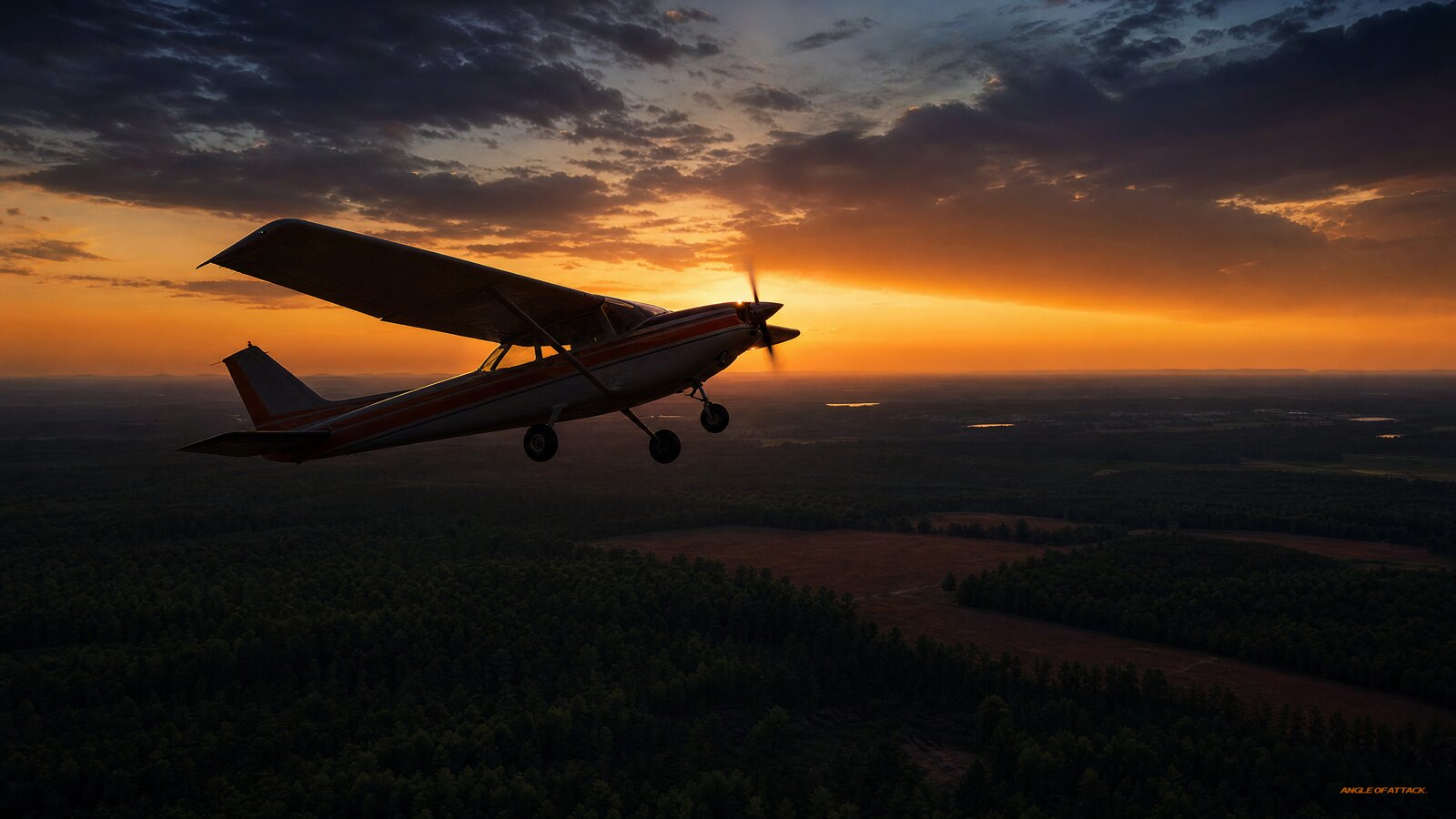
What Is Induced Drag? The Hidden Cost of Lift Explained
Induced drag is the rearward-acting drag created as a direct byproduct of producing lift. When a wing makes lift, high-pressure air below spills around the wingtip into the low-pressure air on top, forming wingtip vortices that tilt the lift vector aft. That aft component is induced drag, and it grows as the airplane slows down.
Here’s the part most students miss: you cannot make lift without making induced drag. They come as a package. The wing pays a toll every time it holds the airplane up, and that toll gets steepest exactly when you’re slow, nose-high, and close to the ground — on climb-out, in slow flight, and on final approach.
Let me walk you through induced drag the way I’d brief it on the ramp before a slow-flight lesson: what it is, where it comes from, why it gets worse as you slow down, and why it explains some of the strangest-feeling things a new pilot ever does in an airplane.
- Induced drag is the price of lift. It is created as a direct byproduct of the wing producing lift, so it can never be fully eliminated in flight.
- Wingtip vortices are the source. High-pressure air below the wing curls around the tip to the low-pressure air on top, rolling up into vortices that drag the airplane back.
- It grows as you slow down. Induced drag is greatest at low airspeed and high angle of attack — the opposite of parasite drag, which grows with speed.
- It is worst near the stall. On approach and in slow flight, the wing flies at a high angle of attack, vortices strengthen, and induced drag does its hardest work.
- It drives the back side of the power curve. Down in the slow, high-angle-of-attack regime, flying slower can need more power because induced drag is climbing fast.
- Ground effect cuts it. Within about a wingspan of the surface, the ground interferes with the vortices and induced drag drops noticeably.
- Wing design fights it. High aspect ratio wings, winglets, and tapered tips all exist to weaken the vortices and reduce induced drag.
WHAT’S IN THIS GUIDE
- 1What is induced drag?
- 2What causes induced drag?
- 3Why does induced drag increase as you slow down?
- 4How is induced drag different from parasite drag?
- 5How does ground effect reduce induced drag?
- 6How do wing design and winglets reduce induced drag?
- 7How does induced drag affect you as a pilot?
- 8A real lesson: induced drag on a nose-high go-around
- 9PLT Study Guide
- 10Frequently Asked Questions
What is induced drag?
Induced drag is the portion of total drag created as a direct byproduct of a wing producing lift. It acts opposite the flight path, and unlike parasite drag, it decreases as the airplane speeds up and increases as the airplane slows down. The Pilot’s Handbook of Aeronautical Knowledge (PHAK, FAA-H-8083-25C, Chapter 5) names it one of the two components of total drag, alongside parasite drag.
The key idea is that lift and induced drag are inseparable. The same physics that lets the wing hold you up also tilts a small piece of the lifting force backward. You can shrink it, but as long as the wing is making lift, you can never zero it out. That makes induced drag fundamentally different from the resistance of the airframe — it isn’t about how slick or clean the airplane is. A perfectly smooth, gear-up airplane still makes induced drag the instant its wing starts making lift.
What causes induced drag?
Induced drag is caused by wingtip vortices, the swirling rolls of air that form at the ends of a lifting wing. A wing makes lift by creating higher pressure beneath it and lower pressure above it. At the wingtip, that high-pressure air below spills around the end to the low-pressure region on top, rolling up into a spinning vortex that trails behind each tip.
Those vortices drag a sheet of air down behind the wing — the downwash. That downwash tilts the relative wind the wing actually feels slightly downward, which tilts the wing’s total aerodynamic force slightly rearward. The PHAK describes this as the lift vector being inclined aft, and that rearward-leaning component is exactly what we call induced drag.
So the chain is simple: lift creates a pressure difference, the pressure difference creates wingtip vortices, the vortices create downwash, and the downwash tilts the lift vector backward into drag. Stronger lift demand means stronger vortices and more induced drag. It’s also why wake turbulence behind a heavy, slow airplane is so powerful — the Aeronautical Information Manual (AIM, Chapter 7, Section 4 on wake turbulence) notes vortex strength is greatest when an aircraft is heavy, clean, and slow.
Why does induced drag increase as you slow down?
Induced drag increases as you slow down because slower flight demands a higher angle of attack to keep making the same lift. To hold altitude at a lower airspeed, the wing must meet the air at a steeper angle. A higher angle of attack produces a larger pressure difference between the top and bottom of the wing, which energizes the wingtip vortices and drives induced drag up sharply.
Think about a normal approach. As you slow from cruise toward landing speed, you keep raising the nose to maintain lift, and each degree of extra angle of attack feeds the vortices. By the time you’re slow on final, the wing is at a high angle of attack and induced drag is near its peak for the whole flight. The relationship is steep, not gentle: induced drag varies roughly with the inverse square of airspeed — cut your speed in half and it roughly quadruples. That’s why the slowest, most nose-high parts of flight feel so draggy, and why the airplane bleeds energy fast when you let it get slow without enough power behind it.
How is induced drag different from parasite drag?
Induced drag and parasite drag are different because they respond to airspeed in opposite directions. Induced drag is the byproduct of making lift and grows as you slow down, while parasite drag is the resistance of the airframe and grows with the square of airspeed. Add the two together and total drag forms a U-shaped curve, with its lowest point — minimum total drag — sitting at the speed where the two are equal.
The cleanest way to keep them straight is side by side:
| Feature | Induced drag | Parasite drag |
|---|---|---|
| Source | A byproduct of producing lift | The airframe moving through air |
| Caused by | Wingtip vortices and downwash | Form, skin friction, interference |
| Varies with airspeed | Increases as speed decreases | Increases with the square of speed |
| Worst when | Slow, high angle of attack | Fast |
| Dominant during | Climb, slow flight, approach | High-speed cruise |
| Reduced by | High aspect ratio, winglets, ground effect | Retractable gear, fairings, clean design |
Notice the mirror image. At high speed, parasite drag dominates and induced drag is almost a non-issue. At low speed, induced drag dominates and parasite drag is small. Where the two curves cross, total drag bottoms out — and that crossing point is your L/Dmax, the speed for best glide and maximum range. Once you can picture those curves crossing, a lot of low-speed flying makes sense: the mushy feel of slow flight, the surprising power needed near the stall, the long float in ground effect — all of it traces back to induced drag.
How does ground effect reduce induced drag?
Ground effect reduces induced drag because the nearby surface interferes with the formation of wingtip vortices and downwash. When the wing is within roughly one wingspan of the ground, the vortices cannot fully develop, the downwash is reduced, and the lift vector tilts back less — so induced drag drops noticeably. The PHAK explains that this effect is strongest when the wing is closest to the surface.
You feel ground effect every landing. In the flare, as the airplane settles into that last wingspan of height, induced drag falls away and the airplane wants to float — that’s the wing getting more efficient because the ground is killing its vortices. The same effect can bite you on takeoff: lift off too early on a hot, heavy, high-density-altitude day and the airplane may stagger into the air in ground effect, then sink back as you climb out of it and induced drag returns. Knowing that ground effect is really an induced-drag reduction is what keeps a pilot from being fooled by it.
How do wing design and winglets reduce induced drag?
Wing design reduces induced drag by weakening the wingtip vortices that cause it. The single biggest lever is aspect ratio — the ratio of wingspan to chord. A long, narrow, high aspect ratio wing, like the wing on a glider, produces far less induced drag than a short, stubby wing because the tips (where vortices form) make up a smaller share of the total wing.
Winglets and upturned tips attack the problem directly. By putting a vertical surface at the wingtip, they make it harder for high-pressure air below to curl around to the low-pressure air on top, which weakens the vortex and cuts induced drag. This is why you see winglets on so many modern airplanes — they buy efficiency, especially in the slower, high-lift phases of flight.
Tapered wings and washout (twisting the wingtip to a lower angle of attack than the root) do similar work. None of these tricks eliminate induced drag, because the wing is still making lift. They just shrink the toll the wing has to pay.
If understanding how the wing actually makes lift and drag is starting to click for you, that’s exactly the foundation our Private Pilot Ground School is built on — we take aerodynamics from “memorized for the test” to “I can fly the airplane and know why it does what it does.”
How does induced drag affect you as a pilot?
Induced drag affects you most in the slow, high-angle-of-attack phases of flight: climb, slow flight, and final approach. In those regimes the wing is working hard, vortices are strong, and induced drag is high — which is why a slow, nose-high airplane needs surprising amounts of power just to hold altitude. This is the heart of the “back side of the power curve.”
On the back side, down in that slow, high-angle-of-attack range, flying slower actually requires more power, not less, because induced drag is climbing faster than parasite drag is dropping. Get slow on a short-field approach without enough power and the airplane can sink alarmingly while the nose is still high. The fix is power, not pitch — you fly out of the induced-drag trap with the throttle.
It also shows up on every go-around. When you firewall the throttle with full flaps and a high angle of attack, the airplane is fighting a mountain of induced drag plus the parasite drag of extended flaps. The airplane accelerates slowly at first, which is exactly why the go-around procedure has you reduce flaps in stages as you gain speed and the wing can fly at a lower, more efficient angle of attack.
A real lesson: induced drag on a nose-high go-around
I had a student up in the Cessna 172 one afternoon at a short strip carved out of the spruce, and we were practicing go-arounds. He’d done a couple of clean ones. Then he set up low, slow, full flaps, nose coming up, and decided late to go around. He shoved the throttle in — and then just sat there waiting for the airplane to leap. It didn’t. The nose was high, the flaps were hanging out, and we mushed along a few feet over the trees while the airspeed crawled.
What he was feeling, even without a name for it yet, was induced drag at its worst. Full flaps, high angle of attack, dead slow — the wing was throwing off strong vortices and dragging us back hard, on top of the parasite drag from those big barn-door flaps. Full throttle alone couldn’t outrun that combination instantly.
The fix is exactly what the go-around procedure teaches: full power, then lower the nose to a climb attitude to break the high angle of attack, and milk the flaps up in stages as the airplane accelerates. The moment we dropped the nose a hair and bled off the first notch of flaps, the airplane came alive and climbed away clean. That day he stopped seeing the go-around as “add power and wait” and started seeing it as “kill the induced drag, then climb.” That’s the difference between memorizing a checklist and understanding the wing.
PLT Study Guide
The FAA writes knowledge-test questions against learning statement codes (PLT codes). For induced drag, these are the codes whose official FAA wording actually matches this article’s content:
PLT237 — Recall forces acting on aircraft: airspeed / air density / lift / drag. This is the core code for induced drag. Know that induced drag is a byproduct of lift, that it decreases as airspeed increases and increases as airspeed decreases, and that it behaves opposite to parasite drag. Be ready to reason about how a change in airspeed shifts induced drag.
PLT241 — Recall forces acting on aircraft: drag / gravity / thrust / lift. Understand that induced drag is one part of total drag, acting opposite the flight path, and that it is inseparable from the production of lift. In steady level flight, thrust equals drag and lift equals weight — and induced drag is part of the drag the thrust must overcome.
PLT168 — Recall angle of attack: characteristics / forces / principles. Induced drag is fundamentally an angle-of-attack story. Higher angle of attack means a larger pressure difference, stronger wingtip vortices, and more induced drag. Connect rising angle of attack at low airspeed to the steep climb in induced drag near the stall.
PLT131 — Recall aircraft performance: ground effect. Within about one wingspan of the surface, the ground interferes with the wingtip vortices, reducing induced drag. Know that ground effect can cause an airplane to float in the flare and to stagger into the air prematurely on takeoff before sinking back as it climbs out of ground effect.
Frequently Asked Questions
What is induced drag in simple terms?
Induced drag is the drag a wing creates as a side effect of making lift. The wing’s pressure difference spills around the wingtips and forms vortices, which tilt the lifting force slightly backward. That backward component is induced drag, and it gets worse the slower and more nose-high you fly.
Why does induced drag increase at low airspeed?
Slower flight requires a higher angle of attack to keep making the same lift. A higher angle of attack creates a bigger pressure difference and stronger wingtip vortices, which means more induced drag. Roughly, halving your airspeed quadruples induced drag, so it spikes near the stall on final approach.
What is the difference between induced drag and parasite drag?
Induced drag is the byproduct of lift and grows as you slow down. Parasite drag is the resistance of the airframe shoving through the air and grows with the square of airspeed. They behave in opposite directions, and total drag is lowest at the speed where the two are equal.
Does induced drag ever go away?
Not while the wing is making lift. As long as the airplane is flying, the wing produces lift and therefore some induced drag. You can reduce it with speed, high aspect ratio wings, winglets, and ground effect, but you can never eliminate it entirely in flight.
How does ground effect relate to induced drag?
Ground effect is mostly an induced-drag reduction. Within roughly one wingspan of the ground, the surface interferes with the wingtip vortices and downwash, so induced drag drops. That’s why the airplane floats in the flare and why it can lift off early on takeoff, then sink as it climbs out of ground effect.
Why do winglets reduce induced drag?
Winglets put a vertical surface at the wingtip that makes it harder for high-pressure air below the wing to curl around to the low-pressure air on top. That weakens the wingtip vortex, which reduces downwash and induced drag. They are most valuable in slow, high-lift phases of flight where induced drag dominates.
How does induced drag relate to the back side of the power curve?
Down in the slow, high-angle-of-attack range, induced drag rises faster than parasite drag falls, so the power the engine has to provide climbs as you slow down. That means flying slower needs more power, not less. This region is the back side of the power curve, and it’s why slow, nose-high flight feels so demanding.
Is induced drag the cause of wake turbulence?
The same wingtip vortices that create induced drag also create wake turbulence. The vortices are strongest when an aircraft is heavy, clean, and slow, which is exactly when induced drag is high. That’s why the AIM’s wake turbulence section warns about staying clear of the wake behind a large, slow aircraft on takeoff and landing.
Master every system on your checkride — and on day one.
The Private Pilot Ground School breaks down every FAA subject area in the same plain-English, real-world way you just read — with quizzes, scenarios, and the explanations that finally make it click.
Induced drag isn’t a villain to memorize for the checkride — it’s the wing telling you the truth about lift. Once you can feel it in the airplane, you stop being surprised by slow flight, go-arounds, and the float in the flare, and you start flying with the wing instead of against it. That’s day-one-ready understanding, and it’s the kind of thing that makes you a safer, smoother pilot from your very first solo.


ON THE SAME TOPIC
IFR vs VFR: The Two Sets of Rules Every Pilot Flies By
IFR vs VFR: The Two Sets of Rules Every Pilot Flies By 19 min read Last updated June 2026 · Chris Palmer The difference between IFR and VFR is which set of rules you fly under. VFR — visual flight rules — lets you navigate by looking outside and staying clear of clouds in good […]
 Read more
ASOS vs AWOS vs ATIS: How to Pull the Right Weather Before You Fly
ASOS vs AWOS vs ATIS: How to Pull the Right Weather Before You Fly 13 min read Last updated June 2026 · Chris Palmer The difference comes down to who is talking and what the broadcast covers. ASOS and AWOS are automated, computer-generated weather observations of the conditions right at the field. ATIS is a […]
Read more 
What Is RNAV Navigation? Area Navigation for VFR Pilots
What Is RNAV Navigation? Area Navigation for VFR Pilots 17 min read Last updated June 2026 · Chris Palmer RNAV — Area Navigation — is a method that lets an aircraft fly any desired path within the coverage of ground- or space-based navigation aids, rather than being forced to fly directly to and from stations. […]
Read more 
NDB and ADF Explained: The Oldest Radio Nav System You Still Need to Understand
NDB and ADF Explained: The Oldest Radio Nav System You Still Need to Understand 16 min read Last updated June 2026 · Chris Palmer An NDB (non-directional beacon) is a ground-based radio transmitter that sends a signal in all directions, and an ADF (automatic direction finder) is the cockpit receiver whose needle points straight at […]
Read more 
Stay Connected
Be the very first to get notified when we publish new flying videos, free lessons, and special offers on our courses.
