
What Is Pitch in Aviation? The Nose-Up, Nose-Down Movement Every Pilot Must Master
In aviation, pitch is the up-and-down movement of an airplane’s nose, rotating about the lateral axis — the imaginary line running wingtip to wingtip through the center of gravity. You control pitch with the elevator, the hinged surface on the tail, and changing pitch changes the airplane’s angle of attack, which is what actually controls airspeed and climb.
If you’re brand new to flying, pitch is one of the very first things you’ll feel. Pull the yoke back and the nose comes up; push it forward and it drops. The mechanical part is easy. What trips up most student pilots is what pitch actually does once that nose moves — because the answer isn’t always what your gut tells you. By the end you’ll know how pitch works, how it ties into angle of attack and airspeed, and why “pitch for airspeed, power for altitude” sparks so many hangar arguments.
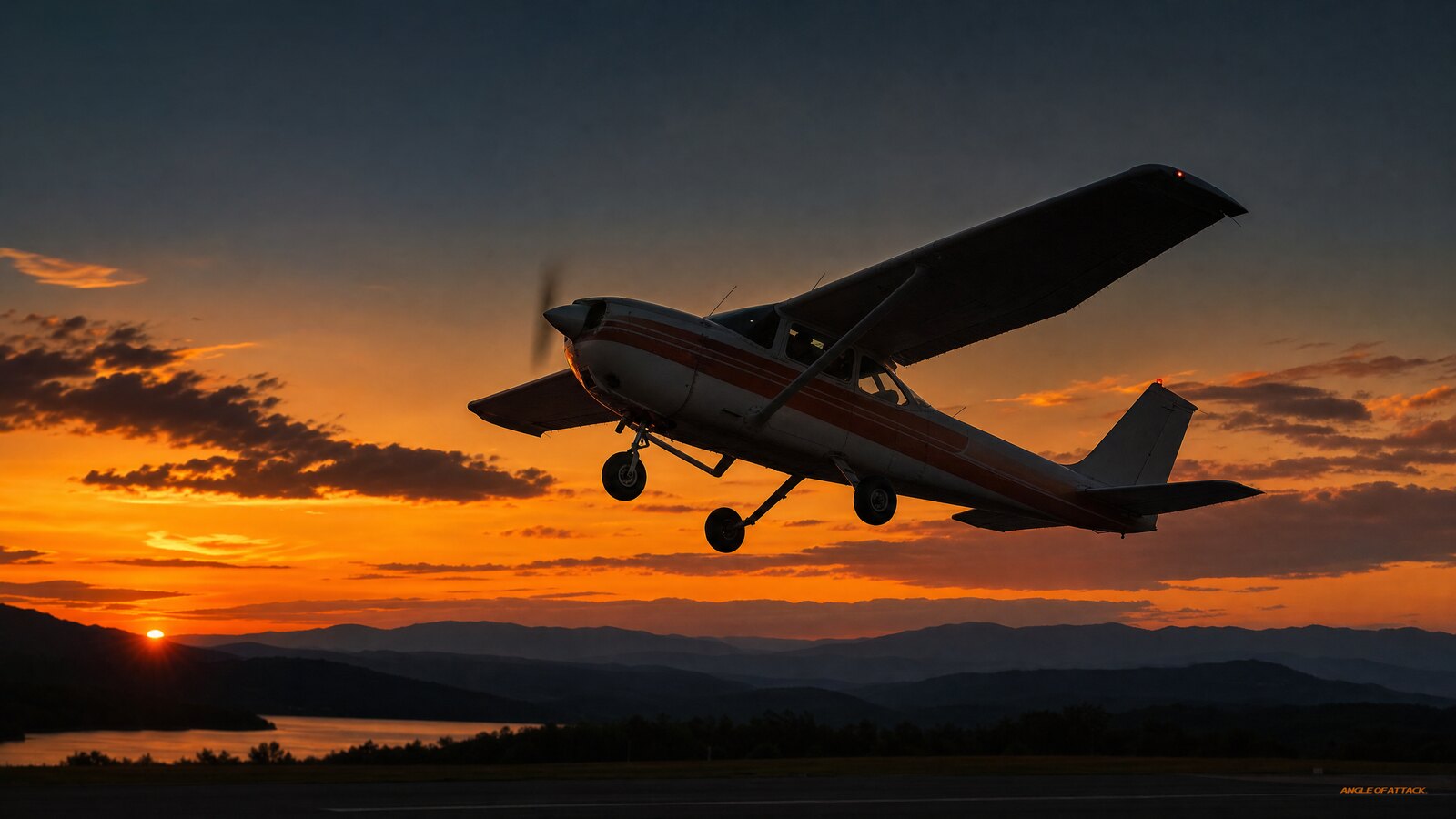
- Pitch is rotation about the lateral axis — the nose-up or nose-down movement of the airplane, controlled by the elevator on the tail.
- The elevator is a primary flight control. The three primary controls — ailerons, elevator, and rudder — move the airplane about its three axes.
- Pitch directly changes angle of attack. Raising the nose increases angle of attack; that’s the link between pitch and lift, stall, and airspeed.
- Trim takes the load off. The trim tab is a secondary flight control that relieves the yoke pressure needed to hold a pitch attitude.
- Pitch is one of three axes — pitch (lateral), roll (longitudinal), and yaw (vertical) together describe everything an airplane does in flight.
- Over-pitching stalls the wing. Pull the nose too high and you exceed the critical angle of attack, and the wing stops flying regardless of airspeed.
WHAT’S IN THIS GUIDE
- 1What does pitch mean in aviation?
- 2What controls pitch on an airplane?
- 3How does pitch relate to angle of attack?
- 4What is the difference between pitch, roll, and yaw?
- 5Does pitch control airspeed or altitude?
- 6How do you read pitch on the instruments?
- 7A real lesson from the cockpit
- 8PLT Study Guide
- 9Frequently Asked Questions
What does pitch mean in aviation?
Pitch in aviation is the rotation of an airplane around its lateral axis — the line running wingtip to wingtip through the center of gravity. When the nose moves up or down relative to the horizon, that is pitch. It’s one of the three fundamental axes of flight, alongside roll and yaw, described in the Pilot’s Handbook of Aeronautical Knowledge (PHAK, FAA-H-8083-25C).
Think of the airplane balanced on a skewer running wingtip to wingtip. Tilt the nose up over that skewer and the tail goes down; drop the nose and the tail rises. The center of gravity is the balance point all three axes pass through — which is why weight and balance matters so much. Pilots call the nose’s position relative to the horizon — nose-high, level, or nose-low — the “pitch attitude,” and recognizing that picture out the windscreen is one of the first skills you build.
What controls pitch on an airplane?
Pitch is controlled by the elevator, a movable surface hinged to the horizontal stabilizer on the tail. The elevator is one of the three primary flight controls — ailerons, elevator, and rudder — which the FAA, in the PHAK, defines as the controls that move the airplane about its axes.
Here’s the mechanical logic. Pull back on the yoke and the elevator deflects up, creating a downward force on the tail. The tail drops, and because the airplane pivots around its center of gravity, the nose rises. Push forward and the opposite happens. (Some airplanes use a one-piece “stabilator,” but the pitch effect is the same.)
To hold a pitch attitude without muscling the yoke all flight, you use trim. The elevator trim tab is a secondary flight control — the FAA groups trim devices, flaps, and spoilers as secondary controls. Set your attitude, trim off the pressure, and the airplane holds that picture hands-light — the fastest way to stop fighting the airplane.
How does pitch relate to angle of attack?
Pitch and angle of attack are closely linked but not identical. Angle of attack is the angle between the wing’s chord line and the relative wind. Raise the nose and you usually increase the angle of attack, which increases lift — up to a point. Past the critical angle of attack, the wing stalls.
This surprises new pilots. You don’t stall because you’re “going too slow” — you stall because you exceeded the critical angle of attack. A wing can stall at any airspeed if you load it hard enough, which is why aggressive nose-up inputs in a steep turn can bite you. Pitch down and you reduce angle of attack and unstall the wing — which is why every stall recovery (covered in the PHAK aerodynamics chapter) starts there.
What is the difference between pitch, roll, and yaw?
Pitch, roll, and yaw are the three rotations an airplane can make, each around a different axis through the center of gravity. Pitch is nose up and down about the lateral axis, roll is wing up and wing down about the longitudinal axis (nose-to-tail), and yaw is nose left and right about the vertical axis. The FAA describes all three in the PHAK; together they account for every movement in flight.
Each axis has its own primary control surface:
| Movement | Axis | Direction of axis | Primary control |
|---|---|---|---|
| Pitch | Lateral | Wingtip to wingtip | Elevator |
| Roll | Longitudinal | Nose to tail | Ailerons |
| Yaw | Vertical | Top to bottom | Rudder |
The easy way to keep them straight: pitch is a porpoise diving and surfacing, roll is barrel-rolling down a hill, and yaw is shaking your head “no.” In real flying these rarely happen alone — a coordinated turn blends roll and yaw with a touch of back pressure (pitch) to hold altitude.
Does pitch control airspeed or altitude?
This is the most argued-about question in primary flight training, and the honest answer is: pitch primarily controls airspeed, and power primarily controls altitude — at least in the stabilized regimes where the FAA teaches it. In a climb, descent, or approach, pull the nose up to slow down; push it down to speed up.
The FAA’s mental model in the Airplane Flying Handbook (AFH, FAA-H-8083-3C): pitch and power are a team you adjust together. On a stabilized final, you pitch for your target airspeed and use power to manage your descent path. You’ll hear instructors fight about this — yank the nose up and you do gain altitude briefly, until the airspeed bleeds off — but as a stable technique, “pitch for airspeed, power for altitude” keeps you out of trouble, especially slow and low on approach. Learn it that way first; the nuance comes later.
Want to understand this instead of memorizing it for the written? Our free Total Student Pilot course walks you through the four forces, the axes, and basic aircraft control — and when you’re ready to go all-in, the Private Pilot Ground School covers every aerodynamics topic on the FAA written.
How do you read pitch on the instruments?
You read pitch directly on the attitude indicator, where a miniature airplane sits against an artificial horizon. When the little airplane’s wings are above the horizon line, you’re nose-up; below it, nose-down. This is the primary pitch instrument, covered by the FAA under basic instrument flying in the Instrument Flying Handbook and the PHAK.
But the attitude indicator only tells you what the nose is doing right now — not the result; the airspeed indicator, altimeter, and VSI confirm that. For visual flying, your real “pitch instrument” is the natural horizon out the windscreen. Good pilots fly attitude first — set the picture, then glance inside to confirm.
A real lesson from the cockpit
I had a student up in a Cessna 172 out of a strip in Alaska who could not stop chasing the altimeter. Every time we leveled off, she’d see us a hair low, haul the nose up to “get the altitude back,” watch the airspeed sag, then shove it down and start over. We porpoised down the valley like that before I called it.
So I covered the altimeter with a sticky note. “Forget the altitude,” I told her. “Set me a level pitch picture over the cowling and trim it off.” She did. The nose settled against that line of spruce on the far ridge, and the airplane just sat there — holding altitude within a hundred feet without her touching a thing, because a trimmed, stable pitch attitude in cruise is level flight.
I’ve been in aviation education since 2006 and a CFI since 2017. The biggest unlock I see in early students is the same one she had that afternoon: they stop flying the needles and start flying the attitude.
PLT Study Guide
The FAA tags knowledge-test questions with PLT (Pilot Learning Statement) codes. These match pitch, axes, and pitch control — in plain-English study points.
| PLT Code | FAA Learning Statement | What to study |
|---|---|---|
| PLT095 | Recall aerodynamics – longitudinal axis / lateral axis | Pitch is rotation about the lateral axis (wingtip to wingtip). Don’t confuse it with the longitudinal (roll) axis, nose to tail. |
| PLT346 | Recall primary / secondary flight controls – types / purpose / functionality / operation | The elevator is the primary control for pitch; ailerons control roll, rudder controls yaw. Trim tabs and flaps are secondary controls. |
| PLT213 | Recall flight characteristics – longitudinal stability / instability | Longitudinal (pitch-axis) stability — how an airplane tends to return to its trimmed pitch attitude, and the role of CG location in that tendency. |
| PLT244 | Recall forces acting on aircraft – stability / controllability | The tail and elevator give you controllability around the pitch axis, while the design gives you stability. |
| PLT186 | Recall basic instrument flying – pitch instruments | The attitude indicator is the primary pitch instrument; airspeed, altimeter, and VSI confirm a pitch change. |
A note on those code numbers: the FAA periodically revises its learning-statement list, so cross-check against the current Airman Certification Standards. The concepts are what’s tested; the exact labels can shift.
Frequently Asked Questions
What is pitch in aviation in simple terms?
Pitch is the up-and-down movement of an airplane’s nose. Pull back on the yoke and the nose pitches up; push forward and it pitches down. Technically, pitch is rotation about the lateral axis — the line running wingtip to wingtip through the center of gravity.
What controls pitch in an airplane?
The elevator controls pitch — the hinged surface on the horizontal tail. Pulling the yoke back raises the elevator, forces the tail down, and brings the nose up. The FAA classifies the elevator as one of the three primary flight controls, with the ailerons and rudder.
Is pitch the same as angle of attack?
No. Pitch is the nose’s position relative to the horizon; angle of attack is the angle between the wing’s chord line and the relative wind. They usually move together, but you can change one without the other — which is why a wing can stall in any pitch attitude.
Does pitch control airspeed or altitude?
In stabilized flight, pitch primarily controls airspeed and power primarily controls altitude. Pull the nose up and you slow down; push it down and you speed up. In practice you adjust pitch and power together — the FAA’s Airplane Flying Handbook teaches them as a team.
What happens if you pitch up too much?
Pitching up too aggressively pushes angle of attack past the critical angle, and the wing stalls — it stops making enough lift to fly. This can happen at any airspeed if you over-pitch or load the wing hard in a turn. Recovery begins with reducing angle of attack by pitching down.
What is the difference between pitch and trim?
Pitch is the nose attitude you set with the elevator. Trim is what holds that attitude for you — the elevator trim tab is a secondary control that relieves the pressure you’d otherwise hold on the yoke. Pitch to the attitude you want, then trim off the pressure so it stays there.
Master every system on your checkride — and on day one.
The Private Pilot Ground School breaks down every FAA subject area in the same plain-English, real-world way you just read — with quizzes, scenarios, and the explanations that finally make it click.
Pitch is the first piece of real airplane control you’ll master, and everything else — climbs, descents, stalls, landings — builds on understanding what that nose movement does. Get comfortable with the picture out the windscreen, learn to trim, and respect the angle of attack behind every pitch input. Do that, and you’re day-one ready to fly the airplane like you mean it.


ON THE SAME TOPIC

What Is Roll in Aviation? The Longitudinal-Axis Motion Every Pilot Controls With the Ailerons
What Is Roll in Aviation? The Longitudinal-Axis Motion Every Pilot Controls With the Ailerons 14 min read Last updated June 2026 · Chris Palmer In aviation, roll is the rotation of an airplane around its longitudinal axis — the imaginary line running nose to tail through the center of gravity. Rolling raises one wingtip and […]
 Read more
What Is Restricted Airspace? Special Use Airspace Explained
What Is Restricted Airspace? Special Use Airspace Explained 15 min read Last updated June 2026 · Chris Palmer Restricted airspace is a type of special use airspace where flight is not entirely prohibited but is subject to restrictions because of unusual, often invisible hazards to aircraft — such as artillery fire, aerial gunnery, or guided […]
Read more 
RAIM vs WAAS: What Every Pilot Should Know About GPS Integrity
RAIM vs WAAS: What Every Pilot Should Know About GPS Integrity 15 min read Last updated June 2026 · Chris Palmer RAIM (Receiver Autonomous Integrity Monitoring) is a self-check your GPS receiver runs to confirm its position is trustworthy, while WAAS (the Wide Area Augmentation System) is an FAA ground-and-satellite network that corrects GPS signals […]
Read more 
What Is Radiation Fog? Why Calm, Clear Nights Hide the Worst IMC
What Is Radiation Fog? Why Calm, Clear Nights Hide the Worst IMC 28 min read Last updated June 2026 · Chris Palmer Radiation fog is a ground-based fog that forms on clear, calm nights when the earth radiates its heat away into space, the ground cools, and the air touching it chills down to its […]
Read more 
Stay Connected
Be the very first to get notified when we publish new flying videos, free lessons, and special offers on our courses.
