
What Is Slow Flight? Flying on the Edge of the Stall — and Owning It
Slow flight is flying the airplane at an airspeed just above a stall — a high angle of attack, mushy controls, and often the stall warning chirping — where any further increase in pitch or load would stall the wing. You hold altitude, heading, and airspeed with constant power, pitch, and rudder corrections, learning the airplane’s behavior at the slow end of its speed range.
Most students brace for slow flight like it’s a punishment. It isn’t. It’s where you finally start feeling the airplane instead of just driving it. When the controls go sloppy and the horn won’t shut up, you’re operating right at the doorstep of the stall — and the whole point is to live there comfortably, in control, on purpose. Every landing you ever make ends in slow flight. So does every short-field takeoff and every soft-field departure. Get good here, and the rest of your flying gets easier.
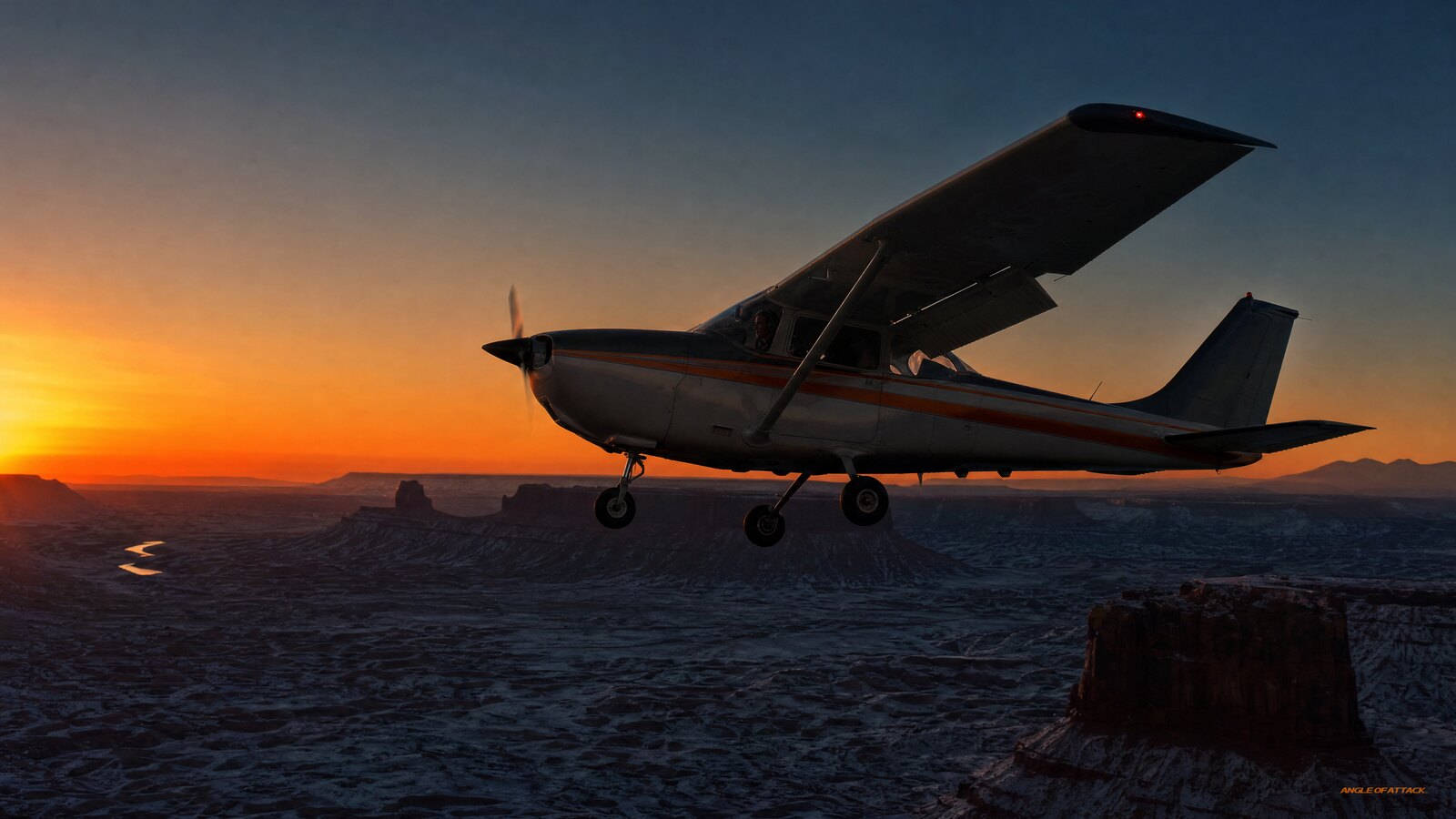
- Slow flight means flying just above the stall. You’re at a high angle of attack with the stall warning often active, where increasing pitch or load would stall the wing.
- A wing stalls at an angle, not a speed. The wing reaches its critical angle of attack at low airspeed in slow flight — the same angle that stalls it in any other regime.
- You’re flying on the “back side of the power curve.” In slow flight, it takes more power to fly slower, because induced drag rises sharply as airspeed drops.
- Pitch and power trade jobs. Down low and slow, pitch controls airspeed and power controls altitude — the reverse of cruise instincts.
- Rudder becomes your best friend. At high power and low airspeed, left-turning tendencies are strong; coordinated rudder keeps the ball centered and prevents a spin entry.
- This is the foundation of every takeoff and landing. Slow flight builds the control feel and stall recognition you use every time you leave or return to the runway.
WHAT’S IN THIS GUIDE
- 1What is slow flight?
- 2Why do we practice slow flight?
- 3What actually happens to the wing in slow flight?
- 4What is the region of reversed command?
- 5How do you fly slow flight step by step?
- 6Slow flight vs. a stall: what’s the difference?
- 7What does the ACS require for slow flight?
- 8A lesson from a short Alaska strip
- 9PLT Study Guide
- 10Frequently Asked Questions
What is slow flight?
Slow flight is the deliberate practice of flying an airplane at an airspeed just above its stalling speed, at a high angle of attack, where the flight controls feel soft and the stall warning is frequently active. You maintain altitude, heading, and a target airspeed using coordinated pitch, power, and rudder. The FAA covers this maneuver in the Airplane Flying Handbook (FAA-H-8083-3C, Chapter 3, Basic Flight Maneuvers) under “Maneuvering During Slow Flight.”
The current FAA standard frames slow flight as flying at an airspeed above the speed where the stall warning activates — so the horn or light may chirp intermittently, but you are not trying to provoke a full stall. You’re hunting for the slowest speed at which you can still hold the airplane steady and controllable.
You’ll sometimes hear it called “flight at minimum controllable airspeed” or “MCA,” an older term. The idea is the same: you’re operating at the slow edge of the airplane’s envelope, where small inputs matter a lot and sloppy flying gets you a stall.
Why do we practice slow flight?
We practice slow flight because every takeoff and every landing happens at the slow end of the speed range, and that’s exactly where stalls and loss-of-control accidents cluster. Learning to fly precisely while slow — holding altitude, recognizing the stall coming, and keeping the airplane coordinated — builds the instinct that keeps you alive in the traffic pattern.
Think about what a normal approach actually is. You’re slow on purpose, flaps extended, nose attitude unfamiliar, and you’re splitting attention between airspeed, the runway, and traffic. That is slow flight, every single time. The maneuver just lets you rehearse it at a safe altitude before you do it three feet off the pavement.
Slow flight also teaches feel. In cruise the airplane is forgiving and the controls are crisp. Down at minimum speed, the same control inputs feel mushy and lazy, and you learn how much rudder it really takes to stay coordinated when the engine is working hard and the airplane is barely flying. That awareness transfers directly to short-field and soft-field work, go-arounds, and recovering from an unexpected slow, sloppy situation in the pattern.
What actually happens to the wing in slow flight?
In slow flight, the wing is producing the same lift it makes in cruise — enough to balance the airplane’s weight — but it’s doing that job at a much higher angle of attack because the airspeed is so low. The angle of attack is the angle between the wing’s chord line and the oncoming air. As you slow down, you must raise the nose to keep that angle high enough to make lift, which is why slow flight is a nose-high maneuver.
Here’s the concept that ties this whole article together: the wing always stalls at its critical angle of attack, no matter the airspeed. In slow flight you’re flying close to that critical angle deliberately. There isn’t much margin left, so any sudden pitch-up, a steep bank, a gust, or a clumsy pull on the yoke can push the wing past critical and stall it. The Pilot’s Handbook of Aeronautical Knowledge (FAA-H-8083-25C) is direct about this — a wing can stall at any airspeed if it exceeds the critical angle of attack.
Because you’re flying at high angle of attack, induced drag is high, the controls are less responsive, and the airplane is more sluggish in roll and yaw. That’s not the airplane being broken — that’s the airplane telling you exactly where you are in its envelope.
What is the region of reversed command?
The region of reversed command is the slow-flight regime where it takes more engine power to fly slower — the opposite of normal cruise. In cruise, pulling power slows you down; in the region of reversed command, slowing down actually requires adding power to stay level, because induced drag rises so sharply at low airspeed. The Airplane Flying Handbook describes this as flight on the “back side of the power curve.”
This is why slow flight feels counterintuitive at first. To hold altitude as you slow toward minimum airspeed, you keep adding power even though you’re going slower. If you let the nose creep up without enough power, you sink. If you chase altitude with pitch alone, you slow further, drag climbs again, and you can dig yourself into a sinking, near-stall situation that pitch alone won’t fix.
That’s the lesson the region of reversed command burns in: down here, pitch controls airspeed and power controls altitude. It reverses the rough cruise habit where you “point and shoot” with the yoke. Master that trade, and a stabilized slow approach stops being a fight.
| Flight regime | Effect of slowing down | Primary altitude control | Control feel |
|---|---|---|---|
| Normal command (cruise) | Less power needed to fly slower | Pitch (point the nose) | Crisp, responsive |
| Region of reversed command (slow flight) | More power needed to fly slower | Power (throttle) | Soft, mushy, sluggish |
How do you fly slow flight step by step?
You fly slow flight by methodically slowing the airplane while trading pitch and power, then holding a stable, controllable attitude at minimum airspeed. The exact numbers come from your airplane’s POH and your instructor, but the sequence is consistent across light trainers like the Cessna 172. Always complete clearing turns and pick an altitude that allows recovery — the ACS calls for entering at an altitude that allows the task to finish no lower than 1,500 feet AGL.
- Clear the area and set up. Do clearing turns, note your altitude, and reduce power to begin slowing.
- Pitch up to hold altitude as you slow. As airspeed bleeds off, raise the nose to maintain altitude. Trim off the pressure as you go.
- Configure as required. Add flaps if your instructor or the task calls for it, adjusting pitch for each change.
- Add power to arrest the descent. Approaching minimum airspeed, you’ll need to add power to hold altitude — that’s the region of reversed command at work.
- Stabilize at minimum controllable airspeed. Settle at the slowest speed where you can hold altitude and heading; the stall warning may chirp intermittently.
- Fly the airplane with rudder. At high power and low airspeed, left-turning tendencies are strong. Keep the ball centered. Use coordinated aileron and rudder for any turns, and keep banks shallow.
- Recover smoothly. To exit, lower the nose slightly to reduce angle of attack, add full power, retract flaps on schedule, and accelerate back to a normal climb or cruise.
The biggest rookie mistake is forgetting your feet. With the prop biting hard and the airplane barely flying, you need real rudder to stay coordinated. Let the ball slide out in a turn down here and you’ve set up the classic uncoordinated, slow, cross-controlled situation that leads to a spin.
Slow flight vs. a stall: what’s the difference?
Slow flight and a stall live right next to each other, but they are not the same thing. In slow flight, the wing is still flying — the airflow is attached and producing lift, even though you’re at a high angle of attack with the stall warning chirping. A stall happens the instant you exceed the critical angle of attack: airflow separates from the upper surface, lift drops sharply, and the airplane begins to sink or the nose pitches down.
The practical line between them is angle of attack, not airspeed. Slow flight keeps you just below the critical angle; a stall is what you get when you cross it. That’s why slow flight is such good stall-prevention training — you spend the whole maneuver learning to recognize the cues (mushy controls, high nose, the warning horn) that tell you the wing is getting close to quitting.
| Slow flight | Stall | |
|---|---|---|
| Wing status | Still flying, airflow attached | Airflow separated, lift lost |
| Angle of attack | High, but below critical | At or beyond critical |
| Stall warning | May chirp intermittently | Active, often continuous |
| Pilot goal | Hold altitude, heading, airspeed | Recognize and recover |
| Recovery action | Lower nose slightly, add power | Reduce AoA first, then add power |
If you want the deeper stall mechanics, our Total Student Pilot course walks through angle of attack and stall recognition in plain language with cockpit video — it’s free, and it pairs perfectly with the slow-flight work you’ll be doing with your instructor.
What does the ACS require for slow flight?
The Private Pilot Airman Certification Standards (ACS) requires you to establish and maintain slow flight at an airspeed above the stall warning, while holding altitude, heading, and airspeed within defined tolerances and keeping the airplane coordinated. Your examiner is checking that you can fly precisely on the slow edge of the envelope without stalling, and that you recognize and correct a developing stall promptly if it occurs.
In broad strokes, the ACS expects you to clear the area, establish slow flight in the specified configuration, and hold your parameters — altitude, heading, and airspeed — within the published tolerances. You’re expected to maintain coordinated flight and to apply correct control inputs throughout, including using power and pitch appropriately in the region of reversed command. Always fly the current ACS and POH numbers your instructor gives you, since the FAA updates these documents.
The mindset that matters most isn’t just passing the ride. It’s being day-one ready: the same precision and stall awareness the ACS measures is exactly what protects you on a gusty, slow final into a strip you’ve never seen.
A lesson from a short Alaska strip
I’ve been in aviation education since 2006 and a CFI since 2017, and slow flight is the maneuver where I watch students go from operating an airplane to genuinely flying one. I remember working with a student up here in Alaska who flew clean cruise and decent stalls but kept ballooning and chasing the runway on landing. On paper, fine. In the flare, a mess.
So we went up and just did slow flight. No landings. We bored holes in the sky over a wide valley at minimum controllable airspeed in the 172 for the better part of an hour — power high, nose up, horn chirping, ball centered with rudder. I had him hold altitude with the throttle and airspeed with the yoke until it stopped feeling backward. Then I had him do shallow turns at minimum speed, feeling how little aileron and how much rudder it really took.
The next lesson, his landings transformed. Not because we practiced landings — because he finally understood the picture and the feel of the airplane barely flying, which is all a landing flare really is. That’s the secret I’d give any student: a landing is just slow flight that ends at the ground. Get comfortable on the edge up high, with altitude underneath you, and the runway stops being scary.
If you want to go from “doing the maneuver” to truly understanding the aerodynamics behind it, the Private Pilot Ground School breaks down slow flight, the region of reversed command, and stall behavior with the kind of cockpit video and clear explanations that make it stick long before your checkride.
PLT Study Guide
These FAA Learning Statement (PLT) codes map to the knowledge behind slow flight. On your written exam, questions in these areas test whether you understand the aerodynamics, not just the procedure.
| PLT Code | FAA Learning Statement | What to know for slow flight |
|---|---|---|
| PLT168 | Recall angle of attack – characteristics / forces / principles | Slow flight is a high-angle-of-attack maneuver. Know that the wing makes lift at a high AoA when slow, and that the critical angle of attack — not airspeed — is what stalls a wing. |
| PLT242 | Recall forces acting on aircraft – lift / drag / thrust / weight / stall / limitations | Understand why induced drag rises as airspeed drops, why slow flight requires more power to fly slower (region of reversed command), and how lift, drag, thrust, and weight balance at minimum airspeed. |
| PLT245 | Recall forces acting on aircraft – stalls / spins | Slow flight is flown just above the stall. Know how an uncoordinated, slow, cross-controlled condition can lead to a spin, and why coordinated rudder matters most when slow and at high power. |
| PLT477 | Recall stalls – characteristics / factors / recovery / precautions | Recognize the cues of an impending stall — mushy controls, high nose, stall warning — and the recovery: reduce angle of attack first, then add power. Slow flight is stall-prevention practice. |
| PLT219 | Recall flight operations – maneuvers | Know the purpose, entry, and execution of slow flight as a flight-training maneuver, including configuration, clearing turns, altitude requirements, and coordinated control use. |
Frequently Asked Questions
What is slow flight in simple terms?
Slow flight is flying the airplane at an airspeed just above a stall, with the nose high and controls feeling soft. You hold altitude, heading, and airspeed using careful pitch, power, and rudder inputs while operating at a high angle of attack near the edge of the airplane’s flight envelope.
Is slow flight dangerous?
Not when done correctly at a safe altitude. Slow flight is a standard training maneuver flown high enough to recover fully — the ACS expects entry that allows finishing no lower than 1,500 feet AGL. The risk comes from being uncoordinated or careless near the stall, which is exactly the discipline the maneuver teaches you.
Why does slow flight require more power to fly slower?
Because you’re in the region of reversed command. As airspeed drops toward minimum, induced drag rises sharply, so you must add power just to hold altitude. This is the “back side of the power curve,” and it reverses the cruise habit where reducing power slows you down.
What airspeed is slow flight flown at?
Current FAA guidance has you fly at an airspeed just above the speed where the stall warning activates — so the horn may chirp intermittently. The exact speed depends on your airplane, weight, and configuration. Use the numbers in your POH and the targets your instructor gives you rather than a single fixed value.
What’s the difference between slow flight and a stall?
In slow flight the wing is still flying, with airflow attached, even at a high angle of attack. A stall happens when you exceed the critical angle of attack and airflow separates, so lift drops. Slow flight stays just below that critical angle; crossing it is what produces the stall.
Why is rudder so important in slow flight?
At low airspeed and high power, left-turning tendencies are strong and the airplane wants to yaw. Coordinated rudder keeps the ball centered. An uncoordinated, slow, cross-controlled condition is the classic setup for a spin, so keeping coordinated with your feet is a core safety habit in slow flight.
How does slow flight help my landings?
Every landing flare is essentially slow flight that ends at the runway — nose high, airspeed low, controls soft. Practicing slow flight at altitude builds the sight picture and control feel you use in the flare, so your landings get smoother once you’re comfortable flying the airplane barely above a stall.
Is “minimum controllable airspeed” the same as slow flight?
Essentially, yes. “Flight at minimum controllable airspeed” (MCA) is the older term for slow flight. Both describe operating at the slowest airspeed where the airplane stays controllable and can hold altitude and heading. The FAA’s current standard refines the target speed but the core skill is identical.
Master every system on your checkride — and on day one.
The Private Pilot Ground School breaks down every FAA subject area in the same plain-English, real-world way you just read — with quizzes, scenarios, and the explanations that finally make it click.
Slow flight gets a bad reputation it doesn’t deserve. Yes, the controls go mushy, the horn chirps, and the airplane feels like it’s hanging on by its fingernails — but that’s the point. The more time you spend comfortable on that edge, the calmer and more precise every takeoff, landing, and go-around becomes. Don’t avoid it. Lean into it, keep the ball centered, and let the airplane teach you what it feels like to fly slow and stay in command.


ON THE SAME TOPIC
IFR vs VFR: The Two Sets of Rules Every Pilot Flies By
IFR vs VFR: The Two Sets of Rules Every Pilot Flies By 19 min read Last updated June 2026 · Chris Palmer The difference between IFR and VFR is which set of rules you fly under. VFR — visual flight rules — lets you navigate by looking outside and staying clear of clouds in good […]
 Read more
ASOS vs AWOS vs ATIS: How to Pull the Right Weather Before You Fly
ASOS vs AWOS vs ATIS: How to Pull the Right Weather Before You Fly 13 min read Last updated June 2026 · Chris Palmer The difference comes down to who is talking and what the broadcast covers. ASOS and AWOS are automated, computer-generated weather observations of the conditions right at the field. ATIS is a […]
Read more 
What Is RNAV Navigation? Area Navigation for VFR Pilots
What Is RNAV Navigation? Area Navigation for VFR Pilots 17 min read Last updated June 2026 · Chris Palmer RNAV — Area Navigation — is a method that lets an aircraft fly any desired path within the coverage of ground- or space-based navigation aids, rather than being forced to fly directly to and from stations. […]
Read more 
NDB and ADF Explained: The Oldest Radio Nav System You Still Need to Understand
NDB and ADF Explained: The Oldest Radio Nav System You Still Need to Understand 16 min read Last updated June 2026 · Chris Palmer An NDB (non-directional beacon) is a ground-based radio transmitter that sends a signal in all directions, and an ADF (automatic direction finder) is the cockpit receiver whose needle points straight at […]
Read more 
Stay Connected
Be the very first to get notified when we publish new flying videos, free lessons, and special offers on our courses.
