
What Is the Difference Between a Turbofan and a Turbojet? The Big Fan Out Front
A turbojet pushes all of its air through the engine core, burning it and blasting it out the back as a high-speed jet. A turbofan adds a large fan up front that pushes most of its air around the core instead of through it. That bypass air produces the bulk of a turbofan’s thrust, making it far quieter and more fuel-efficient than a pure turbojet.
You won’t fly a turbojet or a turbofan for your private certificate — you’ll be behind a four-stroke piston engine pulling a propeller. But the question comes up constantly, because almost every jet you see overhead is a turbofan, and understanding the difference is one of those things that makes the rest of turbine engines click. So let’s stand back from the ramp and look at what that big fan on the front of an airliner is actually doing, the way I’d explain it pointing up at a passing jet.
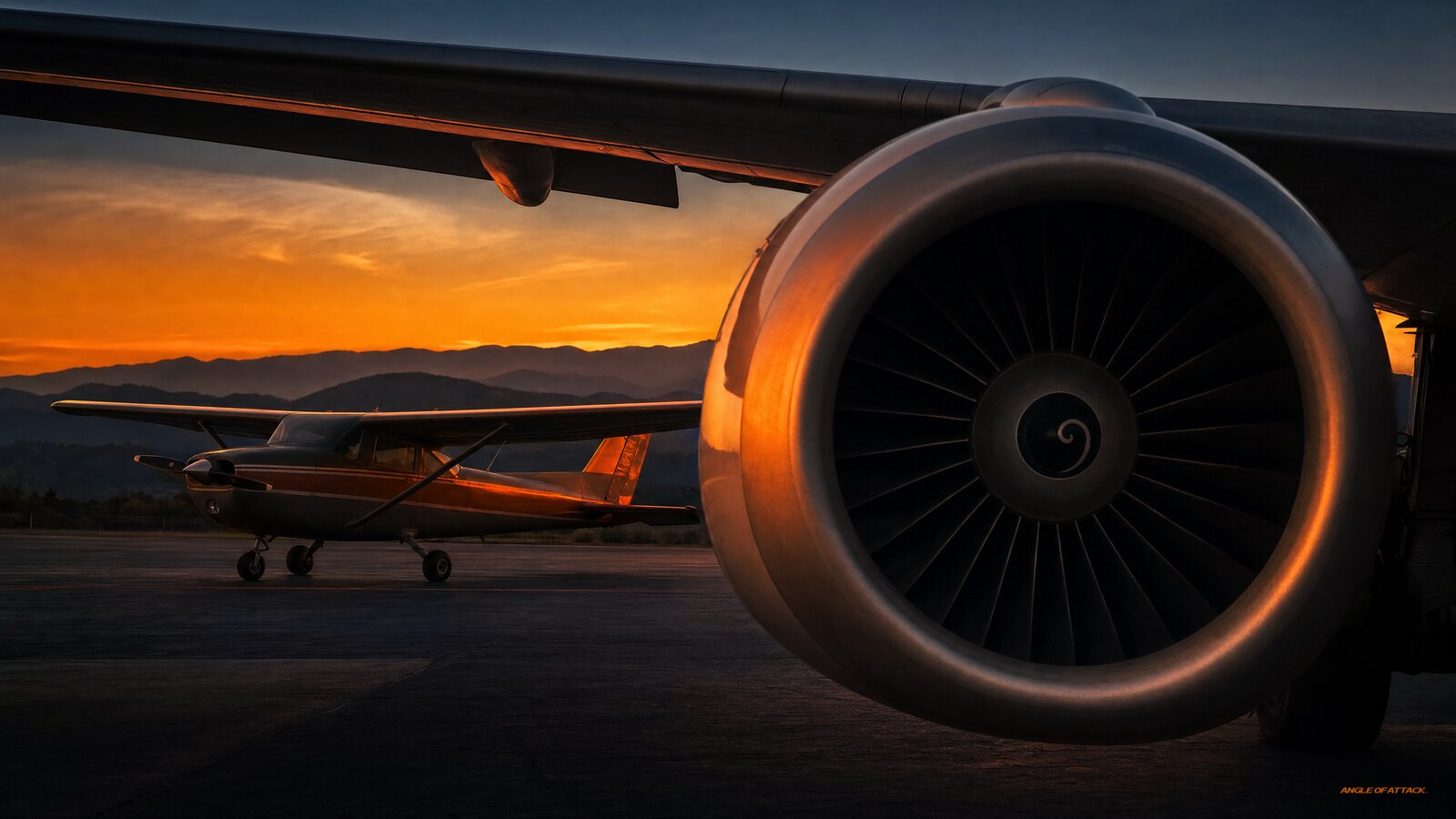
- Both are jet engines. A turbojet and a turbofan are both gas-turbine engines that work on the same Newton’s-third-law principle — accelerate air rearward, and the reaction pushes the airplane forward.
- The fan is the whole difference. A turbofan adds a large fan ahead of the core. That fan moves a huge volume of air, most of which bypasses the burning core entirely.
- Bypass air does the heavy lifting. In a modern high-bypass turbofan, the fan produces the large majority of the thrust. The hot core exhaust contributes only a fraction.
- Turbofans are quieter and thriftier. Moving more air more slowly is more efficient and far less noisy than blasting a small amount of air out very fast, which is what a pure turbojet does.
- Turbojets shine only at very high speed. A pure turbojet is efficient near and above the speed of sound, which is why it survives mainly in military and supersonic designs, not airliners.
- It’s all one engine family. Turbojet, turbofan, turboprop, and turboshaft are all gas-turbine engines built around the same core. They just put the energy to work in different ways.
WHAT’S IN THIS GUIDE
- 1What is the difference between a turbofan and a turbojet?
- 2How does a turbojet engine work?
- 3How does a turbofan engine work?
- 4What is bypass ratio and why does it matter?
- 5Why are turbofans quieter and more fuel-efficient?
- 6Turbofan vs. turbojet: a side-by-side comparison
- 7Where does the turboprop fit in?
- 8Watching a turbofan spool up taught a student the difference
- 9PLT Study Guide
- 10Frequently Asked Questions
What is the difference between a turbofan and a turbojet?
The core difference is the fan. A turbojet sends all of its incoming air through the engine core — compressor, combustor, and turbine — and produces thrust entirely from the high-speed exhaust jet. A turbofan adds a large fan at the front; most of the air that fan moves bypasses the core and is accelerated rearward as a separate, slower, much larger stream of air that produces most of the engine’s thrust.
Both are gas-turbine (jet) engines, and both follow the same physics. The FAA’s Pilot’s Handbook of Aeronautical Knowledge (PHAK, FAA-H-8083-25C) describes the gas-turbine engine as one that produces thrust by accelerating a mass of air rearward — Newton’s third law, the same reaction principle behind every jet. The turbojet and the turbofan simply make that happen with different amounts of air at different speeds.
If you remember nothing else, remember this picture: the turbojet is a small amount of air thrown out the back very fast, and the turbofan is a large amount of air pushed out the back more gently. That single trade — more air, lower speed — is why modern airliners are turbofans and why they’re so much quieter than the early jets your grandparents flew on.
How does a turbojet engine work?
A turbojet works by drawing air through an inlet, compressing it, mixing it with fuel and burning it, then expelling the hot, expanding gas through a turbine and out a nozzle at high speed. The PHAK describes the gas-turbine cycle in a simple chain: the compressor squeezes incoming air, the combustion section adds fuel and ignites it, and the turbine extracts just enough energy from the hot gas to keep the compressor spinning — everything left over leaves as a high-velocity exhaust jet that produces thrust.
In a pure turbojet, all of the thrust comes from that exhaust jet. The whole engine is essentially a tube: air goes in the front, gets compressed and burned in the middle, and rockets out the back. Because it accelerates a relatively small mass of air to a very high speed, a turbojet is loud and burns a lot of fuel for the thrust it makes at the speeds airliners actually fly.
Where the turbojet earns its keep is at very high speed. As an airplane approaches and exceeds the speed of sound, the turbojet’s high-velocity exhaust becomes efficient rather than wasteful. That’s why pure turbojets live on in military fighters, older supersonic designs, and missiles — and why they were the engine of choice on the first generation of jet airliners before the fan took over.
How does a turbofan engine work?
A turbofan works exactly like a turbojet at its core — compress, burn, expand through a turbine — but it adds a large fan at the front, driven by the turbine, that moves a big volume of air. A portion of that air goes through the core to be burned, but most of it bypasses the core entirely, flowing around it through a duct and exiting as a large, slower stream that produces the majority of the engine’s thrust.
Think of the core as the engine that powers the fan, and the fan as the part that actually moves the airplane. The turbine in a turbofan is built to extract more energy from the hot gas than a turbojet needs, and use it to spin that big fan. The result is two streams of thrust: a smaller, hotter jet from the core, and a much larger, cooler stream of bypass air from the fan.
This is the engine on nearly every airliner and business jet flying today — the Boeing 737, the Airbus A320, the regional jets, the Gulfstreams. When you look at a modern jet engine and see that huge fan face filling the front of the nacelle, you’re looking at the defining feature of a turbofan. The bigger that fan relative to the core, the more the engine behaves like a giant ducted propeller, and the more efficient it becomes at airline cruise speeds.
What is bypass ratio and why does it matter?
Bypass ratio is the proportion of air that goes around the core compared to the air that goes through it. A high-bypass turbofan sends many times more air around the core than through it, while a low-bypass turbofan sends only a little extra air around the core. The higher the bypass ratio, the more of the engine’s thrust comes from the cool fan stream rather than the hot core exhaust — and the more fuel-efficient and quieter the engine becomes at subsonic cruise.
Modern airliner engines are high-bypass turbofans, which is exactly why they have those enormous fan faces. Most of the work is being done by air that never gets burned at all — it’s just pushed rearward by the fan, like a propeller hidden inside a duct. A pure turbojet, by contrast, has effectively no bypass: every bit of air goes through the core. The low-bypass turbofans you’ll find on military fighters sit in between, trading some efficiency for compact, high-speed performance.
For a student pilot, you don’t need to memorize specific bypass numbers, and the figures vary widely by engine, so it’s better to understand the trend than to chase a value. The takeaway is the direction: more bypass means quieter and thriftier at the speeds airliners fly; less bypass means better performance up near and beyond the speed of sound. That one spectrum explains almost every design choice in the jet world.
Why are turbofans quieter and more fuel-efficient?
Turbofans are quieter and more fuel-efficient because they move a large mass of air at a lower velocity, instead of a small mass of air at a very high velocity. Jet noise rises steeply with exhaust speed, so the slower bypass stream of a turbofan is dramatically quieter than the screaming exhaust of a pure turbojet. And because thrust can be made more efficiently by accelerating more air a little than by accelerating less air a lot, the turbofan also burns far less fuel at airline cruise speeds.
There’s a useful parallel here to something you’ll feel in your own training airplane. A propeller is efficient because it moves a large column of air at a modest speed. A high-bypass turbofan is doing essentially the same thing — its fan is a many-bladed propeller wrapped in a duct, moving a lot of air gently. That’s why the trend in jet engines over the decades has been bigger and bigger fans: it’s the same reason your trainer uses a propeller instead of a rocket.
This efficiency-and-noise story is the whole reason the airline world abandoned pure turbojets. The first jetliners were loud and thirsty. As engineers added fans and grew them, airplanes got quieter, cheaper to operate, and able to fly farther on the same fuel. The pure turbojet didn’t disappear because it was bad — it disappeared from airliners because the turbofan was simply better for the job airliners do.
Turbofan vs. turbojet: a side-by-side comparison
The fastest way to lock in the difference is to lay the two engines side by side. Both share the same gas-turbine core, but the fan changes nearly everything about how the engine behaves — where its thrust comes from, how loud it is, how much fuel it burns, and the speed range where it makes sense. Here’s how the two line up:
| Factor | Turbojet | Turbofan |
|---|---|---|
| Where thrust comes from | Entirely the hot core exhaust jet | Mostly the cool bypass-fan air |
| Bypass air | None — all air goes through the core | Large stream bypasses the core |
| Fan up front | No fan | Large fan, the defining feature |
| Noise | Very loud (high exhaust speed) | Much quieter (lower exhaust speed) |
| Fuel efficiency (subsonic) | Poor | High |
| Best speed range | Near and above the speed of sound | Subsonic airline cruise |
| Where you’ll see it | Military fighters, supersonic and older designs | Nearly all airliners and business jets |
The practical reading of this table is simple: if it’s a normal jet flying at normal airline speeds, it’s a turbofan, and the big fan is why. If it’s something built to punch through the sound barrier — a fighter, an older supersonic transport — there’s a good chance it’s a pure turbojet or a low-bypass design closer to a turbojet. The mission picks the engine.
For your purposes as a private pilot, you only need to carry the concept: same core, the fan is the difference, and the fan is why airliners are quiet and efficient. That’s the mental model that lets every turbine-engine question on a knowledge test make sense instead of feeling like memorization.
Where does the turboprop fit in?
A turboprop is the same gas-turbine core again, but instead of using the energy to make a jet of exhaust or to spin an internal fan, it uses almost all of it to turn an external propeller through a reduction gearbox. The PHAK groups turboprops with the other gas-turbine engines because the heart of the engine is identical — what changes is how the power gets to the air. A turboprop is essentially a turbine engine driving a propeller.
This matters because it shows you that turbojet, turbofan, and turboprop aren’t three unrelated machines — they’re three ways of using one gas-turbine core. The turbojet throws the energy out the back as a fast jet. The turbofan uses some of it to spin a big internal fan. The turboprop sends nearly all of it to an external propeller. There’s even a fourth, the turboshaft, which sends the power out a shaft to drive a helicopter rotor.
You’ll meet turboprops well before you meet jets — many advanced trainers, regional airliners, and bush airplanes up here in Alaska run turboprops, and they’re a common step on the way to a turbine career. Seeing the whole family on one spectrum, from propeller to fan to pure jet, is what turns “turbine engines” from a confusing list into a single idea you actually understand.
If you want this kind of systems knowledge taught the way it actually clicks — building from the piston engine you’ll fly behind up through how the bigger machines work — our Private Pilot Ground School walks through aircraft systems with clear cockpit visuals so the concepts stick instead of getting memorized for a test and forgotten.
Watching a turbofan spool up taught a student the difference
I had a student a few summers back who could recite the difference between a turbofan and a turbojet off a flashcard but didn’t really see it. We were waiting out some weather on the ramp, a regional jet was getting ready to taxi, and I pointed at the engine and asked him what he was actually looking at.
He gave me the textbook answer — fan up front, bypass air, more efficient. Then the engines started to spool, that low building whoosh you feel as much as hear, and I asked him: where’s most of that air going? He paused, watched the fan blur up to speed, and you could see it land. Most of that air wasn’t getting burned. It was just being shoved out the back by that big fan, like a propeller in a can.
Nothing technical happened. We just stood there and watched an engine. But that was the moment the flashcard turned into understanding. He stopped picturing a tube full of fire and started picturing a fan moving a wall of air, with a small hot core buried in the middle doing the work of spinning it.
Here’s what I wanted him to carry forward. You don’t memorize the difference between these engines — you picture it. Same core in all of them; the question is always where the energy goes. Throw it out the back fast and you have a turbojet. Use it to spin a big fan and you have a turbofan. Once you can see the air instead of reciting the definition, the whole turbine family stops being a list and becomes one simple idea you can reason your way through.
PLT Study Guide
The FAA tags knowledge-test questions with PLT (Pilot Learning Statement) codes. These are the codes whose official FAA wording actually maps to turbine engines and how a turbofan differs from a turbojet, translated into plain study points. (Note: the codes sometimes paired with this topic — PLT250, about fuel types, characteristics, and contamination, and PLT243, about propeller and torque forces — don’t apply here. PLT250 is fuel handling, and PLT243 is about propeller-driven forces, not turbine thrust. Ignore both for this subject.)
PLT499 — Recall turbine engines: components, operational characteristics, and associated instruments.
This is the core code for the topic. Know that turbojets and turbofans are both gas-turbine engines built around a compressor, combustor, and turbine, and understand the defining difference: the turbofan adds a large front fan whose bypass air produces most of its thrust, making it quieter and more efficient than a pure turbojet.
PLT343 — Recall powerplant: operating principles, operational characteristics, and inspecting.
Understand the basic operating principle shared by all jet engines — air is compressed, fuel is added and burned, and the expanding gas is accelerated rearward to produce thrust by reaction. Know how the turbofan splits that airflow into a core stream and a bypass stream, and why that changes the engine’s noise and fuel burn.
PLT500 — Recall turboprop engines: components and operational characteristics.
Know where the turboprop fits in the gas-turbine family: the same core, but the energy drives an external propeller through a reduction gearbox rather than producing a jet of exhaust. Seeing turbojet, turbofan, and turboprop as three uses of one core is the easiest way to keep them straight.
Frequently Asked Questions
What is the main difference between a turbofan and a turbojet?
The main difference is the fan. A turbojet sends all of its air through the core and produces thrust entirely from the hot exhaust jet. A turbofan adds a large front fan whose bypass air flows around the core and produces most of the thrust, making it quieter and far more fuel-efficient.
Is a turbofan a type of jet engine?
Yes. A turbofan is a type of gas-turbine (jet) engine. It shares the same core as a turbojet (compressor, combustor, and turbine) but adds a large fan that moves a big volume of bypass air around the core. Both engines produce thrust by accelerating air rearward, following Newton’s third law.
Why do airliners use turbofans instead of turbojets?
Airliners use turbofans because they’re much quieter and burn far less fuel at subsonic cruise speeds. A turbofan moves a large mass of air at a lower speed, which is both more efficient and dramatically quieter than the small, high-speed exhaust jet of a pure turbojet. That efficiency is why turbofans replaced turbojets on airliners.
What does bypass ratio mean?
Bypass ratio is how much air goes around the engine core compared to how much goes through it. A high-bypass turbofan moves many times more air around the core than through it, producing most of its thrust from the cool fan stream. Higher bypass means quieter, more fuel-efficient operation at airline cruise speeds.
Are turbojets still used today?
Pure turbojets are rare in modern aviation. They survive mainly in military fighters, missiles, and older or supersonic designs, where their high-speed exhaust is efficient near and above the speed of sound. For the subsonic speeds airliners fly, the turbofan is so much better that it long ago replaced the turbojet.
What is the difference between a turbofan and a turboprop?
A turbofan uses its turbine to spin a large internal fan that moves bypass air for thrust. A turboprop uses its turbine to drive an external propeller through a reduction gearbox. Both share the same gas-turbine core — they just differ in whether the air-moving device is an internal fan or an external propeller.
Will I fly a turbofan or turbojet as a private pilot?
No. As a student and private pilot you’ll fly behind a four-stroke piston engine turning a propeller. Turbine engines come later, in advanced training or a professional pilot career. But understanding the turbofan-versus-turbojet difference now gives you a head start and makes turbine-engine knowledge-test questions much easier.
Master every system on your checkride — and on day one.
The Private Pilot Ground School breaks down every FAA subject area in the same plain-English, real-world way you just read — with quizzes, scenarios, and the explanations that finally make it click.
Picture the air, not the flashcard, and the whole turbine family falls into place: one gas-turbine core, three or four ways to use it. Throw the energy out the back fast and you have a turbojet; use it to spin a big fan and you have a turbofan; send it to a propeller and you have a turboprop. Learn it as one idea instead of three definitions, and you’ll understand jets better than most pilots who only ever memorized the answer.


ON THE SAME TOPIC

IFR vs VFR: The Two Sets of Rules Every Pilot Flies By
IFR vs VFR: The Two Sets of Rules Every Pilot Flies By 19 min read Last updated June 2026 · Chris Palmer The difference between IFR and VFR is which set of rules you fly under. VFR — visual flight rules — lets you navigate by looking outside and staying clear of clouds in good […]
 Read more
ASOS vs AWOS vs ATIS: How to Pull the Right Weather Before You Fly
ASOS vs AWOS vs ATIS: How to Pull the Right Weather Before You Fly 13 min read Last updated June 2026 · Chris Palmer The difference comes down to who is talking and what the broadcast covers. ASOS and AWOS are automated, computer-generated weather observations of the conditions right at the field. ATIS is a […]
Read more 
What Is RNAV Navigation? Area Navigation for VFR Pilots
What Is RNAV Navigation? Area Navigation for VFR Pilots 17 min read Last updated June 2026 · Chris Palmer RNAV — Area Navigation — is a method that lets an aircraft fly any desired path within the coverage of ground- or space-based navigation aids, rather than being forced to fly directly to and from stations. […]
Read more 
NDB and ADF Explained: The Oldest Radio Nav System You Still Need to Understand
NDB and ADF Explained: The Oldest Radio Nav System You Still Need to Understand 16 min read Last updated June 2026 · Chris Palmer An NDB (non-directional beacon) is a ground-based radio transmitter that sends a signal in all directions, and an ADF (automatic direction finder) is the cockpit receiver whose needle points straight at […]
Read more 
Stay Connected
Be the very first to get notified when we publish new flying videos, free lessons, and special offers on our courses.
