
What Is Thrust in Aviation? The Force That Pulls Your Airplane Through the Sky
Thrust is the forward force produced by the airplane’s powerplant — the engine and propeller working together — that moves the aircraft through the air and directly opposes drag, the rearward force of air resistance. In a piston trainer, the spinning propeller acts like a rotating wing, pulling air backward and pushing the airplane forward. When thrust is greater than drag, the airplane accelerates.
Thrust is one of the four forces acting on every airplane in flight, alongside lift, weight, and drag. If you’ve ever pushed the throttle forward on a Cessna 172 and felt the airplane surge down the runway, that’s thrust at work. Let’s break it down the way I’d walk you through it on the ramp — what it is, where it comes from, how it fits with the other three forces, and how you’ll feel it in your hand every time you fly.
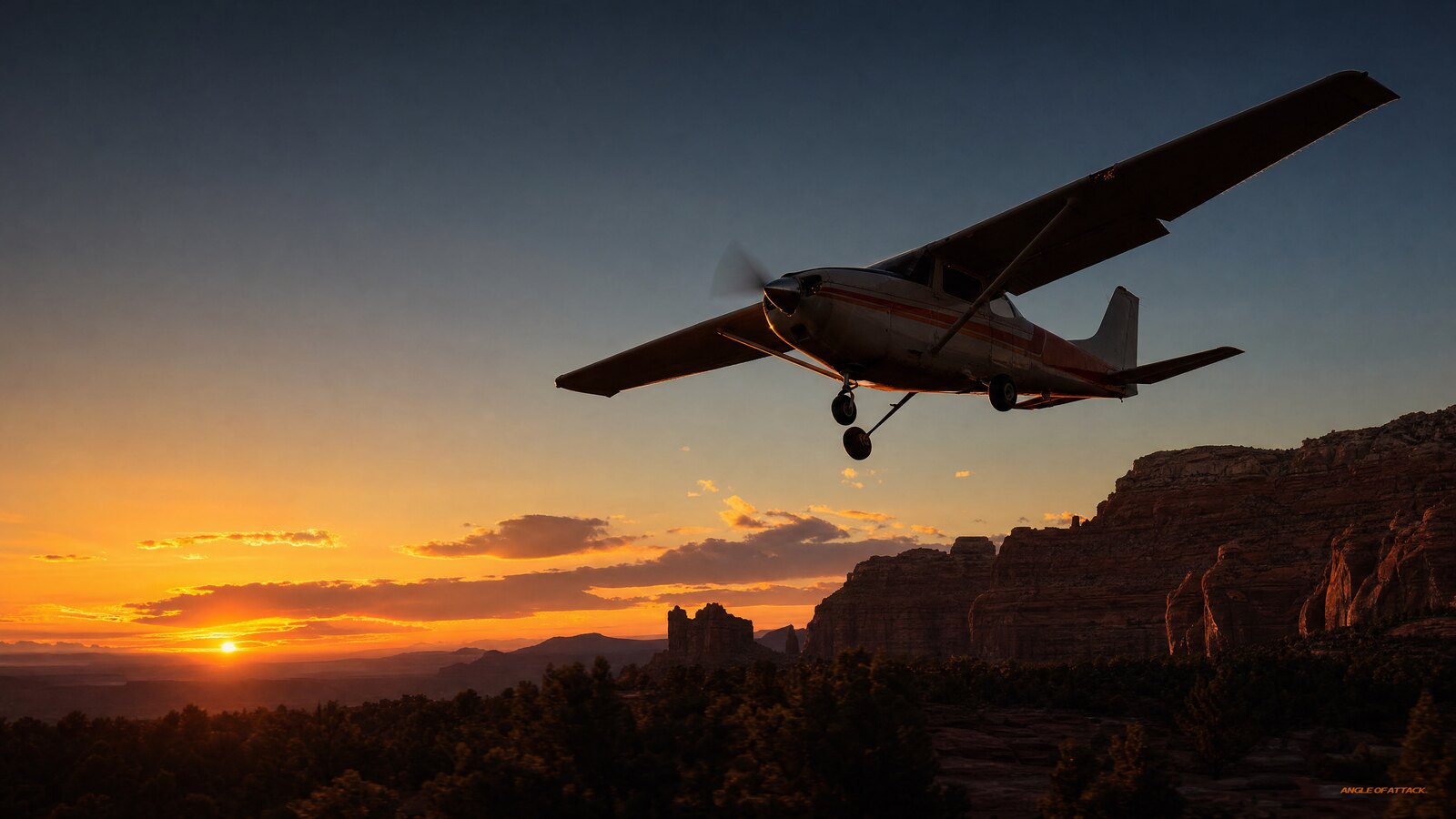
- Thrust is the forward-acting force produced by the engine and propeller that moves the airplane through the air and directly opposes drag.
- The propeller is a rotating airfoil. Each blade is a small wing that produces a forward “lift” we call thrust as it spins.
- Thrust versus drag controls your speed. Excess thrust accelerates the airplane; when thrust equals drag, your airspeed holds steady.
- In a climb, thrust does extra work. A portion of thrust must help support the airplane’s weight along the inclined path, which is why excess thrust — not lift — is what lets the airplane climb.
- The throttle is your thrust control. Moving it changes engine power and therefore propeller thrust; in a fixed-pitch trainer, more throttle means more RPM and more thrust.
- Thrust is one of the four forces (thrust, drag, lift, weight) described in the Pilot’s Handbook of Aeronautical Knowledge, and the relationship between them is core checkride knowledge.
WHAT’S IN THIS GUIDE
- 1What is thrust in aviation?
- 2Where does thrust come from?
- 3How does a propeller produce thrust?
- 4How does thrust work with the other three forces?
- 5What happens to thrust when you climb, cruise, and descend?
- 6How do you control thrust in the cockpit?
- 7A real lesson: chasing thrust out of a short Alaska strip
- 8PLT Study Guide
- 9Frequently Asked Questions
What is thrust in aviation?
Thrust is the forward force that propels an airplane through the air, produced by the powerplant — in a typical trainer, the engine driving a propeller. It acts roughly parallel to the airplane’s flight path and directly opposes drag, the rearward force that resists motion. Thrust is one of the four fundamental forces acting on an aircraft in flight.
The Pilot’s Handbook of Aeronautical Knowledge (PHAK, FAA-H-8083-25C, Chapter 4, Principles of Flight) defines thrust as the forward force produced by the powerplant. The important word there is powerplant — thrust isn’t made by the engine alone or the propeller alone. The engine generates the power; the propeller converts it into a forward pull.
Think of thrust as the airplane’s “go” force, the one you control most directly with your right hand on the throttle. When thrust exceeds drag, the airplane accelerates; when drag catches up and equals thrust, the airplane settles into a steady speed. That tug-of-war between thrust and drag governs how fast you fly.
Where does thrust come from?
Thrust in a piston-powered trainer comes from the powerplant — the engine and propeller working as a team. The engine burns a mixture of fuel and air to turn the crankshaft, the crankshaft spins the propeller, and the propeller moves a large mass of air rearward. By Newton’s third law, pushing air back produces an equal and opposite force forward: thrust.
Most airplanes you’ll train in have a reciprocating (piston) engine, like the four-cylinder Lycoming or Continental engines bolted to a Cessna 172 or Piper Cherokee. The PHAK and the Airplane Flying Handbook (AFH, FAA-H-8083-3C) describe how this powerplant converts chemical energy in the fuel into mechanical energy at the crankshaft, and finally into the forward thrust that flies the airplane.
Turbojets, turbofans, and turboprops make thrust differently, but the principle is identical: accelerate a mass of air or gas backward, and the reaction pushes the aircraft forward. As a student pilot you’ll live in the propeller world. The key takeaway is simple — no powerplant, no thrust — which is why your run-up, fuel management, and mixture control all matter so much.
How does a propeller produce thrust?
A propeller produces thrust because each blade is a rotating airfoil — essentially a small, spinning wing. As the blade slices through the air at an angle, it generates an aerodynamic force the same way a wing generates lift. But because the blade is mounted to spin in a disc facing forward, that “lift” points forward, and we call it thrust.
Look closely at a propeller blade and you’ll see it’s shaped like a wing: a curved face and a flatter back, with a built-in twist from hub to tip. That twist exists because the tip travels much faster than the part near the hub, so the manufacturer angles each section to work efficiently. In most trainers you’ll fly a fixed-pitch propeller, where that blade angle is permanently set and you change thrust by changing RPM with the throttle. The PHAK (Chapter 7) covers this geometry in detail.
Here’s the mental model I give students: imagine screwing a wood screw into a board. Each turn advances it a fixed distance. A propeller does the same thing through air — except air is squishy, so the prop never advances quite as far per revolution as its geometry suggests. That difference is called slip, and it’s why no propeller is 100 percent efficient.
How does thrust work with the other three forces?
Thrust is one of the four forces acting on an airplane, and in steady, unaccelerated flight it sits in balance with the other three: lift, weight, and drag. Thrust acts forward and opposes drag, which acts rearward. Lift acts upward and opposes weight, which acts downward. When all four are balanced, the airplane flies at a constant speed, altitude, and direction.
The PHAK (FAA-H-8083-25C, Chapter 4) is careful to point out that these forces don’t always line up as neatly as a textbook arrow diagram suggests, but for learning the concept, the four-force model is exactly right. Here’s how the pairs match up:
| Force | Direction | Opposes | Source |
|---|---|---|---|
| Thrust | Forward | Drag | Engine and propeller (powerplant) |
| Drag | Rearward | Thrust | Air resistance (parasite + induced) |
| Lift | Upward (perpendicular to flight path) | Weight | The wings |
| Weight | Downward (toward center of earth) | Lift | Gravity acting on aircraft mass |
In steady, level cruise, thrust equals drag and lift equals weight — the airplane holds its speed and altitude. That’s the equilibrium the FAA tests you on. Change one force and the airplane responds: add thrust and you’ll either accelerate or, if you hold speed with pitch, climb.
This is the relationship behind FAA learning statements like PLT247 (thrust / drag / weight / lift) and PLT242. Don’t memorize it as four arrows on a flashcard — understand it as two tug-of-wars happening at once. Thrust pulls against drag; lift pulls against weight.
What happens to thrust when you climb, cruise, and descend?
The role of thrust changes depending on whether you’re climbing, cruising, or descending. In a climb, you need excess thrust — more thrust than is required to balance drag — because some of that thrust must help support the weight of the airplane along the inclined flight path. In cruise, thrust simply equals drag. In a descent, gravity supplies part of the forward force, so you need less thrust.
A common student misconception is that lift makes an airplane climb. It doesn’t. What gets you climbing is excess thrust — the thrust left over after overcoming drag. (The FAA gets precise here: your climb angle tracks excess thrust, and your climb rate tracks excess power, but for a student pilot the headline is the same — it’s the surplus your powerplant has left over, not lift, that buys you altitude.) That’s why a fully loaded trainer on a hot day climbs so poorly: the engine makes less power, so there’s less surplus to convert into altitude. This is straight out of the PHAK’s discussion of climb performance.
Here’s a quick way to keep the three flight conditions straight:
| Flight condition | Thrust vs. drag | What’s happening |
|---|---|---|
| Steady climb | Thrust greater than drag (excess thrust needed) | The surplus left over after beating drag is what buys altitude |
| Steady cruise | Thrust equals drag | Airplane holds constant airspeed and altitude |
| Steady descent | Thrust less than drag (gravity assists) | Reduced power; gravity supplies part of the forward force |
There’s a useful rule of thumb you’ll hear from instructors: pitch controls airspeed, power controls altitude — at least in the typical training regime on an approach. It’s a simplification, and your CFI will refine it, but it captures how intimately thrust and your flight path are linked. Every power change is, at its core, a change in thrust.
If you want this drilled in with real cockpit visuals and the kind of “now I finally get it” explanations that make the four forces stick, that’s exactly what we build step by step inside the Private Pilot Ground School — it’s how thousands of students have gone from confused about aerodynamics to flying with real understanding.
How do you control thrust in the cockpit?
You control thrust with the throttle. Pushing the throttle forward increases engine power, which spins the propeller faster and produces more thrust; pulling it back reduces power and thrust. In a fixed-pitch trainer, you’ll watch the tachometer (RPM gauge) respond — more throttle means more RPM, more RPM means more thrust.
In a fixed-pitch airplane like a basic Cessna 172 or 152, the throttle is your single thrust lever and the tachometer tells you what the engine and propeller are doing. There’s no separate propeller control to think about. Smooth, deliberate throttle movements are part of good airmanship — you don’t slam the throttle, you advance it positively but smoothly.
Airplanes with a constant-speed propeller add a blue-handled propeller control and a manifold pressure gauge, letting you set power more precisely. You’ll meet that system in a high-performance or complex airplane, but the underlying idea never changes: you’re managing how much thrust the powerplant delivers.
A few thrust habits worth building from day one. Lead your power changes — anticipate when you’ll need more or less thrust rather than reacting late. Watch your engine instruments to confirm the engine is making the power you commanded. And remember that thrust available shrinks with altitude and heat. That’s not a malfunction — that’s physics, and a sharp pilot plans for it.
A real lesson: chasing thrust out of a short Alaska strip
I learned what excess thrust really means on a warm afternoon at a short gravel strip in the Alaska bush. I was in a loaded 172 — gear in the back, two of us up front, full fuel — and the density altitude was far higher than the cool morning numbers I’d been spoiled by. On the ramp, full power felt strong. On the takeoff roll the airplane felt sluggish, and the trees at the end of that strip got interesting in a hurry.
What I felt that day was a thrust problem dressed up as a performance problem. The engine was healthy and the throttle was firewalled, but the hot, thin air meant the powerplant couldn’t make the same thrust it made on a cold morning at sea level. Less thrust available meant less excess thrust — a flatter climb and a longer ground roll. The airplane was telling me, in the only language it has, that I’d asked for more than the day could give.
We cleared the trees with margin because I’d run the performance numbers before I ever pushed the throttle up — but it taught me to feel the relationship between thrust, weight, and the air, not just read about it. I’ve been in aviation education since 2006 and flying as a CFI since 2017, and I still think about that strip every time a student shrugs off density altitude. The lesson for you: thrust isn’t a fixed quantity stamped on the engine. It changes with the air you’re flying through, and a day-one-ready pilot respects that long before the trees do.
PLT Study Guide
The FAA tags written-test questions with PLT (Pilot Learning Statement) codes. For thrust and the four forces, these are the codes whose official FAA learning-statement wording actually matches this article’s content. Translate each into plain-English study points and you’ll be ready for the aerodynamics questions on the Private Pilot knowledge test.
| PLT code | FAA learning statement | What to study for thrust |
|---|---|---|
| PLT247 | Recall forces acting on aircraft — thrust / drag / weight / lift | The four-force model. Thrust opposes drag; lift opposes weight. In steady cruise, thrust equals drag and lift equals weight. |
| PLT242 | Recall forces acting on aircraft — lift / drag / thrust / weight / stall / limitations | How the four forces interact, including how changing thrust affects the airplane’s flight path, airspeed, and performance limits. |
| PLT241 | Recall forces acting on aircraft — drag / gravity / thrust / lift | How thrust balances drag and how gravity (weight) factors into climbs and descents — excess thrust drives the climb. |
| PLT237 | Recall forces acting on aircraft — airspeed / air density / lift / drag | Why thrust available falls as air density drops (altitude, heat, humidity) — fewer molecules to work with means less power and less thrust. |
| PLT343 | Recall powerplant — operating principles / operational characteristics / inspecting | How the engine-and-propeller powerplant converts fuel energy into the forward thrust that flies the airplane. |
Study tip: most thrust questions come down to one of two ideas — the balance of the four forces in steady flight, or what happens to thrust available when the air gets thin and hot. Nail those two and the thrust questions become easy points.
Frequently Asked Questions
What is thrust in simple terms?
Thrust is the forward push that moves an airplane through the air. In a trainer, the engine spins the propeller, the propeller pulls air rearward, and the reaction drives the airplane forward. Thrust is the “go” force, and it works against drag, the force that holds the airplane back.
What produces thrust on a small airplane?
The powerplant produces thrust — the engine and propeller working together. The engine burns fuel to spin the crankshaft, the crankshaft turns the propeller, and the propeller moves a large mass of air rearward. By Newton’s third law, that rearward push of air produces an equal forward force on the airplane.
Is thrust the same as lift?
No. Thrust acts forward, roughly along the flight path, and is produced by the powerplant. Lift acts upward, perpendicular to the flight path, and is produced by the wings. They’re two of the four separate forces. A propeller blade does make a “lift” force, but because the blade spins facing forward, that force becomes thrust.
What controls thrust in the cockpit?
The throttle controls thrust. Pushing it forward increases engine power and propeller speed, producing more thrust; pulling it back reduces both. In a fixed-pitch trainer, the tachometer shows engine RPM as you adjust power. Constant-speed propeller airplanes add a separate propeller control and a manifold pressure gauge.
Why does an airplane climb if lift doesn’t increase?
An airplane climbs because of excess thrust — thrust beyond what’s needed to balance drag. In a steady climb, that surplus thrust helps support the airplane’s weight along the inclined path. How well it climbs depends on how much surplus the powerplant has left over, which is why a heavy airplane in hot, thin air climbs poorly.
Does thrust change with altitude and temperature?
Yes. A normally aspirated piston engine makes less power as air density drops with higher altitude, higher temperature, or higher humidity. Less power means less thrust available, which lengthens your takeoff roll and flattens your climb. Always check density altitude and run your performance numbers before a hot or high departure.
What is the difference between thrust available and thrust required?
Thrust required is the thrust needed to overcome drag at a given speed. Thrust available is what the powerplant can actually produce. The difference between them — excess thrust — is what lets you accelerate or climb. When thrust available equals thrust required, the airplane holds a steady speed in level flight.
How does a propeller make thrust?
Each propeller blade is a small rotating wing. As it spins through the air at a pitch angle, it produces an aerodynamic force just like a wing produces lift. Because the propeller disc faces forward, that force points forward and becomes thrust. The blade is twisted from hub to tip so every section works efficiently.
Master every system on your checkride — and on day one.
The Private Pilot Ground School breaks down every FAA subject area in the same plain-English, real-world way you just read — with quizzes, scenarios, and the explanations that finally make it click.
Thrust is the force you’ll feel most directly as a pilot — it lives under your right hand on the throttle and it’s the first thing the airplane gives you on every takeoff. Get comfortable with what it is, where it comes from, and how it trades off against drag, and you’ll understand the four forces better than most pilots ever bother to.


ON THE SAME TOPIC
IFR vs VFR: The Two Sets of Rules Every Pilot Flies By
IFR vs VFR: The Two Sets of Rules Every Pilot Flies By 19 min read Last updated June 2026 · Chris Palmer The difference between IFR and VFR is which set of rules you fly under. VFR — visual flight rules — lets you navigate by looking outside and staying clear of clouds in good […]
 Read more
ASOS vs AWOS vs ATIS: How to Pull the Right Weather Before You Fly
ASOS vs AWOS vs ATIS: How to Pull the Right Weather Before You Fly 13 min read Last updated June 2026 · Chris Palmer The difference comes down to who is talking and what the broadcast covers. ASOS and AWOS are automated, computer-generated weather observations of the conditions right at the field. ATIS is a […]
Read more 
What Is RNAV Navigation? Area Navigation for VFR Pilots
What Is RNAV Navigation? Area Navigation for VFR Pilots 17 min read Last updated June 2026 · Chris Palmer RNAV — Area Navigation — is a method that lets an aircraft fly any desired path within the coverage of ground- or space-based navigation aids, rather than being forced to fly directly to and from stations. […]
Read more 
NDB and ADF Explained: The Oldest Radio Nav System You Still Need to Understand
NDB and ADF Explained: The Oldest Radio Nav System You Still Need to Understand 16 min read Last updated June 2026 · Chris Palmer An NDB (non-directional beacon) is a ground-based radio transmitter that sends a signal in all directions, and an ADF (automatic direction finder) is the cockpit receiver whose needle points straight at […]
Read more 
Stay Connected
Be the very first to get notified when we publish new flying videos, free lessons, and special offers on our courses.
