
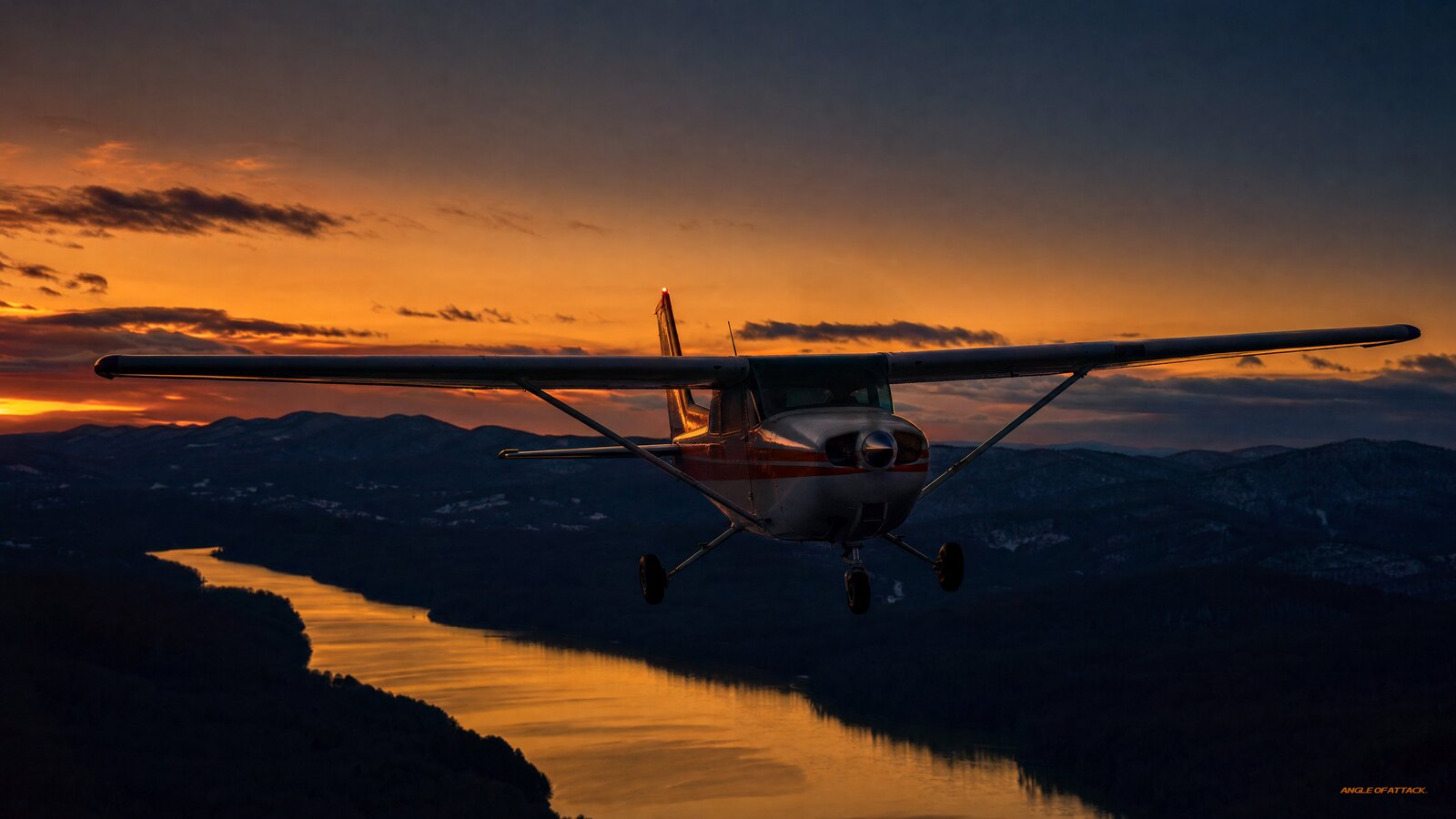
What Is Yaw in Aviation? The Nose-Swinging Motion Your Feet Control With the Rudder
In aviation, yaw is the rotation of an airplane around its vertical axis — the imaginary line running straight down through the center of gravity. Yawing swings the nose left or right without banking the wings. The pilot controls yaw with the rudder, worked by pressing the rudder pedals with the feet, and it keeps the airplane’s flight coordinated.
If you’ve ever watched an airplane’s nose hunt left and right in bumpy air, or felt yourself slide sideways in your seat during a sloppy turn, you’ve met yaw. It’s the third of the three axes of motion, and it’s the one most students underuse — feet glued to the floor while the airplane skids around. Get your feet awake early and your flying gets smoother, safer, and a whole lot more precise. Let’s break down what yaw is, what controls it, and why your rudder pedals matter more than you think.
flight path, illustrating yaw in aviation" src="https://www.angleofattack.com/wp-content/uploads/2026/07/what-is-yaw-in-aviation-featured.jpg" style="margin-bottom: 0;">
- Yaw is rotation about the vertical axis — the line running straight down through the center of gravity (CG). It swings the nose left or right.
- The rudder is the primary flight control for yaw. You command it with the rudder pedals, not the yoke.
- Yaw does not bank the wings. It points the nose; rolling (the ailerons) banks the wings. The two work together in a coordinated turn.
- Adverse yaw is the airplane’s tendency to yaw away from a turn when you roll — and it’s why your feet move with the ailerons.
- Left-turning tendencies (torque, P-factor, spiraling slipstream, and gyroscopic precession) all produce yaw, mostly to the left, especially at high power and low airspeed.
- Directional (yaw) stability is the airplane’s built-in tendency to weathervane back into the relative wind, largely thanks to the vertical stabilizer.
- The inclinometer ball tells you whether yaw is under control — center the ball with rudder and the turn is coordinated.
WHAT’S IN THIS GUIDE
- 1What is yaw in aviation?
- 2What controls yaw on an airplane?
- 3What is the difference between roll, pitch, and yaw?
- 4Why does my airplane yaw left on takeoff?
- 5Why do I need rudder when I roll into a turn?
- 6What keeps the nose pointed straight — yaw stability explained
- 7How do I know if yaw is under control?
- 8A rudder lesson from the Alaska bush
- 9PLT Study Guide
- 10Frequently Asked Questions
What is yaw in aviation?
Yaw is the rotation of an airplane around its vertical axis — the line that runs straight down through the center of gravity, perpendicular to the wings. When an airplane yaws, the nose swings left or right while the wings stay level. Yaw does not turn the airplane the way a car steers; it points the nose, and on its own it just makes the airplane fly slightly sideways.
The vertical axis is sometimes called the yaw axis for exactly this reason. Picture a pole driven straight down through the roof of the cabin and out the belly — yaw is the airplane pivoting around that pole.
Every airplane has three axes of rotation, and all three pass through the center of gravity. According to the Pilot’s Handbook of Aeronautical Knowledge (PHAK, FAA-H-8083-25C, Chapter 5), the longitudinal axis governs roll, the lateral axis governs pitch, and the vertical axis governs yaw. Yaw is the axis students notice last, because it doesn’t feel as dramatic as a wing dipping or the nose pitching — but it’s the one that keeps everything coordinated.
What controls yaw on an airplane?
The rudder is the primary flight control for yaw. It’s the movable surface on the trailing edge of the vertical stabilizer (the tail fin), and you command it with the rudder pedals at your feet. Press the right pedal, the rudder deflects right and the nose yaws right; press the left pedal, the nose yaws left. The rudder is a feet-only control — the yoke has nothing to do with it.
The PHAK (FAA-H-8083-25C) groups flight controls into primary and secondary. The three primary controls are the ailerons (roll), the elevator (pitch), and the rudder (yaw). The rudder owns the yaw axis the same way the elevator owns pitch and the ailerons own roll.
Here’s the most common beginner misconception: the rudder is not the steering wheel. It doesn’t turn the airplane in the air. Its job is to control yaw — to keep the nose tracking where it should and to coordinate turns. On the ground, the rudder pedals also steer the nosewheel, which is why students sometimes think the rudder “steers.” In the air, that’s the ailerons’ and rudder’s job working as a team.
What is the difference between roll, pitch, and yaw?
Roll, pitch, and yaw are the three rotations an airplane can make, and each happens around a different axis passing through the center of gravity. Roll is rotation about the longitudinal axis (controlled by the ailerons), pitch is rotation about the lateral axis (controlled by the elevator), and yaw is rotation about the vertical axis (controlled by the rudder). All three axes intersect at the CG — picture three poles run through the airplane crossing at one point, with one primary control for each.
| Axis | Motion | Primary control | Pilot input | Everyday cue |
|---|---|---|---|---|
| Longitudinal (nose-to-tail) | Roll | Ailerons | Yoke/stick left or right | A wing dips |
| Lateral (wingtip-to-wingtip) | Pitch | Elevator | Yoke/stick fore or aft | Nose up or down |
| Vertical (top-to-bottom) | Yaw | Rudder | Rudder pedals | Nose swings left/right |
Yaw is the easiest of the three to ignore and the easiest to do badly. Roll and pitch give you obvious feedback — a wing dropping, the horizon rising. Yaw is subtler. You feel it as a gentle push into the side of your seat, or you see it as the nose tracking just off your intended path. That’s why instructors harp on “happy feet”: yaw control is mostly about keeping the airplane coordinated, not about making big, dramatic inputs.
Why does my airplane yaw left on takeoff?
Your airplane yaws left on takeoff because of the four left-turning tendencies: torque, P-factor, spiraling slipstream, and gyroscopic precession. In a typical single-engine trainer with a propeller that turns clockwise (as seen from the cockpit), all four tend to push the nose left, especially at high power and low airspeed. You counter the yaw with right rudder.
The PHAK (FAA-H-8083-25C, Chapter 5) breaks these four down. Torque is Newton’s third law in action — the propeller spins one way, so the airframe wants to roll the opposite way, which loads the left main and produces a left-yawing tendency. P-factor (asymmetric propeller loading) shows up at high angles of attack: the descending blade on the right side takes a bigger bite of air than the ascending blade on the left, so the right side of the prop disk produces more thrust and yaws the nose left. Spiraling slipstream is the corkscrew of air the prop throws back; it wraps around the fuselage and strikes the left side of the vertical tail, pushing the nose left. Gyroscopic precession matters most in tailwheel airplanes when the tail comes up — the spinning prop acts like a gyroscope, and pitching the nose down translates into a left yaw.
Here’s the practical takeaway: on the takeoff roll and initial climb, you’ll need right rudder to keep the nose straight, and you’ll need more of it the higher the power and the slower you’re going. That’s not a flaw in the airplane — it’s physics. Your feet are the fix.
Why do I need rudder when I roll into a turn?
You need rudder when you roll because of adverse yaw — the airplane’s tendency to yaw away from the direction you’re rolling. When you roll left, the right wing’s down-aileron makes more lift and more drag, which drags that wing back and swings the nose to the right, opposite your intended turn. Left rudder counters that yaw and keeps the turn coordinated.
The PHAK (FAA-H-8083-25C) describes adverse yaw as a direct consequence of the lift-and-drag difference the ailerons create: the wing with the down-aileron produces more induced drag than the wing with the up-aileron, so the nose initially wants to point the wrong way. Adverse yaw is strongest when you’re rolling in or out of a turn, and most noticeable at slow airspeeds with large aileron deflections.
The fix becomes second nature with practice: roll and rudder go together, in the same direction. Roll left, add left rudder. Roll right, add right rudder. The amount is small — you’re nudging, not stomping. Watch the inclinometer (“the ball”) and keep it centered. A centered ball means a coordinated turn with no skidding or slipping.
Manufacturers help fight adverse yaw with engineering — differential ailerons (the up-going aileron travels farther than the down-going one) and Frise-type ailerons both reduce the drag imbalance. But none of that takes your feet out of the loop. The airplane is built to help, and you finish the job with rudder.
If you want every one of these aerodynamic ideas built up slowly with animations and cockpit walk-throughs instead of dense paragraphs, that’s exactly what we do inside the Private Pilot Ground School — it takes the entire written test and turns it into video you can actually picture in the airplane.
What keeps the nose pointed straight — yaw stability explained
Directional stability — also called yaw stability — is the airplane’s natural tendency to return the nose into the relative wind after a gust or disturbance swings it off heading. The biggest contributor is the vertical stabilizer (the tail fin). When the nose yaws off-center, the airflow strikes the side of the vertical stabilizer and pushes the tail back into line, just like a weathervane points into the wind.
The PHAK (FAA-H-8083-25C, Chapter 5) explains this weathervane effect: the vertical tail surface sits well behind the center of gravity, so any sideways airflow creates a restoring force that swings the nose back into the relative wind. A larger vertical tail, or one farther aft, gives stronger directional stability. The fuselage shape and any sweepback in the wings contribute too.
This is stability and controllability working as a team — a favorite knowledge-test theme. Stability is what the airplane does on its own; controllability is what you make it do with the rudder. A well-designed trainer like a Cessna 172 has enough directional stability to track straight on its own, but enough rudder authority to let you yaw it deliberately when you need to — for a crosswind landing, a forward slip, or recovering from a skid. The airplane wants to fly straight; you’re just guiding it.
How do I know if yaw is under control?
You know yaw is under control when the inclinometer ball is centered. The inclinometer is the curved, fluid-filled tube with a black ball in it, found at the bottom of the turn coordinator or turn-and-slip indicator. A centered ball means the airplane is coordinated — no yaw-induced slip or skid. The rule pilots memorize is “step on the ball”: if the ball slides left, press the left rudder; if it slides right, press the right rudder.
There are two ways yaw goes wrong in a turn. A slip is too little rudder for the bank — the ball falls to the inside of the turn, and the airplane slides toward the low wing. A skid is too much rudder for the bank — the ball slides to the outside, and the airplane skids around like a car on ice. Of the two, the skidding turn is the dangerous one, because a skid at low speed in the traffic pattern is a classic setup for a stall that drops into a spin.
| Condition | What the ball does | Cause | Why it matters |
|---|---|---|---|
| Coordinated | Ball centered | Right amount of rudder for the bank | Smooth, efficient, safe flight |
| Slip | Ball toward inside of turn | Too little rudder (or top rudder held) | Airplane sideslips; used intentionally for crosswind landings and forward slips |
| Skid | Ball toward outside of turn | Too much rudder for the bank | Dangerous near the ground — a skidding stall can become a spin |
Coordinated flight isn’t just about comfort. The PHAK (FAA-H-8083-25C) ties uncoordinated flight — especially a skid — directly to the risk of a spin entry. That’s why keeping the ball centered with your feet is a real safety skill, not just a polish item.
A rudder lesson from the Alaska bush
Here’s a moment from my own flying that made yaw finally click for a student. We were in a Cessna 172 doing turns around a point over a river bend in interior Alaska, and she had the bank right but her feet were asleep. The ball kept sliding to the outside of the turn — a textbook skid — and she couldn’t feel it. She was steering the airplane around the turn with rudder instead of coordinating with it.
I covered the heading indicator and the GPS and told her to fly the turn watching only one thing: the ball. “Step on the ball,” I said. Every time it slid out, she eased off the rudder; every time it slid in, she added a touch. Within a couple of laps her feet woke up. The turn smoothed out, the airplane stopped sliding sideways, and she said the thing every instructor waits to hear: “Oh — I can feel it now.”
That’s the whole game with yaw. You can’t bully it with big inputs, and you can’t ignore it. It’s a conversation between your feet and the ball. In Alaska, where you’re often maneuvering low in a valley with terrain on both sides, a skidding, uncoordinated turn is exactly what you don’t want — that’s the setup that bites pilots near the ground. Coordinated feet aren’t a nicety up here. They’re how you stay relaxed and safe when the canyon walls are close.
PLT Study Guide
These are the FAA knowledge-test learning statement codes that map directly to yaw, the vertical axis, and coordinated flight. On your private pilot written, expect yaw questions framed around axes, the rudder, left-turning tendencies, directional stability, and spins.
| PLT Code | FAA Learning Statement | What to study for yaw |
|---|---|---|
| PLT234 | Recall forces acting on aircraft — 3 axis intersect | The three axes (longitudinal, lateral, vertical) all intersect at the center of gravity. Yaw is rotation about the vertical axis. Be able to name each axis and its motion. |
| PLT095 | Recall aerodynamics — longitudinal axis / lateral axis | Know which axis goes with which motion: longitudinal (roll), lateral (pitch), and — by elimination — the vertical axis is the one yaw turns around. Test questions love to swap these. |
| PLT346 | Recall primary / secondary flight controls — types / purpose / functionality / operation | The rudder is the primary control for yaw, and it’s worked by the rudder pedals. Know that ailerons (roll), elevator (pitch), and rudder (yaw) are the three primary controls. |
| PLT243 | Recall forces acting on aircraft — propeller / torque | Torque, P-factor, spiraling slipstream, and gyroscopic precession all create yaw (mostly left), strongest at high power and low airspeed. Know why you need right rudder on takeoff and climb. |
| PLT244 | Recall forces acting on aircraft — stability / controllability | Directional (yaw) stability returns the nose into the relative wind, mainly via the vertical stabilizer (weathervane effect). Distinguish stability (what the airplane does itself) from controllability (what you command with the rudder). |
| PLT245 | Recall forces acting on aircraft — stalls / spins | A spin is an aggravated, uncoordinated stall — and yaw is what turns a stall into a spin. A skidding (over-ruddered) turn at low speed is a classic spin setup. Coordinated flight prevents it. |
Study tip: if a test question shows an airplane with axes drawn through it, the one running straight up and down (top to bottom) is the vertical axis, and the motion around it is yaw. And whenever a question mentions “right rudder on takeoff” or “left-turning tendency,” it’s testing the four torque/P-factor effects above.
Frequently Asked Questions
What is yaw in aviation in simple terms?
Yaw is when an airplane’s nose swings left or right — rotation around the vertical axis, the line running straight down through the center of gravity. The wings stay level; only the nose moves. You command yaw with the rudder by pressing the rudder pedals with your feet. It keeps your flight coordinated.
Which axis does yaw occur around?
Yaw occurs around the vertical axis, the imaginary line running straight up and down through the center of gravity, perpendicular to the wings. That’s why it’s also called the yaw axis. Roll happens around the longitudinal axis and pitch around the lateral axis, and all three intersect at the CG.
What flight control causes yaw?
The rudder causes yaw. It’s the movable surface on the trailing edge of the vertical stabilizer, and you control it with the rudder pedals — not the yoke. The PHAK (FAA-H-8083-25C) lists the rudder as one of the three primary flight controls, along with the ailerons and the elevator.
Why do I need right rudder on takeoff?
Because of the left-turning tendencies — torque, P-factor, spiraling slipstream, and gyroscopic precession. In a single-engine trainer they combine to yaw the nose left, and the effect is strongest at high power and low airspeed. Right rudder counters that yaw and keeps the airplane tracking straight down the runway.
What is the difference between yaw and roll?
Yaw swings the nose left or right around the vertical axis using the rudder, with the wings staying level. Roll banks the wings around the longitudinal axis using the ailerons. Roll starts a turn by tilting the wings; yaw keeps the turn coordinated. They work together, but they’re different motions with different controls.
What is adverse yaw?
Adverse yaw is the airplane yawing away from the direction you’re rolling. When you roll, the rising wing makes more lift and more drag, which swings the nose the wrong way. You counter it by adding rudder in the same direction as the roll. The PHAK (FAA-H-8083-25C) covers it as a side effect of how ailerons work.
What is the difference between a slip and a skid?
A slip is too little rudder for the bank — the ball falls toward the inside of the turn and the airplane slides toward the low wing. A skid is too much rudder — the ball slides to the outside and the airplane skids around. A skid at low altitude is dangerous because it can lead to a spin.
How do I keep the airplane coordinated?
Watch the inclinometer ball and “step on the ball.” If it slides left, press left rudder; if it slides right, press right rudder. When the ball is centered, yaw is under control and the turn is coordinated — no slip, no skid. Coordinated feet keep your flying smooth and, near the ground, much safer.
Yaw is the axis most students sleep on, and waking up your feet is one of the fastest ways to fly smoother and safer. Don’t just memorize that yaw happens around the vertical axis — go fly it, watch the ball, and feel how a touch of rudder cleans up a sloppy turn. That feel is the difference between a pilot who’s checkride-ready and one who’s truly day-one ready.
Master every system on your checkride — and on day one.
The Private Pilot Ground School breaks down every FAA subject area in the same plain-English, real-world way you just read — with quizzes, scenarios, and the explanations that finally make it click.
We’ve been in aviation education since 2006, and helping students build that real, in-the-cockpit understanding of roll, pitch, and yaw — and the rudder work that ties them together — is exactly what we love to do.


ON THE SAME TOPIC
IFR vs VFR: The Two Sets of Rules Every Pilot Flies By
IFR vs VFR: The Two Sets of Rules Every Pilot Flies By 19 min read Last updated June 2026 · Chris Palmer The difference between IFR and VFR is which set of rules you fly under. VFR — visual flight rules — lets you navigate by looking outside and staying clear of clouds in good […]
 Read more
ASOS vs AWOS vs ATIS: How to Pull the Right Weather Before You Fly
ASOS vs AWOS vs ATIS: How to Pull the Right Weather Before You Fly 13 min read Last updated June 2026 · Chris Palmer The difference comes down to who is talking and what the broadcast covers. ASOS and AWOS are automated, computer-generated weather observations of the conditions right at the field. ATIS is a […]
Read more 
What Is RNAV Navigation? Area Navigation for VFR Pilots
What Is RNAV Navigation? Area Navigation for VFR Pilots 17 min read Last updated June 2026 · Chris Palmer RNAV — Area Navigation — is a method that lets an aircraft fly any desired path within the coverage of ground- or space-based navigation aids, rather than being forced to fly directly to and from stations. […]
Read more 
NDB and ADF Explained: The Oldest Radio Nav System You Still Need to Understand
NDB and ADF Explained: The Oldest Radio Nav System You Still Need to Understand 16 min read Last updated June 2026 · Chris Palmer An NDB (non-directional beacon) is a ground-based radio transmitter that sends a signal in all directions, and an ADF (automatic direction finder) is the cockpit receiver whose needle points straight at […]
Read more 
Stay Connected
Be the very first to get notified when we publish new flying videos, free lessons, and special offers on our courses.
