
Aircraft Categories and Classes Explained: The FAA’s Two Definitions
Aircraft categories and classes are how the FAA sorts every flying machine into groups. A category is the broadest grouping — airplane, rotorcraft, glider, lighter-than-air, and a few more. A class is the next level down within a category — for airplanes, that’s single-engine land, multi-engine land, single-engine sea, and multi-engine sea. Here’s the catch that trips up almost every student pilot: the FAA defines “category” and “class” two completely different ways depending on whether you’re talking about certifying the aircraft or certifying the pilot. Get those two definitions straight and a big chunk of your regulations study falls into place. This guide walks you through both — with the exact regulatory citations, a comparison table, and a simple filter for telling the two systems apart on test day.
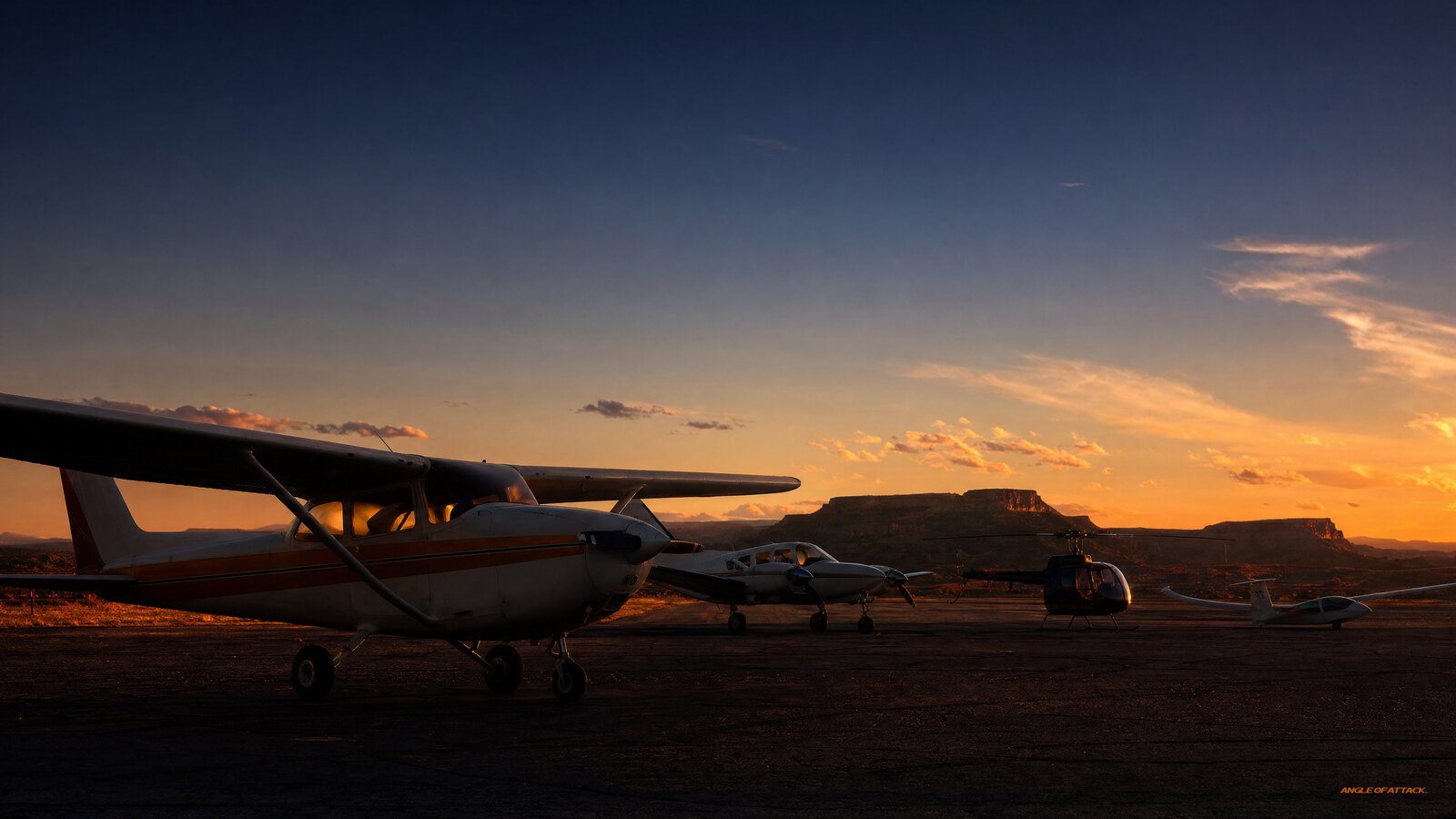
helicopter, and glider lined up on a ramp at golden hour, showing different aircraft categories" src="https://www.angleofattack.com/wp-content/uploads/2026/07/what-are-the-categories-and-classes-of-aircraft-featured.jpg" style="margin-bottom: 0;">
- “Category and class” has two meanings. The FAA uses these words one way for airman certification (rating your pilot certificate) and a different way for aircraft certification (how the airplane itself is type-certificated). Both are defined in 14 CFR § 1.1.
- Category is the broad group; class is the subdivision. In the airman sense, airplane is a category and single-engine land is a class within it.
- Your pilot certificate is rated by category and class. A private pilot certificate doesn’t just say “pilot” — it says, for example, “airplane single-engine land,” and that’s what you’re legally allowed to fly as pilot in command.
- Type is a third, narrower level. Beyond category and class, large or turbojet aircraft require a type rating for the specific make and model (such as a B737 or CL-65).
- The aircraft-certification definitions are different on purpose. There, category means things like normal, utility, acrobatic, commuter, and transport — a measure of how the airplane was stress-tested and what it’s approved to do.
- You add ratings, you don’t start over. Moving from single-engine to multi-engine land, or from airplane to rotorcraft, means earning an additional category or class rating — not a brand-new certificate.
WHAT’S IN THIS GUIDE
- 1What are aircraft categories and classes?
- 2Why does the FAA define category and class two different ways?
- 3What are the categories of aircraft for pilot certification?
- 4What are the classes within each category?
- 5What’s the difference between category, class, and type?
- 6What are aircraft categories for airworthiness certification?
- 7How does this show up on a real pilot certificate?
- 8PLT Study Guide
- 9Frequently Asked Questions
What are aircraft categories and classes?
Aircraft categories and classes are the FAA’s two-tier system for grouping aircraft. A category is the broadest grouping — airplane, rotorcraft, glider, lighter-than-air, powered-lift, powered parachute, and weight-shift-control. A class is the subdivision inside a category. For airplanes, the four classes are single-engine land, multi-engine land, single-engine sea, and multi-engine sea. Both terms are defined in 14 CFR § 1.1, the FAA’s master list of definitions.
The simplest way to picture it is a tree. The trunk is “aircraft.” The big branches coming off it are categories. The smaller branches off each category are classes. When you earn a pilot certificate, the FAA writes the specific branch you’re qualified on right onto the certificate — your ratings.
So when someone asks “what can you fly?”, the honest answer isn’t “airplanes.” It’s the exact category and class on your certificate. That precision is the whole point of the system, and it’s why the FAA spends so much regulatory ink defining these words.
Why does the FAA define category and class two different ways?
Because the FAA is regulating two different things with the same two words. 14 CFR § 1.1 gives “category” and “class” separate definitions depending on whether the subject is airman certification or aircraft certification. When the words describe a pilot (airman certification), they mean a broad-then-narrow grouping like airplane → single-engine land. When the words describe an aircraft (airworthiness certification), they mean something else entirely — category becomes normal, utility, acrobatic, commuter, or transport, and class describes the aircraft’s basic kind.
Slow down on this one, because it confuses a lot of new students. The same word — “category” — means airplane in one sentence of the regulations and normal or utility in another. The FAA didn’t make a mistake; the two systems answer two different questions.
The airman system answers: What is this person trained and tested to fly? The aircraft-certification system answers: How was this machine built, stress-tested, and approved to operate? Once you know which question is on the table, you know which definition to use. On your knowledge test and your checkride, the examiner is almost always asking about the airman definitions — but knowing both keeps you from getting tripped up.
What are the categories of aircraft for pilot certification?
For airman certification, 14 CFR § 1.1 lists these categories of aircraft: airplane, rotorcraft, glider, lighter-than-air, powered-lift, powered parachute, and weight-shift-control. Each is a fundamentally different way of generating lift and staying aloft, which is why each requires its own training, its own checkride, and its own line on your certificate. You don’t automatically get to fly a helicopter because you can fly a Cessna — they’re separate categories.
Here’s a quick mental model for each:
- Airplane — fixed wing, lift from forward motion over an airfoil. The most common path for new pilots.
- Rotorcraft — lift from rotating wings (rotor blades). This category contains helicopters and gyroplanes.
- Glider — a heavier-than-air aircraft with no engine dependence for sustained flight; it soars.
- Lighter-than-air — balloons and airships, which float because they’re less dense than the surrounding air.
- Powered-lift — aircraft like tiltrotors that take off vertically but cruise on a wing. Rare, but it’s a real category.
- Powered parachute and weight-shift-control — the newer sport-aviation categories (think powered parachutes and trikes).
Most student pilots will spend their entire careers inside the airplane category. But understanding that the FAA treats these as genuinely separate worlds explains why your certificate is so specific about what you’re rated for.
What are the classes within each category?
Within the airplane category, 14 CFR § 1.1 defines four classes: single-engine land (SEL), multi-engine land (MEL), single-engine sea (SES), and multi-engine sea (MES). The class tells you two things at a glance — how many engines and where the aircraft is meant to operate from (land or water). Most private pilots start with airplane single-engine land, because that’s a Cessna 172, a Piper Cherokee, or whatever your school’s trainer happens to be.
The other categories have their own classes. Here’s how the airman classes break down by category:
| Category | Classes within it |
|---|---|
| Airplane | Single-engine land, multi-engine land, single-engine sea, multi-engine sea |
| Rotorcraft | Helicopter, gyroplane |
| Lighter-than-air | Airship, free balloon |
| Powered-lift | (no class division) |
| Glider | (no class division) |
| Powered parachute | Land, sea |
| Weight-shift-control | Land, sea |
Notice that not every category subdivides into classes — glider and powered-lift, for example, are rated at the category level without a separate class. The pattern to internalize: category first, class second, and the class describes a meaningful operational difference — engines, water-vs-land, or aircraft type within a family. When you go from a single-engine land airplane to a multi-engine land airplane, you add a class rating through additional training and a checkride; you don’t earn a whole new certificate.
What’s the difference between category, class, and type?
Category and class get you most of the way, but there’s a third, narrower level: type. A type rating is required to act as pilot in command of large aircraft (those certificated for a maximum gross takeoff weight of more than 12,500 pounds) and of turbojet-powered aircraft, under 14 CFR § 61.31(a). A type rating is specific to a make and model — a Boeing 737 or a Citation jet — not just a class. So the hierarchy runs category → class → type, broadest to narrowest.
For a private pilot flying light singles, type ratings never enter the picture — your Cessna 172 is covered by your airplane single-engine land rating, full stop. Type ratings become relevant when you move into airliners, business jets, and heavy iron later in a flying career.
Think of it like a postal address. The category is the state, the class is the city, and the type is the specific street address. The further down you go, the more precisely it pins down exactly what you’re authorized to fly.
What are aircraft categories for airworthiness certification?
Now the other definition. When the FAA certificates the aircraft itself — not the pilot — 14 CFR § 1.1 uses category to mean the airworthiness group the aircraft was designed and stress-tested to meet: normal, utility, acrobatic, commuter, and transport. These categories tell you how much structural load the airplane can take and what maneuvers it’s approved for. Your airplane’s approved category is listed in the type certificate data sheet and reflected in the POH/AFM (FAA-H-8083-25C concepts apply throughout your studies, but the binding numbers live in your aircraft’s documents).
The everyday version of this matters more than students expect. A Cessna 172, for example, is often certificated in both the normal and utility categories — and the maneuvers and weight limits you’re allowed depend on which one you’re operating in that day. Utility category allows certain training maneuvers (like spins, in approved models) but usually with a more restrictive weight and CG envelope. Operate it loaded as a normal-category airplane and those maneuvers are off the table.
Here’s the clean way to keep the two systems apart:
| Concept | Airman certification (the pilot) | Airworthiness certification (the aircraft) |
|---|---|---|
| What “category” means | Broad group: airplane, rotorcraft, glider, lighter-than-air, powered-lift, powered parachute, weight-shift-control | Design/operating group: normal, utility, acrobatic, commuter, transport |
| What “class” means | Subdivision: single-engine land, multi-engine land, etc. | Basic kind of aircraft for certification purposes |
| Defining regulation | 14 CFR § 1.1 | 14 CFR § 1.1 |
| Question it answers | What is this person trained and tested to fly? | How was this machine built, tested, and approved? |
| Where you see it | Your pilot certificate | The aircraft’s airworthiness certificate, data plate, and POH |
If a test question or your examiner mentions normal, utility, or acrobatic, you’re in the aircraft-certification world. If they mention single-engine land or rotorcraft, you’re in the airman world. That one filter resolves nearly every “wait, which category?” moment.
How does this show up on a real pilot certificate?
When a new pilot finally holds that freshly printed certificate, the most useful thing they can do is read the ratings line out loud. It won’t say “pilot.” It’ll say something like “PRIVATE PILOT — AIRPLANE SINGLE-ENGINE LAND.” That single line is the whole category-and-class system written in plain English: the category (airplane) and the class (single-engine land) you’re authorized to fly as pilot in command.
Here’s where it bites people. A pilot trained entirely on wheels in a Cessna 172 assumes the certificate already covers floats — it’s still an airplane, right? It isn’t. Single-engine land and single-engine sea are two different classes. Flying a floatplane off the water as PIC takes additional training and a sea class rating added to that same line, under 14 CFR § 61.31. Up in Alaska, where floats and skis are everyday equipment, that distinction comes up constantly.
That’s the practical payoff of understanding this system: it tells you exactly where your privileges stop and what the next rating actually buys you. When you want to expand what you can fly — add floats, add an engine, jump to rotorcraft — you’re adding a category or class rating to your existing certificate, not starting over.
If you want to walk into your first lesson already understanding how the certificate, categories, and classes fit together, the free Total Student Pilot course is built exactly for that day-one foundation. And when you’re ready to study the full body of knowledge behind the written test and the checkride, the Private Pilot Ground School takes you all the way through the regulations, including how categories and classes drive your operating limits.
PLT Study Guide
The FAA tags each knowledge-test question with a PLT (Pilot Learning Statement) code. For aircraft categories and classes, these are the codes whose official FAA wording actually matches this material — study them this way:
- PLT371 — Recall regulations: Aircraft Category / Class. This is the bullseye for the topic. Know that, for airman certification, category is the broad group (airplane, rotorcraft, glider, lighter-than-air, powered-lift, powered parachute, weight-shift-control) and class is the subdivision (single-engine land, multi-engine land, single-engine sea, multi-engine sea for airplanes) — all defined in 14 CFR § 1.1.
- PLT395 — Recall regulations: definitions. The entire category/class system lives in the definitions section, 14 CFR § 1.1. The FAA loves to test whether you can match the right definition to the right context — airman vs. aircraft certification — so read the definitions carefully.
- PLT113 — Recall aircraft design: categories / limitation factors. This is the airworthiness side: normal, utility, acrobatic, commuter, and transport categories, and how the design category limits the maneuvers, load factors, and weight you’re approved for. Connect it to your aircraft’s POH/AFM and data plate.
- PLT448 — Recall regulations: privileges / limitations of pilot certificates. Know that your certificate authorizes you to act as pilot in command only for the category and class (and type, where required) you’re rated for, and that adding a category or class means additional training and a check — not a new certificate.
When you sit the test, watch the wording closely: if a stem mentions normal or utility, it’s asking about the aircraft; if it mentions single-engine land or rotorcraft, it’s asking about the pilot. The answer choices are designed to punish students who blur the two.
Frequently Asked Questions
What is the difference between a category and a class of aircraft?
A category is the broadest grouping of aircraft, and a class is the subdivision within it. For pilot certification under 14 CFR § 1.1, airplane is a category and single-engine land is a class inside that category. Category comes first and is general; class comes second and is more specific.
What are the categories of aircraft?
For airman certification, 14 CFR § 1.1 lists seven categories: airplane, rotorcraft, glider, lighter-than-air, powered-lift, powered parachute, and weight-shift-control. Each is a fundamentally different way of flying, and each requires its own training and rating. The airplane category is by far the most common path for new pilots.
What are the four classes of airplane?
The airplane category divides into four classes under 14 CFR § 1.1: single-engine land, multi-engine land, single-engine sea, and multi-engine sea. The class tells you the number of engines and whether the airplane operates from land or water. Most student pilots train in the single-engine land class first.
Is a Cessna 172 a category or a class?
Neither — it’s a specific make and model. A Cessna 172 falls into the airplane category and the single-engine land class for airman purposes. For airworthiness, it’s typically certificated in the normal and utility categories. So one airplane sits inside several of these groupings at once, depending on which system you’re using.
Why does the FAA define category and class twice?
Because it regulates two different things with the same words. One definition (airplane, rotorcraft, single-engine land) describes what a pilot is rated to fly. The other (normal, utility, acrobatic, transport) describes how an aircraft was designed, stress-tested, and approved. Both definitions live in 14 CFR § 1.1; context tells you which one applies.
What is a type rating and how is it different from category and class?
A type rating is a third, narrower level required under 14 CFR § 61.31(a) for large aircraft (over 12,500 pounds maximum gross takeoff weight) and turbojets. It’s specific to a make and model, like a Boeing 737. The hierarchy runs category, then class, then type — broadest to most specific. Light single-engine pilots never need one.
Does my private pilot certificate let me fly any airplane?
No. Your certificate authorizes you to act as pilot in command only for the category and class you’re rated for — for most new pilots that’s airplane single-engine land. To fly a multi-engine airplane, a floatplane, or a helicopter, you add the appropriate category or class rating through additional training and a checkride, under 14 CFR § 61.31.
What does “airplane single-engine land” mean on a certificate?
It’s your category and class rating written in full. Airplane is the category; single-engine land is the class — one engine, operating from land. It tells the FAA, and any examiner, exactly the kind of aircraft you’re legally qualified to fly as pilot in command. It’s the most common rating a new private pilot earns.
Master every system on your checkride — and on day one.
The Private Pilot Ground School breaks down every FAA subject area in the same plain-English, real-world way you just read — with quizzes, scenarios, and the explanations that finally make it click.
Categories and classes look like dry regulatory bookkeeping until you realize they define the exact edges of what you’re allowed to do as a pilot. Learn the two definitions, keep them straight, and read your own certificate’s ratings line like it’s the answer to “what can I fly?” — because it is. The system is built so you grow it one rating at a time.


ON THE SAME TOPIC

What Are VFR Weather Minimums? The Numbers Every Pilot Must Know Cold
What Are VFR Weather Minimums? The Numbers Every Pilot Must Know Cold 15 min read Last updated June 2026 · Chris Palmer VFR weather minimums are the minimum flight visibility and distance you must keep from clouds to fly legally under visual flight rules. They’re defined in 14 CFR § 91.155, and they change with […]
 Read more
What Are V-Speeds? The Pilot’s Guide to Every Airspeed That Matters
What Are V-Speeds? The Pilot’s Guide to Every Airspeed That Matters 19 min read Last updated June 2026 · Chris Palmer V-speeds are standardized airspeeds that define how an airplane should be flown in a specific situation — the speed for best climb, the speed to never exceed, the maximum speed for extending flaps, and […]
Read more 
What Are the Types of Fog? A Pilot’s Guide to the 6 Kinds and How They Form
What Are the Types of Fog? A Pilot’s Guide to the 6 Kinds and How They Form 36 min read Last updated June 2026 · Chris Palmer The main types of fog a pilot needs to know are radiation fog, advection fog, upslope fog, precipitation-induced (frontal) fog, and steam (evaporation) fog, plus freezing fog and […]
Read more 
What Are the Types of Clouds in Aviation? A Pilot’s Field Guide to Reading the Sky
What Are the Types of Clouds in Aviation? A Pilot’s Field Guide to Reading the Sky 15 min read Last updated June 2026 · Chris Palmer Clouds in aviation are grouped into four families by their height in the sky — low, middle, high, and clouds with vertical development — and named by combining Latin […]
Read more 
Stay Connected
Be the very first to get notified when we publish new flying videos, free lessons, and special offers on our courses.
