
AIM Text
There are six types of signs installed on airfields: mandatory instruction signs, location signs, direction signs, destination signs, information signs, and runway distance remaining signs. The characteristics and use of these signs are discussed in paragraph 2-3-8, Mandatory Instruction Signs, through paragraph 2-3-13, Runway Distance Remaining Signs.
FIG 2-3-24
Runway Holding Position Sign
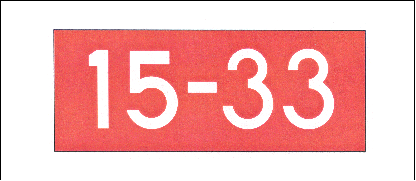
FIG 2-3-25
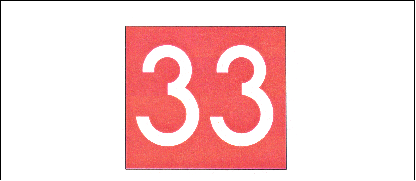
Holding Position Sign at Beginning of Takeoff Runway
2-3-8. Mandatory Instruction Signs
- These signs have a red background with a white inscription and are used to denote:
- An entrance to a runway or critical area; and
- Areas where an aircraft is prohibited from entering.
- Typical mandatory signs and applications are:
- Runway Holding Position Sign. This sign is located at the holding position on taxiways that intersect a runway or on runways that intersect other runways. The inscription on the sign contains the designation of the intersecting runway, as shown in FIG 2-3-24. The runway numbers on the sign are arranged to correspond to the respective runway threshold. For example, “15-33” indicates that the threshold for Runway 15 is to the left and the threshold for Runway 33 is to the right.
- On taxiways that intersect the beginning of the takeoff runway, only the designation of the takeoff runway may appear on the sign (as shown in FIG 2-3-25), while all other signs will have the designation of both runway directions.
FIG 2-3-26
Holding Position Sign for a Taxiway that Intersects the Intersection of Two Runways
FIG 2-3-27
Holding Position Sign for Runway Approach and Departure Areas
- If the sign is located on a taxiway that intersects the intersection of two runways, the designations for both runways will be shown on the sign along with arrows showing the approximate alignment of each runway, as shown in FIG 2-3-26. In addition to showing the approximate runway alignment, the arrow indicates the direction to the threshold of the runway whose designation is immediately next to the arrow.
- A runway holding position sign on a taxiway will be installed adjacent to holding position markings on the taxiway pavement. On runways, holding position markings will be located only on the runway pavement adjacent to the sign, if the runway is normally used by ATC for “Land, Hold Short” operations or as a taxiway. The holding position markings are described in paragraph 2-3-5, Holding Position Markings.
- On taxiways that intersect the beginning of the takeoff runway, only the designation of the takeoff runway may appear on the sign (as shown in FIG 2-3-25), while all other signs will have the designation of both runway directions.
- Runway Approach Area Holding Position Sign. At some airports, it is necessary to hold an aircraft on a taxiway located in the approach or departure area for a runway so that the aircraft does not interfere with operations on that runway. FIG 2-3-15 depicts common situations. A sign with the runway designation(s) and the protected area(s) will be located at applicable holding positions on the taxiway. For locations protecting only the approach area, the holding position on the taxiway includes a sign identifying the approach end runway designation (e.g., 15) followed by a dash (-) and the letters “APCH”. For locations protecting both the approach and departure areas, the holding position on the taxiway includes a sign with the approach end runway designation and letters “APCH” followed by a dash (-), the departure end runway designation and the letters “DEP”. The arrangement of the runway designations and protected areas legend on the sign reflects the orientation of the runway as viewed from the holding position. Holding position markings in accordance with paragraph 2-3-5, Holding Position Markings, are co-located on the taxiway pavement in line with the sign. Examples of these signs are shown in FIG 2-3-27.
FIG 2-3-28
Holding Position Sign for ILS Critical Area
FIG 2-3-29
Sign Prohibiting Aircraft Entry into an Area
- ILS Critical Area Holding Position Sign.At some airports, when the instrument landing system is being used, it is necessary to hold an aircraft on a taxiway at a location other than the holding position described in Paragraph 2-3-5, Holding Position Markings. In these situations, the holding position sign for these operations will have the inscription “ILS” and be located adjacent to the holding position marking on the taxiway described in paragraph 2-3-5. An example of this sign is shown in FIG 2-3-28.
- No Entry Sign.This sign, shown in FIG 2-3-29, prohibits an aircraft from entering an area. Typically, this sign would be located on a taxiway intended to be used in only one direction or at the intersection of vehicle roadways with runways, taxiways, or aprons where the roadway may be mistaken as a taxiway or other aircraft movement surface.
FIG 2-3-30
Taxiway Location Sign
FIG 2-3-31
Taxiway Location Sign Collocated with Runway Holding Position Sign
- Runway Holding Position Sign. This sign is located at the holding position on taxiways that intersect a runway or on runways that intersect other runways. The inscription on the sign contains the designation of the intersecting runway, as shown in FIG 2-3-24. The runway numbers on the sign are arranged to correspond to the respective runway threshold. For example, “15-33” indicates that the threshold for Runway 15 is to the left and the threshold for Runway 33 is to the right.
Source: FAA Aeronautical Information Manual · current edition · paragraph 2-3-7.
Research Notes
AIM 2-3-7 covers Airport Signs (parallel to AIM 4-3-8 with operational focus).
The five sign categories (review):
- Mandatory instruction (WHITE on RED) — hold short, no entry. Must have ATC clearance to pass.
- Location (YELLOW on BLACK) — identifies the taxiway you're on
- Direction (BLACK on YELLOW with arrow) — identifies taxiways you can turn onto
- Destination (BLACK on YELLOW) — identifies destinations
- Information (BLACK on YELLOW) — various info (radio freq, noise abatement, etc.)
Operational use: Visualize the airport layout from the airport diagram. Match signs to your taxi clearance. Confirm your position by location signs at intersections.