
G5 — Final Draft: The Real Hour-Building Strategy
```html
Hour building as a CFI is the 12-to-24-month grind from your commercial certificate, around 250 hours, to ATP minimums of 1,500 hours, or 1,000 to 1,250 hours under the Restricted-ATP if you have an aviation degree. The math is simple: hours to build, divided by your monthly hour rate, equals the months to the airlines. The variable you actually control is your monthly rate. Everything else is downstream of that.
Walking into your first lesson with a 50-page binder won't help you.
Get my Anti-Binder One-Page Lesson Plan Template free — the lesson plan tool I built for CFI candidates who want to be ready Day 1.
Get the Anti-Binder Template Free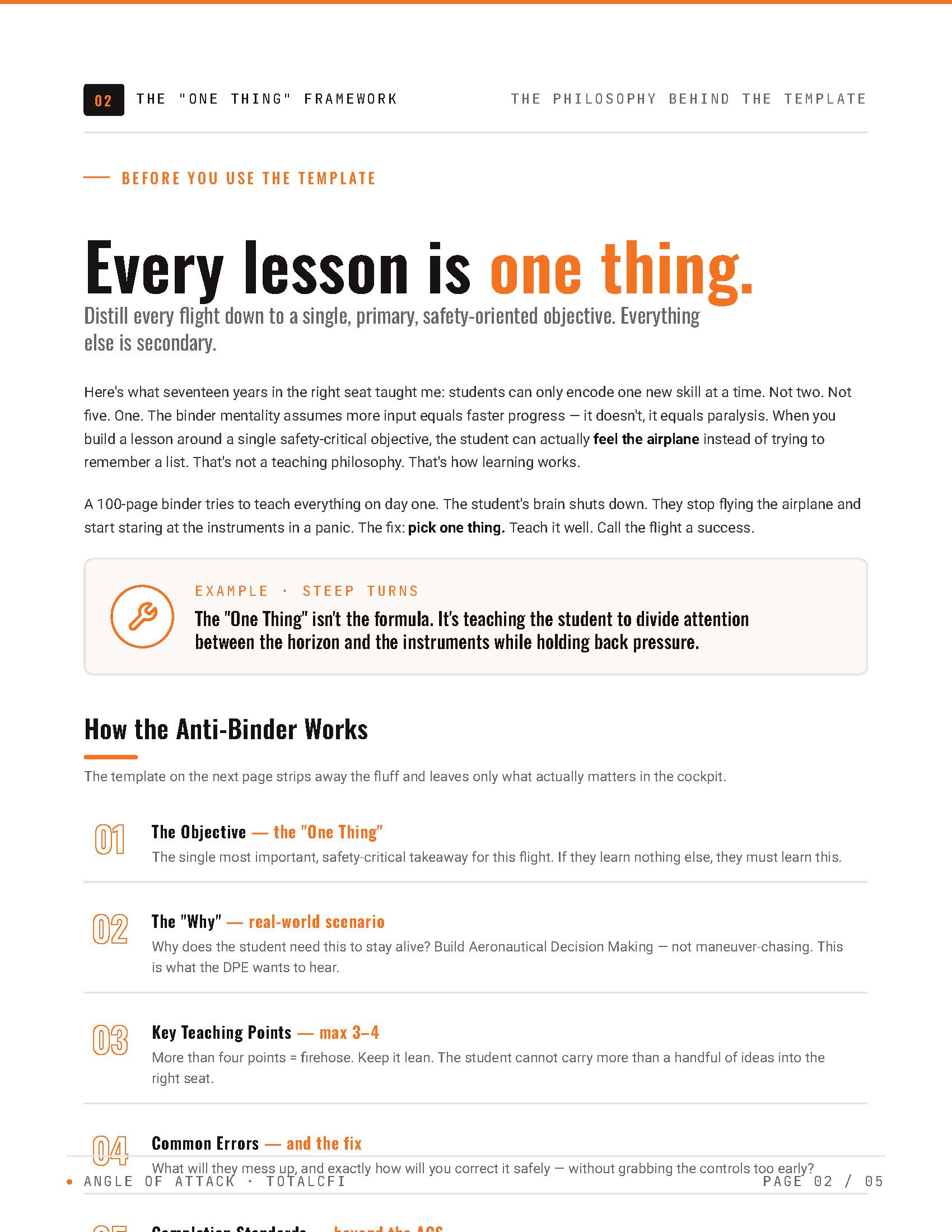
- The hour-building math is one equation: 1,200-1,250 hours to build divided by your monthly hour rate equals your months to ATP. Everything else in this article comes back to that one variable.
- R-ATP cuts the cross-country requirement from 500 hours to 200 hours under 14 CFR 61.160(e). For a CFI doing mostly local primary instruction, that's the most underrated wedge in the entire pathway.
- The honest sustainable rate is 60-75 hours per month, not 70-85. The 2025 NAFI national survey found 62% of working CFIs report burnout symptoms. Push past 90 and you crater your retention, which craters your monthly rate.
- Retention is the hidden hour-building multiplier. AOPA's data, reaffirmed at the 2025 NAFI Summit, shows 80% of student pilots quit before earning their PPL. Every student who finishes is 30-50 future hours you don't have to replace.
- Safety pilot work logs SIC by default, not PIC. Most "PIC safety pilot" stories on the forums are actually SIC. ATP requires 250 logged PIC hours. Get this wrong and you'll discover it at the application stage.
- 18 months is doable, not the default. The prepared CFI with a degree, an active market, and a retention discipline gets to R-ATP in 16-20 months. The cold-start CFI in a slow market with a leaky roster takes 30+.
WHAT'S IN THIS GUIDE
- 1The 1,500-Hour Math (Stop Guessing, Start Calculating)
- 2How Many Hours Per Month Does a CFI Realistically Fly?
- 3The Roster Math: How Many Active Students You Need
- 4Why Retention Is the Hidden Hour-Building Multiplier
- 5Do Multi-Rating CFIs (CFII / MEI) Build Hours Faster?
- 6The Realistic 18-Month Plan
- 7When 18 Months Is Realistic vs Optimistic vs Fantasy
- 8R-ATP, The Eligibility Wedge That Cuts Months Off
- 9How Do You Handle the 500-Hour Cross-Country Requirement?
- 10Can a CFI Burn Out at 100 Hours Per Month?
- 11What Are the Best Supplemental Hour-Building Jobs?
- 12What Happens After 1,500 Hours? The Regional Airline Path
- 13Hour-Building FAQs
The 1,500-Hour Math (Stop Guessing, Start Calculating)
Most pilots Google their way to "you'll get to 1,500 in 18 to 24 months as a CFI" and stop reading. That's the average. And the average hides the math.
You arrive at your CFI rating somewhere around 250 to 300 hours total time. That's the FAA minimum for an unrestricted commercial single-engine certificate under 14 CFR 61.129, and most candidates run a little over because of training overrun.
The standard unrestricted ATP under 14 CFR 61.159 requires 1,500 hours total time, plus subcategories: 500 hours cross-country, 100 hours night, 75 hours instrument, 250 hours pilot-in-command, and 50 hours in the class of airplane for the rating sought (multi-engine for the airline track).
So the gap you actually have to close is 1,200 to 1,250 hours. Call it 1,250 for clean math.
Now divide that gap by whatever monthly hour rate you can sustain, and you get your months to ATP.
| Monthly hour rate | Months to 1,500 (standard ATP) | Months to 1,250 (R-ATP, associate's or 30-credit bachelor's) | Months to 1,000 (R-ATP, full aviation bachelor's) | Months to 750 (R-ATP, military) |
|---|---|---|---|---|
| 50 hrs/mo | 25 | 20 | 15 | 10 |
| 60 hrs/mo | 21 | 17 | 13 | 8 |
| 70 hrs/mo | 18 | 14 | 11 | 7 |
| 80 hrs/mo | 16 | 13 | 9 | 6 |
| 90 hrs/mo | 14 | 11 | 8 | 6 |
| 100 hrs/mo | 12.5 | 10 | 7.5 | 5 |
That's it. That's the whole pathway in one table.
The variable you actually control is the leftmost column: your monthly hour rate. The rest of this article looks at why that rate isn't fixed, what drives it up or down, and why teaching better turns out to be the highest-leverage thing a hour-building CFI can do.
How Many Hours Per Month Does a CFI Realistically Fly?

The honest range is 50 to 100 hours per month. The median sustainable rate for a full-time working CFI is around 70 hours per month. That number won't match the recruiting brochure. It matches reality.
Six variables drive your monthly rate. Some you control, some you don't.
1. Roster size. How many active students do you have, and how often are they actually flying? More on the math in the next section.
2. Retention rate. Do your students finish, or do they drop out at lesson 6 and take a chunk of your future hours with them? This is the hidden multiplier. We'll come back to it.
3. Market. A busy regional airport with three flight schools and a steady GI Bill pipeline runs at a different pace than a small-town field with a hangar of weekend flyers. You can move; that's a real lever. But it's not the first lever to pull.
4. Ratings you can teach. A primary-only CFI is limited to PPL students. Add the CFII and you pick up instrument students, who fly more hours per lesson and tend to be more committed. Add the MEI and you're teaching twin time, which is more valuable per hour for the airline track.
5. Weather and season. Some markets lose two months a year to weather. Others don't. Honest math accounts for this. Don't assume 75 hours every month and then act shocked when February only delivers 35.
6. Your endurance. Eighty hours of flying per month is roughly 100 hours of working when you count ground, briefing, debriefing, paperwork, and drive. You can sprint for a few months. Sustaining it for two years without burning out takes deliberate effort.
If you want a real-world picture of the work behind the hours, watch this:
The variable you most directly control is your roster size and your retention rate. Everything else (market, weather, endurance) bounds the upper limit. Roster math next.
The Roster Math: How Many Active Students You Need
A typical primary student flies one to two times per week at about 1.5 to 2 hours per lesson. Call it 4 to 8 hours per student per month at a steady cadence. Use 8 as a clean per-student number for active, on-schedule students.
Multiply that across your roster, then pad about 25% for weather, no-shows, stage gaps, and the days when a student's car breaks down on the way to the airport.
| Target monthly rate | Avg hrs/student/mo at steady cadence | Theoretical active students needed | Realistic active students (with 25% pad) |
|---|---|---|---|
| 50 hrs/mo | 8 | 7 | 8-9 |
| 70 hrs/mo | 8 | 9 | 11-12 |
| 80 hrs/mo | 8 | 10 | 12-13 |
| 100 hrs/mo | 8 | 13 | 15-17 |
So if you're aiming at a sustainable 70 to 80 hours per month, you need somewhere around 11 to 13 active students. Not signed-up students. Active, on-the-schedule students who are showing up.
This is where most new CFIs miss. They count names on a list and call that a roster. The real roster is the count of students who flew with you in the last 14 days. The mechanics of building that roster (where your first five anchor students come from, how to get the phone ringing without an ad budget) is its own discipline; we go deep on that in our CFI marketing playbook.
Why Retention Is the Hidden Hour-Building Multiplier

Roughly 80% of student pilots quit before earning their Private Pilot Certificate. AOPA has cited this for years; it was reaffirmed at the 2025 NAFI Summit and continues to show up in SAFE research. The FAA's own data backs the underlying problem: the average PPL takes around 77.5 hours of training versus the 40-hour regulatory minimum, and most dropouts happen well before either number.
Now think about what a dropout costs you in hours.
A student who quits at lesson 3 cost you about 5 hours of flight time. That's the visible cost. The invisible cost is the 30 to 50 future hours that student would have flown with you if they'd finished: primary, solo cross-countries, dual cross-countries, checkride prep, the works.
Run the math on a roster of 12. If your retention rate is 50%, you're losing 6 students a year. If it's 80%, you're losing 2 to 3. The difference between those two outcomes, at 30-plus future hours per lost student, is somewhere on the order of 30 hours per month in your average across a year.
Thirty hours a month is the difference between 18 months and 30 months. Same hustle. Same hours behind the yoke. Different teaching.
Here's where I learned this the hard way. My first year as a CFI in Wisconsin, I had a student, call him Mike, who almost quit two weeks in. Not because of the flying. Because of me. Day 1, I handed him a four-inch FAR/AIM binder, a study schedule that would have intimidated a sim instructor at FlightSafety, and a list of acronyms longer than my pre-solo checklist. The man went home, looked at the pile, and called me Sunday night to ask if maybe flying just wasn't for him.
That phone call recalibrated me. We restarted the next Saturday with one airplane, one ground reference maneuver, and a single page on engine starts. Mike finished his PPL. Then he came back for instrument. He flew with me for the next eight months before I left for North Carolina. By the time I packed up, he'd put about 60 hours on my logbook all by himself.
One student. Sixty hours. From a guy I almost lost on Day 1 because I confused "thorough" with "intimidating."
The CFI version of this, the playbook for being Day-1 ready instead of Day-1 overwhelming, is what TotalCFI teaches. Quality compounds. Retention compounds. Your monthly rate is downstream of both.
Do Multi-Rating CFIs (CFII / MEI) Build Hours Faster?

Short answer: yes, but not the way most people think.
Adding the CFII (the instrument instructor rating) typically lifts your monthly hours by 15-30%. Two reasons. First, instrument students fly longer lessons on average. Actual approaches, hold entries, and procedure work add up. Second, instrument students tend to be more committed because they've already invested in the PPL. They show up.
Adding the MEI (multi-engine instructor) doesn't necessarily add a lot of hours per month, because twin time is harder to come by, but the hours you do log count toward your ATP 50-hour multi-engine requirement under 14 CFR 61.159 (which, again, is "50 hours in the class of airplane for the rating sought" — multi-engine for the airline-track AMEL ATP). For airline track, that's gold.
The sequence matters. Most CFIs are best served by stabilizing the primary roster first (three to six months of steady PPL work, with a real retention discipline) before going for the CFII. Stacking the CFII on top of an unstable roster usually costs more momentum than it adds. The MEI is typically a months 12-15 add-on, once total time is north of 800 hours and twin operations make economic sense for the school.
If you're sizing up which rating to chase next and when, that's the kind of decision we go deep on in our broader CFI cluster, particularly the article on CFI vs CFII vs MEI sequence.
The Realistic 18-Month Plan

Here's a concrete month-by-month plan, assuming you arrive at the CFI rating with a four-year aviation degree (R-ATP 1,000-hour pathway, 200-hour cross-country requirement), an active local market, and a retention discipline.
| Phase | Status | Avg hrs/mo | Cumulative TT | What's happening |
|---|---|---|---|---|
| Months 1-3 | New CFI, building roster | 45 | ~385 | First students, learning your teaching tempo, normal Day-1 ramp-up |
| Months 4-6 | Roster filling, CFII training | 60 | ~565 | Add CFII rating mid-period, start instrument students |
| Months 7-12 | Mature roster, dual rating | 80 | ~1,045 | Primary + instrument students, peak monthly hours, possibly add MEI late in window |
| Months 13-18 | Mature roster, MEI optional | 80 | ~1,525 | Sustained 75-85 hrs/mo, R-ATP 1,000-hr eligible at month 14-15 |
Read the cumulative column carefully. Under the R-ATP 1,000-hour pathway, you hit eligibility somewhere around month 14 to 15. By month 18, you've completed the ATP-CTP course (a 50-hour FAA-approved course required before you take the ATP written, per AC 61-138A), passed the ATP written, the regionals have made the conditional job offer, and you're scheduled for class.
For the standard 1,500-hour ATP (no degree pathway), add roughly 6 to 7 months. You're looking at 24 to 26 months to the regionals on the same monthly cadence.
When 18 Months Is Realistic vs Optimistic vs Fantasy

Let me be honest about the timeline math so you don't end up writing me an email in 14 months asking why you're at 1,100 hours instead of 1,400.
Realistic, 16 to 20 months to R-ATP. Four-year aviation degree. Active local market with 11-13 students on schedule. Good retention discipline. Steady 70-80 hours per month after the months 1-3 ramp. This is the prepared CFI.
Optimistic, 13 to 15 months. Same setup, plus you grind 85-95 hours per month for the back half of the timeline. Doable. The cost is burnout risk and retention erosion in the middle stretch. We'll get to that in two H2s.
Fantasy, 30+ months. Cold-start CFI in a slow market with a leaky roster, no retention strategy, no R-ATP eligibility. This is the path most "I'll just be a CFI for a year" people end up on without realizing it.
The honest message: 18 months is a target, not a baseline. The prepared CFI hits it. The CFI who treats monthly rate as a thing that happens to them does not.
R-ATP, The Eligibility Wedge That Cuts Months Off
If there's one regulation in this whole article you should know cold, it's 14 CFR 61.160. This is the Restricted ATP rule, and it cuts months, sometimes years, off the timeline for pilots who qualify.
| Pathway | Total Time Required | Cross-Country Required | Citation |
|---|---|---|---|
| Bachelor's degree, aviation major, 60+ aviation credits, FAA-authorized institution | 1,000 hours | 200 hours | 14 CFR 61.160(b) |
| Associate's degree, aviation major, 30+ aviation credits, FAA-authorized institution | 1,250 hours | 200 hours | 14 CFR 61.160(c) |
| Bachelor's degree, 30+ aviation credits | 1,250 hours | 200 hours | 14 CFR 61.160(d) |
| Military undergraduate pilot training, honorable discharge | 750 hours | 200 hours | 14 CFR 61.160(a) |
| Standard ATP (no degree pathway) | 1,500 hours | 500 hours | 14 CFR 61.159 |
Now look at that table again. Specifically, look at the cross-country column.
Every R-ATP pathway drops the cross-country requirement from 500 hours to 200 hours. That's 14 CFR 61.160(e), and it is the single most underrated wedge in the entire airline pathway.
Here's why. Most CFIs build their hours doing primary instruction: pattern work, ground reference maneuvers, traffic pattern entries, the bread and butter of the PPL syllabus. Almost none of that counts as ATP cross-country. So a CFI doing mostly local work can hit 1,400 hours total time with only 200 hours of cross-country and stall right there, watching the calendar burn while they manufacture XC hours the hard way.
Under R-ATP, the 200-hour XC requirement matches the cross-country time most CFIs naturally accumulate through dual XCs with students and the occasional ferry flight. The bottleneck disappears.
If you're inside 61.160(b), the full aviation bachelor's at an FAA-authorized institution, you're looking at 500 fewer total time hours AND 300 fewer XC hours than the standard ATP path. At 80 hours per month, that's roughly six months of timeline saved on total time alone, and the XC reduction effectively eliminates the secondary bottleneck.
The schools that count for R-ATP are listed by the FAA under the institutional authorization framework. AC 61-139 describes how they qualify. Check your school's status before you assume.
How Do You Handle the 500-Hour Cross-Country Requirement?

One detail that surprises a lot of CFIs at the ATP application stage: ATP cross-country is defined differently than private or commercial cross-country.
For private and commercial cross-country (14 CFR 61.1), you need a landing at an airport more than 50 nautical miles from the original point of departure. For ATP, the FAA's longstanding legal interpretation, cited consistently by Boldmethod, AOPA, and ATP forums, is that a landing at another airport is NOT required. The flight must just be more than 50 nautical miles from the point of departure.
That changes how you count. A 1.2-hour flight where you go 55 nautical miles out, do approaches, and come home: that's ATP cross-country, even though it's not PPL/commercial cross-country. For an instrument student running airwork at a nearby practice area beyond the 50-NM line, every hour of that flight counts toward your 500-hour (or 200-hour R-ATP) requirement.
The math on the time you spend matters. For a CFI on the standard 1,500-hour ATP path, you need to be flagging cross-country opportunities everywhere you can find them: dual XCs with students, repositioning flights, ferry work, glider tow runs that hit the 50-NM mark. Plan something like a 3-to-1 ratio: for every 3 hours of total time you fly, target 1 hour of ATP-qualifying cross-country. That's roughly the ratio you need to arrive at 1,500 TT with 500 XC in hand.
If you're on the R-ATP path, the math is far easier. You only need 200 hours of cross-country, which most CFIs accumulate naturally just through dual XCs with primary and instrument students.
Can a CFI Burn Out at 100 Hours Per Month?

The honest answer: yes. And the data finally exists to prove it.
A 2025 NAFI national survey found that 62% of active CFIs reported symptoms consistent with occupational burnout: chronic fatigue, cynicism, reduced engagement. That's not folklore anymore. That's a national association quantifying what the working CFI community has been saying for a decade.
Why does it happen? Eighty hours of flying per month is roughly 100 hours of working when you count ground briefings, debriefs, scheduling, paperwork, weather watches, and drive time. Push to 90 hours of flying, and you're past 110 hours of work. That's a 25-hour-a-week side life on top of your flying. And remember, your flying IS the work, so there's no "evenings off" to recover.
The early warning signs:
- Decision fatigue in the cockpit. Small calls feel heavier than they should.
- Relief on bad-weather days instead of frustration.
- Dropping enthusiasm with the students you used to genuinely enjoy.
- Skipping the debrief because you "covered it in the air."
- Stage stalls across multiple students at once. Your teaching quality is slipping uniformly.
And the feedback loop is cruel: when you push past your durable rate, your teaching quality drops, your retention drops, and your actual monthly hours drop within about 60 to 90 days. The peak monthly rate that burns you out can't be sustained. It pulls itself back down through retention erosion.
The honest sustainable rate for most working CFIs is 60 to 75 hours per month. Eighty to 85 is the push-hard rate, fine for short stretches, costly if you live there. Ninety-plus sustained is the burnout zone, and the 2025 NAFI data is showing what happens when an entire profession lives in that zone for too long.
What Are the Best Supplemental Hour-Building Jobs?

Most "alternatives to CFI" articles get this wrong. They frame the supplemental jobs (glider tow, ferry, pipeline patrol, banner tow, safety pilot work) as replacements for CFI hour-building. They're not. They're supplements. Most of them pay less per hour than CFI work, require minimum hour totals you're still building toward, and have weather/safety constraints that make them inconsistent.
Treat them as seasoning, not the main course.
Glider tow. The most underrated supplement for working CFIs. Under 14 CFR 61.69, you need 100 hours PIC in the category and class of aircraft used for towing (most CFIs already have this from primary instruction) plus the towing endorsements. Pay is typically $30-50 per hour, the work is concentrated on weekends when CFI primary work slows, each tow flight is short (15-25 minutes), and you log PIC time on every tow. If you live near an active soaring club, this is the highest-leverage supplement available. Five to fifteen hours a month is realistic.
Ferry flights. Variable pay: $200-500 per day plus expenses. The big advantage isn't the pay. It's that ferry flights are typically long cross-country blocks, which is exactly where standard-ATP CFIs need help. One four-day ferry trip can add 15-25 hours of XC time. The downside: ferry work is irregular, weather-driven, and usually goes to known pilots.
Pipeline patrol and aerial survey. Typically require 250-500 hours total time and pay $40-65 per hour. Reasonable supplemental income but tight margins, and most patrol work is structured around long days that conflict with steady CFI schedules.
Banner tow. Seasonal (mostly summer beach season), often requires 250-500 hours, pays $20-40 per hour, and has tight margins on safety. Less practical for full-time hour builders.
Safety pilot, read this carefully. Under 14 CFR 61.51(f), a safety pilot logs SIC time by default, NOT PIC. The safety pilot can only log PIC when (a) the two pilots have specifically agreed before the flight that the safety pilot is the acting PIC, AND (b) the pilot flying is actually under the hood (which is what makes the flight an operation requiring more than one crewmember). And remember, ATP requires 250 logged PIC hours under 14 CFR 61.159. If you've been logging "PIC" as a safety pilot on flights where you weren't actually acting PIC, you're going to discover that gap at the ATP application stage. Most of the safety-pilot-PIC stories on r/flying are people logging SIC and calling it PIC. Don't be that pilot.
What Happens After 1,500 Hours? The Regional Airline Path

The transition from CFI to regional first officer isn't a single moment. It's a window.
Most regionals will let you apply when you're 200 hours short of ATP minimums. So at around 1,300 hours total time, you start applications. You interview at roughly 1,400 hours. The conditional job offer (CJO) typically comes in shortly after the interview, and class assignment follows when you have the hours in the logbook and the ATP-CTP and ATP written done.
The ATP-CTP (Airline Transport Pilot Certification Training Program) is a 50-hour FAA-approved course required before you take the ATP knowledge test, per 14 CFR 61.156 and AC 61-138A. Most regional airlines pay for it once you have the CJO; some require you to do it on your own. Plan for it.
The 2026 hiring environment continues to favor pilots. Regional first-year pay at most majors' affiliates is sitting around $90 to $150 per flight hour, with total first-year compensation typically in the $80,000 to $110,000 range depending on which regional, your domicile, and the bonus structure. That's the destination role; we cover the transition in more depth in our broader CFI-to-airlines coverage.
One honest warning: a conditional job offer at 1,400 hours doesn't guarantee a class date at 1,500. The hiring market shifts. Classes fill. Some regionals can hold a CJO for 6+ months before a class opens up. Build the relationship with the regional you want long before you hit minimums.
Hour-Building FAQs
Can I really fly 100 hours per month as a CFI?
Technically yes, in a busy market with a mature 15-17 active student roster and good weather. Sustainably, no. The 2025 NAFI data shows what happens when CFIs live above 90 hours per month. The durable monthly rate is 60-75 hours; 80-85 is the push-hard rate; 100 is the burnout-zone sprint rate. You can sprint there for a month or two; don't try to live there for a year.
Does cross-country time count differently for ATP than for private or commercial?
Yes. For private and commercial cross-country (14 CFR 61.1), a flight must include a landing at an airport more than 50 nautical miles from the original point of departure. For ATP, the FAA's interpretation, cited consistently by Boldmethod, AOPA, and ATP guidance, is that a landing at another airport is NOT required. The flight just has to take you more than 50 NM from the departure point. That changes which flights you can claim toward your 500-hour (or 200-hour R-ATP) requirement.
Should I take a second CFI job to build hours faster?
Usually not. A second job typically means a second roster of students at half the depth of your primary roster, which means worse retention, more scheduling chaos, and lower per-student commitment. You'll likely add 10-15 hours per month while losing 5-10 hours per month from primary roster erosion. Net gain is small and the cognitive load is high. Better play: deepen your primary roster, add the CFII, and pick up glider tow on weekends if it's available locally.
What if my school doesn't have enough students for me to hit 70 hours per month?
Two real options. First, check whether the school is the bottleneck or the market is. If three CFIs at the school are all hitting 70 hours per month and you're the one at 45, that's a teaching-quality problem (fixable). If everyone is at 45, that's a market problem. Second, if it's a market problem, you have to make a call: move to a busier market, go independent under a different operating model, or accept the longer timeline. The math doesn't care about your zip code.
How long does it take to go from 250 hours to 1,500 hours?
On a sustainable 70 hours/month, roughly 18 months. On 80 hours/month, roughly 16 months. On R-ATP 1,000-hour pathway at 70 hours/month, roughly 11 months. On R-ATP 1,000-hour pathway at 80 hours/month, roughly 9 months. The standard estimate of "18-24 months" assumes a 60-75 hour monthly rate without R-ATP.
Can I get hired by a major airline directly out of CFI hour-building?
Generally no. Most major-airline hiring still goes through a regional or military pathway, even in the current pilot-shortage environment. The standard track is CFI → regional → major, with the regional adding the turbine PIC time the majors typically require. There are exceptions (military, corporate jet pathways), but the regional-first track is the modal route for civilian CFI hour-builders.
If the CFI checkride is keeping you up at night, you're prepping for the wrong thing.
TotalCFI teaches you to walk into the oral as a teacher, not a test-taker — the reframe most candidates only figure out after they've already failed once.
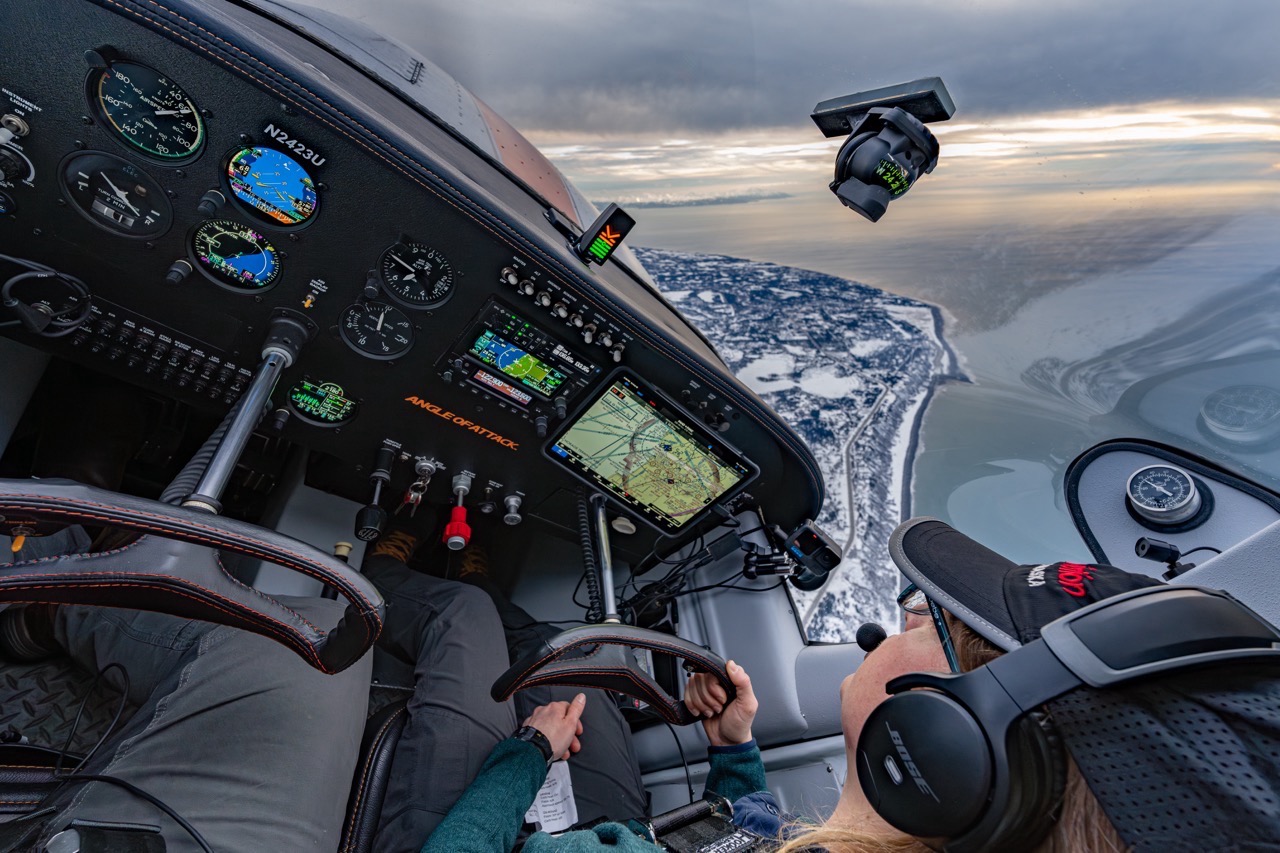

Throttle On!
Chris Palmer
Founder & Chief CFI, Angle of Attack
Two-Time Master Aviation Educator (NAFI) · Gold Seal CFI · In aviation education since 2006
I'm Chris Palmer — two-time Master Aviation Educator and Gold Seal CFI. I've been in aviation education since 2006 and a working CFI since 2017. Throttle On!