How Much Should a New CFI Charge in 2026? Real-World Pricing for Your First Year

Most new CFIs going independent or setting side-student rates in 2026 should open between $45 and $65 per hour in average markets, $65–$95 in major metros, and $35–$55 in slower markets. Where you land inside that range depends on six variables — local market rate, your differentiators, aircraft access situation, cost floor, career motive, and positioning goal. The rate isn’t just a number. It’s the first message you send to every prospective student before they ever meet you.
- 2026 opening rates for a brand-new CFI: $45–$65/hr in average markets, $65–$95 in major metros, $35–$55 in slower markets. Pilots of America forum data shows about 42% of indie CFIs sit in the $50–$59 band.
- Your rate is the first signal you send to every prospect — before they meet you, before they hear you teach. Set it too low and you signal “amateur” and attract price-shoppers. Set it where the math works and the message lands, and you attract the students who’ll make you a better CFI.
- Run the cost-floor math before you set a rate. Insurance, ForeFlight, SAFE/NAFI dues, your own currency, and a small gear/misc bucket run about $1,900–$3,500 a year in fixed operating costs before you’ve fueled a single airplane — and self-employment tax and federal income tax take their cuts on top of that.
- There are four billing methods, not three. Hourly, block, package, and per-lesson flat rate — each has a moment to use it and a moment to avoid it.
- Raise your rate the right way. Announce 60–90 days ahead, individually (not mass email), honor old rates for current students, new rate for new students from a clean date forward.
- The Anti-Binder lesson plan template is the framework I use to teach CFI candidates the kind of clean, simple instruction that defends a higher rate from day one. It’s free below.
Walking into your first lesson with a 50-page binder won't help you.
Get my Anti-Binder One-Page Lesson Plan Template free — the lesson plan tool I built for CFI candidates who want to be ready Day 1.
Get the Anti-Binder Template Free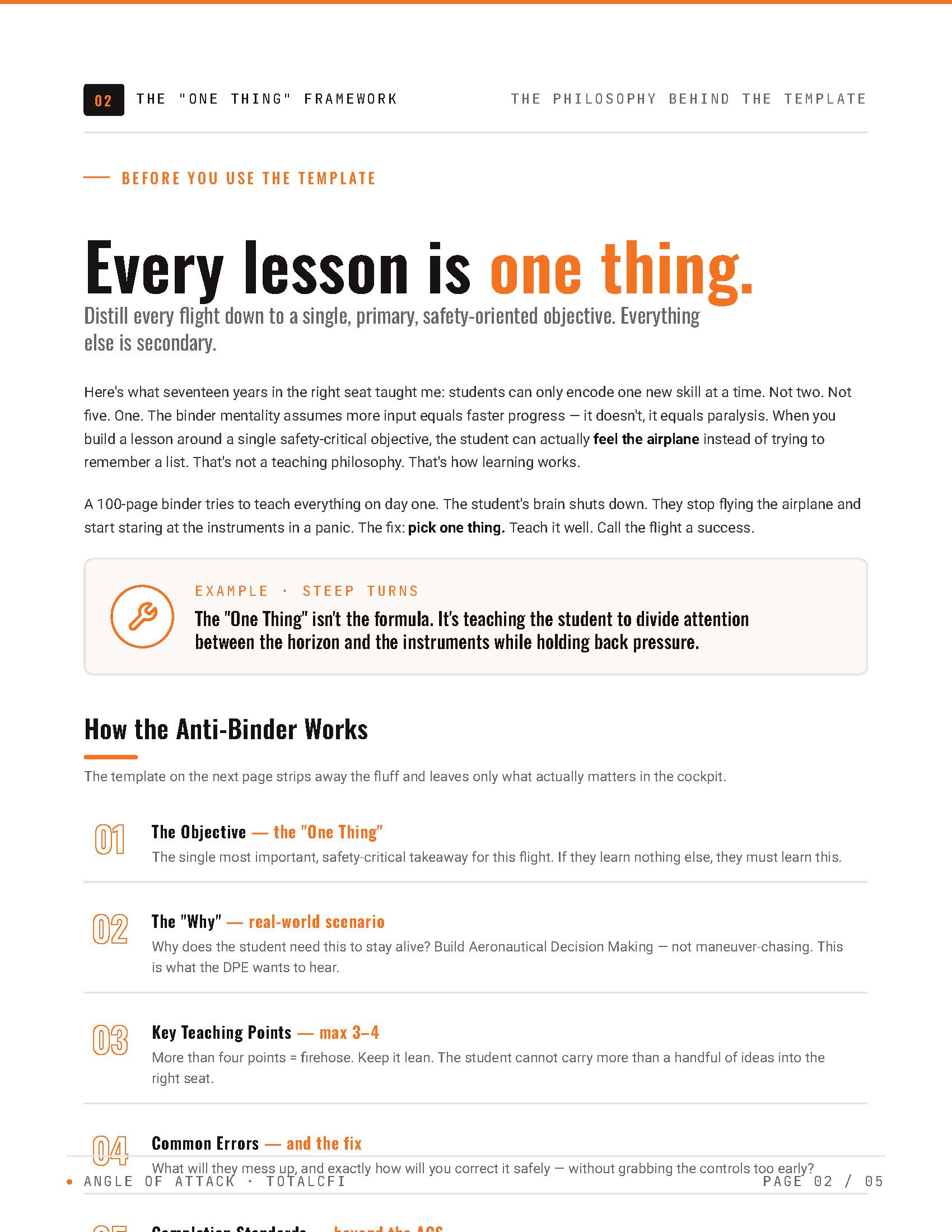
WHAT'S IN THIS GUIDE
- 1First — The Pricing Mindset Most New CFIs Get Wrong
- 2The 2026 New-CFI Rate Reality
- 3How to Set YOUR Opening Rate — The 6-Variable Method
- 4The Opening-Rate Formula — Three Worked Examples
- 5Hourly vs. Block vs. Package vs. Per-Lesson
- 6Ground Instruction Pricing — The Often-Ignored Lever
- 7When and How to Raise Your Rate
- 8Handling Price Shoppers (And When to Walk Away)
- 9The Other Income Streams Most New CFIs Miss
- 10New CFI Pricing FAQs
First — The Pricing Mindset Most New CFIs Get Wrong

Your rate is the first conversation you have with every prospect — and it happens before you ever say a word.
Every prospective student who hears your hourly rate makes an instant judgment about you — before they’ve ever sat in the right seat with you, before they’ve watched you teach, before they know your name. Too cheap, and you signal amateur. Too expensive without proof, and you signal ripoff. The right rate, defended with the right framing, attracts the right students and lets you actually pay your bills.
This is the part most new CFIs miss. They treat pricing like a math problem. It’s a positioning problem with math underneath it.
Greg Brown wrote about this in AOPA’s Flight Training magazine almost twenty years ago and the piece still holds up. He told a story about a student who was irritated with him for not charging enough — the student felt like the low rate undermined the value of the instruction. Brown’s point: most CFIs are broke, so we assume everyone else is broke, so we set our rates too low. The students aren’t broke. They’re paying for an airplane and an instructor. They expect the instructor to cost real money.
When I set my first CFI rate in Wisconsin in 2017, I went exactly where every new CFI goes: I asked around, found out what the local schools charged, and went a few dollars under. I thought I was being smart. What I actually did was tell every prospective student “I’m new and I’m cheap.” The students I attracted at that rate were the ones who haggled, the ones who skipped lessons, the ones who quit after their first solo. The students who would have paid full rate didn’t even call — because the cheap rate told them I wasn’t who they were looking for.
It took me about six months to figure out what I’d done. By then I had a roster of price-shoppers and no easy way to raise. That’s the trap.
There are two competing signals you have to balance. Too cheap = amateur — you’re telling the student you don’t think you’re worth real money, so why should they? Too expensive without proof = ripoff — you’re asking for premium pricing without any evidence you can deliver premium teaching. The job is to find the rate where the math works and the message lands. We’ll get to the math in a minute.
The other thing to know up front: you cannot beat the flight school on price. They have the airplane. Their rate includes the airplane. If you try to undercut a school’s CFI rate by a few dollars, the student does the math, sees they save $10/hr but have to find their own airplane, and goes back to the school. Don’t run that race. You won’t win it, and even if you do, the prize is a calendar full of price-shoppers.
The 2026 New-CFI Rate Reality (Quick Reference)

Here’s the snapshot for 2026, pulled from ZipRecruiter’s April data, the Pilots of America independent-CFI rate poll, AskACFI threads, and a survey of nearby-market quotes.
| Market type | New CFI opening range | Experienced independent CFI | Notes |
|---|---|---|---|
| Major metros (NYC, LA, SF, Boston, Seattle, Miami, DC) | $65–$95/hr | $90–$200/hr | High cost of living, dense pilot population, willingness to pay. Top end is specialty work — Cirrus, jet transition. |
| Average markets (most of the country — mid-size cities, regional airports) | $45–$65/hr | $60–$90/hr | The modal range. Pilots of America forum data shows ~42% of indie CFIs sit in this band. |
| Slower markets (rural, small towns, lower cost of living) | $35–$55/hr | $50–$70/hr | Lower cost of living offsets, smaller pilot pool. Don’t underprice your own time even here. |
| Ground instruction (when separated) | 60–80% of flight rate | Same as flight rate | Industry tradition is the discount. AOPA’s editorial position and modern best practice: flat. Pick a position. |
| Block rate (when offered) | 5–10% discount on 10+ hours pre-paid | Same | Don’t discount more than 10% — you’re negotiating against yourself. |
The honest read: the bottom of the average-market range — $45/hr — is where a brand-new CFI with a fresh PPL-only CFI ticket, no specialty endorsements, and zero hours of dual given typically opens. The top of the range — $65/hr — is where you land once you have a CFII, a tailwheel endorsement, or three or four completed students under your belt. Most generic salary aggregators put the new-CFI floor at $55. The real floor is lower — that’s what the market actually pays day-one CFIs in average markets.
If you want the full regional breakdown — what salaried CFIs at major academies make, how the pilot shortage shifted rates from 2019, where the highest-paying markets are — that’s all in the CFI salary article. This article is the layer underneath: how you, specifically, set your number.
How to Set YOUR Opening Rate — The 6-Variable Method

A defensible rate is the answer to six questions stacked together. Run through these in order before you quote anyone.
Variable 1 — Local Market Rate
Call five nearby CFIs and two flight schools. Ask their rate, or pull it from their website. Write the numbers down. Find the median, not the average — the average gets skewed by one $200/hr Cirrus specialist. The median is your anchor.
This is your floor of reality. If the local median is $55/hr, you’re not opening at $30 (you’ll signal amateur and attract no real students) and you’re not opening at $90 without a serious differentiator (the market won’t bear it).
Variable 2 — Your Differentiators
List your ratings (CFII, MEI), specialty endorsements (tailwheel, complex, high-performance, seaplane), and any unusual fit (career-track student focus, military background, retiree or first-time pilot specialty).
Here’s where the conventional advice gets it wrong: each differentiator does not add a flat $5/hr to your rate. Differentiators unlock different student pools at different rate tiers. CFII unlocks instrument students who pay 20–30% more across the board. MEI unlocks multi-engine students at a 25–40% premium. Tailwheel and complex unlock niche students at 10–20% premiums. The Master CFI track unlocks a premium-positioning audience that pays 30–50%+ more.
You don’t add differentiators to a base rate. You stack different rates for different student pools.
Variable 3 — Your Aircraft Access Situation
Three scenarios: - Student brings the airplane (private owner or rental from somewhere else). Lowest cost to them, highest billing rate available to you. - You rent through a flight school. Less price flexibility — the school’s per-hour rental rate is on top of your time, and the total has to make sense to the student. - You own or share an airplane. You can offer total package pricing (rental + instruction together), which opens up flat-rate package options.
This shapes what number works. A CFI working with private owners can defend a higher hourly rate because the total cost to the student is lower than a flight school. A CFI renting at a busy school is competing against the school’s own CFI rate (which usually includes a discount when you buy block time). Know which lane you’re in. If you’re still weighing whether to go fully independent or work for a flight school, see going independent versus flight-school work — the tradeoffs run deeper than the hourly rate.
Variable 4 — Your Cost Floor
This is the math most new CFIs skip. The full cost-floor table is below in the next section. The short version: insurance, ForeFlight, SAFE/NAFI dues, your own currency, and a gear/misc bucket cost you somewhere between $1,900 and $3,500 a year in fixed operating costs before you’ve stepped near an airplane. Self-employment tax (~14% effective) and federal income tax (12–22% bracket) come off the top of every dollar you earn after that. If your rate doesn’t clear all three layers by a wide margin, you’re running a hobby with billing.
Variable 5 — Your Career Motive
This is the variable most rate guides skip, and it’s the most important one for shaping your number. Two basic camps:
Hour-builder. You’re here to earn the 1,500 hours toward an ATP, transition to a regional first officer seat, and never instruct again. You’ll deliberately undercharge to keep the schedule full because hours are the goal, not income. A hour-builder might open at the bottom of the local range to fill 80–100 hours/month fast.
Career CFI. You’ve chosen instruction as the work. You’re tracking toward Master CFI. You’re not racing to leave the seat. You charge more than the hour-builder because you’re not selling time — you’re selling skill. A career CFI prices for value, not utilization.
This is a fork. Pick a side before you set the rate. The hour-builder strategy that fills the schedule will starve the career CFI’s positioning. The career CFI strategy that defends premium will leave the hour-builder under-booked.
Variable 6 — Your Positioning Goal
Cheap, average, or premium. You can pick exactly one.
- Cheap attracts price-shoppers — the worst students. They haggle, skip lessons, write bad reviews. They also leave first.
- Premium attracts students who care about quality — the best students. Smaller pool, but they refer, retain, and pay full rate without flinching.
- Average is the safe default. You’re not signaling anything strong, but you’re also not actively repelling anyone.
Most new CFIs land at “average” because they don’t know they’re picking. Pick on purpose. The decision shapes everything else — your marketing, your conversation in the first call, the students who say yes.
Final Step — Synthesize the Number
Local median ± career-stage adjustment ± positioning adjustment, validated against your cost floor + your differentiators. Three worked examples below.
The Cost-Floor Math (Run This Once a Year)
Realistic 2026 fixed annual costs for an independent new CFI. Your numbers will vary, but the order of magnitude won’t.
| Cost | Annual ($/year) | Source |
|---|---|---|
| CFI non-owned liability insurance ($100K/$1M policy) | $400–$700 | Avemco / SAFE / NAFI 2026 |
| ForeFlight Pro Plus subscription | $240 (or $0 via the CFI Referral Program) | ForeFlight 2026 |
| SAFE or NAFI annual membership | $45–$90 | SAFE / NAFI 2026 |
| AOPA membership (optional but standard) | $79 | AOPA 2026 |
| Your own BFR every 24 months (amortized) | $150–$250 | Industry typical |
| Your own instrument currency if CFII (approaches with a safety pilot or in IMC, plus an IPC if you fall outside the 6-month grace window per 14 CFR 61.57(d)) | $300–$500 | Industry typical |
| FAA medical (Class 3 — valid 60 calendar months under age 40, 24 calendar months age 40 and over per 14 CFR 61.23; BasicMed is a viable alternative for many CFIs giving dual in light aircraft) | $50–$120 amortized | FAA AME pricing |
| iPad / mount / headset replacement (5-yr amortized) | $200–$400 | — |
| Logbook, Sporty’s training materials, FAR/AIM refresh | $100–$200 | Annual |
| Misc. (gas to airport, printing, business cards) | $300–$500 | Conservative |
| Subtotal annual fixed costs | $1,864–$3,479 | |
| Self-employment tax (15.3% of net) | Variable — ~14% effective on net | IRS Schedule SE |
| Federal income tax | Variable — typically 12–22% bracket | IRS |
The interpretation. If you bill 400 hours of instruction a year (eight hours a week, fifty weeks), your fixed costs alone eat about $5–$9 of every billable hour before SE tax. Self-employment tax takes another ~14% off the net. Federal income tax takes another 12–22%. Your take-home on a $50/hr rate is roughly $50 minus $7 (fixed cost amortized) minus $7 (SE tax) minus $5 (income tax) — about $31/hr in your pocket.
That’s why opening below $45/hr in an average market isn’t a business. It’s a hobby with billing.
This is general pricing guidance, not tax advice. Consult a CPA or tax professional for your specific situation.
The Opening-Rate Formula — Three Worked Examples

Three CFI profiles, three different number sets. Find yourself in one of them.
Profile 1 — Brand-new CFI, PPL-only, average market
- Local market median: $55/hr (flight school rate; independent CFIs in area $50–$65)
- Differentiators: None beyond CFI initial. No CFII, no specialty endorsements, no completed students yet.
- Aircraft access: Students bring their own airplane (FBO rental club + private owners)
- Cost floor: $2,400/year fixed → ~$6/hr at 400 hours/year
- Career motive: Hour-building toward ATP — wants to fill the schedule fast
- Positioning: Average (no premium signal yet to defend)
- Open at: $50/hr — at the lower-middle of the local market.
Why not $45? Because $45 signals discount-shop and attracts price-shoppers. Why not $60? Because you have no differentiators yet and the market won’t bear premium pricing without proof.
Plan: Hold at $50 for the first three completed students. After three PPL passes, raise to $55. Once you add CFII, jump to $60–$65 for instrument work and hold $55 for PPL.
Profile 2 — New CFI with CFII + tailwheel + ~100 hours of dual given, average market
- Local market median: $55/hr (PPL); $65/hr (instrument students typically pay more)
- Differentiators: CFII unlocks instrument students at a higher tier. Tailwheel unlocks the niche tailwheel-curious crowd.
- Aircraft access: Mixed — flight school for PPL students; private tailwheel owners come to you
- Cost floor: $2,800/year fixed (slightly higher with IPC currency) → ~$7/hr at 400 hours/year
- Career motive: Mixed — still hour-building, but enjoying the teaching and not in a rush
- Positioning: Mid-tier — you have ratings to defend a higher rate
- Open at: $60/hr for PPL students, $70/hr for instrument students, $75–$80/hr (or flat-rate) for tailwheel endorsements.
Different rates for different work, defended by different student pools. The PPL student is paying for primary instruction. The instrument student is paying for IFR work and is used to higher rates. The tailwheel student is paying for a niche endorsement and is paying for access to a CFI who can give it.
Plan: Hold these rates for six months. After your first five instrument students complete, raise CFII rate to $75/hr. The tailwheel rate moves with demand.
Profile 3 — Career CFI, Master track, CFII + MEI + 500+ hours of dual given, average market
- Local market median: $55/hr — and irrelevant. You’re not in the median.
- Differentiators: CFII + MEI + reputation + a curriculum + 5+ referrals/year + a first-time checkride pass rate that beats the national average (most recent FAA-tracked national first-time CFI pass rates have hovered in the 50–60% range — Master-track CFIs typically run well above that, though specific personal pass rates should be tracked from your own logbook before you market the number)
- Aircraft access: Doesn’t matter — you teach value, not seat time
- Cost floor: $3,500/year fixed → ~$9/hr at 400 hours/year (also irrelevant — you’re not pricing at the floor)
- Career motive: Career — you ARE the destination. You’re not stopping at 1,500 hours.
- Positioning: Premium — students are paying for who you are
- Open at: $85–$95/hr for PPL, $100–$120/hr for instrument, $125–$150/hr for multi-engine, flat-rate packages for endorsements.
You have a waitlist. Students who haggle don’t get in. The students who do come in pay full rate without flinching because they’ve watched your YouTube channel or read your blog or talked to a referral, and they know what they’re getting.
Plan: Raise $5/hr every twelve months based on demand. When the waitlist exceeds three students, raise faster.
Hourly vs. Block vs. Package vs. Per-Lesson — Which to Use When

Most new-CFI articles treat this as a three-way choice. There’s a fourth option that’s gaining ground in modern indie practice — per-lesson flat rate. Run through all four and pick what fits your situation.
1. Pure Hourly (Hobbs or handshake-to-handshake)
You bill X per hour of instruction. Hobbs time is the airplane meter — only counts when the engine is running. Handshake-to-handshake is clock time including the brief and the debrief.
When to use: Default for new CFIs. Simplest billing. Most students expect it.
When to avoid: When you want to incentivize the student to slow down and value the brief and debrief — per-lesson is better.
Pro tip: Always bill handshake-to-handshake, not Hobbs. Hobbs trains the student to skip the brief. The brief is where the learning lives.
2. Block Rate (pre-paid block of hours)
The student pre-pays for ten hours at a 5–10% per-hour discount.
When to use: When you have a student you trust to use the hours and you want cash flow predictability. A mid-training student who’s already proven they show up.
When to avoid: With a brand-new student who hasn’t proven they’ll keep coming. With aggressive discounts above 10% — you’re negotiating against yourself. With refundable blocks (loophole — student can cancel and ask for the money back).
Pro tip: Block rate is for retention, not acquisition. Don’t lead with block-rate pricing on the first call.
3. Package (flat-rate completion bundle)
“$X for PPL completion through checkride.” Or “$Y for instrument completion.” Flat fee regardless of how many hours it takes.
When to use: When you have a track record of consistent completion times, the student is highly motivated, and you have airplane access nailed down. Most common in accelerated or career-track programs.
When to avoid: As a brand-new CFI. You don’t know your completion times yet. A mispriced package costs you thousands.
Pro tip: This is the highest-cash-flow option but the highest risk if your math is wrong. Wait until your second or third year minimum.
4. Per-Lesson Flat Rate
“$180 for a pre-solo flight lesson — includes ~1 hour brief, ~1 hour flight, ~0.3 hour debrief.” Flat per lesson regardless of exact stopwatch time.
When to use: When you want to align pay with value delivered, not seat time. Rewards thorough briefs and debriefs. Predictable for the student. Gaining adoption in modern indie practice.
When to avoid: When your lesson length varies dramatically student-by-student. Requires you to be disciplined about lesson scope.
Pro tip: This is the modern alternative to hourly. It’s the billing model that rewards thorough briefs and debriefs. Try it in year two, once you know your typical lesson lengths.
Ground Instruction Pricing — The Often-Ignored Lever

Two competing positions on this one, and I’ll tell you where I land.
Industry tradition. Charge ground at 60–80% of flight rate. Rationale: ground is “less stressful,” doesn’t carry in-flight responsibility, students perceive ground as less valuable.
AOPA editorial position (Greg Brown, “CFI to CFI”). Charge the same. An hour of teaching is an hour of teaching. Discounting ground rewards the wrong behavior — rushing the brief, skipping the debrief. Brown’s analogy: the dentist doesn’t charge less for explaining the x-ray than for drilling the cavity.
Where I land. Flat rate. Same number for ground and flight. Here’s why.
The brief and debrief are where the learning lives. If you charge less for ground, you’re literally telling the student to spend less time there — and they will. They’ll show up five minutes before engine start, blow through the brief, and treat the debrief as something to skip if the airplane runs late. That’s the worst possible training pattern, and you set it the minute you discounted the ground.
Flat-rate ground also simplifies billing. No “wait, were we doing ground or flight” arguments. No tracking which hour was which. One rate, one invoice.
It defends the teaching-quality argument. Your value is the teaching, not the seat time. The CFIs who command premium rates do it because they teach well — and they teach well because they brief and debrief like the lessons they are. You can’t price ground like an afterthought and then ask the student to take it seriously.
It matches modern best practice. More indie CFIs and small schools are moving to flat or per-lesson billing every year.
The compromise. If you absolutely have to differentiate (some students will push for a ground discount), set ground at 80% of flight, not lower. Then explain the rationale in the first meeting so the student doesn’t try to push you lower in lesson three.
This is the part of the rate conversation where teaching quality stops being abstract and starts being load-bearing. The CFIs who charge full rate for ground are the ones whose ground sessions are worth full rate — they walk in with a one-page lesson plan, they identify the simpleness of the topic, they leave the student understanding why the maneuver works rather than memorizing eight facts about it. That’s the curriculum I built TotalCFI around. The Anti-Binder method, the twenty-four lessons, the Day-One Ready frame — it’s the teaching quality that defends the rate. The CFI who can teach a stall recovery in fifteen minutes and have the student get it is worth a different number than the CFI who needs forty-five minutes and hands the student a binder. The market knows.
When and How to Raise Your Rate (Without Losing Half Your Students)

The single biggest retention-killer in the new-CFI playbook is the same-day, mass-email rate increase. “Hey everyone, rates go up tomorrow, see you next week.” I’ve watched a new CFI lose four students out of six in one week from exactly that move. Don’t do it.
Here’s the right sequence.
Step 1 — The Trigger Check (you’re ready when…)
- You’ve completed three or more students at the current rate (proof of teaching value)
- You have a waitlist (demand exceeds supply — strongest signal)
- It’s been at least twelve months since your last raise (annual rhythm is normal)
- You’ve added a rating, endorsement, or differentiator since your last rate set (CFII, MEI, tailwheel, completed Master CFI requirements)
Step 2 — Don’t Raise When…
- Retention is below 70% (students are leaving — fix the retention problem before raising; raising will accelerate departures)
- You’re under-booked (raising won’t bring more students; check your positioning first)
- You haven’t completed any students yet (you have no proof to defend the raise with)
- The market just shifted up and you’re chasing it (chase your own value, not the market’s)
Step 3 — The 60–90 Day Communication Sequence
- Decide the new rate and the effective date 60–90 days out
- Tell each current student individually at their next lesson — phone or in-person, never mass email
- Honor the OLD rate for current students through the effective date (this is the loyalty signal)
- New rate applies to new students starting from the effective date forward
- Update your website, your Avemco listing, your NAFI profile, any public-facing rate sheet on the effective date — not before
Step 4 — The Script (paste-ready)
Here’s the conversation. Have it at the end of a lesson, after a debrief, when the student is in a good mood:
“Hey [Student Name], I want to give you a heads-up on something. Starting [60–90 days from now], my new-student rate is going up from $X to $Y. Two reasons — I want to keep growing as your instructor (I’m investing in [Master CFI track / additional rating / continuing education]), and my rate hasn’t moved in [time]. Your rate stays at $X through [date], because you started with me at this rate and I want to honor that. After that, you’ll see the new rate. Any questions?”
That’s the whole script. It does three things at once: it gives notice, it explains the why (so it doesn’t feel arbitrary), and it honors the existing rate (so the current students don’t feel punished for being early). You’ll lose almost nobody.
The CFI I mentioned at the top of this section did the opposite. Mass email, same-day, “rates go up tomorrow.” Four students gone by the end of the week. He spent the next three months trying to fill the schedule back at the higher rate and never got there. The raise was right. The communication was wrong.
Handling Price Shoppers (And When to Walk Away)

A new prospect calls or emails. Their first or second question — sometimes the only question — is “what’s your hourly rate?”
This is the moment most new CFIs torch the relationship. They answer the question. “I charge $55/hr.” Click. The prospect goes shopping for someone $5 cheaper. You never hear from them again.
Don’t answer the question. Re-frame it.
The Qualifying Question
“Before I quote you a rate — what’s your end goal, and what’s your timeline?”
That’s it. One sentence. You’re not refusing to answer; you’re saying you need a little context first to make sure you’re a fit. Almost nobody pushes back.
What you’re listening for in the answer:
- “I want my PPL by next summer.” Real prospect. Quote the rate, schedule the meet.
- “I’m career-track — I want to fly for the regionals.” Real prospect. Quote the rate.
- “I just want to fly safely for my family.” Real prospect.
- “I just want to compare a few CFIs.” Price-shopper. Walk away politely.
- “I’m shopping around for the cheapest.” Price-shopper. Walk away.
The Walk-Away Script
“It sounds like you’re early in the process and weighing options — that’s smart. Honestly, I’m probably not the cheapest CFI in town, and I want to be straight with you so you don’t waste your time. My students typically come to me because they want [quality / a specific niche / completion]. If price is the main factor, you’ll find better fits than me. If you ever decide quality is more important than price, my door’s open.”
Why this works: it self-selects. The price-shopper goes away (they would have anyway, just with more drama). The quality-seeker often comes back — sometimes weeks later, after they’ve talked to two cheaper CFIs and realized those CFIs were cheaper for a reason. You haven’t burned the relationship. You’ve sorted it.
Four Walk-Away Signals
- Their first question is rate, not goal
- They mention they’re “shopping around” for the cheapest
- They push for a discount before they’ve met you
- They cite competing rates that are at the rock-bottom of your market
When you see two or more of these in the same conversation, the script is the right move. Better to lose them in the first five minutes than to lose them in lesson eight after they’ve eaten three weekends of your calendar.
Defending a higher rate is partly a marketing problem — see how to market yourself as a new CFI for the lead-generation playbook that brings quality-seekers to your door instead of price-shoppers.
The Other Income Streams Most New CFIs Miss

Most new CFIs think only in terms of PPL and IFR student blocks. The reality is that an independent CFI can generate $500–$1,500 a month from “transactional” non-student work — flight reviews, IPCs, checkouts, endorsements. Low time investment per booking, high billing density, and the bookings often turn into ongoing students.
| Service | Typical time¹ | Typical rate | Pricing notes |
|---|---|---|---|
| BFR (14 CFR 61.56) | 1 hr ground + 1 hr flight minimum (often 1.5–2 total) | Flat $150–$300 per BFR | Flat rate is standard. Adjust by aircraft complexity. |
| IPC (14 CFR 61.57) | 1.5–2.5 hours typical | Flat $200–$400 per IPC | Often combined with BFR for ~$300–$500 combined |
| Aircraft checkout (rental club / FBO partnership) | 1–3 hours depending on complexity | Hourly rate or flat $150–$400 per checkout | FBO partnership often pays you $50–$75/hr |
| Tailwheel endorsement (14 CFR 61.31(i)) | 4–10 hours of dual typical | Flat $400–$800 per endorsement | Niche premium — your tailwheel students refer |
| Complex endorsement (14 CFR 61.31(e)) | 2–5 hours | Flat $200–$500 | Cessna 182 / Cirrus typical |
| High-performance endorsement (14 CFR 61.31(f)) | 2–5 hours | Flat $200–$500 | Similar to complex |
| High-altitude endorsement (14 CFR 61.31(g)) | 2–4 hours ground + 1–2 flight | Flat $200–$400 | Less common but billable |
| Discovery flights (FBO partnership) | 1 hour | $99–$199 per intro flight | FBO splits — typical CFI take $50–$100/intro |
| Mentoring / coaching (one-time consult) | 1–2 hours | $100–$300 per session | Career-track CFIs and aviation-pivoter consults |
¹ “Typical time” reflects industry norms, not regulatory minimums. The IPC has no statutory duration in the FARs — FAA Advisory Circular 61-98E outlines the recommended scope. Endorsement times reflect average completion, not FAA hour minimums.
What this looks like in a real month: 2–3 BFRs ($450–$900) + 1–2 IPCs ($300–$800) + 1 checkout ($150–$400) + 1 endorsement ($200–$800) = $1,100–$2,900/month without taking a single primary student.
This is the lever new CFIs miss. Set up the FBO partnership. Get on the rental club’s checkout instructor list. Tell every CFI in your area you’re available for BFR and IPC work. The transactional book is the difference between a CFI who’s barely covering costs and a CFI who’s making a living.
What you’re billing for under all this is your CFI privileges — ground training, flight training, endorsements, flight reviews, and IPCs are all explicitly listed in 14 CFR 61.193. The legal authority is the certificate. The pricing power is what you do with it.
New CFI Pricing FAQs
Should I charge less because I’m new?
No. Charging less because you’re new is discounting based on self-perception — and most students don’t know your hour count. They know whether you teach well. If you set your rate below market because you feel new, you signal “amateur” to every prospect and you attract the worst students. Set your rate at the local average for a brand-new CFI (the lower-middle of the range — $45–$55 in average markets), defend it with teaching quality, and raise after three completed students.
How much should I charge for ground instruction vs. flight?
The most defensible answer is the same rate as flight — flat. The brief and debrief are where the learning lives, and discounting ground tells the student to skip them. If you have to differentiate (some students will push), set ground at 80% of flight rate, never lower. AOPA’s editorial position (Greg Brown, CFI to CFI) supports flat rate for both.
Is $50/hr too much for a new CFI?
No. $50/hr is at or near the lower-middle of the average-market range for a brand-new independent CFI in 2026. Pilots of America forum data shows 42% of independent CFIs charge $50–$59/hr. Below $45/hr in an average market and the cost-floor math (insurance, ForeFlight, SE tax) means you’re netting under $30/hr after costs.
When can I charge $100/hr as a CFI?
When you can defend the rate with proof. That usually means a CFII rating, multiple completed students, a referral pipeline, a specialty (tailwheel, complex, multi-engine), or a marketing presence (YouTube, blog, local reputation). Most CFIs reach the $100/hr tier in a major metro within 2–4 years of going independent. Career CFIs on the Master CFI track often reach it sooner.
Do independent CFIs make more than flight school CFIs?
It depends on utilization. Independent CFIs can charge more per hour but have to handle their own marketing, scheduling, billing, and gear costs. Flight school CFIs typically earn $25–$40/hr on a salary or hourly W-2, but the school provides students, scheduling, and benefits. A high-utilization independent ($60/hr × 80 hrs/month = $57K/year) usually out-earns a salaried flight school CFI ($55K). A low-utilization independent doesn’t. For a deeper teardown of the tradeoffs on each side, see going independent versus working for a flight school.
What do CFIs charge for a BFR?
Flat $150–$300 per BFR is the typical 2026 range. Higher in major metros, higher for complex aircraft. BFRs are usually billed flat (not hourly) because they’re a defined deliverable — 1 hour ground + 1 hour flight minimum per 14 CFR 61.56. Combined BFR + IPC packages run $300–$500 typically.
Ready to teach with quiet confidence?
TotalCFI is the course I built to close the gap between passing your CFI checkride and actually being ready to teach — the framework that helps new CFIs build the kind of teaching reputation that defends a higher rate from day one. Twenty-four lessons, the Anti-Binder method, the Day-One Ready Guarantee. Day-One ready CFIs command Day-One rates.
Your rate is the first conversation you have with every prospective student — before they ever meet you, before they hear you teach, before they sit in the right seat. Set it where the math works and the message lands. The students who choose you at a defended rate will be the students who finish their ratings, refer their friends, and come back for the next one. The students you would have caught with a discount were never going to make you a better CFI anyway. Trust the math, hold the line, and teach well enough that the rate stops being a question.