
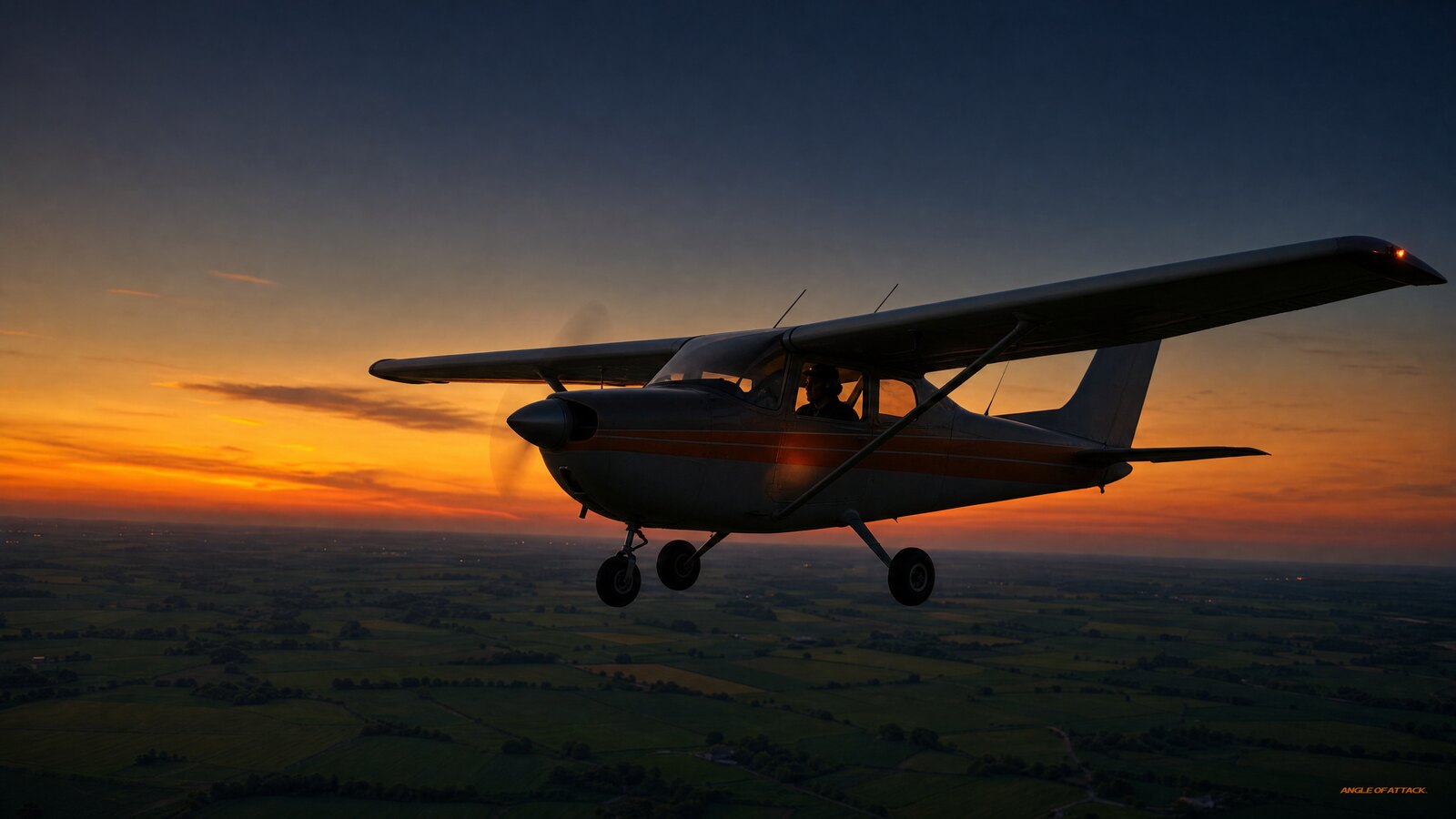
Engine Failure in Flight: The Procedure Every Pilot Must Know Cold
An engine failure procedure in aviation is the memorized, prioritized sequence a pilot flies the moment an engine loses power: fly the airplane to best glide speed, pick a landing spot, run the restart flow, declare the emergency, then secure the airplane for a forced landing. That order never changes. The single biggest mistake in an engine failure is staring at the instruments instead of flying the airplane. Your first job is always to keep the wings level, the nose where it belongs, and the airspeed pinned to best glide. Everything else comes after.
This isn’t a drill you do once for the checkride and forget. It’s a flow you should be able to run in your sleep, because when it counts, you won’t have time to read a checklist from page one. Let’s break it down the way I teach it on the ramp.
propeller windmilling during an engine failure" src="https://www.angleofattack.com/wp-content/uploads/2026/07/what-is-engine-failure-procedure-in-aviation-featured.jpg" style="margin-bottom: 0;">
- Fly first. The instant the engine quits, pitch for best glide speed (your POH number) and hold heading. Control the airplane before you touch anything else.
- Best glide buys you time and distance. Flying the published best-glide speed gives you the most runway-over-the-ground to reach a survivable landing spot.
- Use a flow, not a frantic search. The memory sequence is Aviate, Navigate (pick a spot), Troubleshoot (restart attempt), Communicate, then Secure.
- A forced landing is survivable when flown under control. People get hurt stalling and spinning while trying to stretch a glide, not from a controlled touchdown.
- You’re legally allowed to do whatever it takes. Under 14 CFR § 91.3, the pilot in command is the final authority and may deviate from any rule of Part 91 to the extent required to meet an in-flight emergency.
- Practice this every flight. Most engine “failures” in training are simulated, and the muscle memory you build is what saves you for real.
WHAT’S IN THIS GUIDE
- 1What is an engine failure procedure in aviation?
- 2Why do small airplane engines fail?
- 3What do you do first when the engine quits?
- 4What is best glide speed and why does it matter?
- 5How do you run an in-flight engine restart?
- 6How do you fly a forced landing?
- 7A glassy morning over the Susitna
- 8PLT Study Guide
- 9Frequently Asked Questions
What is an engine failure procedure in aviation?
An engine failure procedure is the fixed, prioritized sequence a pilot flies when an engine loses partial or total power: establish control at best glide speed, choose a landing site, attempt a restart, communicate the emergency, and prepare the airplane and occupants for landing. It works because the order matches your priorities — first survive, then save the airplane.
Pilots organize the whole thing around an old, reliable mantra: Aviate, Navigate, Communicate — with “troubleshoot” tucked in between navigate and communicate. The reason that order exists is brutal and simple. A flying airplane under control can land almost anywhere and walk away. An airplane that someone let stall and spin while they were heads-down fiddling with the fuel selector usually does not.
The FAA lays this philosophy out in the Airplane Flying Handbook (FAA-H-8083-3C), Chapter 18, “Emergency Procedures.” Your specific airplane’s exact steps and numbers live in the emergency section of your Pilot’s Operating Handbook (POH). Learn the universal flow here, then marry it to your airplane’s checklist.
Why do small airplane engines fail?
Most piston engine failures in general aviation trace back to fuel — running a tank dry, mismanaging the fuel selector, or carburetor ice choking the engine. Mechanical failures happen too, but fuel starvation and fuel exhaustion are the leading causes pilots can actually prevent. Understanding the cause helps you fix a partial failure before it becomes a total one.
Here’s the thing most students don’t realize: a lot of “engine failures” aren’t the engine breaking. They’re the engine being starved. You switched to an empty tank. You forgot carb heat on a cool, humid day and ice built up in the throttle body. You leaned too aggressively. Those are pilot-fixable in seconds — if you know to look.
That’s exactly why “troubleshoot” is part of the flow. A quick, disciplined check of the obvious culprits can give you your engine back. Carburetor ice, for example, is a slow strangle, not a bang — the engine runs rough and the RPM sags before it quits. Carb heat is the cure, and applying it early is the prevention.
| Common cause | What it looks like | Pilot action |
|---|---|---|
| Fuel exhaustion (tanks empty) | Engine quits, fuel gauges low | Land; this is preventable with fuel planning |
| Fuel starvation (selector/tank issue) | Sudden power loss | Switch tanks, fuel pump on, mixture rich |
| Carburetor ice | Gradual roughness, RPM drop | Apply carburetor heat early |
| Mechanical failure | Roughness, noise, vibration | Best glide, forced landing flow |
What do you do first when the engine quits?
The very first thing you do is fly the airplane: pitch to best glide speed and trim for it, then hold a heading toward open terrain. Do not reach for anything, do not stare at gauges, do not key the mic. Control comes first, always. A stabilized glide at the correct speed is what gives you the time to do everything else right.
It feels backwards when adrenaline hits. Your instinct is to fix the problem — grab the throttle, work the controls, figure out why. Fight that instinct. The engine is already quiet; another three seconds won’t change that. But three seconds of not flying the airplane can put you in an unrecoverable attitude.
So the sequence is: pitch, trim, and pick. Pitch for best glide. Trim so you’re not fighting the yoke. Pick the best landing spot you can see — into the wind if you have a choice, flat, and clear of obstacles. Once the airplane is gliding hands-light toward a survivable spot, then you start troubleshooting.
This is the answer-first habit the FAA wants ingrained. The Airplane Flying Handbook is explicit that maintaining aircraft control takes priority over every other action during any emergency.
What is best glide speed and why does it matter?
Best glide speed is the airspeed that gives you the maximum distance over the ground per foot of altitude lost — your best lift-to-drag ratio. Flying it after an engine failure means you reach the farthest possible landing spot from wherever you are. Fly faster or slower than best glide and you sink faster, losing precious distance and options.
Every airplane has its own published best glide speed in the POH, often marked or memorized for the type. In many training Cessna 172s it sits in the 65-knot range, but you fly your airplane’s number — never a number from a forum. Best glide assumes a specific weight; lighter than max gross, the speed is a touch lower.
There’s a related number worth knowing: minimum sink speed, which is slightly slower than best glide and keeps you airborne the longest in time (useful if a restart attempt needs a few more seconds). For reaching ground, though, best glide is your workhorse.
One trap to avoid: stretching the glide. When a field looks just out of reach, pilots pull the nose up to “stretch” it. That bleeds airspeed below best glide, increases the sink rate, and can drop you into a stall close to the ground. You cannot stretch a glide by pulling. Pick a closer spot instead.
How do you run an in-flight engine restart?
Once the airplane is stabilized at best glide and aimed at a landing spot, you run a quick restart flow targeting the most common, fixable causes: fuel selector to the fullest tank (or BOTH), mixture rich, fuel pump on, carburetor heat on, and check the magnetos/ignition. This flow takes seconds and catches fuel and ice problems that account for most failures.
Memorize a simple version. A widely taught flow is fuel, air, spark — does the engine have fuel reaching it, air (carb heat clearing ice), and spark (mags on, ignition working)? Walk those three and you’ve covered the high-probability fixes. Your POH emergency checklist has the exact items and order for your airplane; this article teaches the logic so the checklist makes sense.
Be honest about altitude and time. If you’re at 5,000 feet AGL over flat ground, you have time for a careful, full restart attempt. If you’re at 700 feet on downwind, you don’t — you commit to the forced landing and stop troubleshooting. Altitude is the currency that buys you restart attempts.
If you’re still learning to think through systems like this calmly, that’s exactly what structured ground training is for. Our free Total Student Pilot course walks beginners through how the airplane’s systems work so emergency flows actually make sense instead of being rote memorization, and the full Private Pilot Ground School takes you all the way to day-one ready.
How do you fly a forced landing?
A forced landing is a controlled, engine-out landing onto the best available surface. You set up a normal approach to your chosen spot, manage your glide with flaps and slips rather than power, plan to touch down at the slowest safe speed with wings level, and brace for a firm arrival. A controlled forced landing onto rough terrain is highly survivable — losing control is what hurts people.
Pick your spot early and commit. Aim for a point slightly into your field, not the near edge, so you have margin to slip off energy if you’re high. Field selection priorities are simple: into the wind, flat, long, and free of wires, fences, and ditches. Roads tempt pilots, but power lines, signs, and traffic make them risky — an open field usually beats a road.
Before touchdown, secure the airplane: fuel selector off, mixture to idle cutoff, ignition off, master off (timed so you keep flaps if electric). This reduces fire risk. Unlatch a door so it can’t jam shut on impact. Then fly it all the way to the ground — keep the wings level and the nose tracking straight through the touchdown and rollout.
Under 14 CFR § 91.3, you, the pilot in command, are the final authority and may deviate from any rule of Part 91 to the extent required to handle the emergency. Land on the highway, land at the closed airport, do what keeps people alive. The paperwork is a problem for tomorrow.
A glassy morning over the Susitna
I had a student up in a 172 one calm Alaska morning, smooth air over the Susitna valley, when I quietly reached over and pulled the throttle to idle. Simulated engine failure — standard training. What I watched next is the lesson I’ve taught a hundred times since: his hands went straight to the throttle and the panel, and the nose started dropping while the airspeed wandered. He was troubleshooting an airplane he’d stopped flying.
I put my hand on his and said one word: “Glide.” He pitched up, trimmed, and the airplane settled into that hands-light best-glide attitude. Suddenly he had time. We picked a gravel bar, ran the fuel-air-spark flow out loud, and “found” the problem. The whole thing went from panic to procedure in about five seconds — the difference was flying first.
That’s the entire game. In aviation education since 2006 and as a CFI since 2017, the engine-out flow is the one I drill hardest, because it’s the one where freezing up actually kills people. The pilots who do well aren’t braver. They’ve just flown the first three seconds so many times that “pitch, trim, pick” happens before fear does.
PLT Study Guide
The FAA tags knowledge-test questions with PLT (Pilot Learning Statement) codes. These are the codes that actually match engine-failure content — translated into plain study points:
-
PLT208 — Recall emergency conditions / procedures. Know the priority order of any in-flight emergency: maintain aircraft control (aviate), choose a course of action (navigate), troubleshoot, then communicate. Be able to apply this to an engine failure scenario. Source: Airplane Flying Handbook (FAA-H-8083-3C), Chapter 18.
-
PLT210 — Recall engine shutdown — normal / abnormal / emergency / precautions. Understand the securing flow for a forced landing: fuel selector off, mixture idle cutoff, ignition/magnetos off, master switch off, and why each step reduces fire risk. Know it differs from a normal shutdown.
-
PLT343 — Recall powerplant — operating principles / operational characteristics / inspecting. Understand how a reciprocating engine makes power (fuel, air, spark) so you can reason through a restart and recognize causes like carburetor ice, fuel starvation, and mixture issues.
-
PLT394 — Recall regulations — declaration of an emergency. Know that 14 CFR § 91.3 makes the pilot in command the final authority and permits deviation from any rule of Part 91 to the extent required to meet an in-flight emergency. Know too that the spoken word “Mayday” declares a distress condition to ATC and gets you priority handling — the AIM covers the phraseology in its emergency procedures section.
Note: the original hint code PLT367 (additional equipment/operating requirements for large transport aircraft) does not apply to a Private Pilot engine-failure topic and has been dropped.
Frequently Asked Questions
What is the first thing to do when an engine fails in flight?
Fly the airplane. Immediately pitch for best glide speed and trim to hold it, keeping the wings level and a heading toward open terrain. Do not troubleshoot, stare at gauges, or transmit until the airplane is under control in a stable glide. Aircraft control always comes before everything else.
What is best glide speed?
Best glide speed is the airspeed that produces the maximum gliding distance per foot of altitude lost, corresponding to the airplane’s best lift-to-drag ratio. Flying it after an engine failure maximizes how far you can travel to reach a landing site. Every airplane publishes its own best glide speed in the POH.
Can you restart an engine in flight?
Often, yes — if the cause is fuel or ignition related. After establishing best glide and picking a landing spot, run a quick flow: fuel selector to a good tank, mixture rich, fuel pump on, carburetor heat on, and check the magnetos. Fuel and carb-ice problems, the most common causes, are frequently fixable this way.
What causes most small airplane engine failures?
Fuel-related issues lead the list: fuel exhaustion from empty tanks, fuel starvation from selector or tank problems, and carburetor ice strangling the engine. These are largely preventable through fuel planning and proper carb-heat use. Mechanical failures also occur but are far less common than pilot-preventable fuel causes.
Where should you land during an engine failure?
Aim for the best available surface: into the wind, flat, long, and clear of wires, fences, and obstacles. An open field usually beats a road because of power lines and traffic. Pick your spot early, commit to it, and aim slightly into the field so you have margin to slip off extra altitude.
Is a forced landing survivable?
Yes — a controlled, engine-out landing onto rough terrain is highly survivable. The danger isn’t the touchdown; it’s losing control by stalling and spinning while trying to stretch a glide. If you keep the airplane flying at best glide, land wings-level at the slowest safe speed, and brace, the odds are strongly in your favor.
Are you allowed to break rules during an emergency?
Yes. Under 14 CFR § 91.3, the pilot in command is the final authority for the operation of the aircraft and may deviate from any rule of Part 91 to the extent required to meet an in-flight emergency. You can land off-airport, enter airspace you’d normally need a clearance for, or do whatever keeps people safe. Sort out the paperwork afterward.
How often should you practice engine failures?
Make it a habit on nearly every flight, even just mentally. Pick a forced-landing field as you cruise, recall your best glide number, and rehearse “pitch, trim, pick.” This builds the muscle memory that takes over when a real failure floods you with adrenaline and you have no time to think it through fresh.
Master every system on your checkride — and on day one.
The Private Pilot Ground School breaks down every FAA subject area in the same plain-English, real-world way you just read — with quizzes, scenarios, and the explanations that finally make it click.
When the engine goes quiet for real, you won’t rise to the occasion — you’ll fall back on your training. So train the first three seconds until they’re automatic: pitch, trim, pick. Build the habit now, on every flight, and the day it matters you’ll be flying the airplane while your brain catches up.


ON THE SAME TOPIC
IFR vs VFR: The Two Sets of Rules Every Pilot Flies By
IFR vs VFR: The Two Sets of Rules Every Pilot Flies By 19 min read Last updated June 2026 · Chris Palmer The difference between IFR and VFR is which set of rules you fly under. VFR — visual flight rules — lets you navigate by looking outside and staying clear of clouds in good […]
 Read more
ASOS vs AWOS vs ATIS: How to Pull the Right Weather Before You Fly
ASOS vs AWOS vs ATIS: How to Pull the Right Weather Before You Fly 13 min read Last updated June 2026 · Chris Palmer The difference comes down to who is talking and what the broadcast covers. ASOS and AWOS are automated, computer-generated weather observations of the conditions right at the field. ATIS is a […]
Read more 
What Is RNAV Navigation? Area Navigation for VFR Pilots
What Is RNAV Navigation? Area Navigation for VFR Pilots 17 min read Last updated June 2026 · Chris Palmer RNAV — Area Navigation — is a method that lets an aircraft fly any desired path within the coverage of ground- or space-based navigation aids, rather than being forced to fly directly to and from stations. […]
Read more 
NDB and ADF Explained: The Oldest Radio Nav System You Still Need to Understand
NDB and ADF Explained: The Oldest Radio Nav System You Still Need to Understand 16 min read Last updated June 2026 · Chris Palmer An NDB (non-directional beacon) is a ground-based radio transmitter that sends a signal in all directions, and an ADF (automatic direction finder) is the cockpit receiver whose needle points straight at […]
Read more 
Stay Connected
Be the very first to get notified when we publish new flying videos, free lessons, and special offers on our courses.
