
AIM Text
- Direction signs have a yellow background with a black inscription. The inscription identifies the designation(s) of the intersecting taxiway(s) leading out of the intersection that a pilot would normally be expected to turn onto or hold short of. Each designation is accompanied by an arrow indicating the direction of the turn.
- Except as noted in subparagraph e, each taxiway designation shown on the sign is accompanied by only one arrow. When more than one taxiway designation is shown on the sign, each designation and its associated arrow is separated from the other taxiway designations by either a vertical message divider or a taxiway location sign as shown in FIG 2-3-35.
- Direction signs are normally located on the left prior to the intersection. When used on a runway to indicate an exit, the sign is located on the same side of the runway as the exit. FIG 2-3-36 shows a direction sign used to indicate a runway exit.
- The taxiway designations and their associated arrows on the sign are arranged clockwise starting from the first taxiway on the pilot's left. (See FIG 2-3-35.)
- If a location sign is located with the direction signs, it is placed so that the designations for all turns to the left will be to the left of the location sign; the designations for continuing straight ahead or for all turns to the right would be located to the right of the location sign. (See FIG 2-3-35.)
- When the intersection is comprised of only one crossing taxiway, it is permissible to have two arrows associated with the crossing taxiway, as shown in FIG 2-3-37. In this case, the location sign is located to the left of the direction sign.
FIG 2-3-35
Direction Sign Array with Location Sign on Far Side of Intersection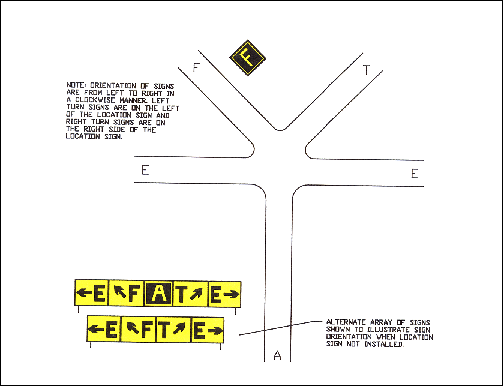
FIG 2-3-36
Direction Sign for Runway Exit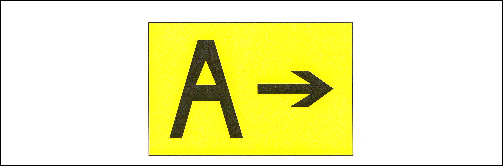
FIG 2-3-37
Direction Sign Array for Simple Intersection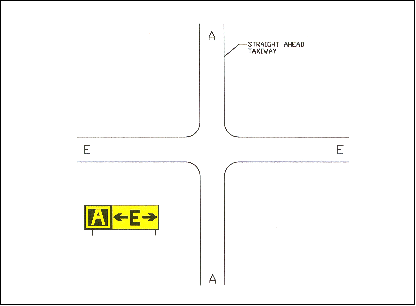
Source: FAA Aeronautical Information Manual · current edition · paragraph 2-3-10.
The short answer
AIM 2-3-10 is FAA advisory guidance describing direction signs: yellow background, black inscription, identifying the intersecting taxiway designations leading out of an intersection, each with an arrow. It explains arrangement (clockwise from the pilot's left), placement relative to a collocated location sign, and use as runway exit indicators. It supports surface-movement safety under 14 CFR 91.129.
Research Notes
Common Questions
What color is a taxiway direction sign and what does it tell me?
Per AIM 2-3-10, a direction sign has a yellow background with a black inscription. It identifies the designation(s) of the intersecting taxiway(s) leading out of the intersection that a pilot would normally turn onto or hold short of, with each designation accompanied by an arrow indicating the direction of the turn.
How are multiple taxiway designations arranged on a direction sign?
AIM 2-3-10 states the designations and their arrows are arranged clockwise starting from the first taxiway on the pilot's left. When more than one designation is shown, each is separated by a vertical message divider or a taxiway location sign. If a location sign is collocated, turns to the left appear left of it and straight-ahead or right turns appear to the right.
Where are direction signs located?
Direction signs are normally located on the left prior to the intersection. When used on a runway to indicate an exit, the sign is located on the same side of the runway as the exit. Each designation normally has only one arrow, but a simple intersection with one crossing taxiway may show two arrows, with the location sign placed to the left of the direction sign.