
How to Get Your First CFI Job in 2026: The Honest Playbook

Your first CFI job is the first paid teaching position you take after passing your initial flight instructor checkride, typically within 1-3 months of certification. Most new CFIs spend 12-18 months at their first school before moving to the regionals. The 2026 market is more selective than it was in 2022, not slower. Schools are choosing better instructors, not fewer instructors. The candidates who get hired in this market are the ones who can teach a student well enough that the student finishes their certificate at the same school, with the same CFI. Hours don’t get you hired in 2026. Teaching does.
- The 2026 CFI job market is more selective, not slower. The underlying pilot shortage is real. Oliver Wyman projects a 24,000-pilot gap in North America in 2026, the decade’s peak. But schools are picking quality over quantity. The wedge is teaching ability, not hours.
- Entry-level CFI pay starts around $25/hour flight time. Full-time independent or W-2 CFIs in busier markets earn $50,000–$85,000/year with CFII and MEI add-ons. Salaried Part 141 academies pay roughly $3,200–$4,000/month for ~70 flight hours plus ~20 sim.
- There are three honest paths to your first job: hire on at the school where you got your CFI (fastest), cold-apply to a regional Part 141 school (steadiest), or build an independent book of business (highest hourly, hardest to start).
- Every interview includes a teaching demo. Chief instructors ask six standard interview questions and a “teach me something” demonstration. The five-minute demo prep framework matters more than your resume.
- Industry-average tenure at a first CFI job is 12–18 months. The first job shapes the next two years of your career, so don’t take the first offer reflexively.
Walking into your first lesson with a 50-page binder won't help you.
Get my Anti-Binder One-Page Lesson Plan Template free — the lesson plan tool I built for CFI candidates who want to be ready Day 1.
Get the Anti-Binder Template Free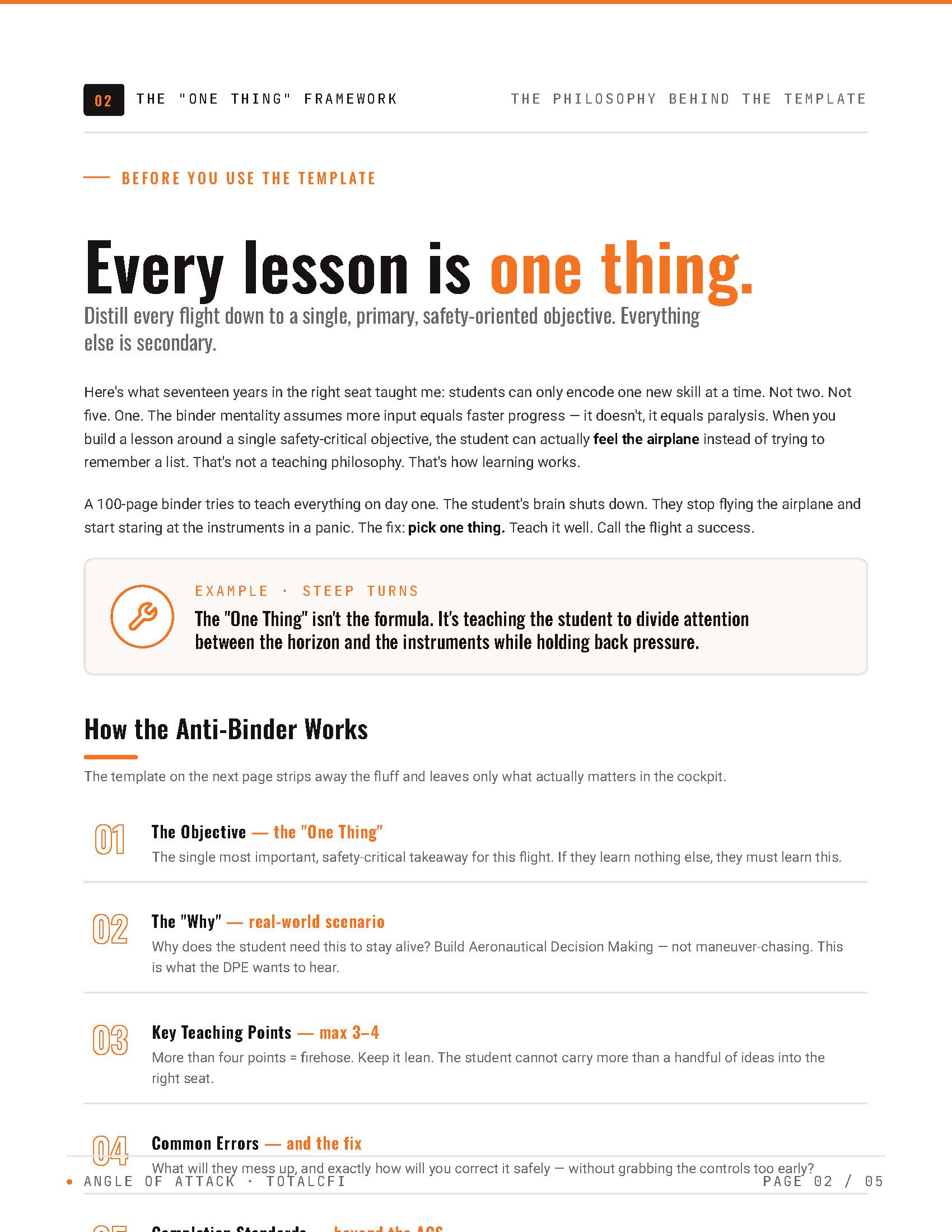
WHAT'S IN THIS GUIDE
- 1The CFI Job Market in 2026 — Selective, Not Slow
- 2What Flight Schools Are Actually Buying (Hint: It's Not Your Hours)
- 3The Three Paths to Your First CFI Job
- 4How to Build a CFI Portfolio Before the Interview
- 5The CFI Interview — What They'll Ask, What They'll Test
- 6How Do You Network as a New CFI Without Being Cringe?
- 7CFI Insurance — What You Need Before You Teach in Someone Else's Airplane
- 8Negotiating Your First CFI Pay
- 9Where Can You Apply for CFI Jobs?
- 10Your First 90 Days on the Job
- 11Frequently Asked Questions
The CFI Job Market in 2026 — Selective, Not Slow

The thing every new CFI walking into 2026 needs to understand first: the market hasn’t collapsed. It’s just gotten pickier. The 2021-to-2023 hiring frenzy, when a fresh CFI ticket basically guaranteed a job offer within 30 days, has normalized. But normalization is not the same as a downturn.
Oliver Wyman’s 2026 pilot demand model projects a 24,000-pilot gap across the North American industry, the peak shortage year of the decade. The Bureau of Labor Statistics has airline and commercial pilots growing at about 4% through 2034, which lines up with about-average occupational growth. Regionals are still hiring. ATP-style academies are still hiring. Smaller Part 141 and Part 61 schools are still hiring. What changed is that schools are no longer hiring every warm body who hands them a CFI certificate.
The flight schools I talk to (and I know a lot of them, because Angle of Attack’s 191K-subscriber audience has put me on the phone with hundreds of chief instructors over the years) are using the same phrase. They’re “choosing better instructors, not just more instructors.” That’s a quote you’ll hear from CFI Academy and a quote you’ll hear from a 6-airplane Part 61 shop in the Midwest. It’s the market consensus.
Why does this matter for your job hunt? Because the candidates who do well in 2026 are the candidates who can answer one question convincingly: “Can I retain a student past lesson 3?” That’s the unsaid hiring filter. Schools that retain students are the schools whose CFIs teach well. The first 18 months of your career as a CFI is your career as a teacher, not a stepping-stone. Schools know this now. They’re hiring for it.
This is the market reality. The good news: it’s the best possible market for anyone who actually likes teaching.
What Flight Schools Are Actually Buying (Hint: It’s Not Your Hours)

Most CFI candidates don’t realize this: the chief instructor who interviews you is not buying your flight hours. They’re buying revenue retention.
Every flight school in the country is built on the same financial math. A student who completes their Private from start to finish at one school spends somewhere between $12,000 and $20,000. A student who drops out at lesson 5 spends $1,800 and disappears. Multiply that across a school’s roster and you understand why student retention is the single most-watched metric in the flight school office.
The instructors who retain students are the instructors who get hired, get promoted, get more students, and get raises. The instructors who lose students at lesson 3 get fewer students assigned, get squeezed out of the schedule, and eventually get let go. It’s that direct.
So when a chief instructor walks into a 30-minute interview with you, the chief is trying to figure out four things, in this order:
- Can you teach? Not “do you have a commercial certificate,” not “did you pass your CFI checkride first try.” Can you take a real concept, break it into pieces a beginner can hold in their hands, and walk that beginner to understanding? This is the dominant question.
- Will students like you? Will you show up patient on a bad day? Can you handle the student who shows up unprepared? Can you correct without crushing? Will the front desk hear good things about you?
- Are you safe? Do you know the regulations cold? Do you know your aircraft cold? Will you make a conservative weather call when you should?
- Will you stay long enough to be worth the training cost? Schools invest in standardizing every new CFI. They want at least 12 months of return on that investment before you ladder up to a regional.
Missing from that list: your hour count. Hours are a prerequisite. You have to meet CFI eligibility under 14 CFR 61.183, but you already do because you have the certificate. Beyond the floor, hours don’t move the needle. A 300-hour CFI who can teach beats a 1,000-hour CFI who can’t every time.
I’ve sat on the hiring side too. I interviewed a candidate once. Solid hours, clean record, fresh CFI cert, and the interview was going great right up until the teaching demo. I asked him to teach me steep turns on a whiteboard like I was a Private student. He pulled out a stack of printed notes and read them to me for fifteen minutes. Never made eye contact. Never asked if I had questions. Never wrote a single thing on the whiteboard. When I asked him at the end how he’d know if I understood, he said “you’d take the test.” That was the end of the interview. Hours don’t equal hireability. Teaching does.
This is the most important reframe of your entire job hunt: you’re not selling hours. You’re selling teaching. Walk into every interview ready to prove you can teach, and the rest of the conversation gets easier.
The Three Paths to Your First CFI Job

There are basically three paths to your first CFI job. Each has honest tradeoffs. Most new CFIs end up on Path 1 or Path 2. Path 3 is usually the wrong first move, but I’ll cover it because it comes up.
Path 1 — Hire on at the school where you got your CFI
This is the fastest hire by a wide margin. The chief instructor already knows you. They watched you train. They saw how you handled your stage checks. They know your flying. They’ve vetted you whether they meant to or not.
I had this experience myself in Wisconsin in 2017, the year I got my CFI. My chief instructor pulled me aside after my DPE signed my temporary and asked when I could start. I started the next Monday with two students already on my schedule. That’s not unusual. The Jet Careers forums are full of “got hired the day of my checkride” stories for a reason. It happens when the chief instructor has already watched you teach and likes what they saw.
Tradeoffs of Path 1:
- Pro: Fastest hire. Lowest interview friction. Existing relationships at the front desk and the maintenance hangar. You know the aircraft, the airport, the syllabus.
- Pro: Your first students often come pre-warmed. They’ve seen you around the school for the last six months.
- Con: Smaller schools may have limited student flow. If the school has 30 students and 6 CFIs, the math doesn’t work out for you to fly 80 hours/month.
- Con: You may be the most junior CFI competing for the same students as senior CFIs. Senior CFIs get the priority pick.
- Con: If the relationship sours, your reputation in the local market is tied to one school’s reputation.
Pay: Generally $25–$40/hour flight time, hourly only (no salary at smaller schools). 1099 contractor is most common at small Part 61 shops. We’ll cover the 1099 vs. W-2 distinction in Negotiating Your First CFI Pay; it matters more than most new CFIs realize.
What to do: Ask the chief instructor 30 to 60 days before your CFI checkride if there’s a position. Don’t wait until after. The conversation should be along the lines of “I’m planning my next 12 months, is there a path to instruct here once I have my ticket?” Specific, professional, gives them time to think.
Path 2 — Cold-apply to a regional Part 141 school
Part 141 academies (especially university-affiliated programs and ATP-style operations) hire in cohorts. March, May, and August are common start windows. They have steady student flow because the program is structured top to bottom. Students enter, complete the syllabus, exit on time, repeat.
The structural reason Part 141 schools always need new CFIs: 14 CFR 141.36 requires assistant chief instructors with specific qualifications (commercial or ATP, current CFI, appropriate ratings, flight-time minimums), and 14 CFR 141.35 sets even higher bars for the chief instructor. Those people need a roster of junior CFIs underneath them to actually carry the student load. The staffing ladder is required by reg. Schools have to maintain it.
Tradeoffs of Path 2:
- Pro: Steady hours. Often W-2 employee with benefits (health insurance, PTO, sometimes 401(k) match).
- Pro: Standardized training and clear advancement: junior CFI → CFII → MEI → stage-check authorized → assistant chief instructor.
- Pro: Direct airline pathway. Most major Part 141 academies have cadet pipelines into regional airlines, so your job there is partly an airline interview.
- Con: Less teaching flexibility. You teach the syllabus, not your own ideas. New CFIs sometimes find this frustrating; others find it freeing.
- Con: Many of these schools require relocation. Phoenix, Florida, north Texas, wherever the academies are clustered.
- Con: Cohort hiring windows. Miss a window and you wait months.
Pay: Salaried roughly $3,200–$4,000/month at ATP-style academies (their own published numbers), which works out to roughly $38,400–$48,000/year base plus side income from knowledge-test proctoring and Flight Standards roles. At smaller Part 141 schools, $30–$45/hour flight time or $35,000–$50,000/year salary. W-2 most common.
Application materials commonly required: Cover letter, resume, two professional letters of recommendation (often from your training CFIs and your DPE), a video interview round (especially at ATP), and a clean 10-year background. No more than two practical-test failures across all certificates. If you’ve had a checkride bust on the CFI initial, address it directly in your application. Don’t hide it.
Path 3 — Build an independent CFI book of business
Path 3 is the entrepreneurial route. You operate as an independent CFI, find your own students, charge your own rates, and handle everything from billing to insurance to scheduling yourself.
I’ll be honest with you: this is usually the wrong first move. It’s the right second or third move once you have 500+ hours of dual given, a local reputation, and an existing referral network. As a brand-new CFI it’s hard to make work because you have no name recognition, no insurance discount, and no built-in student pipeline.
Tradeoffs of Path 3:
- Pro: Higher hourly rate. $50–$85/hour at busy independent CFIs (CFI Academy data); specialized or corporate work can pay $75–$200/hour.
- Pro: Schedule control. You set your minimums. You decide which students you take.
- Pro: Builds entrepreneurial skills (marketing, pricing, customer service) useful later if you build your own flight school or training business.
- Con: No steady paycheck. Weather plus cancellations equals income volatility.
- Con: You handle your own insurance. Liability plus non-owned hull runs roughly $3,000–$8,000/year. See the insurance section.
- Con: You pay self-employment tax at 15.3% on top of income tax. On a $60K independent year that’s roughly $9,200 in tax you wouldn’t pay as a W-2 employee.
- Con: You find your own students. This is the hardest part for new CFIs with no network.
Verified pay (full-time independent at a busy school): $50,000–$75,000/year (CFI Academy data, 2026).
What to do: Probably not now. The independent path gets a lot easier once you’ve spent 12 months at a school building a local name. Once you can walk into a flying club and 8 pilots already know who you are, Path 3 starts to make sense. (See Independent CFI vs Flight School for the full breakdown when you’re ready.)
How to Build a CFI Portfolio Before the Interview

Most CFI candidates show up to interviews with a resume and a logbook and hope that’s enough. It’s not. The candidates who get offers walk in with what I call a portfolio: three artifacts that prove they’re worth hiring.
1. Your resume, one page, aviation-focused. Drop the high school marching band. Drop the part-time barista job from 2018. Lead with your certificates, your hours by category, your training history (where you got each rating, which DPE checked you), and any teaching or mentoring experience (even informal). One page. Clean type. PDF. The chief instructor will scan it for 90 seconds.
2. A sample lesson plan. This is the one most candidates skip. Bring a single-page lesson plan for a maneuver you’d teach to a Private student. Steep turns is the safest bet, but any commercial-or-private ACS maneuver works. The lesson plan should fit on one page. It should have: objective, completion standards, schedule, equipment, instructor actions, student actions, common errors, and evaluation criteria. This is the work product the chief instructor needs from you every week once you’re hired. Show them you already produce it.
This is exactly the work your lesson plans need to be: clean, teachable, on one page, not buried in a 50-page binder. Hiring managers can spot a usable lesson plan in 20 seconds. They can also spot a copy-pasted internet template in 5 seconds. Make sure yours is the first one.
3. A 5-minute teaching demo, ready cold. You don’t necessarily film it (though some candidates do, and it doesn’t hurt). What matters is you can walk into a room with a whiteboard, pick a topic the chief instructor names, and teach for five minutes with no notes. This is the single highest-leverage prep item on the entire job hunt. We’ll go deep on the demo framework in the next section.
Bring these three artifacts to every interview. If the chief instructor doesn’t ask for them, you offer them: “Before we wrap up, I brought a sample lesson plan and a demo I can show you if you have a few minutes.” Nine times out of ten they’ll say yes. The tenth time, leave the lesson plan with them when you go.
The portfolio is what separates the candidate who’s “applying for a CFI job” from the candidate who’s “showing up to work as a CFI.” Different signal entirely.
The CFI Interview — What They’ll Ask, What They’ll Test

Every CFI interview I’ve seen (and I’ve been on both sides of dozens of them) follows a similar shape. Knowing the shape gives you a huge advantage walking in.
The typical interview flow runs 60 to 90 minutes:
- Oral knowledge spot-check (15–20 min). The chief instructor confirms you know basic regs, your aircraft, the syllabus, and the standard maneuvers.
- Teaching demo (15–30 min). The chief instructor assigns you a topic and asks you to teach it as if they were a student. This is the part that decides the interview.
- Chief instructor conversation (15–30 min). Your goals, your timeline, your fit with the school’s culture, your willingness to stay 12+ months.
- (Optional) flight evaluation (1.5 hr). Some schools, especially Part 141 academies, will fly with you before the offer. Treat it as a checkride. Show up briefed, current, with charts ready.
The Six Standard CFI Interview Questions
Boldmethod published a now-classic list of six interview questions every chief instructor asks. The list has held up since 2021. These are still the six questions, almost verbatim, that I get asked when I sit on hiring panels. Here they are with what the chief is actually testing:
1. “You have a student who consistently shows up unprepared. What do you do?”
What they want to hear: You set expectations at lesson 1. You don’t fly unprepared students. It wastes their money and yours. You use the pre-brief to require preparation. And you have the spine to send a student home if they came unprepared. Schools that retain students are schools whose CFIs hold the line. Don’t say “I’d just be patient with them.”
2. “What are the endorsements required for a commercial pilot practical exam?”
What they want to hear: You know AC 61-65 cold. You can name the endorsements: aeronautical knowledge test, acknowledgment of 61.127 and 61.129, written test deficiency review, timely completion verification, practical-test recommendation. You can describe each one in plain English. This question is a knowledge check. Get the regs right and move on.
3. “What will you base your decision on when recommending a student for a checkride?”
What they want to hear: Three factors. Aircraft mastery (can they fly the maneuvers to ACS standards consistently), student confidence (do they trust their own judgment in the airplane), and error correction (when something goes wrong, do they catch it and fix it without panic). Not “they’ve finished the syllabus.” Finishing the syllabus is the floor, not the ceiling.
4. “Define professionalism for me.”
What they want to hear: Professionalism is behavior, not credentials. The way you show up. The way you treat the student. The way you handle a missed lesson. The way you talk to the front desk. The way you debrief a bad flight. Reference FAA-H-8083-9B Chapter 9 if you’ve read it (you should). My phrasing has always been: “Professionalism is not a certificate — it’s behavior.” That holds up.
5. “Name a few special emphasis areas in the CFI ACS.”
(Note: Boldmethod’s 2021 source article phrased this question as “CFI PTS.” The FAA published the CFI ACS in May 2024, replacing the legacy Practical Test Standards. The special emphasis areas carried over substantively unchanged, so older study materials still apply — just expect the document name to be “ACS” in any 2026 interview.)
What they want to hear: Aircraft control, stall awareness, wake turbulence avoidance, LAHSO procedures, wire-strike avoidance, TFRs, security and runway incursion avoidance. Pick three and say why they’re emphasized. The chief wants to know you understand why these are special-emphasis, not just that you memorized the list.
6. “Your student keeps ballooning on exit from a steep turn. How do you fix it?”
What they want to hear: You diagnose it first. Likely over-trimmed for the turn, then aggressive back pressure on exit. You teach the fix (gradual re-trim during rollout, progressive release of back pressure, eyes outside referencing the horizon). You don’t dive into a checklist. You teach. This question is really a stealth teaching demo. Answer it the way you’d answer a real student.
The Teaching Demo — 5-Minute Prep Framework
Now the part that decides most interviews. The chief instructor hands you a marker, points at the whiteboard, and says something like: “Teach me steep turns like I’m a Private student.”
This is where most candidates panic. They start dumping facts. They forget the student. They wing it.
The framework I teach every TotalCFI candidate is the same one I use myself when I teach a brand-new maneuver:
1. Objective (15 seconds). “By the end of this lesson, you’ll be able to perform a 45-degree banked steep turn, maintain altitude within 100 feet, and roll out within 10 degrees of the entry heading.” Specific. ACS-grounded.
2. Why it matters (30 seconds). Real-world scenario. “Steep turns build the rudder and elevator coordination you’ll use every time you maneuver tight in the pattern or avoid traffic.” Tie it to a safety reason. Don’t skip this. The chief is listening for whether you teach the why.
3. The Steps (90 seconds). Three or four numbered steps. Not seven. Not ten. People remember three or four. So: clear the area; pick a reference point; roll smoothly to 45° while adding back pressure and a touch of power; hold altitude with elevator and bank with aileron; roll out on the reference point.
4. Common errors (60 seconds). Two common errors and how to catch them. “Losing altitude means you’re not adding enough back pressure as bank increases. Gaining altitude means too much back pressure. The fix is small, continuous corrections, not big ones.”
5. Demonstration → Performance → Evaluation (60 seconds). Walk through how you’d actually fly this. “I’d demonstrate one from the right seat, narrating each step. Then you’d fly one while I watch. Then we’d debrief: what worked, what didn’t, what to fix next time.” This is the four-phase teaching method from FAA-H-8083-9B Chapter 4 (The Teaching Process). Name it if you can.
That’s a five-minute demo. Eye contact. Whiteboard. Check for understanding (“does that make sense?” is okay, but better: “show me what you’d do here”). Stay calm when the chief plays dumb. Stay patient when they get it wrong on purpose to test you.
This framework is the exact backbone of TotalCFI Section 4 — Maneuvers Teaching. Every maneuver lesson plan in the course uses this five-block structure. The candidate who walks into the interview with this framework already running wins. The candidate who reads from notes loses.
If you do nothing else to prep for your interviews, prep this. Pick three maneuvers (steep turns, power-off stalls, short-field takeoff), build the five-minute demo for each one, practice it on a friend, then practice it on a whiteboard alone in a room. By the third pass it’ll feel natural. By the time you walk into an interview, it’ll be the easiest part.
How Do You Network as a New CFI Without Being Cringe?

Aviation is small. The same chief instructors talk to each other. The same DPEs check rides at multiple schools. The same regional airline recruiters show up at multiple academies. One good recommendation from someone the hiring chief instructor respects will skip you past the resume pile every time.
The catch: “networking” in aviation isn’t LinkedIn polish. It’s being known by the right five people before you need them.
Where to actually network:
- The flight school where you got your CFI. Your training CFIs and your chief know your work better than anyone. They are referral source number one. Stay in touch even if you don’t end up working there.
- Your DPE. A DPE checks rides at multiple schools and often has standing relationships with their chief instructors. After your checkride, ask: “Are there schools in the area you’d recommend I talk to?” Most will give you a name or two.
- FIRC events and CFI workshops. A weekend at a flight instructor refresher clinic puts you in a room with 40 working CFIs and chief instructors. Talk to them. Ask what they’re hiring for.
- Local IMC clubs and AOPA chapters. Small monthly meetings, lots of long-time pilots, very low-pressure social setting.
- Type clubs and flying clubs. If you’re thinking Path 3, this is where independent students come from. Show up, fly with the club, get known.
- Aviation podcasts and YouTube comments. Sounds weird but it’s real. The aviation community is small enough that consistent thoughtful comments on the major CFI-focused channels put you on the radar of working instructors.
What networking is not:
- It’s not cold-DMing a chief instructor on LinkedIn with “Hi, I’d love to connect!” That gets ignored.
- It’s not handing out resumes at every event you attend. People remember who annoyed them.
- It’s not pretending to care about someone’s career so you can ask for a favor. That’s transactional and people see through it.
The send-three-emails-a-week approach. When you’re actively job-hunting, send three thoughtful emails a week to chief instructors at schools you’d want to work at. Not blanket applications. Thoughtful emails. Reference something specific about the school (a video they posted, a recent hire, a syllabus detail you noticed). Mention one specific reason you’d be a fit. Attach your resume and sample lesson plan. Ask if they’d be open to a 15-minute call.
Three emails a week is twelve a month. Over three months that’s 36 schools. Even at a 10% response rate that’s three or four real conversations. One of those becomes an interview. One of those becomes an offer. That’s how the math works when you do it right.
CFI Insurance — What You Need Before You Teach in Someone Else’s Airplane

This one catches more new CFIs by surprise than anything else on this list. Plainly: the flight school’s insurance policy generally does not extend to you as a CFI by default. Being “named” on the policy requires explicit endorsement. If you teach in any airplane you don’t own (which is every airplane on Day 1), you have a coverage gap by default unless someone fixed it.
If you’re a W-2 employee at a Part 141 academy, the school often carries non-owned CFI coverage that extends to you. Verify it in writing before you fly. Don’t take “yeah, you’re covered” from the front desk as confirmation.
If you’re a 1099 contractor (common at smaller Part 61 schools and required for Path 3), you need your own coverage. The two main products to know:
Avemco CFI Non-Owned. Liability and property damage up to about $1M / $200K per passenger. Industry standard. Important gap to know: it generally does not cover professional malpractice claims (i.e., a student or owner suing you specifically for teaching quality issues). For liability and property damage, it’s solid.
SAFE / NAFI CFI policies. Available through the membership organizations (you have to be a member to qualify). Covers liability, negligent instruction matching the policy limit, medical, search-rescue, and hangar damage. The “negligent instruction” coverage closes the gap Avemco doesn’t cover. Many independent CFIs carry both: Avemco for the broader liability and SAFE/NAFI for the teaching-quality coverage.
Realistic annual cost for an independent CFI: $3,000–$8,000/year for liability plus non-owned hull coverage, depending on the policy and the limits.
If you’re going Path 1 or Path 2, get the school’s policy structure in writing before your first flight as a CFI. If you’re going Path 3, budget the insurance into your hourly rate before you set it.
This is one of those topics that doesn’t matter at all until it suddenly matters a lot. The full deep-dive on coverage products, exclusions, and how to file a claim lives at CFI liability insurance. Worth reading before you sign anything.
Negotiating Your First CFI Pay
Most new CFIs need to make this realization: most “CFI pay” is paid as flight-hour rate, not salary or day rate. That means you only get paid for hours logged with a student in the airplane. The pre-brief, the post-brief, the time you spent waiting for the student to show up, the time you spent prepping the lesson plan: none of that is paid.
The math gets ugly fast if you don’t understand this. An “$30/hour CFI” who flies 60 hours/month at a flight school actually nets $1,800/month from flight pay before tax. That’s $21,600/year. Then add another 10–15 hours/week of unpaid pre/post-brief and prep, and the real hourly rate when you divide gross by actual work hours is closer to $15. This is the #1 cause of new-CFI burnout.
This is why the utilization rate matters so much. Industry benchmark for a healthy flight school: 80% utilization (Aviatize data), meaning of the hours you’re scheduled, 80% actually become billable flight hours. Below 60% utilization, you can’t make a living. Above 90% sustained is burnout territory. Ask the chief instructor in your interview: “What’s your typical CFI utilization rate?” If they don’t have a number, that tells you something.
| Structure | Typical 2026 rate | Notes |
|---|---|---|
| Entry-level hourly (Part 61) | $25–$40/hour flight time | 1099 contractor most common |
| Entry-level hourly (Part 141) | $25–$45/hour flight time | W-2 more common |
| Salaried (ATP-style academy) | $3,200–$4,000/month + ~70 flight + ~20 sim | W-2 with benefits |
| Salaried (smaller Part 141) | $35,000–$50,000/year | Often W-2 |
| Full-time independent at busy school | $50,000–$75,000/year | 1099, manages own insurance |
| Experienced (CFII + MEI) | $50–$85/hour flight time | Usually 1099 or independent |
1099 vs. W-2. This is a real career decision, and AOPA flagged it back in 2011 as an IRS audit risk for schools. A flight school that prohibits you from working for competitors but still pays you 1099 is at high reclassification risk per AOPA’s analysis. As a new CFI, knowing the difference matters because the math is different:
- 1099 (independent contractor): You pay self-employment tax at 15.3% on top of income tax. You pay your own health insurance. You can deduct business expenses (training, gear, mileage), which helps somewhat.
- W-2 (employee): The school pays the employer share of payroll tax. You get health insurance, PTO, sometimes 401(k) match. You can’t deduct most expenses.
On a $50K year, the difference between 1099 and W-2 is roughly $15,000–$20,000 of pre-tax income equivalent. Not small. If the school is offering you 1099, the hourly rate should be 20–30% higher than the equivalent W-2 to compensate.
When to negotiate. Not at the first interview. The first interview is about whether you can do the job. Negotiation comes after they’ve signaled they want you, usually when they make the offer or in the day or two after. At that point you have leverage, because they’ve already decided. Negotiate then. Negotiate respectfully. And know your floor before you walk in.
For the full pay deep-dive with region-by-region breakdowns, mid-career rates, and the high end of the range, see CFI Salary 2026.
Where Can You Apply for CFI Jobs?
Most CFI hiring still happens through direct relationships, not job boards. But job boards are useful for Path 2 (cold-applying to regional Part 141 schools) and for getting a baseline read on what’s hiring in your area.
| Source | What it is |
|---|---|
| NAFI Job Board | 11,000+ aviation listings, partnered with JSfirm. Free to search. Strong for CFI-specific roles. |
| SAFE Job Board | Members-only. Higher quality, smaller volume. Worth the membership if you’re serious about networking. |
| ATP Flight School Careers | Closed system; ATP graduates only. |
| American Flyers CFI Jobs | Multiple locations, full and part time. |
| Coast Flight Training Careers | Destination school, safety-first culture. |
| ZipRecruiter (CFI search) | Aggregator. Mixed quality. Good for salary baseline. |
| Indeed (CFI search) | Aggregator. Mixed quality. |
| LinkedIn (CFI search) | Best for university-affiliated programs and corporate roles. Less useful for small Part 61 schools. |
| AOPA Flight Training | Career resources, not a job board. Useful background. |
The hidden hiring channel. This is the channel that gets people hired and almost never gets mentioned in articles:
- The chief instructor at the school where you trained.
- The DPE who gave you your checkride. They know multiple schools and often know who’s hiring.
- The instructors who are 6–12 months ahead of you on the airline pathway and are now leaving openings to fill.
- The maintenance shop on your field. Mechanics see every airplane that comes through and know which schools are growing.
- The front desk at your home airport. They know everyone.
The hidden channel is why Path 1 is so often the fastest hire. You’ve been in the hidden channel for six months already.
Your First 90 Days on the Job

You got the job. Now don’t blow the first 90 days.
The first 90 days of your first CFI job is when you set your habits, the habits you’ll carry for the next 1,500 hours and beyond. Get them right early and the next two years get easier. Get them wrong and you spend years unlearning.
Day 1, your first discovery flight. Almost certainly your first paying student is a discovery flight. The 90-minute structure, the conversion-to-booked-student work, what to charge, what to wear, what to brief: I cover all of it in the first day as a CFI playbook. Worth reading before your first student walks in.
The first 30 days, your standardization period. Most schools put new CFIs on a 30-day standardization track where you fly with senior CFIs, sit in on stage checks, and shadow the syllabus. Treat this period with the seriousness it deserves. The standardization period is where you learn the school’s actual rhythm, not the syllabus on paper, but how the senior CFIs adapt the syllabus in practice. Take notes. Ask questions. Find the simpleness of every lesson.
Building your roster from zero. Your first students are assigned. After 60–90 days you start getting requests by name. Students who heard about you from another student, or saw you handle a tough lesson well. That’s when your career starts to compound. Every retained student tells about three people, on average. Three retained students becomes nine referrals becomes a waiting list.
The mindset. Calm as a skill. Composure is trained, not innate. You’ll have a bad lesson. You’ll have a student who scares you. You’ll have a weather day where you make a no-fly call that the student doesn’t like. Show up calm. Debrief calm. Make the conservative call when it matters. The students will respect it and the chief instructor will notice.
Retention is marketing. The single best marketing you’ll ever do is keeping the student you have. Every retained student is three referrals. Every dropped student is a story the student tells someone who would’ve been your next student. Treat retention like the metric it is. It’s the metric your career will eventually be measured by.
Frequently Asked Questions
How long does it take to get a CFI job?
It ranges from the same day as your checkride (Path 1, at the school where you trained; common) to 2–4 months (Path 2, cold-applying to regional Part 141 schools). The slowest end of the range is candidates who are also geographically restricted and applying to a narrow market. The median is somewhere around 4–8 weeks from CFI initial pass to first paid student.
How much does a new CFI make?
Entry-level CFI hourly rates start around $25/hour flight time. Annual income for a new CFI is typically $30,000–$50,000 at a small Part 61 school, $38,000–$48,000 salaried at an ATP-style academy, or $50,000–$75,000 full-time independent at a busy school. CFIs with CFII and MEI add-ons earn $50–$85/hour in their first few years.
What do flight schools look for when hiring a CFI?
In order: (1) teaching ability, can you actually teach a student to fly; (2) student retention potential, will students keep working with you; (3) safety judgment, do you know regs cold and make conservative calls; (4) commitment, will you stay at least 12 months. Missing from that list: your hour count beyond the CFI eligibility floor.
Do I need to network to get a CFI job?
You don’t need to “network” in the LinkedIn sense. You do need to be known by the people who matter: your training chief instructor, your DPE, and the working CFIs in your local area. The fastest hires happen through existing relationships. The slowest hires happen through pure cold-applying.
Is it hard to get hired as a flight instructor in 2026?
It’s more selective than it was in 2022 but not slower. Schools are choosing better instructors, not fewer instructors. If you can teach well and you can show that in a 5-minute teaching demo, the market is favorable. If you’re banking on hours alone or a polished resume, the market is harder than it used to be.
Where can I find CFI jobs?
The strongest channels: the school where you got your CFI; the NAFI and SAFE job boards; large Part 141 academies (ATP, American Flyers, Coast Flight Training) for cohort hiring; ZipRecruiter and Indeed for baseline market scans; LinkedIn for university-affiliated programs. The fastest channel is almost always the school where you trained.
Should I work at a Part 61 or Part 141 school as a new CFI?
Part 61 schools tend to be smaller and more flexible, with hourly 1099 pay and lower student volume. Part 141 schools tend to be larger and more structured, with W-2 salaried roles, steadier student flow, and a direct airline pathway. Neither is universally better — Part 141 is faster for airline-bound CFIs, Part 61 fits CFIs who want geographic flexibility and to teach their own way.
Do new CFIs need their own insurance?
If you’re W-2 at a Part 141 academy, often the school’s policy covers you (verify in writing). If you’re 1099 at a smaller school or independent, you almost certainly need your own non-owned CFI policy. Budget $3,000–$8,000/year for liability plus non-owned hull coverage as an independent CFI.
Walk into your interview ready to teach.
TotalCFI is the course I built to close the gap between passing your CFI checkride and being the candidate flight schools actually want to hire: the maneuver-teaching framework, the Anti-Binder lesson-plan method, and the Day-1 readiness that makes a chief instructor say "you're hired" before you leave the building. Twenty-four lessons. The Day-One Ready Guarantee.
Your first CFI job isn't a stepping stone. It's the first 12 to 18 months of your career as a mentor. The 2026 market gives you more leverage than CFIs had two years ago, but only if you walk in with what hiring managers actually buy. Hours don't get you hired. Teaching does. Get the 5-minute demo right and you'll have an offer before you finish your coffee. Get it wrong and you'll spend three months papering every job board in the region for nothing. The good news: teaching is trainable. The license you just earned is your license to learn what teaching actually is. Start there. The rest follows.