
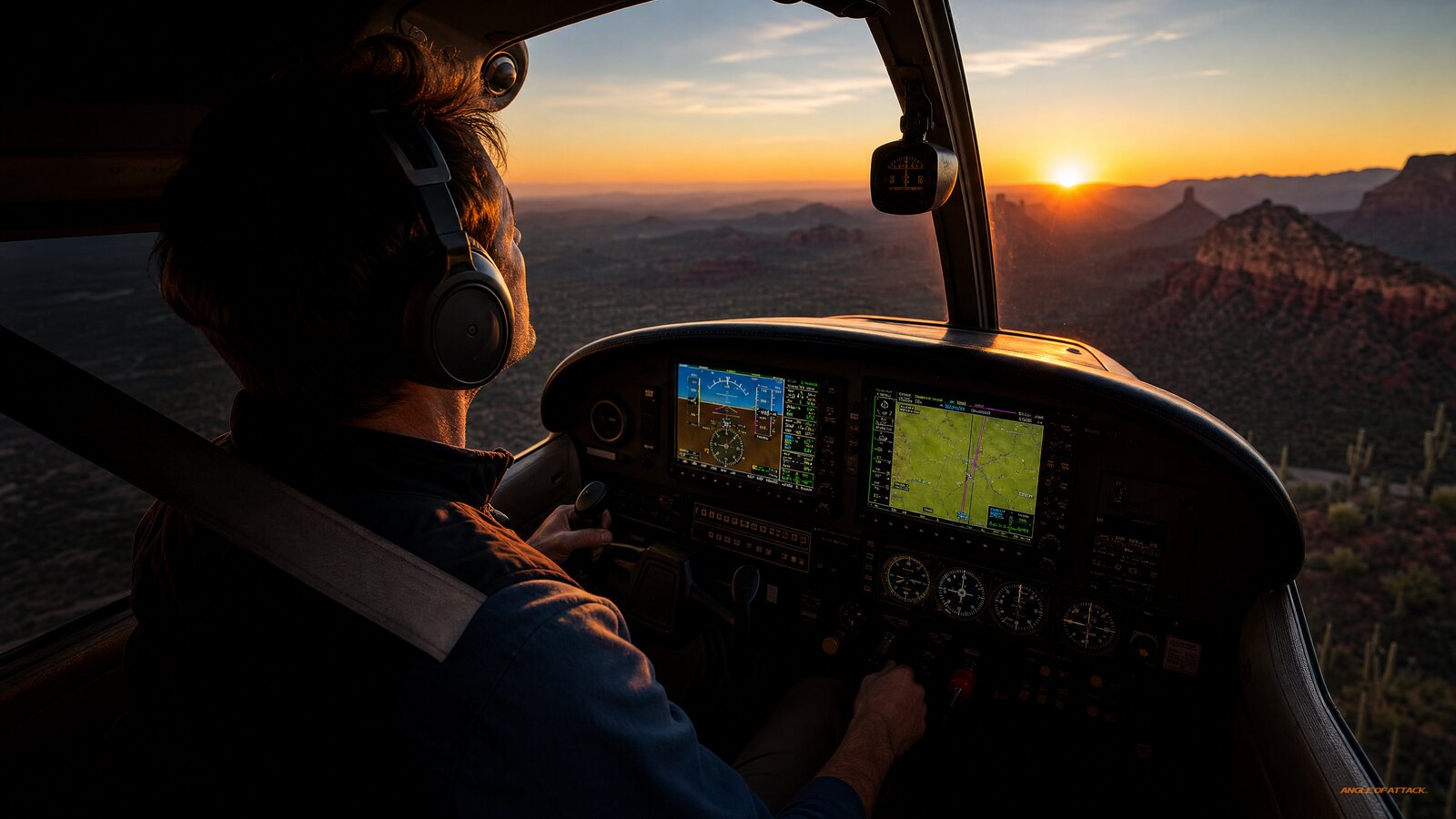
How Does a Magnetic Compass Work? Errors Every Pilot Must Know
A magnetic compass works by suspending a magnetized float in fluid so it freely aligns with Earth’s magnetic field, pointing the magnets toward magnetic north. A painted card on that float shows your heading through a small window. It needs no electrical power, which makes it your last-ditch heading reference.
That simple, self-powered design is exactly why the magnetic compass still sits at the top of every certificated airplane’s windshield, decades into the glass-cockpit era. But “simple” does not mean “honest.” The same physics that makes the compass work also makes it lie to you in predictable ways — during turns, during acceleration, and anytime your wings aren’t level. Learning those errors is one of the rites of passage in Private Pilot training, and it shows up on your written test, your oral, and a real low-visibility night when your vacuum pump or your PFD quits.
Let’s break down how the instrument actually works, why it misbehaves, and the memory tricks that keep you from chasing a swinging card all the way into a graveyard spiral.
- No power required. The magnetic compass is fully self-contained — no electricity, no vacuum, no gyros — which makes it the backup that survives a total electrical or instrument failure.
- It points to magnetic north, not true north. The angular difference between the two is called variation, and it changes depending on where you are on Earth.
- Deviation is your airplane’s own magnetic footprint. Radios, wiring, and metal create local fields; the compass correction card tells you how to compensate.
- It only reads true in straight, level, unaccelerated flight. Turns and speed changes make the card swing in misleading ways.
- Remember ANDS for acceleration and UNOS for turns. Accelerate North, Decelerate South covers the speed-change error; Undershoot North, Overshoot South covers the turning rollout. These two dip errors trip up most students.
- Northerly turning error is worst near north and south headings. Lead your rollout heading north, lag it heading south.
WHAT’S IN THIS GUIDE
- 1How does a magnetic compass work?
- 2What is the difference between variation and deviation?
- 3Why does the compass lie during turns?
- 4What is acceleration error and how do I remember it?
- 5When can I actually trust the magnetic compass?
- 6A night over the Susitna: when the compass was all I had
- 7How do I use the compass for a real timed turn?
- 8PLT Study Guide
- 9Frequently Asked Questions
How does a magnetic compass work?
A magnetic compass works because a magnetized needle, mounted on a float that pivots freely in a fluid-filled housing, naturally aligns itself with the horizontal component of Earth’s magnetic field. A numbered card is attached to that float, and you read your magnetic heading through a small lubber-line window. The fluid damps the swinging so the card settles instead of oscillating forever.
Pop the cover off the theory and there’s not much to it. Two small bar magnets are bonded to a float assembly. That float rides on a hardened pivot point so it can rotate with almost no friction. The whole works sits in a sealed bowl of fluid — a kerosene-type liquid, which is why the old-timers call it the “whiskey compass.” The fluid does two jobs: it floats the assembly to reduce pivot wear, and it dampens motion so the card doesn’t whip around with every bump.
The Pilot’s Handbook of Aeronautical Knowledge (PHAK, FAA-H-8083-25C) covers this in its flight-instruments chapter. The key takeaway for a student pilot is what the compass is not: it is not gyroscopic, it has no power source, and it has no idea which way is true north. It only knows where the magnetic lines of force are pointing right where the airplane sits at this instant.
That independence is the whole point. When your alternator dies on a dark night and the glass goes dark, the magnetic compass is still sitting there, quietly pointing the way home.
What is the difference between variation and deviation?
Variation is the angular difference between true north (the geographic pole) and magnetic north (where the compass points), and it changes with your geographic location. Deviation is a separate, smaller error caused by the airplane’s own magnetic fields — radios, wiring, and metal near the compass. Variation comes from the planet; deviation comes from your specific airplane.
Start with variation. Earth’s magnetic pole is not at the geographic North Pole, so depending on where you stand, magnetic north and true north can be off by a few degrees east or west — and in some parts of Alaska, by a lot more. Lines of equal variation are called isogonic lines, printed as dashed magenta lines on your sectional chart. The line where variation is zero is the agonic line. You apply variation when converting between true and magnetic course during navigation planning.
Deviation is the local problem. Bolt a couple of comm radios, a transponder, and a bundle of wiring within a few feet of a magnetic instrument and you create small magnetic fields that tug the card off true magnetic heading. To handle this, every airplane carries a compass correction card mounted near the instrument, calibrated during a process called “swinging the compass.”
Here is the practical version on the correction card:
| Heading you want (magnetic) | What you actually steer (compass) |
|---|---|
| N (000) | 002 |
| E (090) | 088 |
| S (180) | 183 |
| W (270) | 274 |
Those numbers are examples — your airplane’s card will read differently. The point is that deviation is unique to each airplane and even changes when you turn on the radios, which is why the card lists “radios on.”
Why does the compass lie during turns?
The compass lies during turns because of magnetic dip — Earth’s field doesn’t run flat across the ground; it dips downward toward the poles. In the Northern Hemisphere that downward pull tilts the compass float when the airplane banks, dragging the card so it reads incorrectly while you’re turning to or from a northerly or southerly heading. This is northerly turning error.
Here’s the behavior to memorize, and the mnemonic for it is UNOS — Undershoot North, Overshoot South. That phrase tells you how the card behaves when you turn to a northerly or southerly heading: near north it lags, so you’ll undershoot if you chase it; near south it leads, so you’ll overshoot.
- Turning to a northerly heading, the compass lags behind the airplane — it’s sluggish. You roll out before reaching your target number, leading the turn.
- Turning to a southerly heading, the compass leads the airplane — it races ahead. You roll out after passing your target number, lagging the turn.
A common rule of thumb taught for the checkride: when rolling out near north or south, lead or lag by roughly your latitude in degrees, plus about half your bank angle. So flying near 30 degrees latitude in a standard-rate turn, you might lead a northbound rollout by 25 to 30 degrees. Near east and west headings (090 and 270), turning error is minimal — the card tracks the turn well.
The single most important operational takeaway: do not use the magnetic compass to roll out of a turn while you’re still turning. Wait until the wings are level and the card settles, then read it.
What is acceleration error and how do I remember it?
Acceleration error happens on east-west headings when the airplane speeds up or slows down. Because of magnetic dip pulling on the float, accelerating makes the compass swing toward north, and decelerating makes it swing toward south. The mnemonic is ANDS: Accelerate North, Decelerate South — and it tells you exactly which way the card will lie.
Picture it on a westerly or easterly heading. Push the throttle in and accelerate, and the card lurches toward a northerly indication even though your actual heading hasn’t changed. Pull the power and decelerate, and the card swings the other way, toward south. On north or south headings, acceleration error is essentially nonexistent — the errors flip depending on whether you’re turning or accelerating, which is exactly why students mix them up.
So keep the two phenomena in separate mental boxes:
| Error | When it shows up | What the compass does | Memory aid |
|---|---|---|---|
| Northerly turning error | Turning to N or S headings | Lags near north, leads near south | UNOS (Undershoot North, Overshoot South) |
| Acceleration error | Speed change near E or W headings | Toward north when accelerating, toward south when decelerating | ANDS (Accelerate North, Decelerate South) |
If you only memorize one phrase for acceleration, make it ANDS: Accelerate-North, Decelerate-South. It tells you the direction the card falsely swings, so you know to ignore it until your airspeed stabilizes.
When can I actually trust the magnetic compass?
You can trust the magnetic compass only in straight, level, unaccelerated flight — wings level, constant airspeed, no climb or descent. Under those conditions the float hangs flat and reads your magnetic heading accurately. The instant you bank, accelerate, decelerate, or hit turbulence, the card becomes unreliable until the airplane settles back into steady flight.
This is why your heading indicator (the gyroscopic one) exists: it’s stable through turns and acceleration, but it drifts over time and needs to be realigned. The standard technique is to set the heading indicator to the magnetic compass during straight-and-level cruise, roughly every 15 minutes, because that’s the only time the compass is telling the truth.
There’s one more error worth naming: oscillation error. In turbulence the card bounces around, and the fluid can only damp so much. The fix is patience — average the swings, or fly off the heading indicator and reset it once things smooth out.
If you want to build these instrument habits into real muscle memory before you ever touch a checkride, our free Total Student Pilot course walks you through the six-pack instrument by instrument, and the full Private Pilot Ground School drills the compass errors with the kind of repetition that makes UNOS and ANDS automatic when the panel goes dark.
A night over the Susitna: when the compass was all I had
Years ago, flying a 172 back toward the Susitna valley after the sun had dropped behind the Alaska Range, I lost my heading indicator to a slowly dying vacuum pump. Not a dramatic failure — just a gyro that got lazy and started drifting faster than I could trust. Out there the ground gives you almost nothing at night: no road grid, no town glow, just black river bends and darker mountains.
So I did what every instructor drills and what most students think they’ll never actually need. I flew the magnetic compass directly. Wings dead level, power set, hands quiet — and I waited for the card to settle before I read it. Every heading change, I rolled in a gentle bank, held it, and let the wings come level before I believed a single number. I knew the northerly turning error was waiting to fool me, so I led my northbound rollouts and let the southbound ones lag.
It was slow. It was boring in the best possible way. And it worked, because the compass doesn’t care that your vacuum pump quit or your alternator died — it just keeps pointing.
I’ve taught aviation since 2006 and held a CFI since 2017, and that night is the story I tell every student who rolls their eyes at the compass-error chapter. The instrument you ignore in the classroom is the one that gets you home when the fancy stuff fails.
How do I use the compass for a real timed turn?
To use the magnetic compass for a heading change without a reliable heading indicator, fly a timed turn using the turn coordinator instead of the swinging card. A standard-rate turn changes your heading 3 degrees per second, so a 90-degree turn takes 30 seconds. You time the turn, roll out, then let the compass settle to confirm your new heading.
The logic is simple: the compass is useless during the turn but accurate after it. So you don’t try to read it mid-turn. Instead you establish a standard-rate turn on the turn coordinator (one needle-width or the wings-level index on the doghouse), start a count or a clock, and roll out when the time is up. For 3 degrees per second, divide the heading change by three to get your seconds.
Once you’re level and the card stops swinging, read it. If you’re a few degrees off, make a small correction and re-confirm in level flight. This timed-turn technique is straight out of partial-panel instrument training, and it’s a genuinely useful day-one skill even for VFR pilots flying older airplanes with finicky gyros.
The same discipline applies to compass-only straight flight: pick a distant landmark when you can, fly toward it, and use the compass to confirm rather than to chase. Chasing a swinging card is how pilots overcontrol and wander.
PLT Study Guide
The FAA tags written-test questions with PLT (Pilot Learning Statement) codes. The two that genuinely match magnetic compass content are below. (Heads up: codes like PLT334 and PLT204 sometimes get attached to this topic by mistake — they actually cover spatial disorientation and radio communication, not the compass.)
PLT215 — Recall flight instruments / magnetic compass. This is the core code for everything on this page: how the compass senses the horizontal component of Earth’s magnetic field, the source of magnetic dip, northerly turning error, acceleration error (ANDS), oscillation error, and the fact that the instrument is accurate only in straight-and-level, unaccelerated flight. Know which errors appear on north-south versus east-west headings.
PLT320 — Recall navigation / true north vs. magnetic north. This code covers variation: the angular difference between true and magnetic north, isogonic and agonic lines on the sectional, and how you convert between true and magnetic course during flight planning. Don’t confuse variation (a property of the planet and your location) with deviation (a property of your specific airplane’s magnetic fields).
Study tip: when a test question describes the airplane turning, think northerly turning error. When it describes the airplane changing airspeed, think acceleration error (ANDS). When it asks about true versus magnetic, that’s variation (PLT320).
Frequently Asked Questions
Why is the magnetic compass mounted at the top of the windshield instead of in the panel?
The compass is placed away from the metal and electrical fields of the instrument panel to reduce deviation error. The top of the windshield, on the centerline, keeps it relatively clear of radios, wiring, and ferrous structure. Even there, residual deviation is documented on the compass correction card mounted nearby.
What is the fluid inside a magnetic compass for?
The fluid — a clear, kerosene-type liquid — does two jobs. It buoys the float assembly to reduce wear on the pivot, and it dampens oscillation so the card settles to a steady reading instead of swinging endlessly. A compass with a fluid leak or a visible bubble is a maintenance squawk, since the damping suffers.
Does a magnetic compass need electrical power?
No. The magnetic compass is entirely self-powered by Earth’s magnetic field. That total independence from the airplane’s electrical and vacuum systems is exactly why it’s the required backup heading reference and the instrument you fall back on during an electrical or instrument failure.
What is the difference between variation and deviation again?
Variation is the angular difference between true north and magnetic north, and it depends on your geographic location (shown by isogonic lines on the sectional). Deviation is the error caused by your specific airplane’s magnetic fields and is corrected using the compass correction card. Variation is the planet; deviation is your airplane.
What does ANDS stand for?
ANDS stands for Accelerate North, Decelerate South. It describes acceleration error on east-west headings: when you accelerate, the compass card falsely swings toward north; when you decelerate, it swings toward south. On north and south headings, acceleration error is negligible, which is the catch students forget.
Why does the compass read wrong when I turn?
Magnetic dip pulls the compass float downward toward the magnetic pole, and when the airplane banks, that pull tilts the card. The result is northerly turning error: the compass lags when turning through north and leads when turning through south. It tracks turns accurately only near east and west headings.
When is the magnetic compass actually accurate?
Only in straight, level, unaccelerated flight with the wings level and airspeed constant. That’s why pilots reset the gyroscopic heading indicator to the compass during steady cruise, roughly every 15 minutes — it’s the one moment the compass is reliably telling the truth.
How do I turn to a heading using only the compass?
Don’t read the compass mid-turn. Use the turn coordinator to fly a standard-rate turn (3 degrees per second), time it (a 90-degree turn takes 30 seconds), roll out, then let the card settle in level flight to confirm. Correct in small steps. This is the classic partial-panel timed-turn technique.
Master every system on your checkride — and on day one.
The Private Pilot Ground School breaks down every FAA subject area in the same plain-English, real-world way you just read — with quizzes, scenarios, and the explanations that finally make it click.
The magnetic compass is the oldest, dumbest, most stubborn instrument in your airplane — and on the worst night of your flying career, it might be the only one still talking to you. Learn its lies so well that you can predict them, and it becomes a friend instead of a trap. Spend the time on UNOS, ANDS, and northerly turning error now, while the cost of a mistake is just a missed test question, not a missed checkpoint over dark terrain.


ON THE SAME TOPIC

What Are PIREPs? Pilot Reports That Sharpen Your Weather Picture
What Are PIREPs? Pilot Reports That Sharpen Your Weather Picture 16 min read Last updated June 2026 · Chris Palmer A PIREP (Pilot Report) is a firsthand report of actual weather conditions a pilot encounters in flight — cloud tops, turbulence, icing, in-flight visibility, and ride quality — relayed to a ground station, usually Flight […]
 Read more
What Are Ground Reference Maneuvers? The Wind-Drift Skills Every Pilot Learns First
What Are Ground Reference Maneuvers? The Wind-Drift Skills Every Pilot Learns First 16 min read Last updated June 2026 · Chris Palmer Ground reference maneuvers are low-altitude training maneuvers — the rectangular course, S-turns across a road, and turns around a point — in which a pilot flies a precise path over the ground while […]
Read more 
What Are Flaps in Aviation? Lift, Drag & When to Use Them
What Are Flaps in Aviation? Lift, Drag & When to Use Them 14 min read Last updated June 2026 · Chris Palmer Flaps are hinged panels on the trailing edge of an airplane’s wing that pilots extend to increase both lift and drag at slow speeds. By changing the wing’s camber and area, flaps let […]
Read more 
Canard Wings Explained: Why Some Airplanes Wear Their Tail Up Front
Canard Wings Explained: Why Some Airplanes Wear Their Tail Up Front 16 min read Last updated June 2026 · Chris Palmer A canard wing is a small horizontal lifting and control surface mounted ahead of the main wing — in front of the airplane’s center of gravity — instead of behind it like a conventional […]
Read more 
Stay Connected
Be the very first to get notified when we publish new flying videos, free lessons, and special offers on our courses.
