How to Teach Chandelles: A New CFI’s Guide to the Maximum-Performance Climbing Turn

A chandelle is a maximum-performance 180° climbing turn required on the commercial pilot checkride under FAA-S-ACS-7B Area V Task C and required to teach on the CFI initial under FAA-S-ACS-25 Area IX Task C. The maneuver has two halves: in the first 90° of turn, the bank stays at 30° and the pitch keeps coming up; in the second 90°, the bank starts coming out and the pitch stays up — finishing wings level just above stall speed at the 180° point. Teach those two halves and every error your student makes becomes diagnosable in one question.
- A chandelle is a maximum-performance 180° climbing turn — required on the commercial checkride (FAA-S-ACS-7B Area V Task C) and required to teach on the CFI initial (FAA-S-ACS-25 Area IX Task C).
- The maneuver is two halves with two rules. First 90°: bank stays at 30°, pitch keeps coming up. Second 90°: bank starts coming out, pitch stays up.
- The ACS tolerance for bank in the first 90° is 30° ±5°, maintained — not just set at roll-in. Heading at rollout: 180° ±10°. Airspeed at the rollout: just above stall speed (within stall warning).
- Every student error you’ll see is a violation of one of those two rules. Every right-seat correction maps to one of them.
- The debrief comes down to one question: which half got away from you?
- Pitch attitude is variable throughout the maneuver — there is no single number to hold. Teaching it as “15° up at 90°” flat-lines the climb.
Walking into your first lesson with a 50-page binder won't help you.
Get my Anti-Binder One-Page Lesson Plan Template free — the lesson plan tool I built for CFI candidates who want to be ready Day 1.
Get the Anti-Binder Template Free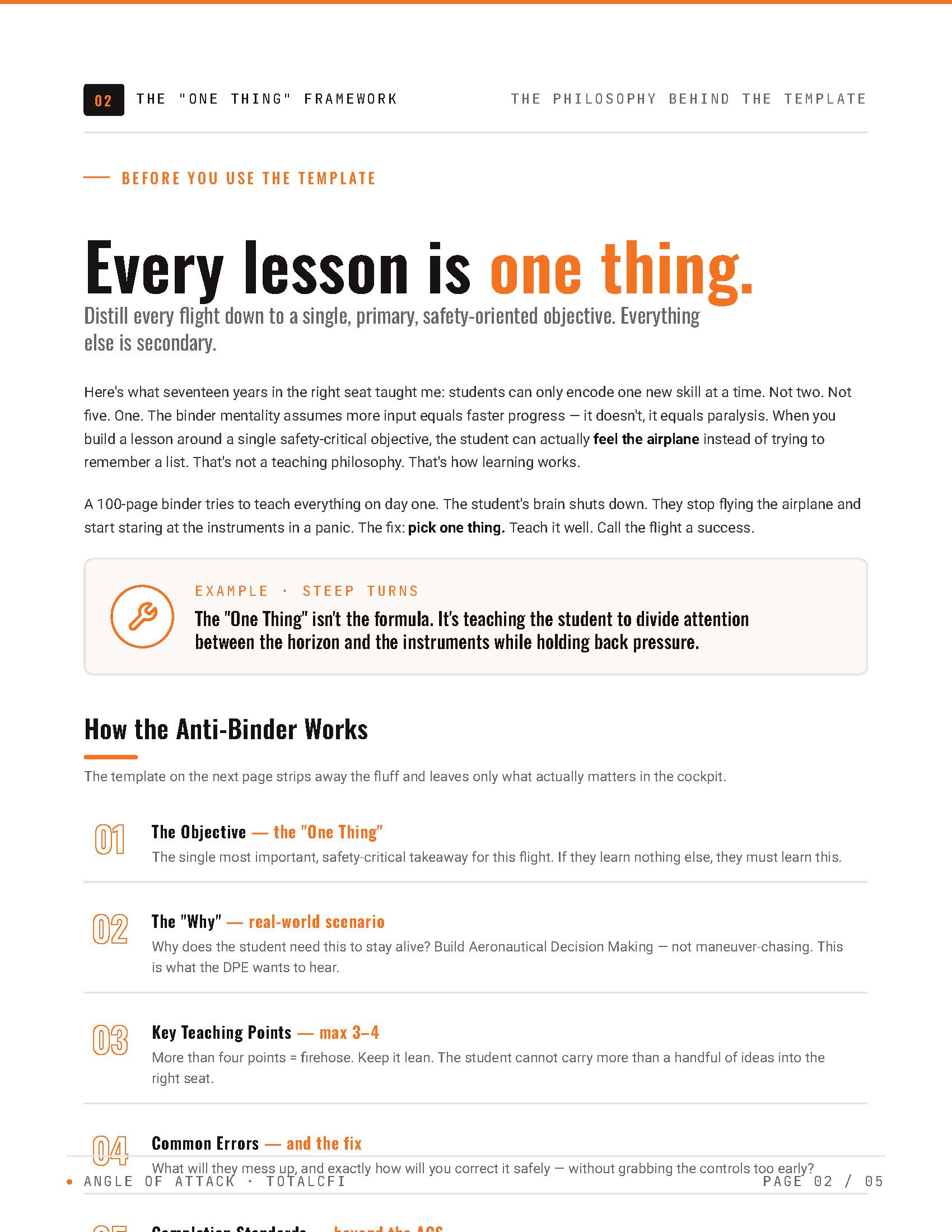
WHAT'S IN THIS GUIDE
- 1What a Chandelle Actually Is (And Why It's Easier to Teach Than It Looks)
- 2Find the Simpleness — Two Halves, Two Rules
- 3The One-Page Lesson Plan for Chandelles (Six Boxes Applied)
- 4How to Teach a Chandelle from the Right Seat
- 5Chandelle ACS Standards (Commercial Pilot — FAA-S-ACS-7B Area V Task C)
- 6The Most Common Errors on a Chandelle (And What to Say When You See Them)
- 7Chandelle vs Lazy Eight — The Comparison
- 8Where This Lives in TotalCFI
- 9Frequently Asked Questions
What a Chandelle Actually Is (And Why It’s Easier to Teach Than It Looks)
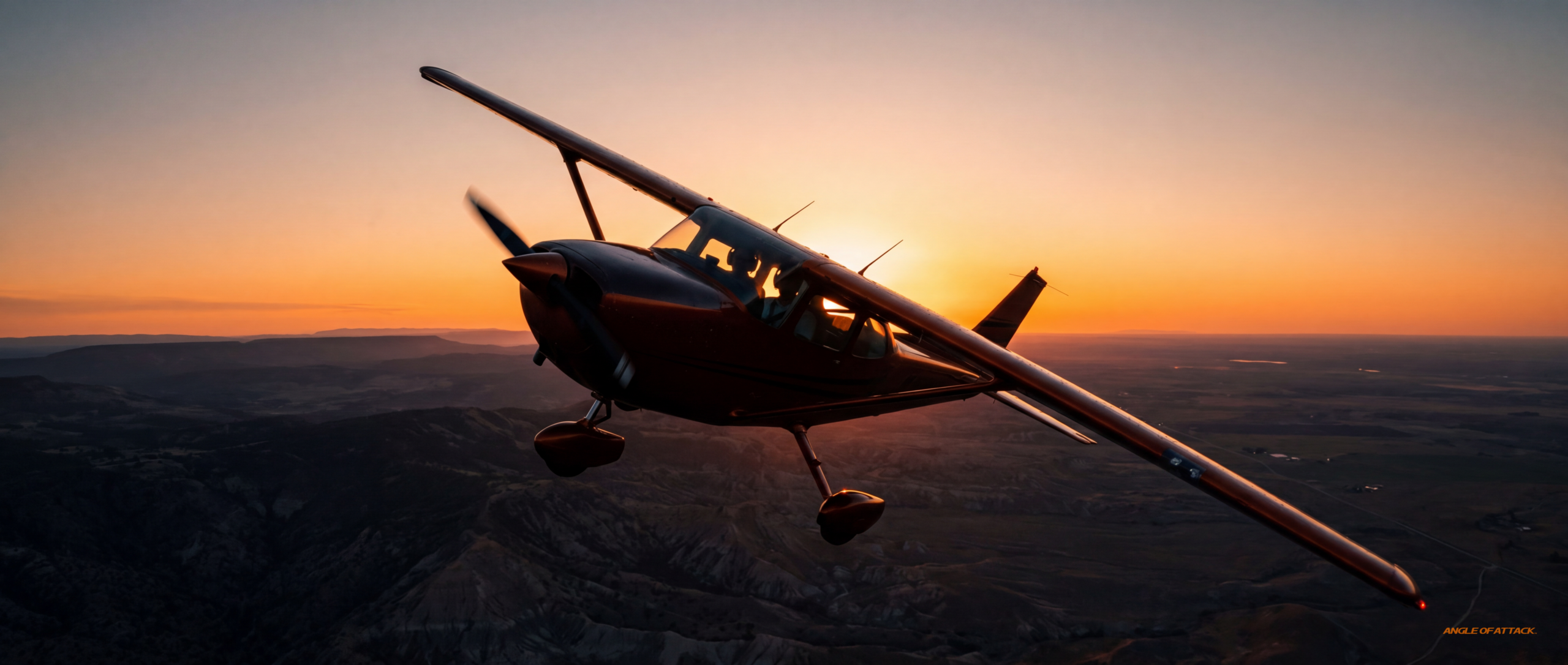
The chandelle is a maximum-performance 180° climbing turn. You enter from straight-and-level flight (or a shallow dive) at maneuvering speed (or the manufacturer-recommended entry speed if the POH specifies one), roll into a 30° bank, and spend the next 180° of turn climbing as hard as the airplane will let you — finishing wings level, nose high, just above stall speed exactly at the 180° point. That’s the Airplane Flying Handbook (FAA-H-8083-3C) Chapter 10 description, more or less. The maneuver originated in French WWI air combat — chandelle is French for “candle,” and monter en chandelle meant climbing vertically to escape pursuit or pivot onto a target. Today it lives on as a commercial maneuver because it teaches energy management, coordination, and rudder feel at low airspeed — exactly the muscle memory that keeps pilots out of stall-spin accidents in the traffic pattern.
That’s the encyclopedia version. Here’s why new CFIs walk in dreading it.
The book makes the chandelle sound like a recipe with a lot of ingredients. Maximum performance. Climbing turn. 180° heading change. Minimum controllable airspeed at the rollout. 30° bank. Variable pitch. The candidate reads the procedure, walks to the airplane sweating, and tries to remember everything at once. So does the student. The maneuver becomes a checklist neither of them can keep straight.
That’s not a chandelle problem. That’s a teaching problem.
The first time I taught a chandelle to a paying student, back in California somewhere around 2015, I taught it as a list of attitudes. “Roll to 30°. Pitch up about 15° at the 90° point. Hold the pitch through the rollout.” He nodded politely. He flew it. The airplane flat-lined.
Then he asked the question that changed how I teach commercial maneuvers. He said, “What pitch attitude do I hold?”
I opened my mouth to answer and realized I’d been teaching the maneuver as a static target. Pitch isn’t a number on a chandelle — it’s changing the entire time. The number I’d given him was a snapshot of a single moment, and he was trying to hold a snapshot through a movie. No wonder it flat-lined.
We landed. I stopped trying to teach attitudes. I drew the two halves on a napkin and gave him two rules. The next chandelle was clean. He never asked about pitch attitude again, because there was no number to ask about.
That napkin is the rest of this article.
Find the Simpleness — Two Halves, Two Rules

A chandelle is two halves with two rules. Here it is, the whole maneuver, on one napkin:
First 90 degrees — bank stays at 30°, pitch keeps coming up.
Second 90 degrees — bank starts coming out, pitch stays up.
That’s the entire chandelle. If your student understands those two halves, they fly a clean one. If they don’t, no number of altitude or airspeed callouts will fix it.
I call this finding the simpleness — not a quote from any handbook, just my own teaching shorthand for the discipline of boiling a complicated-looking maneuver down to its load-bearing rules. The Aviation Instructor’s Handbook talks about the same idea under different names — the law of primacy, progressive teaching, the move from rote to understanding — but the phrase is mine. It came out of teaching, not out of a book.
The reason it matters: every student error you will ever see on a chandelle is a violation of one of those two rules.
- Bank steepening in the second 90°? Rule 2 broken — bank should be coming out.
- Pitch easing back at the rollout? Rule 2 broken — pitch should stay up.
- Bank too steep in the first 90°? Rule 1 broken — bank should be at 30° and holding.
- Pitch not increasing in the first 90°? Rule 1 broken — pitch should be coming up.
Every right-seat correction maps to one of those two rules. Every debrief comes back to one question: which half got away from you? That question is the most useful question in the whole maneuver, because the answer is binary. The student didn’t just fly an imperfect chandelle. They violated one specific rule in one specific half. Find the rule, fix the half, fly it again.
This is also the reason the discipline of finding the simpleness matters far beyond chandelles. The CFI who can do this for one maneuver can do it for stalls. For crosswind landings. For emergencies. For radio communications. The maneuver is a teaching exercise for the instructor as much as the student.
The One-Page Lesson Plan for Chandelles (Six Boxes Applied)
The Aviation Instructor’s Handbook (FAA-H-8083-9B) outlines the six-box lesson plan format — Objective, Elements, Equipment, Instructor’s Actions, Student’s Actions, Completion Standards. Most CFI candidates first see those six boxes filled out as a fifty-page binder, one section per maneuver, every cell padded with FAA boilerplate. That binder won’t survive contact with a real student. A one-page lesson plan will.
Here’s chandelles, six boxes, one page:
| Box | What goes in it |
|---|---|
| Objective | The student will safely demonstrate a chandelle in both directions to commercial ACS standards, articulating the two halves and the two rules during the demonstration. |
| Completion Standard | Bank 30° ±5° maintained through first 90°. Heading at 180° ±10°. Airspeed just above stall speed at rollout, within stall warning. Coordination throughout. Minimum altitude loss during recovery. The student articulates which half they’re in and what rule applies. (Per FAA-S-ACS-7B Area V Task C.) |
| The One Thing | A chandelle is two halves with two rules. First 90°: bank at 30°, pitch up. Second 90°: bank out, pitch held. Every error is a rule violation. |
| Common Errors + Right-Seat Corrections | (1) Bank steepens in second 90° → “Roll the bank out — pitch stays up.” (2) Pitch eases at rollout → “Pitch stays up, don’t release until the airplane stops climbing.” (3) Bank too steep in first 90° → “Set 30 and hold it — pitch comes up, bank doesn’t.” (4) Loses 180° point → “Match your rate of rollout to your rate of turn.” |
| Teaching Sequence |
|
| Debrief Prompt | “Which half got away from you?” |
That fits on one page. That’s a lesson plan the student can read in 90 seconds and refer back to between attempts. That is a lesson plan you can use on a checkride without flipping through a binder. That is the format I teach in TotalCFI — every maneuver gets one of these, every CFI candidate builds them for every maneuver they teach, and the binder dies a quiet death.
If you want a blank template, the Anti-Binder One-Page Lesson Plan is the same format I just walked through, free for download. Bring it to your CFI initial. Bring it to your first commercial student. It works for both.
For a deeper walk-through of why the six-box format wins over a binder, see the CFI lesson plan template article.
How to Teach a Chandelle from the Right Seat

Teaching a chandelle from the right seat is a four-step flow: brief on the ground, demo in the air, let the student fly, debrief with one question. The mistake new CFIs make on chandelles isn’t a flying mistake. It’s a teaching-flow mistake. They get to the practice area, point the airplane in a direction, and demo a chandelle while half-narrating something the student is half-hearing through the noise. Then they hand over the controls and hope.
Here’s the flow that actually works.
The Pre-Flight Brief
Brief on the ground, before you walk to the airplane. Pull out a one-page plan. Draw the two halves with your finger in the air. Say the rules out loud. Then ask the student to repeat both rules back to you. Don’t move on until they do.
“First 90° — bank stays at 30°, pitch keeps coming up. Second 90° — bank starts coming out, pitch stays up. Tell me what I just said.”
If the student repeats it cleanly, you’re ready to fly. If they fumble, brief it again. The brief is the cheapest teaching minute you’ll spend all day — running it twice on the ground saves you ten minutes of frustration in the air.
The In-Flight Demo
On the way to the practice area, recite the rules out loud one more time. Set up the maneuver — straight-and-level at maneuvering speed, clearing turns, the works. Then talk through the demo as you fly it. Not the procedure. The rules.
“Bank’s at 30 and I’m holding it… pitch is coming up… we’re at the 90° point, pitch is still high, now the bank starts coming out… pitch is staying right where it is, bank’s coming out smoothly… wings level… 180°.”
That’s six sentences. Each one is a rule statement. The student is hearing the framework while watching the airplane execute it. That’s the law of primacy doing its job.
The Student’s Attempt
Hand over the controls. Let them set it up. Let them fly it.
This is where new CFIs over-correct in real time. Don’t. Unless the maneuver becomes unsafe (the bank goes past 45°, the airplane stalls, you’re losing situational awareness), let it play out. The student needs to feel the error to learn the rule. If you call out “more pitch” or “less bank” mid-maneuver, you’re teaching them to chase your callouts instead of the rules.
The exception: safety. If the airplane is approaching an uncoordinated stall — typically because the student let the bank steepen and forgot the rudder — take the controls cleanly, recover, and brief on the ground after the next attempt. That’s a separate teaching moment. Don’t try to handle it mid-rollout.
The Debrief
Land or stay aloft, doesn’t matter. Either way, the debrief opens with one question.
“Which half got away from you?”
That’s it. Not “you ended 30 feet low.” Not “you lost five knots at the rollout.” Not “your coordination was sloppy at the 120° point.” All of those are symptoms. The cause is a rule violation in one of the two halves. Make the student diagnose it.
If they don’t know which half, walk them through both. “Bank stay at 30 in the first 90? Yes. Pitch keep coming up? Yes. So the first half was clean. Bank start coming out in the second 90? Yes. Pitch stay up? No — you eased it back at about 160°. So the second half got away from you. What was the rule?” The student finishes the diagnosis with the rule already in their mouth.
A right-seat note for the new CFI: torque effect is asymmetric. A left chandelle needs more right rudder than a right chandelle because the rollout aileron in the second 90° adds left adverse yaw on top of the climbing turn’s natural yaw. A right chandelle needs less right rudder because the rollout aileron generates favorable yaw to the right. Your student may never need to articulate this. You need to feel it from the right seat so you can demo the rudder pressure that keeps the maneuver coordinated.
Chandelle ACS Standards (Commercial Pilot — FAA-S-ACS-7B Area V Task C)
The Commercial Pilot ACS lists chandelles under Area V — Performance Maneuvers and Ground Reference Maneuvers, Task C. The CFI initial lists them under Area IX — Performance and Ground Reference Maneuvers, Task C in FAA-S-ACS-25. The tolerances:
| Element | Commercial ACS Tolerance |
|---|---|
| Bank angle (first 90°, maintained) | 30° ±5° |
| Heading at 180° rollout | ±10° |
| Airspeed at rollout | Just above stall speed, within stall warning |
| Coordination | Maintained throughout |
| Minimum altitude loss during recovery | Required |
The maneuver is demonstrated in both directions — left chandelle and right chandelle. Entry altitude per the AFH is at least 1,500 ft AGL; in practice, plan another 1,000 ft buffer because a typical Cessna 172 chandelle gains around 500 feet of altitude between entry and rollout.
For the CFI candidate, the standard is teaching, not just flying. FAA-S-ACS-25 Area IX Task C requires you to demonstrate the maneuver, identify common errors, and correct them — all while flying from the right seat. That is the bar you’re training to.
The Most Common Errors on a Chandelle (And What to Say When You See Them)

The Airplane Flying Handbook (FAA-H-8083-3C) Chapter 10 lists the common chandelle errors. Every one of them maps back to a rule violation in one of the two halves.
Error 1 — Bank steepens in the second 90°
This is the most common error, full stop. The student starts the rollout and either forgets to roll smoothly or chases the pitch and lets the bank drift back to 35-40° before catching it. Rule 2 — bank starts coming out — is broken.
Right-seat callout (in debrief, not in flight): “Bank gets out in the second 90°. If you’re still at 30° at the 135° point, you’re behind the rollout.”
Error 2 — Pitch eases back at the rollout
A CFI candidate I prepped a few years ago kept doing this. Every chandelle, somewhere around the 160-170° point, he’d relax back-pressure on the elevator, the nose would drop a degree or two, and he’d bust the max-performance climb criterion at the rollout. Pretty chandelle. Failed standard.
The fix was one sentence in debrief. “Pitch keeps going UP through the second 90° — don’t release the elevator until the airplane stops climbing.” He flew the next one clean. Rule 2 violated, rule 2 corrected.
Right-seat callout: “Don’t release the elevator until the maneuver finishes. Pitch stays up through 180°.”
Error 3 — Bank too steep in the first 90°
The student rolls past 30°, sometimes to 35° or 40°, on entry. The maneuver immediately becomes a level turn instead of a climbing turn — the bank is consuming the airplane’s energy that should be going into altitude. Rule 1 — bank stays at 30° — is broken.
Right-seat callout: “Set 30 and hold it. The bank doesn’t change in the first 90°. Only the pitch.”
Error 4 — Trying to hold a pitch attitude
This is the trap I fell into with my first commercial student. The candidate memorizes a number — usually 15° up — and tries to hold it through the maneuver. The chandelle flat-lines. Energy goes nowhere.
In one CFI candidate I worked with, this one was the only error. He could do everything else right. He just kept trying to fly the maneuver as a target pitch attitude. The fix, in the ground debrief: “Pitch is changing throughout — there’s no number. Watch the airspeed, feel the airplane, keep coming up until you’re at minimum controllable airspeed at the 180° point.” Next attempt was clean. The maneuver is dynamic, not static.
Right-seat callout: “There’s no number. Pitch is changing the whole time. Feel the airspeed bleed off.”
Error 5 — Uncoordinated power-on stall
The most dangerous failure mode. The student lets the bank steepen, neglects the rudder, and the airplane departs into an uncoordinated stall at low airspeed. This is exactly the energy state that produces base-to-final spin accidents in the traffic pattern. SAFE’s David St. George has documented that 89.3% of pattern stalls happen on takeoff or turn-out — the same energy state chandelles teach you to manage. That is why this maneuver matters beyond the checkride.
Right-seat response: Take controls. Recover with reduced angle of attack, level the wings, restore coordination. Then debrief on the ground — this is a teaching moment, not an in-flight correction.
Chandelle vs Lazy Eight — The Comparison
Both maneuvers are commercial-side, both live in FAA-S-ACS-7B Area V, and both come up in the same lesson block when you’re prepping a commercial student. They are easy to confuse on paper and very different in the airplane.
| Element | Chandelle | Lazy Eight |
|---|---|---|
| Heading change | 180° | Two 180° turns, alternating direction (720° of cumulative banking) |
| Performance level | Maximum performance | Never at maximum performance |
| Pitch and bank | Two distinct phases (bank held, then pitch held) | Continuous, simultaneous, flowing through symmetrical pattern |
| Ends at | Minimum controllable airspeed | Entry airspeed and altitude (or very close) |
| What it teaches | “Don’t bank and pitch at the same time” for large excursions | “You can bank and pitch at the same time” — with limited rate of change |
The teaching contrast is the lesson. Chandelles teach a student to isolate bank and pitch — change one at a time, hold the other constant. Lazy eights teach the student to combine bank and pitch in a continuous, coordinated motion. A commercial student who can fly both has the full energy-management vocabulary the certificate is meant to build.
For the right-seat side of lazy eights, see how to teach lazy eights. For the third in the commercial-maneuvers triad, how to teach eights on pylons. And if the bank control is the part your student is struggling with, the foundation maneuver is steep turns — same overbanking tendency, no climb.
Where This Lives in TotalCFI
Chandelles are one of the maneuvers I teach in TotalCFI, the course I built around the way I prepare CFI candidates today. The chandelle lesson sits inside the broader module on teaching performance maneuvers from the right seat — the moment in the CFI ride where most candidates lose composure, because they suddenly realize they’ve never explained what their hands are doing while their hands are doing it.
The course doesn’t drill chandelles in isolation. It teaches the framework you just read — find the simpleness, build the one-page plan, deliver the brief, narrate the demo, run the debrief on the one question — and then applies it across every commercial maneuver on the CFI ride. Chandelles, lazy eights, eights on pylons, steep turns, slow flight, stalls. Same framework, different rules.
That’s the Day-1 readiness piece. The CFI ride is not the test. The first time a paying student sits next to you in the right seat is the test. If the framework worked on the DPE, it’ll work on the student. That is what I want for every CFI who comes through the course.
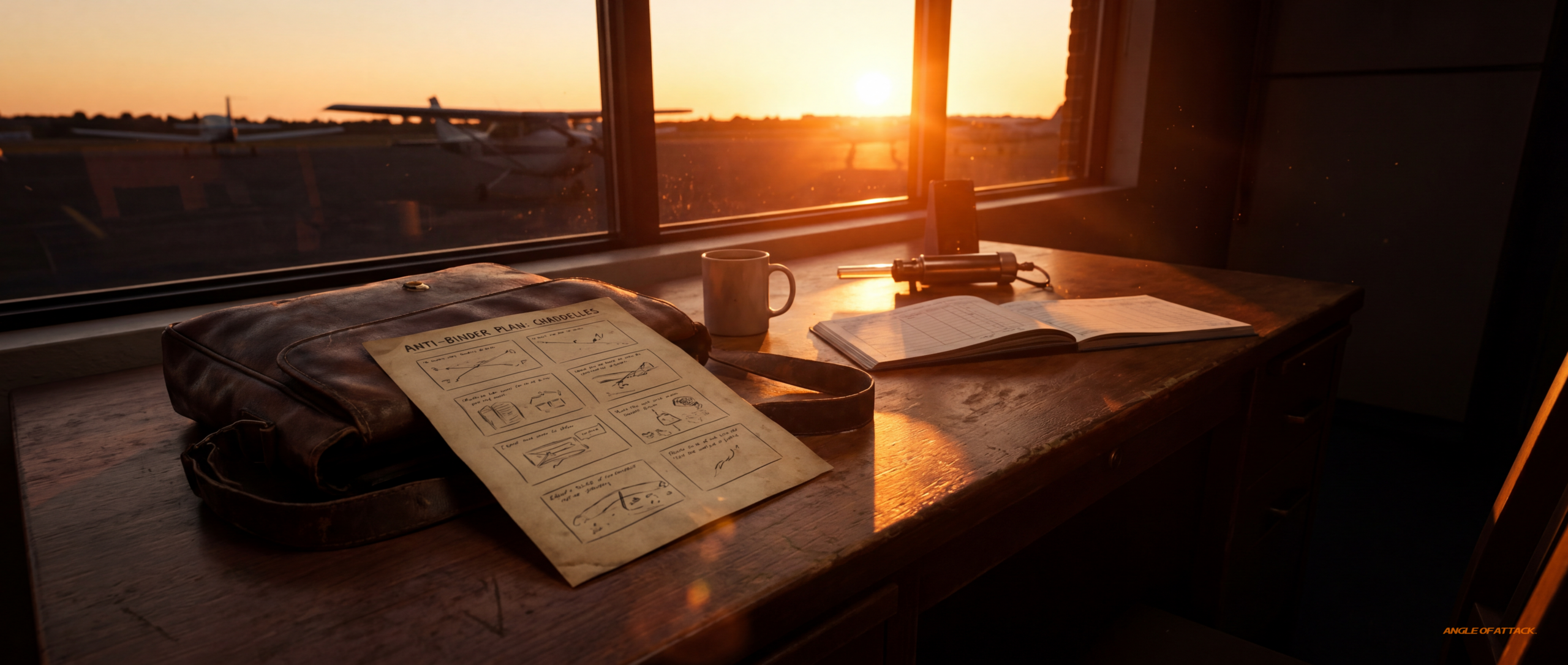
The Anti-Binder Lesson Plan Template is the free starting point. The full course is the build-out.
Frequently Asked Questions
What is a chandelle?
A chandelle is a maximum-performance 180° climbing turn beginning from straight-and-level flight (or a shallow dive) at maneuvering speed and finishing wings level, nose high, just above stall speed at the 180° point. It is required on the commercial pilot checkride under FAA-S-ACS-7B Area V Task C and is taught in two phases: a first 90° with constant 30° bank and increasing pitch, then a second 90° with constant pitch and decreasing bank.
What is the purpose of a chandelle?
The chandelle teaches energy management, coordination, and rudder feel at low airspeed — the same muscle memory that keeps pilots out of stall-spin accidents in the traffic pattern. It is not, despite the name, intended for emergency max-performance climbs in real flying. It is a training exercise designed to build the coordinated low-airspeed skill set the FAA wants every commercial pilot to own.
What pitch attitude should I use for a chandelle?
There is no single pitch attitude to hold. Pitch is variable throughout the maneuver — increasing through the first 90°, holding through the second 90°, and ending nose-high at minimum controllable airspeed at the 180° point. Teaching the chandelle as “hold 15° up” flat-lines the climb. Teach it as a changing pitch profile, governed by the two-halves rules, and the airplane finds the right attitude on its own.
What are the ACS standards for a chandelle?
The Commercial Pilot ACS (FAA-S-ACS-7B Area V Task C) requires: a 30° bank ±5° maintained through the first 90°, heading at the 180° rollout within ±10°, airspeed at rollout just above stall speed (within stall warning), coordination maintained throughout, and minimum altitude loss during recovery. The maneuver is flown in both directions.
What is the difference between a chandelle and a lazy eight?
A chandelle is a single 180° maximum-performance climbing turn with two distinct phases (bank-held-then-pitch-held). A lazy eight is two 180° turns in alternating directions — 720° of cumulative banking — at a continuous, flowing rate, never at maximum performance. Chandelles teach you to isolate bank and pitch. Lazy eights teach you to combine them. Both live in FAA-S-ACS-7B Area V.
What is the most common error on a chandelle?
Letting the bank steepen in the second 90° instead of rolling it smoothly out — a violation of the rule that says bank starts coming out, pitch stays up in the second half. Second most common: easing pitch back at the rollout, which busts the max-performance climb criterion. Both errors are diagnosed with the same debrief question: which half got away from you?
What altitude do you start a chandelle?
The Airplane Flying Handbook recommends entering at a minimum of 1,500 ft AGL. In practice, plan another 1,000 ft of altitude buffer above that. A typical Cessna 172 chandelle gains around 500 feet between entry and rollout, so an entry at 2,500 ft AGL gives you a clean margin and recovery altitude.
Why are chandelles hard to teach?
They look complicated on paper — maximum performance, 180° heading change, peaking at minimum controllable airspeed at the rollout. A new CFI reads that and tries to teach all the elements at once. The maneuver becomes easy to teach the moment you stop teaching the procedure and start teaching the two rules. Find the simpleness, build the one-page plan, and the rest follows.
You're not training to pass the CFI ride. You're training to be the right-seat pilot a paying student trusts on Day 1.
TotalCFI teaches the framework behind this article — across every commercial maneuver, every student error, every right-seat correction. Twenty-four lessons, the Anti-Binder method, lifetime community access, and the Day-One Ready Guarantee.
The chandelle is the easiest commercial maneuver to teach once you stop teaching it as a procedure and start teaching it as two rules. Every student error becomes diagnosable in one question. Every right-seat correction becomes one sentence. The maneuver stops being intimidating the moment you find the simpleness — and the discipline of finding the simpleness in one maneuver is the discipline of teaching anything. Chandelles first, then stalls, then crosswind landings, then emergencies. Same skill. Different rules.
You've already done the flying. The work that's left is between your ears. Find the simpleness, teach the two halves, ask the one question. Be the teacher in the right seat your student will remember.