How to Teach Lazy Eights: A New CFI’s Guide to the Coordinated Demonstration
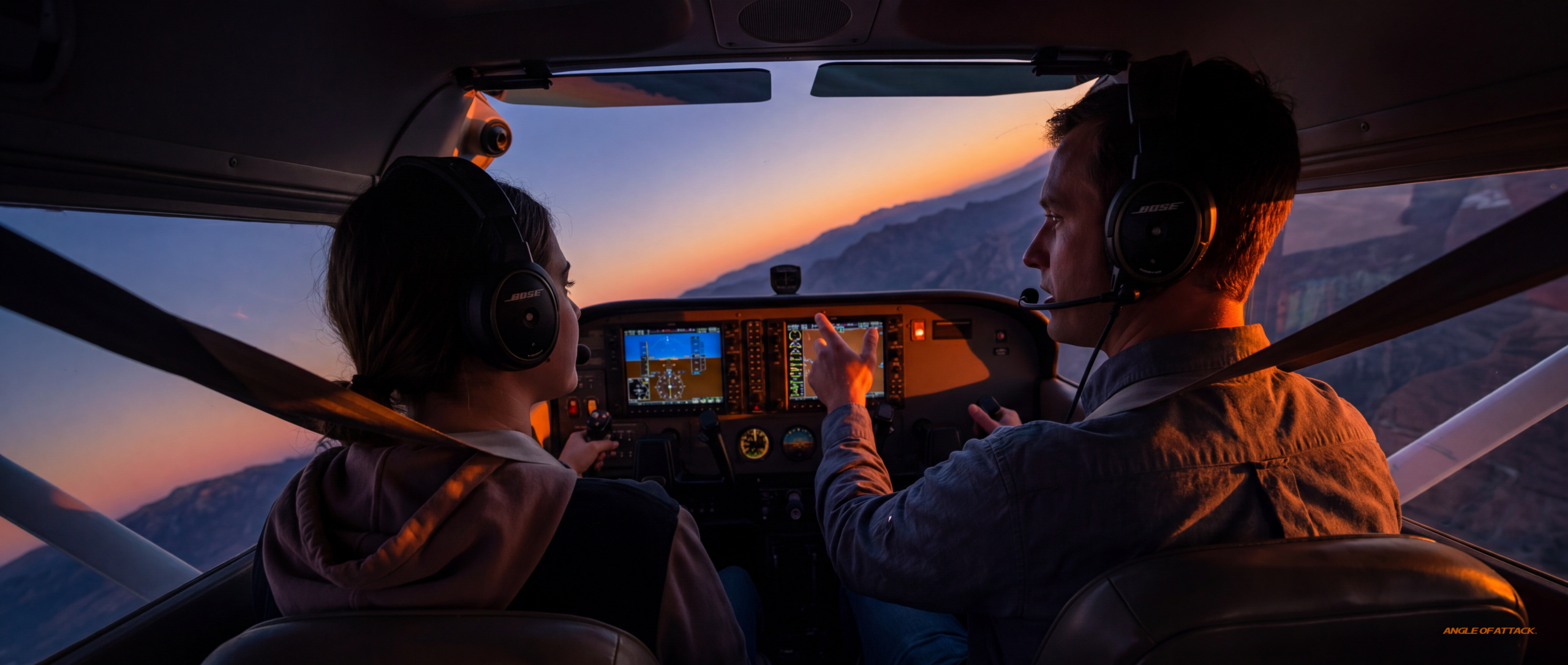
A lazy eight is the maneuver in the Commercial Pilot ACS, Area of Operation V, Task D, that you cannot fly by the numbers. Two 180° turns of alternating direction, executed with continuous, coordinated changes in pitch and bank, the flight path tracing a horizontal figure-eight in the sky. The control pressures change continuously and never repeat. That’s by design. I’m Chris Palmer, two-time Master Aviation Educator, Gold Seal CFI, founder of Angle of Attack, and the lazy eight is the maneuver most CFI candidates learn to fly but never learn to teach. This article gives you the right-seat language.
- The lazy eight lives at Commercial Pilot ACS Area V, Task D (FAA-S-ACS-7B) and at Flight Instructor ACS Area IX, Task D (FAA-S-ACS-25). The CFI applicant must demonstrate AND teach the maneuver from the right seat.
- The FAA’s word is “reference points,” not checkpoints. The 45°, 90°, and 135° marks are visual cues, not tolerance gates. Tolerance is measured at the 180°: ±100 ft, ±10 kt, ±10° from entry.
- Maximum bank at the 90° reference point is approximately 30°. The FAA word is “approximately.” There is no hard tolerance. The maneuver is symmetrical, coordinated, and smooth. Those are the standards.
- Power is set at cruise before entry and not adjusted during the maneuver. This is what makes the lazy eight an energy management maneuver. Your student trades altitude for airspeed and back without touching the throttle.
- The teaching wedge: most CFI candidates flew the lazy eight from the left seat and never learned the right-seat patter. The brief script, the in-flight narration, the silent first attempt, and the one-question debrief are the difference between a CFI who demos the maneuver and one who teaches it.
The CFI Toolkit Every New Instructor Wishes They Had on Day One
Most new CFIs build their teaching system from scratch. A binder of borrowed lesson plans, scattered notes, and ACS PDFs. The Anti-Binder Template is the one-page lesson framework I use to plan every lesson, including commercial maneuvers like the lazy eight. The same six-box shape works for the brief, the demo, the student attempt, and the debrief.
Grab the Anti-Binder Template — Free →
Walking into your first lesson with a 50-page binder won't help you.
Get my Anti-Binder One-Page Lesson Plan Template free — the lesson plan tool I built for CFI candidates who want to be ready Day 1.
Get the Anti-Binder Template Free
WHAT'S IN THIS GUIDE
- 1What Is a Lazy Eight?
- 2What Does a Lazy Eight Actually Demonstrate?
- 3Find the Simpleness — It’s a Coordinated Dance, Not a Checklist
- 4The Four Reference Points (45° / 90° / 135° / 180°)
- 5What Are the ACS Standards for Lazy Eights?
- 6How to Teach a Lazy Eight From the Right Seat
- 7The Most Common Student Errors on Lazy Eights
- 8Lazy Eight vs. Chandelle — What’s the Difference?
- 9Where This Lives in TotalCFI
- 10Frequently Asked Questions
What Is a Lazy Eight?
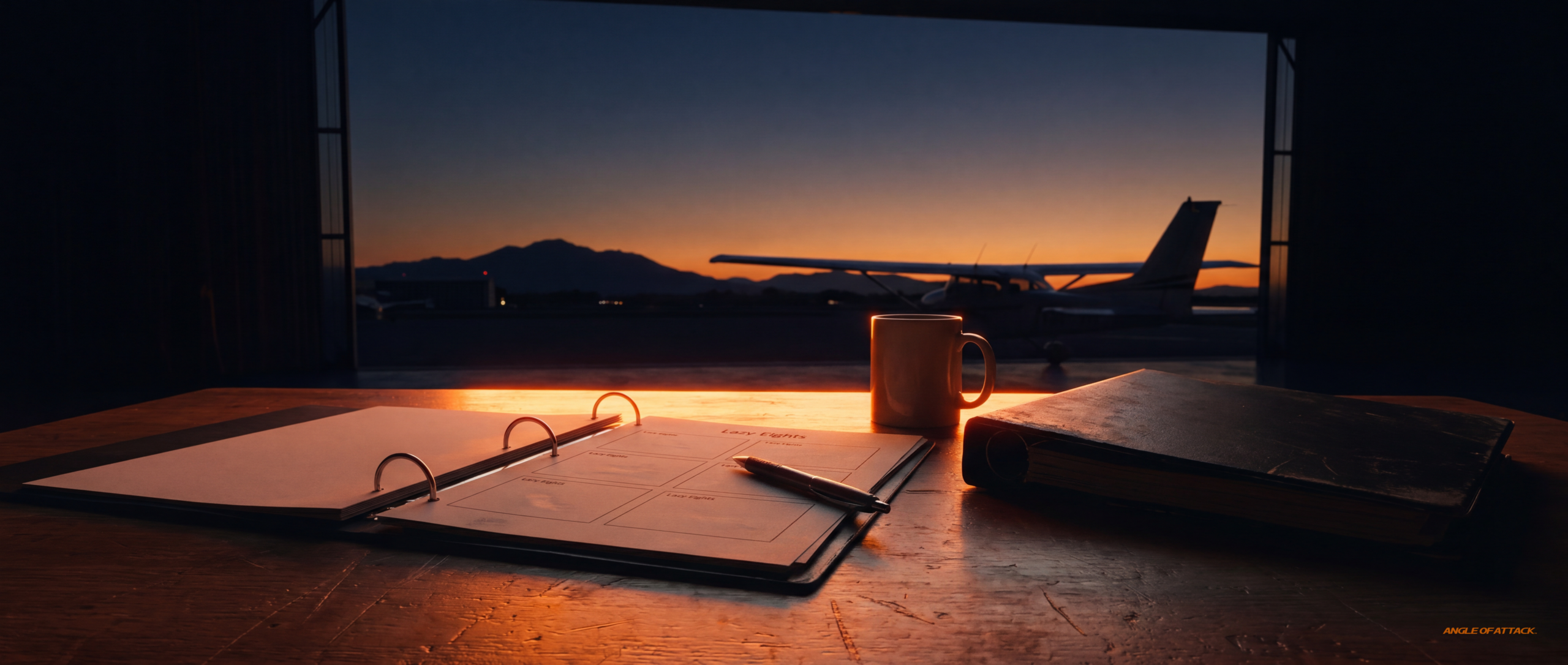
A lazy eight is a flight maneuver consisting of two 180° turns of alternating direction, executed with continuous, coordinated changes in pitch and bank, so the flight path traces a horizontal figure-eight in the sky. The “lazy” refers to the slow, smooth, deliberate pace, not the difficulty. Most students think the name means the maneuver is easy. It is not.
Required by the FAA’s Commercial Pilot ACS, Area of Operation V — Performance and Ground Reference Maneuvers, Task D, the lazy eight is the only maneuver in the ACS that tests energy management and coordination across a constantly changing combination of airspeeds and attitudes. The pilot trades kinetic energy (airspeed) for potential energy (altitude) and back, without power input. Cruise power is set before the entry and not touched until the maneuver is complete.
The procedure is documented in the Airplane Flying Handbook (FAA-H-8083-3C, October 2021), Chapter 10, Performance Maneuvers. Older AFH revisions carried this material in Chapter 9; if you find a CFI study source citing Chapter 9, check the date. The current chapter is 10.
What Does a Lazy Eight Actually Demonstrate?
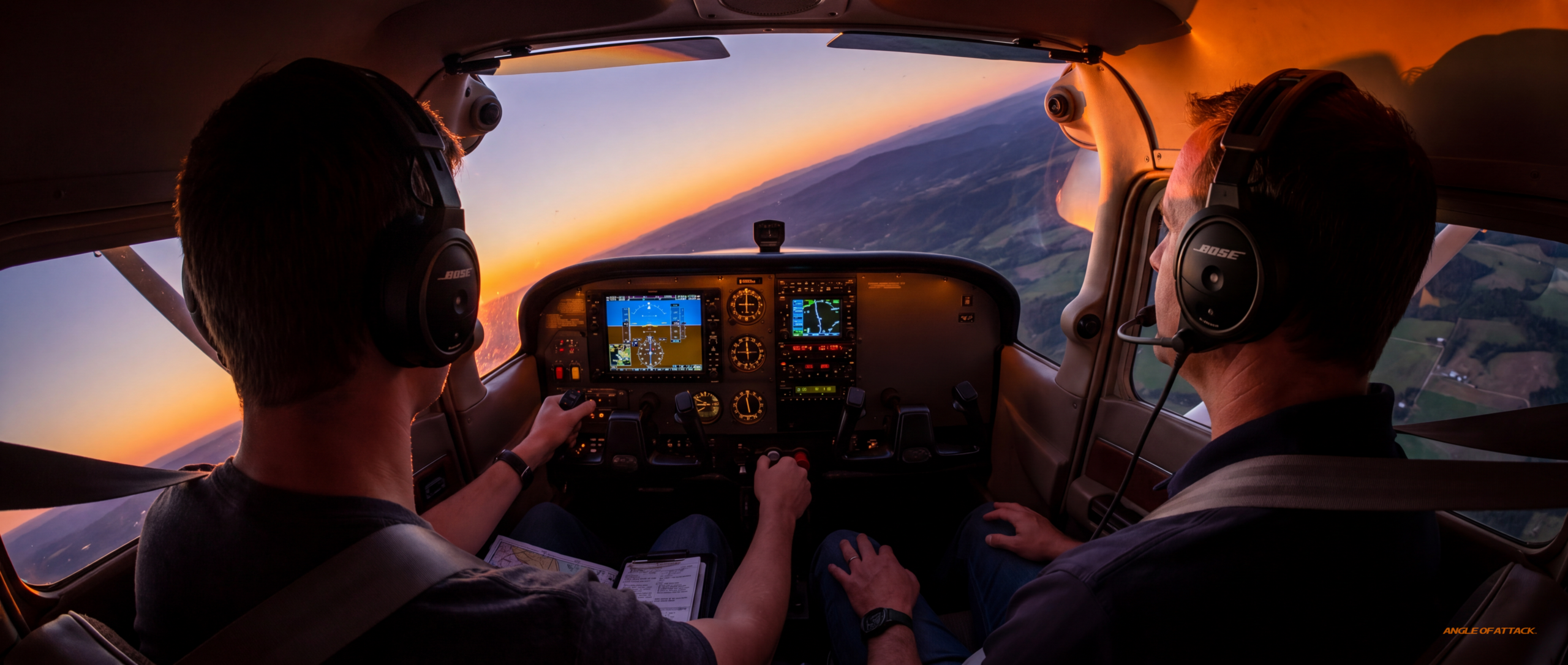
The lazy eight is the FAA’s deliberate test of three things at once: energy management, coordination, and division of attention. By the time a pilot is sitting in the commercial checkride, they should be able to feel the airplane through their feet and their hands as a single instrument. The lazy eight is where the FAA finds out whether they can.
Most CFI candidates I’ve worked with can recite that. Few have ever been taught it. They were taught the maneuvers that require coordination (slow flight, steep turns, ground reference), but no one ever sat them down and named coordination itself as the skill. The lazy eight is where you go back and teach the foundation. That’s the Restorative Airmanship piece of this maneuver. We don’t just check the box. We teach the feel.
There’s a story behind that. In about 2014, during my commercial training in California, my CFI took us up to a comfortable practice altitude and told me to close my eyes. He flew one lazy eight, narrating every control input, and asked me to feel the bank rate change with my hands on the yoke and the airplane through my seat. Then he had me fly one with my eyes open. The difference was night and day. I’d flown lazy eights for weeks before that flight, chasing the picture, chasing the numbers, never feeling the maneuver. Eyes closed, I felt it for the first time. Eyes open, I flew it. I open every lazy eight lesson with that exercise. It works because it strips out the only thing the student knows how to chase: the picture.
This is the thing your student will not know on the day of the first lesson. They have spent the entire commercial-pilot phase of their training being taught by the numbers. They have never been told that on the lazy eight, the numbers are the result, not the target.
Find the Simpleness — It’s a Coordinated Dance, Not a Checklist

The Aviation Instructor’s Handbook (FAA-H-8083-9B), Chapter 7, calls this Find the Simpleness, the discipline of reducing a complex task to its one operating principle. For the lazy eight, the principle is one sentence.
A lazy eight is a coordinated dance of changing pitch and bank, not a sequence of waypoints.
That’s the One Thing. Burn it in. Every other thing you say in the brief, the demo, and the debrief either reinforces that sentence or distracts from it.
The student who hears “15° at the 45, 30° at the 90” will fly a mechanical lazy eight. Bank in to 15, hold, bank in to 30, hold, bank out to 15, hold, roll level. Jerky. Uncoordinated. Off-heading. Off-altitude. Every time. The student who hears “let the bank rate rise smoothly with the pitch rate, peak together at the 90, fall together back through the 180” flies a beautiful one. Teach the feel. The numbers fall out of the feel.
This isn’t theoretical. A November 2025 article from Flight Training Central by a working DPE made the same point from the examiner’s seat: the most common error he sees is candidates doing the maneuver too quickly, rushing the roll-rate transition, arriving at the 45° reference point before max pitch-up is established, mechanizing the whole figure. Examiners feel it. The maneuver tests not just technical skill but “that elusive ‘feel’ for the aircraft.” Your job as the CFI is to teach the feel before the picture. The picture follows.
The Four Reference Points (45° / 90° / 135° / 180°)
The FAA calls the 45°, 90°, and 135° marks reference points. Not checkpoints. Not milestones. The terminology matters because it tells your student what those positions are for: visual cues to gauge the maneuver’s progress, not numerical targets to chase. Use the FAA word.
How each reference point breaks down on a coordinated lazy eight in a 172-class airplane is shown below. These are the results of a well-flown maneuver. Do not teach them as targets.
| Reference Point | Bank | Pitch | Airspeed | What the Pilot Is Doing |
|---|---|---|---|---|
| 45° | ~15° (still increasing) | Maximum nose-up | Decreasing through cruise | Smoothly rolling in while pitching up, the climbing entry |
| 90° | ~30° (maximum) | Level (pitch passes the horizon) | Minimum, 5–10 kt above stall | The apex. Max bank, min airspeed, level pitch. Quiet moment. |
| 135° | ~15° (decreasing) | Maximum nose-down | Increasing back toward cruise | Smoothly rolling out while pitching down, the descending exit |
| 180° | 0° (wings level) | Level | Back to entry airspeed | Back to entry altitude, heading, speed, straight into the opposing turn |
The maneuver continues immediately into the opposing 180° turn. There is no pause at the wings-level point. That’s why the figure-eight in the sky is continuous. The pilot who pauses at the 180° has flown two separate 180° turns. The pilot who flows directly into the opposing entry has flown a lazy eight.
The teaching insight you give your student in the brief: the pilot’s actual job is to smoothly increase bank rate from 0 to peak through the 90° apex, then smoothly decrease it back to 0 through the 180° exit, coordinated with a smoothly rising and falling pitch rate. The 45° and 135° reference points are visual cues the pilot uses to confirm the timing is right. They are not numerical targets.
What Are the ACS Standards for Lazy Eights?
The Commercial Pilot lazy eight task lives in FAA-S-ACS-7B Area of Operation V — Performance and Ground Reference Maneuvers, Task D — Lazy Eights. The CFI initial task lives in FAA-S-ACS-25 Area IX — Performance Maneuvers, Task D — Lazy Eights. The CFI applicant must demonstrate the maneuver from the right seat and teach it to commercial standards. The examiner role-plays as the student.
The full regulatory backbone is short: 14 CFR 61.127(b)(1)(v) requires performance maneuvers (which includes lazy eights) for the Commercial Pilot certificate; 14 CFR 61.183 requires the CFI candidate to demonstrate instructional proficiency on the same areas of operation they are certified to teach; the Private foundation lives at 14 CFR 61.107(b)(1) — the regulation that puts coordination, slow flight, and maneuvering on the same training ladder the commercial student climbs.
The verified tolerance picture is below. Numbers come direct from the current ACS revision.
| Parameter | Tolerance | Where Measured |
|---|---|---|
| Entry altitude | No lower than 1,500 ft AGL (or manufacturer recommendation, whichever is higher) | Throughout the maneuver |
| Entry airspeed | At or below maneuvering speed (Va) | Maneuver entry |
| Power | Set at cruise, NOT adjusted during the maneuver | Throughout |
| Bank angle at the 90° reference point | Approximately 30° (no hard tolerance, “approximately” is the FAA’s word) | 90° point |
| Altitude at each 180° point | ±100 ft from entry altitude | 180° points only |
| Airspeed at each 180° point | ±10 kt from entry airspeed | 180° points only |
| Heading at each 180° point | ±10° from entry heading | 180° points only |
| Coordination | Ball centered throughout | Every degree of the maneuver |
Two things in that table catch new CFIs off guard. First: the only point with a tolerance is the 180°. Many of the SERP articles on lazy eights imply the 45° and 135° reference points have tolerances. They do not. Those are visual cues, not measurement gates. Second: the bank at 90° is “approximately 30°.” There is no hard ceiling or floor. Most examiners accept 25° to 35° as long as the maneuver is symmetrical, coordinated, and exits within the ±100 / ±10 / ±10 box at the 180°. Flying it symmetrically and coordinated is the standard. The exact bank angle is not.
For a 172S at gross weight, Va is 105 KIAS. That’s your entry airspeed ceiling. You can enter slower. Many CFIs enter at 95 KIAS so the airplane has the energy to reach the apex but not so much that the descent runs the airspeed up against Va in turbulence on the way down. Pick your entry speed in the brief. Set cruise power. Hands off the throttle for the rest of the maneuver.
For broader Area V context on the commercial checkride, see the CFI checkride pillar guide.
How to Teach a Lazy Eight From the Right Seat
This is the SERP gap. Every other lazy eights article online tells the pilot what to do. None of them tell the CFI what to say. The four-phase patter table I use with every commercial-pilot-turned-CFI candidate is below.
| Teaching Phase | What the CFI Does | The Patter (Say This) |
|---|---|---|
| Pre-flight brief (at the FBO table) | Draw the rising-and-falling shape on a napkin or whiteboard. Use your hand to trace the climb–peak–descent–wings-level–climb–peak shape. | “Watch my hand. See how the bank rate rises with the pitch rate, then peaks together at the 90, then falls together back through the 180? That’s it. That’s the whole maneuver. The numbers (15° at 45, 30° at 90) happen to a coordinated pilot. We don’t aim at them; we let them happen.” |
| In-flight demo (right seat, you flying) | Narrate every control input. Don’t just fly it. Describe it as you fly. | “Watch the bank build slowly from level through the 45. I’m not snapping the bank in, I’m letting it build. Pitch is rising at the same rate. Now we’re approaching the 90. Bank’s peaked, pitch is leveling, airspeed is at minimum. Feel the airplane go quiet? That’s the apex. Now we let it all unwind together. Bank rolling out, nose coming down, airspeed building. Through the 180, wings level, right back to entry, and into the opposing turn.” |
| Student’s first attempt (you silent, hands off) | Let them fly it wrong. Don’t correct unless safety is at risk. The first attempt is data, not performance. | (Silent. Watch. Note where the student stiffens up, where they chase numbers, where they over-bank, where they dump pitch at the apex. Don’t speak until the maneuver completes.) |
| Debrief (back at altitude or on the ground) | Ask one question. Not many. One. | “Where did your eyes go? Walk me through the maneuver from the inside. What were you watching? Where were you ahead of the airplane, and where were you chasing it?” |
A couple of things to call out. The napkin brief is the part new CFIs skip because they want to save time and get to the airplane. Don’t. The napkin brief at the FBO table does more for the maneuver than the first three demonstrations. Once the shape is in the student’s head, the airplane will follow. I had a commercial student years back who couldn’t fly a clean lazy eight to save his life. He kept arriving at the 90° apex with the pitch already dumping forward. We left the airplane, sat at the FBO table, and I drew the rising-and-falling shape on a napkin. Five minutes. He flew the next one inside tolerances on the first attempt. The shape was missing. The drawing put it in.
The silent first attempt is the hardest part of the four phases. Every CFI instinct in your body will tell you to grab when the student over-banks at the 90° or dumps pitch at the apex. Calm as a skill — yours, first, before it’s theirs. Grab during a recovery the student would have flown and you’ve robbed the moment. The maneuver is safe. You’re at 1,500+ AGL with the airplane at minimum airspeed but coordinated. Let it play.
The one-question debrief is the most powerful tool in your right-seat kit. “Where did your eyes go?” gets the student to walk through the maneuver from the inside. You learn whether they were watching the airspeed indicator (number-chasing), the horizon (picture-flying), or feeling the airplane (where you want them). The fix is in their answer, not in your lecture.
The Most Common Student Errors on Lazy Eights

The Airplane Flying Handbook lists 13 common pilot errors for the lazy eight. The five that actually show up in your right seat are these.
-
Mechanizing the checkpoints. The student treats the 45°, 90°, and 135° marks as numerical targets (15°, 30°, 15° of bank) instead of as visual cues to confirm a smooth roll-rate transition. The fix is in the brief: name the One Thing before they touch the airplane. Bank rate, not bank angle.
-
Dumping back-pressure at the apex. As the airplane reaches the 90° point, the student feels the buffet-adjacent slow-flight sensation, panics, and releases back pressure. The nose pitches forward. The airplane breaks the apex flat-and-fast instead of quiet-and-slow. The fix: in the demo, narrate the quiet moment. “Feel the airplane go quiet? That’s the apex.” Make the apex a sensation, not a number.
-
Adding rudder reactively instead of proactively. Lazy eights are the only ACS maneuver where rudder pressure changes continuously across 360° of flight. Left rudder in the climbing entry, neutralizing through the wings-level 180°, right rudder in the descending exit, mirrored on the opposing turn. Students wait for the ball to drift, then add rudder. The ball stays drifted. The fix: teach the rudder into the maneuver, not as a correction. Lead with the feet.
-
Losing the 180° heading reference. The student picks a reference point on the horizon at the start, flies the maneuver, and forgets to verify they’re back to that reference at the 180°. The ±10° heading tolerance becomes a problem they didn’t see coming. The fix: in the brief, name a specific feature on the horizon (a road, a peak, a piece of weather) and have them call it out at every 180°.
-
Flying the maneuver too quickly. This is the DPE’s pet peeve, per the Nov 2025 Flight Training Central article, and the leading cause of “not symmetrical” feedback on the practical test. The student rushes the roll-rate transition and arrives at the 45° before max pitch-up is established. The maneuver loses its rising-and-falling shape and becomes two awkward turns. The fix: in the demo, exaggerate the slowness. Make the first demo deliberately slower than it needs to be. The student will speed up naturally; better to fight back from slow than chase down from fast.
I had a CFI candidate I prepped last year who illustrated the difference. He flew the maneuver inside altitude and speed tolerances every time (±50 ft, ±5 kt at the 180°). He kept the ball off-center the whole way around. The DPE issued a Notice of Disapproval for “coordination not demonstrated.” The fix wasn’t the numbers. He’d been chasing them and ignoring the feet. We re-briefed the maneuver around the ball: the ball is centered at the 90° apex or you don’t have a lazy eight. We re-flew it ten days later. Passed. The numbers were almost identical to the first ride. The ball was the difference.
Lazy Eight vs. Chandelle — What’s the Difference?
CFI candidates confuse these two more often than any other pair of commercial maneuvers. They live in the same area of the ACS, they both involve climbing turns, and both look “graceful” in a textbook diagram. They are not the same maneuver, and the FAA tests them for very different reasons.
| Lazy Eight | Chandelle | |
|---|---|---|
| Shape | Two 180° turns, alternating direction. Figure-eight in horizontal plane. | One 180° climbing turn, single direction. Ends wings-level at the 180°. |
| Power | Cruise, never adjusted | Cruise on entry, may increase to climb power |
| What it tests | Energy management, coordination, division of attention | Maximum performance climb, coordination |
| Apex | At the 90°: max bank, min airspeed, level pitch | At the 180°: wings level, just above stall, max altitude gain |
| Heading at exit | Returns to entry heading after each 180° | 180° from entry heading at completion |
AOPA’s Alicia Herron made the cleanest memory aid I’ve seen in her 2022 Flight Training piece “Pieces of Eight”: lazy eights are an “S-turn updated for commercial.” That framing helps the student keep the two maneuvers separate in their head.
For the full teaching breakdown on the sister maneuver, see How to Teach Chandelles. And for the third leg of the commercial maneuvers triad, the one that requires a fixed pivotal altitude and the most attention-division of all three, see How to Teach Eights on Pylons. The coordination foundation for all three is built in How to Teach Steep Turns. Most CFI candidates skip back to steep turns when their lazy eights aren’t clicking, and they should.
Where This Lives in TotalCFI
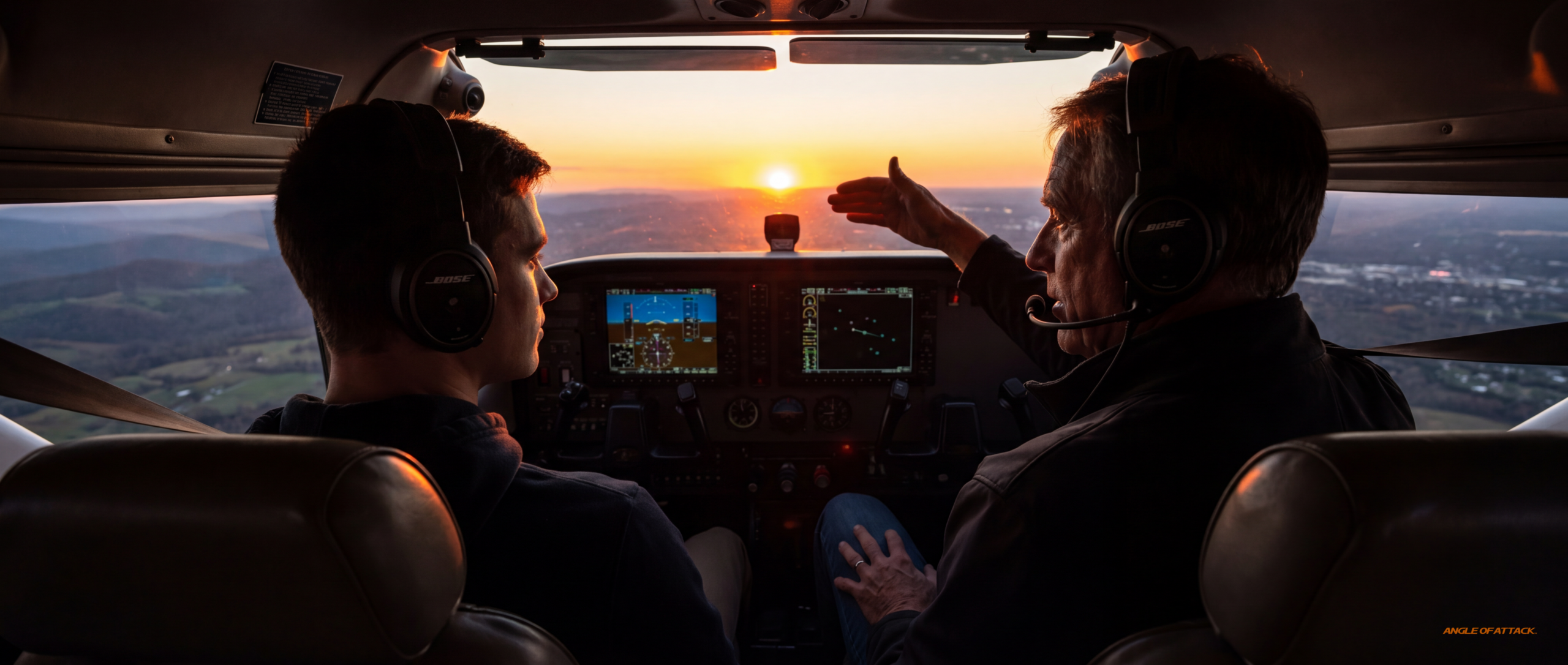
The right-seat patter, the napkin brief, the four-phase teaching sequence: these aren’t intuitions. They’re a framework you can apply to any commercial maneuver. In TotalCFI, the broader framework lives in Lesson 3.3 (Find the Simpleness) and Lesson 3.4 (Scenario-Based Training). Lazy eights are one of the three deep-dive case studies in 3.4 alongside chandelles and eights on pylons.
If you’re the kind of new CFI who wants the napkin brief, the demonstration patter, and the debrief script for every maneuver you’ll have to teach in your first six months, instead of building them from scratch every Sunday night before Monday’s lessons, that’s what TotalCFI is.
What is the purpose of a lazy eight?
The lazy eight tests energy management, coordination, and division of attention. It is the only Commercial Pilot ACS maneuver where the control pressures change continuously across the full flight path and never repeat. The FAA designed it to teach pilots to feel the airplane through their hands and feet as a single instrument, without using power to bail them out of energy mistakes.
What altitude do you fly lazy eights at?
No lower than 1,500 ft AGL or the manufacturer’s recommendation, whichever is higher. Most CFIs enter at 3,000 to 4,000 ft AGL: enough margin above the floor that altitude loss during a slow-recovery error doesn’t violate the floor. Entry altitude is also the reference altitude. The ±100 ft tolerance at each 180° is measured from entry altitude.
What are the ACS standards for lazy eights?
At each 180° reference point: altitude ±100 ft from entry, airspeed ±10 kt from entry, heading ±10° from entry. Bank at the 90° apex is approximately 30° (no hard tolerance). Coordination (ball centered) is required throughout. Entry at or below Va. Power set at cruise and not adjusted during the maneuver. The full task is FAA-S-ACS-7B Area V, Task D; the underlying regulation is 14 CFR 61.127(b)(1)(v).
Do you adjust power during a lazy eight?
No. Cruise power is set before entry and not touched until the maneuver is complete. This is what makes the lazy eight an energy management maneuver. The pilot trades airspeed for altitude and back without using the throttle as a crutch. If you find yourself wanting to add power to fix something, you’re flying the maneuver wrong, not flying it short on power.
Why are lazy eights so hard?
Because the control pressures change continuously and never repeat. There is no “hold this attitude for two seconds” beat in a lazy eight. Every quarter-second the pitch is changing, the bank is changing, the airspeed is changing, and the rudder pressure is changing. Most students arrive at the lazy eight from a training history where every maneuver had a steady-state element. The lazy eight has none. It is the maneuver that teaches the student to fly the airplane through transition, not equilibrium.
What are the most common errors on lazy eights?
Mechanizing the reference points (treating 45/90/135 as targets instead of visual cues), dumping back-pressure at the apex, reactive rudder instead of proactive rudder, losing the 180° heading reference, and flying the maneuver too quickly (rushing the roll-rate transition). The fixes all live in the brief: name the One Thing before the airplane.
What’s the difference between a lazy eight and a chandelle?
A lazy eight is two alternating 180° turns tracing a horizontal figure-eight, flown at cruise power without power adjustment, testing energy management. A chandelle is a single 180° climbing turn ending wings-level at maximum altitude gain, flown with optional power increase to climb power, testing maximum-performance climb. They live in the same area of the ACS but they’re testing different skills.
Be Day-One Ready as a CFI
TotalCFI is the only CFI course built around the idea that the checkride is just the FAA checking your work. You’re not training for a test. You’re training to teach. Every commercial maneuver, every right-seat patter, every brief script is engineered so that on the day your first commercial student walks up to the airplane, you are ready. That’s the Day-One Ready Guarantee.
If the CFI checkride is keeping you up at night, you're prepping for the wrong thing.
TotalCFI teaches you to walk into the oral as a teacher, not a test-taker — the reframe most candidates only figure out after they've already failed once.
What’s your patter for the lazy eight brief? How do you handle the student who chases the numbers? Drop a comment below. I read every one.