Imposter Syndrome as a New CFI: Why You Feel Like a Fraud (and How to Project Confidence Anyway)

If you’re a brand-new CFI between lessons wondering whether you actually belong in the right seat — that feeling is the most universal experience in flight instruction. And you’re not actually a fraud. You’re a new instructor. There’s a difference. The CFIs who learn to operate inside that difference, instead of faking their way out of it, are the ones who become great.
I’m Chris Palmer — two-time Master Aviation Educator (NAFI), Gold Seal CFI, founder of Angle of Attack. I’ve been in aviation education since 2006 and a CFI since 2017. My own first week with a CFI ticket is still recent enough that I remember exactly what your headset feels like right now.
- Imposter syndrome is functionally universal among new CFIs — peer-reviewed research estimates prevalence between 9% and 82% across professions, depending on the screening tool used, with consistent links to early-career stress and self-doubt (Bravata et al., 2019).
- The feeling is rational, not evidence you’re unqualified. The DPE already vouched for you under 14 CFR 61.183, and 14 CFR 61.193 defines exactly what you’re authorized to teach.
- New CFI confidence isn’t certainty — it’s the trained ability to be calm, present, and clear under pressure. Calm is a skill.
- Project confidence in your first 30 days: slow your voice 20%, over-prepare ground briefings, use your hands deliberately, pre-commit to the honesty answer, own the 2-minute debrief. (For the practical day-one logistics companion piece, see your first day as a CFI.)
- Working CFIs report nerves notably calming between two weeks and six months — with first-student-solo and first-student-checkride-pass as the inflection events.
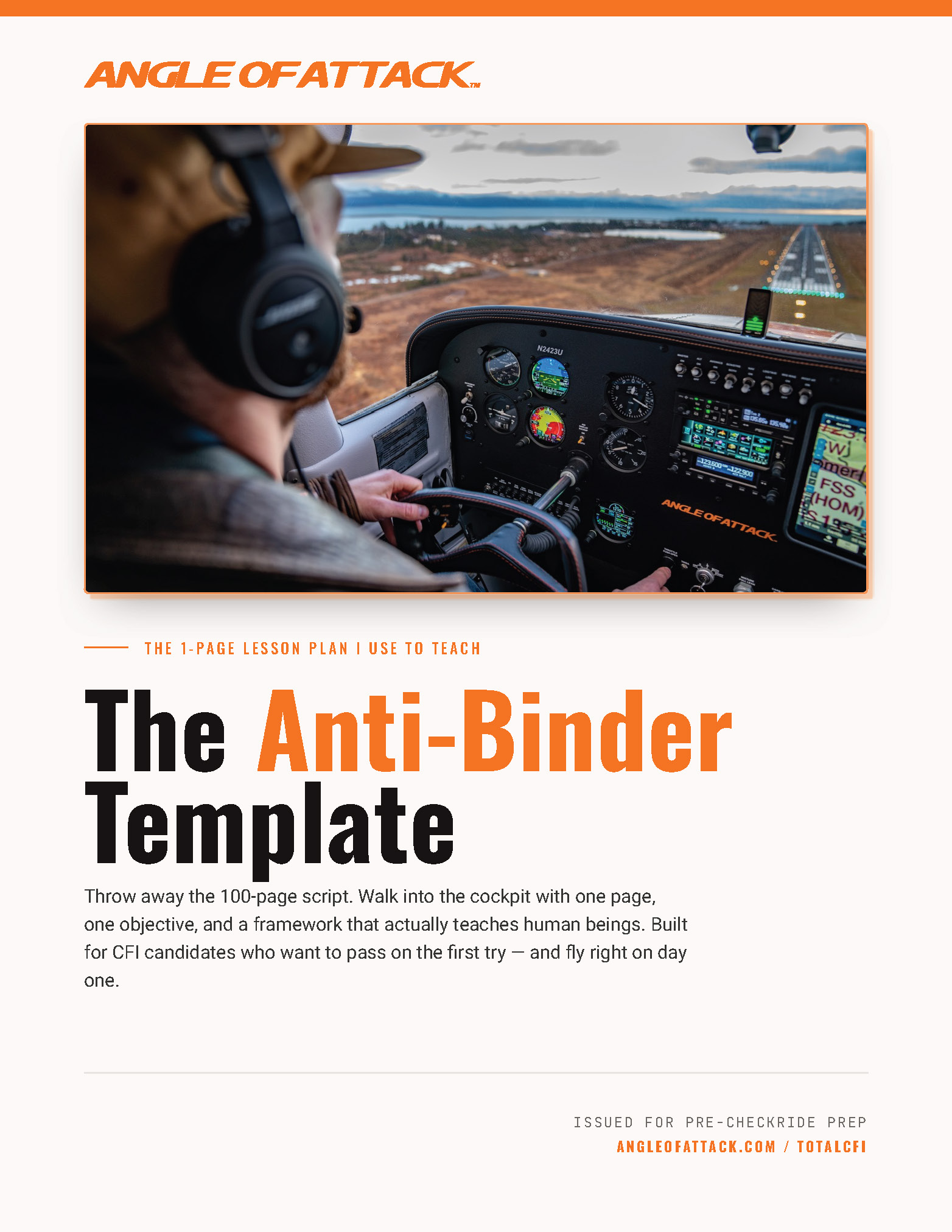
Walking into your first lesson with a 50-page binder won't help you.
Get my Anti-Binder One-Page Lesson Plan Template free — the lesson plan tool I built for CFI candidates who want to be ready Day 1.
Get the Anti-Binder Template Free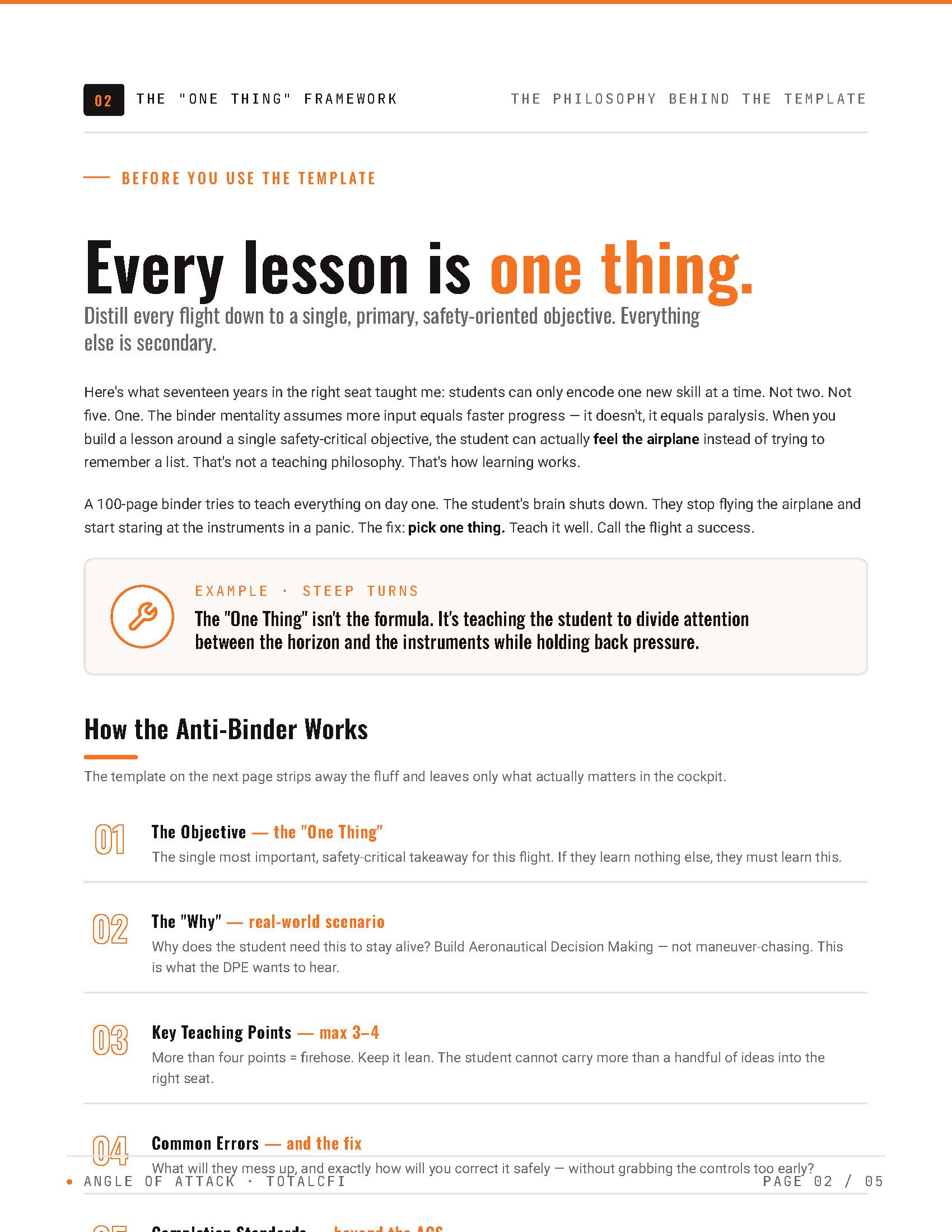
WHAT'S IN THIS GUIDE
- 1Is It Normal to Feel Like an Imposter as a New CFI?
- 2Why You Actually Aren’t a Fraud
- 3What Is Confidence, Really? (Calm as a Skill)
- 4Five Tactics to Project Confidence in Your First 30 Days
- 5What Should You Say When a Student Asks Something You Don’t Know?
- 6How Do You Handle a Student Who’s Older or More Experienced Than You?
- 7When Does CFI Confidence Actually Kick In?
- 8What’s the Biggest Confidence Mistake New CFIs Make?
- 9A Letter to the New CFI Reading This
- 10Frequently Asked Questions
Is It Normal to Feel Like an Imposter as a New CFI?

Yes — imposter syndrome is the most universal experience in new flight instruction. Peer-reviewed research estimates prevalence between 9% and 82% across professions depending on the screening method used (Bravata et al., 2019). For new CFIs in the first 90 days, the prevalence is functionally 100%. The feeling is evidence you’re paying attention, not evidence you’re unqualified.
The 1978 paper that named the experience — The Imposter Phenomenon in High Achieving Women by Pauline Rose Clance and Suzanne Imes — described it as the internal experience of intellectual phoniness in people who, by every external measure, are competent. The original PDF is still hosted on Dr. Clance’s site. Read the abstract. Tell me it doesn’t sound like the loop running in your head between lessons.
Here’s why the feeling is rational. You are new. Your students will discover things you haven’t seen yet. You haven’t encountered the rare engine roughness on a specific Cessna 172 at altitude, and your second student in two weeks might. That’s not a problem to fix. That’s a reality to work with.
Forget the shift from feel like an imposter to feel like a pro — that takes time you don’t have today. The shift you can make today is from feel like an imposter to act like a professional anyway. The acting comes first. The feeling catches up.
Why You Actually Aren’t a Fraud

A fraud lies about qualifications they don’t have. You’re a qualified, brand-new instructor.
14 CFR 61.183 lists what you had to prove before anyone handed you a CFI certificate. Commercial certificate. Instrument rating. Fundamentals of Instructing knowledge test. Flight instructor knowledge test. 15 hours of PIC in the category and class. A practical test where you demonstrated, in front of a Designated Pilot Examiner, the ability to teach. The DPE signed your temporary airman certificate. That’s the FAA vouching for you.
That’s the bar the FAA decided is required to teach. It exists for a reason, and you cleared it. And 14 CFR 61.193 defines what you are authorized to teach — including ground training for any pilot certificate and the practical-test endorsements your students need. The privileges are real. The certificate didn’t come with a footnote.
Your students will know more than you about specific things. The 60-year-old real estate broker in your right seat will know more about reading people and staying calm in high-stakes conversations than you will for a long time. That’s a Day-One reality, not a Day-One failure. He’s paying you to teach him to fly an airplane to a defined standard. That, you can do.
Here’s the framing that takes the weight off your shoulders: the CFI certificate is a license to learn. The certificate is the start of a new phase of your training, not the end. The year you become a CFI is the year you learn more than any year before it. Not because the certificate made you smart, but because teaching makes you a better pilot than flying alone ever did. Your students will be your teachers, too. That’s the design, not a flaw in the system. (If you’re at this article from the CFI candidate side — you haven’t taken the checkride yet — start with how to become a CFI.)
What Is Confidence, Really? (Calm as a Skill)

Here’s the reframe the rest of this article rests on.
Certainty is the opposite of confidence — and the opposite of useful. Certainty is arrogance. Certainty is the new CFI who thinks he knows enough. Certainty is the pilot who tells himself the weather will hold. Certainty is the precursor to most of the accident chains in the NTSB database.
Confidence is the trained ability to be calm, present, and clear under pressure. Not the absence of uncertainty — the presence of trained composure inside it. Your students are measuring whether you’re steady — whether your voice sounds the same when the wind shifts on final, whether your hand goes to the throttle at the right moment without your face changing. They’re not measuring certainty.
A hundred-year-old principle from experimental psychology explains the mechanism. The Yerkes-Dodson principle holds that performance climbs with arousal up to an optimum, then collapses — and for complex cognitive tasks, that optimum is lower than for simple ones. Instructing is complex: flying, teaching, watching for errors, managing a human, simultaneously. Your nerves on your first day are above optimum. The job is to train your arousal down to where your brain works best, not to feel nothing. That training is what we call calm as a skill.
The FAA already wrote the body-language manual. From the Aviation Instructor’s Handbook (FAA-H-8083-9B):
“The instructor should avoid erratic movements, distracting speech habits, and capricious changes in mood.”
Steady hands. Steady voice. Steady tone whether the maneuver went well or badly. You don’t have to feel unflustered. You have to behave unflustered — and the feeling, in time, follows the behavior. The moment you pull the power to idle for your student’s first power-off stall, your face is the lesson. The moment your hand drifts to the throttle on their first crosswind landing, your voice on the intercom is the lesson. Calm reads through a headset more clearly than words do.
If you want the framework I use to build a steady instructor identity, it’s Section 2 of TotalCFI. Lesson 2.4 — “Defining the Instructor You Want to Be” — is the lesson former students tell me changed their first year. Not because it gave them confidence, but because it gave them a clear picture of who they were becoming, and a way to act it out before they fully felt it.
Five Tactics to Project Confidence in Your First 30 Days

Confidence is a set of behaviors you practice until your nervous system catches up — not a feeling you summon.
1. Slow your voice down by 20%. Fast talk reads as nervous. Slow, paced speech reads as present. Pause after each sentence. Let silence do work. The same lesson takes the same time at a slower cadence because clarity reduces repetition. Direct application of avoid distracting speech habits from the Aviation Instructor’s Handbook.
2. Over-prepare every ground briefing. Knowledge becomes physical calm. Walk in knowing the maneuver, the why, the common errors, the ACS standard, and one good debrief question — before the student sits down. Your brain stops searching mid-sentence. Your hands stop wandering. The Anti-Binder lesson plan template is the one-page framework I built for exactly this. (For the deeper how-to on building your own lesson plans from scratch, see the CFI lesson plan template guide.)
3. Use your hands deliberately. Point at the chart. Point at the panel. Point at the airspeed indicator when you say Vy. Anchor every concept to a physical reference. The opposite is fidgeting — your student’s eyes will track every restless gesture. Deliberate gesture reads as authority. The active version of the FAA’s avoid erratic movements.
4. Pre-commit to the honesty answer. Before you ever stand in front of a student, script the response to “I don’t know” out loud, until it’s automatic. The full script is the next H2. The cascade of pretending starts with one made-up answer. Pre-scripting the honesty answer kills the cascade at step zero.
5. End every lesson with a 2-minute structured debrief. Same three questions, every flight. What did we set out to do? What worked? What’s one thing we’re carrying into the next lesson? Two minutes, structured, owned by you. The debrief is where teaching actually lands.
Pick one. Do it consistently for a week. Then add the next. You won’t feel different after Day One. You will by Day Twenty.
What Should You Say When a Student Asks Something You Don’t Know?

If you only remember one tactic from everything here, remember this one.
A student is going to ask you a question you don’t know the answer to. It’ll happen in your first week, on a Tuesday afternoon, and the question will be specific enough that you can’t bluff. For a half second, you’ll feel like the imposter feeling was right all along.
It wasn’t. This is the moment that defines whether you become a good instructor or a brittle one.
The wrong answer: “Oh, yeah — that’s because [makes something up].” That answer feels like it costs nothing. It costs you the room. Sometimes students sense it immediately. Sometimes they Google it on the drive home. Once they catch you, every previous answer is now suspect.
The right answer — script verbatim and rehearse until automatic:
“Great question. I want to give you the precise answer, not a guess. Let me look it up and bring you the answer before our next lesson.”
That sentence validates the question, tells the truth, and commits you to the follow-through.
The follow-through 90% of new CFIs skip: actually look it up. Bring the answer to the next lesson. Open with it: “Remember your question last time about [X]? Here’s the answer, and here’s where to find it in [FAR/POH/AIM].”
Do this once, the student knows you’re honest. Do it three times, they know you’re a professional. Pretending shortcuts trust. Honesty builds it. And the model you’re showing the student — I don’t know, so I’ll find out and bring it back — is the exact behavior you want them using for the rest of their flying career.
This is what we mean when we say professionalism is not a certificate — it’s behavior. The certificate doesn’t make you a professional. The way you answer a question you don’t know, on a Tuesday afternoon in your second week, with no one watching but the student in front of you — that’s what makes you a professional. Every time.
How Do You Handle a Student Who’s Older or More Experienced Than You?

You’ll sit in the right seat next to a student older than you, with more total time, or more business experience. This used to be a fear of mine in 2017. It isn’t anymore.
You’re there because you have a specific qualification the student doesn’t — the legal authority and training to teach them to fly to a defined standard. Not to prove you’re more experienced. Both of you carry value into that cockpit. Theirs is life experience. Yours is the bridge to the standard — the ACS, the FARs, the POH.
What NOT to do: peer up or power down. Peering up is over-collegial — telling jokes about regulations, soft-pedaling the standard because you don’t want to seem like you’re lecturing your dad. The student loses respect within three lessons. They didn’t hire a friend. Powering down is over-deferring — hedging every correction, asking the older student what they think the right answer is when you already know. You become apologetic. They feel it. They don’t trust you to keep them safe.
The mindset: I’m here to serve your training, not prove my qualifications. Lean on the structure. When you say “the ACS requires altitude within 100 feet,” you’re pointing at a document the FAA wrote, not asserting personal authority. The document doesn’t care how old either of you is.
The older or higher-time student is often the easiest, not the hard case you’re imagining. They’ve been competent at something else in their lives. They know what it takes to learn. They want a teacher, not a buddy.
When Does CFI Confidence Actually Kick In?

Across pilot-community forums where this question gets asked yearly — Pilots of America, AskaCFI, the relevant Reddit threads — working CFIs consistently report nerves notably calming somewhere between two weeks and six months. The first weeks are the rawest. By the three-month mark, the lesson sequence feels more familiar than novel. By six months, the feeling of being an imposter is usually quiet.
The inflection events matter more than the calendar. CFIs describe the same three moments as the ones that flipped the switch:
- First student to complete a stage check — the first proof that what you’re teaching is sticking.
- First student to solo — the day the certificate stops feeling theoretical.
- First student to pass a checkride as your recommended candidate — the loop closes.
Until those happen, fly on the structure, not the feeling. The lesson plan does the heavy lifting. The 2-minute debrief closes the loop. You don’t have to feel confident to act confident. Every CFI’s curve is different. Two-week-to-six-month is a window, not a deadline.
What’s the Biggest Confidence Mistake New CFIs Make?

Pretending.
Pretending to know what they don’t. Pretending to be more experienced than they are. Pretending to be unbothered when something startles them. Pretending to like the older student they’re intimidated by.
The cascade is predictable. Students sense the pretense. Trust degrades. Retention drops. The CFI feels more like a fraud, not less. Pretending was supposed to be the bridge to confidence. It turned out to be the moat.
The antidote: small, repeated acts of honesty paired with operational competence. Honesty without competence is a likable amateur. Competence without honesty is the brittle CFI in the prior paragraph. Together, they compound. You become the CFI who said I don’t know — let me find out three times in a student’s first month, then said here’s where to find that in the POH every time after. By month six, that student is recommending you.
Managing yourself as a new instructor is its own skill. Lesson 4.3 of TotalCFI, “Managing Students as People,” is built around exactly this — the honest CFI’s playbook for the first hundred lessons. Not motivational. Operational.
A Letter to the New CFI Reading This

If you’re still reading this far down — here’s the part that isn’t in any handbook.
You’re going to be okay. The fact that you’re sitting somewhere on a Tuesday night, between lessons, reading an article about imposter syndrome, means you’re exactly the kind of person who becomes a good instructor. The CFIs I trust with the people I love are the ones who feel it, name it, and keep showing up anyway. The ones who never feel like imposters? I don’t send my son to them.
Your students are measuring whether you care, not whether you’re confident. Care visibly. Show up early. Be honest when you don’t know. Bring the answer back. Slow your voice down. Ask one good question at the end of every lesson. The rest builds itself.
In ten years you’ll have a student in your right seat — a fresh-minted CFI of his own — and he’ll ask whether the feeling ever goes away. You’ll tell him the truth: the feeling fades, but the seriousness of what you’re doing never does. The fade is mercy. The seriousness is the job.
You earned the certificate. Now earn the trust. One lesson at a time, one honest answer at a time, one steady debrief at a time. The students you’ll teach are lucky to have a CFI who reads articles like this one.
Welcome to the right seat.
Frequently Asked Questions
Is it normal to feel scared as a new CFI?
Yes. Functionally every new CFI reports it in the first 90 days. The goal is to train calm as a skill, the trained ability to be present, clear, and steady inside the fear. Feeling no fear isn't the goal.
How do you not look nervous in front of a student?
Slow your voice down about 20%. Use your hands deliberately rather than fidgeting. Pre-commit to the honest "I don't know — let me look it up" answer so you never freeze. The Aviation Instructor's Handbook (FAA-H-8083-9B) calls these avoid distracting speech habits and avoid erratic movements.
Why do new CFIs feel like imposters?
Because the feeling is the rational response to being new. Imposter feelings reported in 9–82% of people across professions depending on screening tool (Bravata et al., 2019); functionally universal in the first 90 days of CFI work. The feeling is data, not a defect.
What should I say when a student asks me something I don't know?
"Great question. I want to give you the precise answer, not a guess. Let me look it up and bring you the answer before our next lesson." Then actually do it. Cite the source — FAR, POH, AC, or AIM — at the next lesson.
When does CFI confidence kick in?
New CFI confidence typically arrives between two weeks and six months — the pattern across pilot-community forums. Inflection events: first-student-stage-check, first-student-solo, first-student-checkride-pass as the recommending instructor.
What's the biggest mistake new CFIs make?
Pretending. The antidote is small, repeated acts of honesty paired with operational competence.
If the CFI checkride is keeping you up at night, you're prepping for the wrong thing.
TotalCFI teaches you to walk into the oral as a teacher, not a test-taker — the reframe most candidates only figure out after they've already failed once.

Yes. Functionally every new CFI reports it in the first 90 days. The goal is to train calm as a skill, the trained ability to be present, clear, and steady inside the fear. Feeling no fear isn’t the goal.