
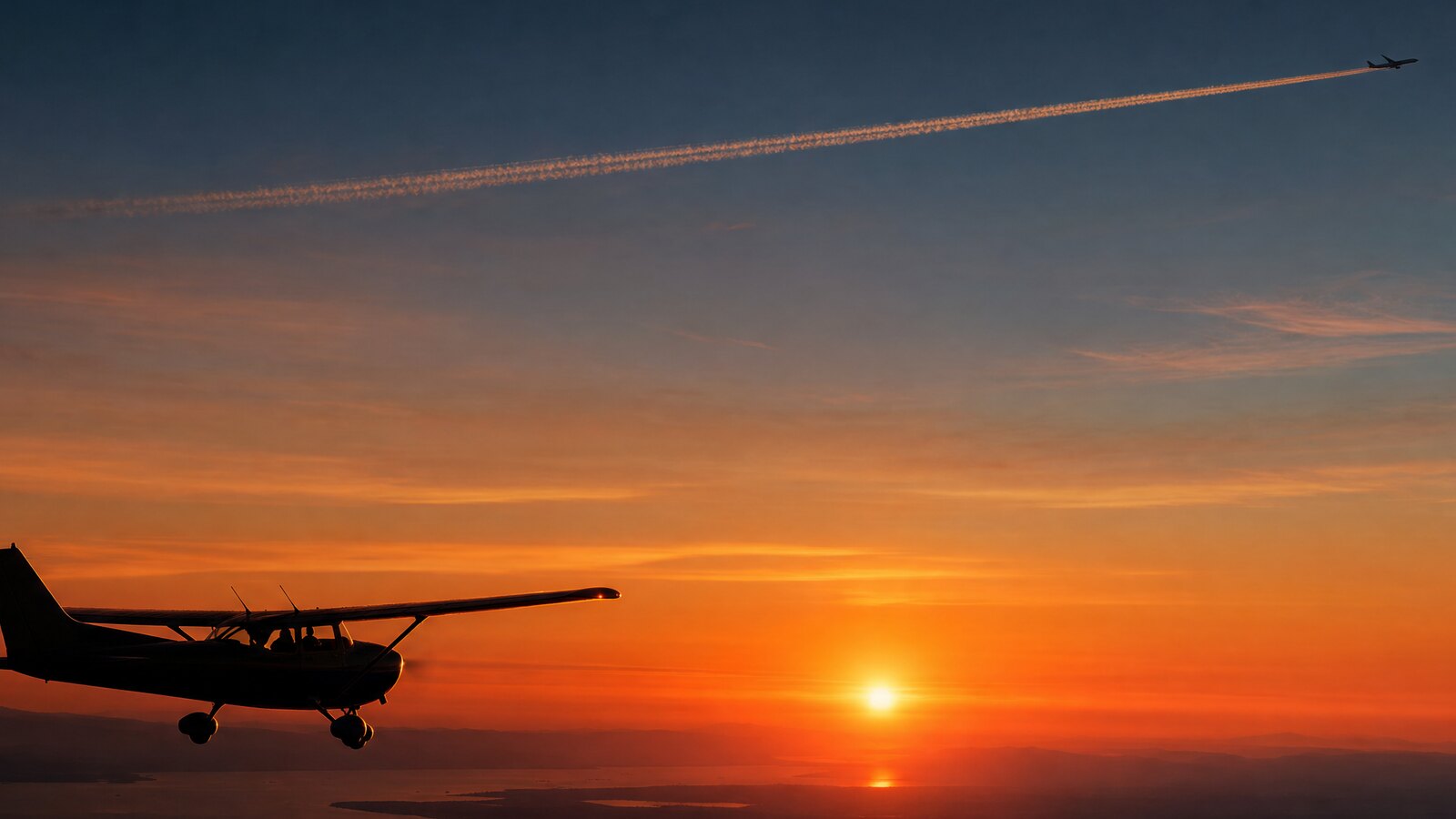
How Fast Do Airplanes Fly? Speeds by Aircraft Category Explained
Most airplanes cruise somewhere between 100 and 575 mph depending on their category: small training planes like the Cessna 172 fly around 120–140 mph, regional turboprops 300–400 mph, and jet airliners 500–575 mph at cruise. Speed climbs with altitude, engine type, and design — but every airplane is bound by the same physics you’ll learn as a student pilot.
That range surprises a lot of people. “Airplane” covers everything from a two-seat trainer puttering along at the speed of a fast car to a Boeing 787 covering nearly ten miles a minute. So let’s break it down by category, then unpack the part that actually matters for your checkride and your day-one flying: why those numbers are what they are, and which “speed” you’re even talking about.
- Speed depends on category. A Cessna 172 cruises near 120–140 mph; a 737 cruises near 500–575 mph. There is no single “airplane speed.”
- Four speeds, not one. Pilots track indicated airspeed (IAS), true airspeed (TAS), ground speed (GS), and — for jets — Mach number. They’re rarely the same value.
- Altitude buys speed. Thinner air at altitude means your true airspeed runs higher than the number on your airspeed indicator.
- Wind changes your real-world speed. Ground speed equals true airspeed adjusted for headwind or tailwind — it’s what determines your arrival time.
- Drag is the ceiling. Airplanes don’t fly faster mostly because drag rises with the square of speed, so doubling speed roughly quadruples the power needed to push through the air.
- The fastest aircraft on record is the retired Lockheed SR-71 Blackbird at over Mach 3; the fastest civil airliner ever flown was the Concorde at about Mach 2.04.
WHAT’S IN THIS GUIDE
- 1How Fast Does a Small General Aviation Airplane Fly?
- 2How Fast Does a Commercial Jet Airliner Fly?
- 3How Fast Does a Military Fighter Jet Fly?
- 4What Is the Difference Between IAS, TAS, Ground Speed, and Mach?
- 5Why Don’t Airplanes Just Fly Faster?
- 6Does Wind Change How Fast an Airplane Flies?
- 7A Cessna 172 Over Kachemak Bay: What 120 MPH Actually Feels Like
- 8Airplane Speeds by Category: Comparison Table
- 9PLT Study Guide
- 10Frequently Asked Questions
How Fast Does a Small General Aviation Airplane Fly?
Most small general aviation airplanes cruise between roughly 100 and 200 mph. A Cessna 172 — the most common trainer in the world — cruises around 120–140 mph (about 105–122 knots true airspeed). A Cirrus SR22 or a Beechcraft Bonanza runs faster, near 180–205 mph. These are the airplanes you’ll actually learn in, and their speeds feel approachable.
Here’s a number that grounds the whole conversation: in cruise, a Cessna 172 moves at about the pace of a car on a highway — just with a much better view. That’s deliberate. Trainers are built to be slow enough to be forgiving and fast enough to go somewhere.
Note that pilots almost always talk in knots, not mph. One knot equals about 1.15 mph, so when your instructor says “we’re indicating 110,” that’s roughly 127 mph. We’ll use both units here, but get comfortable with knots — it’s the language of the cockpit and the FAA written exam.
How Fast Does a Commercial Jet Airliner Fly?
Commercial jet airliners cruise around 500–575 mph (roughly Mach 0.78–0.85) at altitudes near 35,000 feet. A Boeing 737 or Airbus A320 cruises near 500–520 mph; a Boeing 787 or 777 pushes closer to 560–575 mph. They fly that high precisely because the thin air cuts drag, which lets them go fast on far less fuel — and it puts them above most of the weather.
Airliners measure cruise speed as a Mach number — a fraction of the speed of sound — once they’re up high. The speed of sound itself drops as the air gets colder with altitude, so a fixed Mach number is a cleaner way to keep the airplane safely below its aerodynamic limit (the onset of high-speed buffet near the sound barrier) than a single mph figure.
Takeoff and landing are far slower. A loaded 737 rotates off the runway around 150–170 mph and crosses the threshold to land near 140–160 mph. The huge gap between that and cruise speed is exactly why airliners carry such elaborate flaps and slats — devices that reshape the wing to fly slow when they need to.
How Fast Does a Military Fighter Jet Fly?
Most modern military fighter jets can exceed the speed of sound — roughly Mach 1.6 to Mach 2.5, which is about 1,200 to 1,900 mph at altitude. The F-15 Eagle and the F-22 Raptor both top out above Mach 2 (over 1,500 mph). These speeds are possible because of afterburning turbofan engines and airframes designed to survive supersonic shock waves.
Fighters rarely fly that fast for long. Going supersonic burns fuel at a brutal rate, so top speed is a combat capability, not a cruise setting. Most missions are flown at high subsonic speeds for range and endurance, with the afterburner saved for when it’s actually needed.
As a student pilot, you’ll never operate in this regime — but the spread is worth understanding. The same four forces (lift, weight, thrust, drag) govern an F-22 and your Cessna. The fighter just has a wildly different balance of thrust and drag to play with.
What Is the Difference Between IAS, TAS, Ground Speed, and Mach?
Pilots track four different “speeds” because each answers a different question. Indicated airspeed (IAS) is what your airspeed indicator reads — it’s a measure of dynamic air pressure on the airframe, and it tells you whether you’re about to stall or overspeed. True airspeed (TAS) is how fast you’re actually moving through the air mass, which runs higher than IAS as you climb into thinner air. Ground speed (GS) is TAS adjusted for wind — your real speed over the dirt. Mach number expresses speed as a fraction of the local speed of sound, which matters most near the sound barrier.
A rough rule of thumb: true airspeed increases roughly 2% above indicated airspeed for every 1,000 feet of altitude. So at 10,000 feet, an indicated 110 knots is closer to 132 knots true. That’s not a precise figure for every airplane — your Pilot’s Operating Handbook and an E6B flight computer give you the real number — but it captures the relationship.
This is one of the most-tested concepts on the FAA Private Pilot knowledge exam, and it trips up beginners constantly. Per the Pilot’s Handbook of Aeronautical Knowledge (PHAK, FAA-H-8083-25C, Chapter 8), the airspeed indicator works by comparing pitot (ram air) pressure to static pressure — which is exactly why it reads lower than your true speed as the air thins out.
The takeaway: the number on your gauge keeps you safe; the number you compute keeps you on schedule. You need both.
Why Don’t Airplanes Just Fly Faster?
Airplanes don’t fly faster mainly because drag rises with the square of airspeed. Double your speed and you roughly quadruple the aerodynamic drag, which means you need about four times the power to overcome it. At some point the engine simply can’t produce enough thrust to push through any faster — that’s the airplane’s maximum level-flight speed.
For jets there’s a second wall. As an airplane approaches the speed of sound, shock waves form over the wing and drag spikes dramatically — the “transonic drag rise.” Pushing past it takes a specially designed airframe and a lot of thrust, which is why airliners cruise comfortably below Mach 0.85 and leave Mach 1+ to the fighters.
There’s also a cost question. Flying faster burns far more fuel per mile, so airliners cruise where they do because it’s the sweet spot between speed and efficiency. Physics sets the ceiling; economics sets the cruise.
Does Wind Change How Fast an Airplane Flies?
Wind doesn’t change how fast an airplane moves through the air, but it absolutely changes how fast it moves over the ground — and ground speed is what sets your arrival time. A 30-knot headwind subtracts 30 knots from your true airspeed to give your ground speed; a 30-knot tailwind adds 30. Your airspeed indicator doesn’t budge, but your trip gets longer or shorter.
This is why the same flight can take noticeably different times in each direction. Flying west into the prevailing winds is routinely slower than flying east with them — sometimes by a meaningful margin on a long leg.
For flight planning, pilots compute ground speed using an E6B or an app, factoring in wind direction and speed aloft. Per the FAA, this calculation — time, speed, distance, and wind — is a core navigation skill you’ll demonstrate on your checkride and use on every cross-country flight.
If you’ve decided this is the year you actually start flying, the cleanest way in is our free Total Student Pilot course — it walks you through these exact concepts before your first lesson, then the Private Pilot Ground School takes you all the way to checkride-ready and day-one ready.
A Cessna 172 Over Kachemak Bay: What 120 MPH Actually Feels Like
Here’s something I tell every student who’s fixated on speed: it feels completely different than you expect. The first time I took a brand-new student up over Kachemak Bay here in Homer, she watched the airspeed indicator settle around 110 knots and said, “That’s it? That doesn’t feel fast at all.” And she was right — at altitude, with no fence posts whipping by, 120 mph feels calm. Almost slow.
Then we descended for a low pass along the spit, and suddenly the water and the gravel were close enough to give us a reference. Same airspeed. Completely different sensation. She got quiet, then laughed — now it felt fast. That’s the whole lesson about speed perception in one flight: your eyes lie to you based on how close the ground is, but the airspeed indicator never does.
I’ve been at this a long time — in aviation education since 2006, a CFI since 2017 — and the students who internalize that early become the calmest, most precise pilots. They learn to trust the instrument over the seat of their pants when it counts. Speed isn’t a feeling. It’s a number on a gauge that means something specific, and your job is to know which number you’re reading and why.
Airplane Speeds by Category: Comparison Table
The numbers below are typical cruise figures. Real values vary by model, weight, altitude, and configuration — always defer to the specific aircraft’s Pilot’s Operating Handbook.
| Aircraft / Category | Typical Cruise Speed (mph) | Typical Cruise Speed (knots) | Approx. Mach |
|---|---|---|---|
| Cessna 172 (trainer) | 120–140 | 105–122 | ~0.18 |
| Cirrus SR22 (high-perf. single) | 180–205 | 156–178 | ~0.27 |
| King Air 350 (turboprop) | 310–360 | 270–312 | ~0.48 |
| Cessna Citation (light jet) | 400–460 | 350–400 | ~0.60 |
| Boeing 737 / Airbus A320 | 500–520 | 435–452 | ~0.78 |
| Boeing 787 / 777 | 560–575 | 487–500 | ~0.85 |
| F-22 Raptor (fighter, max) | 1,500+ | 1,300+ | 2.0+ |
| Concorde (retired airliner) | 1,350 | 1,175 | 2.04 |
| SR-71 Blackbird (retired) | 2,200+ | 1,910+ | 3.2+ |
Notice the pattern: as you move down the list, the airplanes get more powerful, fly higher, and burn through the air with very different design philosophies. But the trainer at the top is where every one of those pilots started.
PLT Study Guide
These are the FAA Learning Statement (PLT) codes tied to the speed concepts in this article. If you miss a knowledge-test question in one of these areas, the code on your test report points you straight back to the topic to review.
| PLT Code | Official FAA Learning Statement | What to study |
|---|---|---|
| PLT123 | Recall aircraft performance – airspeed | How airspeed varies with altitude, weight, and configuration; why cruise speed differs by aircraft category. |
| PLT132 | Recall aircraft performance – instrument markings / airspeed / definitions / indications | The airspeed indicator color arcs (white, green, yellow, red line) and the V-speeds they mark; how to read what the gauge is telling you. |
| PLT032 | Define MACH speed regimes | What Mach number means, subsonic vs. transonic vs. supersonic, and why high-altitude jets manage speed in Mach rather than mph. |
| PLT012 | Calculate aircraft performance – time / speed / distance / course / fuel / wind | How to compute ground speed from true airspeed and wind, then turn it into trip time and fuel burn — core E6B navigation. |
Study these against the Pilot’s Handbook of Aeronautical Knowledge (PHAK, FAA-H-8083-25C), Chapters 8 (Flight Instruments) and 11 (Aircraft Performance). Don’t just memorize numbers — understand the relationships, because that’s what makes you a thinking pilot instead of a test-taker.
Frequently Asked Questions
How fast does a Cessna 172 fly?
A Cessna 172 cruises around 120–140 mph (about 105–122 knots true airspeed) at a typical cruise altitude. Its maximum structural cruising speed is higher, but pilots normally cruise at a power setting that balances speed, fuel burn, and engine wear rather than flying flat-out.
How fast does a Boeing 737 fly?
A Boeing 737 cruises around 500–520 mph, which is roughly Mach 0.78 at a cruise altitude near 35,000 feet. It rotates off the runway near 150–170 mph and lands around 140–160 mph, using flaps and slats to fly safely at those much slower speeds.
What is the fastest commercial airplane ever?
The fastest civil airliner ever flown in service was the Concorde, which cruised at about Mach 2.04 — roughly 1,350 mph. It was retired in 2003. Today’s subsonic airliners cruise far slower, near Mach 0.85, because supersonic flight is enormously expensive and fuel-hungry.
What is the difference between airspeed and ground speed?
Airspeed is how fast the airplane moves through the air; ground speed is how fast it moves over the ground. The difference is wind. A headwind makes ground speed lower than true airspeed; a tailwind makes it higher. Ground speed, not airspeed, determines your arrival time.
Why do airplanes fly so high?
Airplanes — especially jets — fly high because the air is thinner up there, which reduces drag and lets them fly fast efficiently. Thin air also means smoother rides above most weather and turbulence. Jet engines run more efficiently in the cold, thin air at cruise altitude too.
Is mph or knots used for airplane speed?
Pilots almost always use knots (nautical miles per hour) rather than mph. One knot equals about 1.15 mph. Knots tie cleanly to latitude and nautical charts, which is why the FAA, air traffic control, and aircraft instruments all standardize on them. Get comfortable thinking in knots early.
Why don’t airplanes fly faster than they do?
Drag rises with the square of airspeed, so going faster takes disproportionately more power and fuel. Jets also hit a “transonic drag rise” near the speed of sound. Airliners cruise just below that wall because it’s the efficient sweet spot — physics sets the ceiling and economics sets the cruise.
How fast does a small plane go for takeoff?
A small trainer like a Cessna 172 typically lifts off around 55–65 knots (roughly 65–75 mph), depending on weight and configuration. The exact rotation and liftoff speeds come from the aircraft’s Pilot’s Operating Handbook, which every pilot references before flight.
Speed is one of the first things that hooks people on aviation, but the deeper you go, the more you realize it’s a small part of a much bigger picture — energy management, decision-making, and judgment are what actually make a pilot. The good news: none of it is out of reach. It starts with a few gauges and the physics behind them, and it builds from there, one flight at a time.
Master every system on your checkride — and on day one.
The Private Pilot Ground School breaks down every FAA subject area in the same plain-English, real-world way you just read — with quizzes, scenarios, and the explanations that finally make it click.
If you’re standing at the start of that journey, that’s exactly where I love meeting people. Get the fundamentals right, learn to trust your instruments, and the rest follows.


ON THE SAME TOPIC
How High Can a Plane Fly? Altitude Limits From Cessnas to Jets
How High Can a Plane Fly? Altitude Limits From Cessnas to Jets 17 min read Last updated June 2026 · Chris Palmer How high a plane can fly depends on the airplane: a typical Cessna 172 tops out near 13,000–14,000 feet, jet airliners cruise at 35,000–42,000 feet, and the highest a civil jet is certified […]
 Read more
How Does a Magnetic Compass Work? Errors Every Pilot Must Know
How Does a Magnetic Compass Work? Errors Every Pilot Must Know 16 min read Last updated June 2026 · Chris Palmer A magnetic compass works by suspending a magnetized float in fluid so it freely aligns with Earth’s magnetic field, pointing the magnets toward magnetic north. A painted card on that float shows your heading […]
Read more 
How Does a Four-Stroke Aircraft Engine Work? The Four Strokes That Turn Your Propeller
How Does a Four-Stroke Aircraft Engine Work? The Four Strokes That Turn Your Propeller 16 min read Last updated June 2026 · Chris Palmer A four-stroke aircraft engine turns fuel into propeller thrust through four repeating piston strokes — intake, compression, power, and exhaust. Each piston draws in a fuel-air mixture, compresses it, ignites it […]
Read more 
How to Recover From a Spin: The PARE Procedure Every Pilot Must Know Cold
How to Recover From a Spin: The PARE Procedure Every Pilot Must Know Cold 31 min read Last updated June 2026 · Chris Palmer To recover from a spin, use the PARE procedure: pull the Power to idle, neutralize the Ailerons, apply full opposite Rudder against the rotation, then briskly move the Elevator forward to […]
Read more 
Stay Connected
Be the very first to get notified when we publish new flying videos, free lessons, and special offers on our courses.
