How to Teach a Student Pilot to Talk to ATC (And Why Most CFIs Get This Wrong)
Radio communications with ATC and other pilots use a simple four-part structure: Who you are, Where you are, What you Want, and Whither you’re going. Every call from ground taxi to final approach fills in those four blanks. Learning the structure beats memorizing phrases. Use AIM 4-2 phraseology for the words. Use Who-Where-Want-Whither for the shape. ATC is working with you, not grading you.
- Every ATC call collapses to four pieces: Who you are, Where you are, What you Want, Whither you’re going. Once a student knows the structure, they can fill in the blanks for any situation, at any frequency, in any airspace.
- The fear of the radio is muscle memory, not vocabulary. Most CFIs teach phraseology when they should teach structure, and the student leaves the lesson with a list of phrases instead of a frame.
- AIM 4-2 Radio Communications Phraseology and Techniques is the canonical phraseology source. AIM 4-1-9 plus AC 90-66B govern non-towered (CTAF) procedures. Read both before you teach your first radio comms lesson.
- The teaching sequence that defeats mic fright is five steps: fear reframe, ground drill, LiveATC.net listen-along, listen-only flight, supervised calls, solo calls. Skip any step and the student’s first attempt is in the pattern. That’s where the freeze lives.
- The magic phrases (Standby, Say again, Unable, Verify, Speak slower, With you, Student pilot) are not optional polish. They’re the safety net every student should walk into the airplane already knowing.
The CFI Toolkit Every New Instructor Wishes They Had on Day One
Most new CFIs build their teaching system from scratch: a binder of borrowed lesson plans, scattered notes, and PDFs of every ACS the FAA’s ever published. The Anti-Binder Template is the one-page lesson framework I use to plan every lesson, including the radio comms block. Same scenario-first shape. Same Day-One focus.
Grab the Anti-Binder Template — Free →
Walking into your first lesson with a 50-page binder won't help you.
Get my Anti-Binder One-Page Lesson Plan Template free — the lesson plan tool I built for CFI candidates who want to be ready Day 1.
Get the Anti-Binder Template Free
WHAT'S IN THIS GUIDE
- 1Why Students Are Scared of the Radio (And Why Most CFIs Don’t Help)
- 2The W-W-W-W Structure (The Framework That Replaces Memorization)
- 3What’s the Difference Between CTAF and ATC?
- 4The One-Page Radio Comms Lesson Plan (Six Boxes Applied)
- 5How to Teach Radio Communications (The Five-Step Sequence)
- 6What Do You Say on the Radio? Sample Calls From Taxi to Touchdown
- 7What If You Make a Mistake on the Radio?
- 8What If Your Radio Actually Fails? (Lost Comms in Plain English)
- 9The Five Most Common Radio Communication Errors
- 10Frequently Asked Questions
Why Students Are Scared of the Radio (And Why Most CFIs Don’t Help)
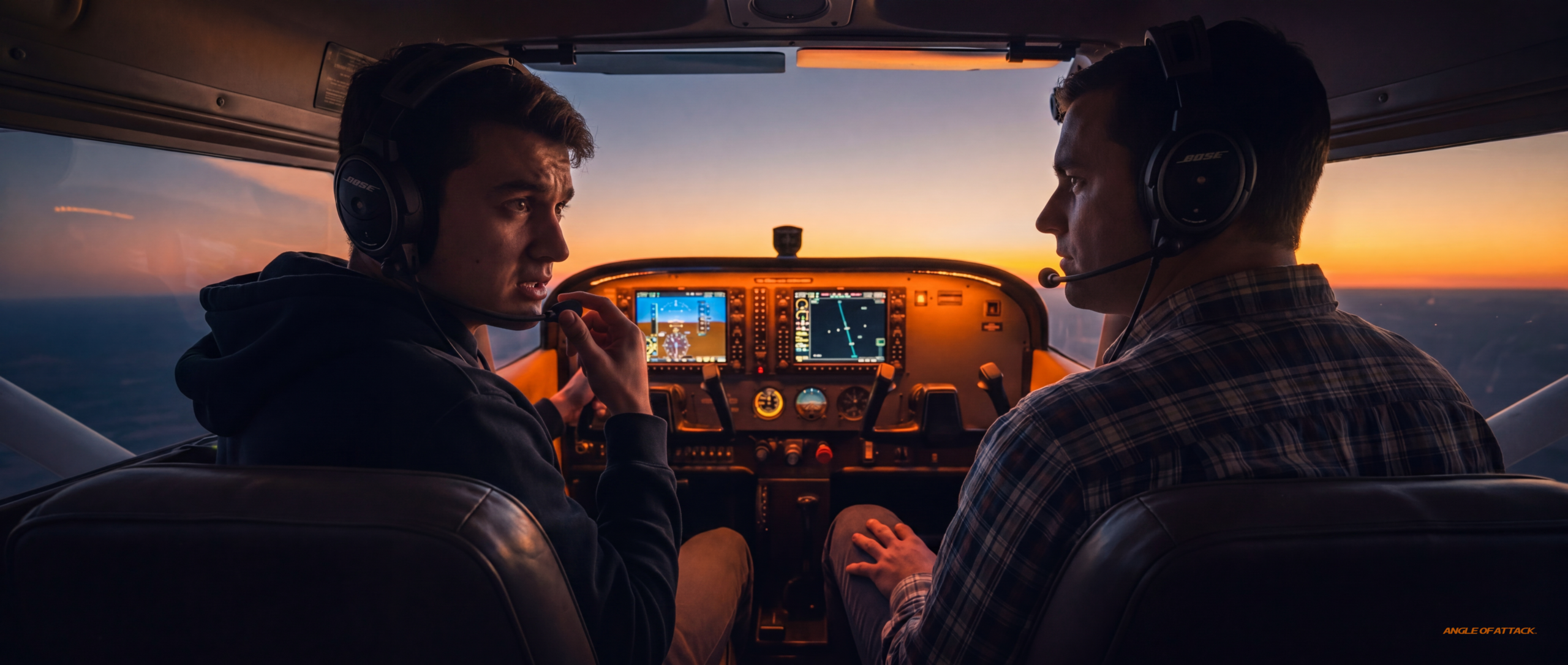
Almost every student pilot is terrified of the radio. They’ve been told ATC communicates in some kind of code, and that one wrong word will get them yelled at, or worse, in trouble with the FAA. None of that is true. But the fear is real, and most CFIs don’t know how to teach around it.
Here’s what happens in the typical first radio lesson. The CFI hands the student a phraseology cheat sheet, reads through it together on the ground, then keys the mic on the way out of the run-up and says, “Okay, your turn.” The student freezes. The CFI grabs the mic, makes the call, says “we’ll work on it next time,” and the next time looks exactly the same. The fear hardens because the lesson never built the frame underneath the words.
The first radio comms lesson I taught was in Wisconsin in 2017. Fresh CFI ticket. The student could chair-fly any radio call I gave him on the ground. Sitting at the briefing table he was crisp, complete, and clear. We launched into the pattern at KFLD and on the very first taxi call he grabbed the mic, keyed it, and froze. Nothing came out. He let go of the PTT, looked at me, and said, “I forgot how to talk.”
He hadn’t forgotten how to talk. He’d forgotten the structure. On the ground he was filling in the blanks of a frame I’d given him: Who you are, Where you are, What you Want, Whither you’re going. In the airplane, under the pressure of an open mic and a live frequency, the frame disappeared and he was reaching for individual phrases instead. The vocabulary was there. The structure wasn’t.
That’s the gap most CFIs miss. Mic fright is muscle memory, not vocabulary. You don’t fix it by drilling phrases harder. You fix it by drilling the structure until it’s the only thing the student has to think about.
The reframe I give every student on the ground, before the first lesson, is one sentence. ATC is working with you, not grading you. Controllers aren’t sitting in the tower waiting for you to mess up. They’re trying to keep airplanes from hitting each other and they need you to be one of those airplanes. If you tell them where you are and what you want, in any reasonable order, they’ll work with you. They’ve seen worse than anything you’re about to say. Calm as a skill. Yours, first, before it’s theirs.
The W-W-W-W Structure (The Framework That Replaces Memorization)

Every radio call you’ll ever make in a single-engine airplane collapses to four pieces. Teach the four pieces and the student can build any call from scratch.
- Who you are. Your callsign. “Cessna One Two Three Four Five.” On initial contact at a new facility, add the student-pilot identifier per AIM 4-2-4: ”…student pilot.” That single word slows controllers down and adds context. Full callsign on initial contact at each facility; pilots may shorten to the last three after ATC abbreviates first.
- Where you are. Location, altitude, position. “South ramp.” “Holding short Runway One Seven.” “One zero miles south, three thousand.” The detail varies with the situation, but the slot is always there.
- What you Want. The action. “Request taxi.” “Ready for departure.” “Inbound for landing.” “Request flight following.” The verb that tells the controller what to do with you.
- Whither you’re going. Destination, direction, runway, intent. “VFR departure to the south.” “Runway Three Four.” “to Henderson” (destination by name on first reference; spell phonetically only if asked to clarify).
Every call fills in those four blanks. Sometimes one or two are implied. Once you’re talking to Tower and they already know your callsign and position, you might drop one in a follow-up transmission. But on initial contact at any facility, all four belong in the call. Teach the student to think of every call as a four-blank fill-in. Then they’re not reaching for a phrase. They’re filling in a form they already know.
You’ll find slight variants in print. Pilot Institute and a handful of flight schools market a “four W’s” framework where the called party is baked in as the first W: Who you’re calling, Who you are, Where you are, What you want. That’s a defensible mnemonic. It makes you say “AoA Tower” before “Cessna One Two Three.” I prefer Who-Where-Want-Whither because it puts the content of the call into the four slots and treats the called party as the address line on the envelope, not the message inside. Either way, the structure beats memorization. Build the call. Don’t memorize it.
The standard phraseology lives in AIM 4-2-1 through 4-2-4: initial contact format, brevity rules, callsign use, the ICAO phonetic alphabet, frequency change procedures, readback requirements. The pilot’s obligation to comply with ATC clearances once received and acknowledged is 14 CFR 91.123. Anchor the student to both. The AIM tells them how to talk. The CFR tells them why they have to do what ATC says, once they accept the clearance. The frame fits inside that.
What’s the Difference Between CTAF and ATC?

The two acronyms confuse almost every student because the words sound similar but the mental model is opposite. Get this straight on the ground.
ATC, Air Traffic Control. At a towered airport, ATC is the controller in the tower (or Approach, Departure, or Center if you’re in their airspace). They have separation authority. They issue clearances. When ATC says “cleared for takeoff,” you have legal permission to take the runway. You’re talking to a controller with authority. Your job is to fly the airplane, comply with their clearances, and read back what they tell you. Mental model: somebody is in charge, and they’re not me.
CTAF, Common Traffic Advisory Frequency. At a non-towered airport, there’s no controller. CTAF is the single radio frequency on which pilots in the area talk to each other, announcing position and intent so everybody knows where everybody else is. You’re not talking to a controller. You’re talking to other pilots. Nobody clears you for anything. You self-separate based on the calls you make and the calls you hear. Mental model: I’m in charge of staying out of everybody’s way, and so is the next pilot inbound.
Two related terms confuse new students:
- UNICOM is a non-government air-to-ground frequency at airports without a tower or FSS, typically run by an FBO. UNICOM can give you advisories (wind, runway in use, ramp traffic) but it’s not ATC. It’s a service.
- MULTICOM is the catch-all frequency 122.9 used at airports with no tower, no FSS, and no UNICOM. Same self-announce rules, just a default frequency for the smallest fields.
The non-towered procedures themselves come from AIM 4-1-9, with AC 90-66B as the FAA’s expanded advisory circular on non-towered operations. The standard pattern: monitor CTAF within 10 NM of a non-towered field, self-announce inbound at 10 NM, then again on downwind, base, and final, and once more clear of the runway. Outbound: monitor from start-up through 10 NM out and self-announce as you taxi, take the runway, depart the pattern.
Same W-W-W-W structure on both. Same four blanks. Different stress profile, different mental model. Teach the distinction before the student’s first dual radio flight and the cognitive load on the day drops in half.
The One-Page Radio Comms Lesson Plan (Six Boxes Applied)
The six-box lesson plan format is the shape every lesson takes. Radio comms fits it cleanly. (See the CFI lesson plan template for the full breakdown of the shape.)
| Box | Radio Communications Lesson |
|---|---|
| Objective | Student initiates and completes five standard radio exchanges (ground taxi, tower departure, en route handoff, non-towered inbound, non-towered pattern) without coaching from the right seat. |
| Completion Standard | Calls follow Who-Where-Want-Whither. Readbacks are complete and verbatim where required (runway assignments, hold-short, altitudes, headings, frequencies; see AIM 4-4-7). Phraseology is conventional but not robotic. |
| The One Thing | Build the call. Don't memorize it. Who-Where-Want-Whither. |
| Common Errors | Keying before composing. Talking over other transmissions. Missing the callsign on readback. Flying degrades while talking. Non-standard phraseology that confuses the controller. |
| Teaching Sequence | Fear reframe → ground drill / chair-fly → LiveATC listen-along → listen-only flight → supervised calls → solo calls. (Full sequence in the next H2.) |
| Debrief Prompt | "What did you hear before you transmitted? What were you trying to say?" Recognition first, words second. |
A one-page lesson plan written this way is a contract with the student. They know what they’re going to do, what counts as done, what to avoid, and how you’re going to teach it. The procedure-trained CFI candidate often writes a one-page plan that’s a list of phrases. The scenario-trained instructor writes one that’s a frame plus a teaching sequence. Same airplane, same student, completely different lesson.
How to Teach Radio Communications (The Five-Step Sequence)
Mic fright dies the same way every other fear in the cockpit dies: through repetition, structure, and somebody you trust in the right seat. Here’s the five-step teaching sequence I use. Don’t skip steps. Each one earns the next.
Step 1: The fear reframe. Sit down with the student before the first radio lesson, on the ground, no engine running. Two minutes. One sentence: ATC is working with you, not grading you. Explain that controllers correct, they don’t punish. The FAA only cares about negligent or reckless radio use. There is no FAR that says “shall not stumble.” Tell them about the magic phrases (the next H2 in this article) so they walk into the airplane already knowing they can say “standby” or “say again” without consequence. The reframe is the foundation. Skip it and every later step is uphill.
Step 2: Ground drill (chair-fly with paper). Sit at a table with the student. Give them a scenario (“You’re at the south ramp at AoA. You want to taxi for departure to the south.”) and have them write the call on paper first. Who. Where. Want. Whither. Make them write the four words down the side of the page and fill in the blanks. Read the call back to you when it’s done. Do this for ten scenarios. Then ten more. The student is building the frame on paper before they ever key a mic. This is the step that pays back the most, and the one new CFIs are most likely to skip.
Step 3: LiveATC listen-along. LiveATC.net is a free archive of live ATC audio at roughly 1,450 airports worldwide. Pick a local Class D tower and have the student listen for 30 minutes, at home, in the car, anywhere. Their job is to identify Who-Where-Want-Whither in every transmission they hear. This is structure recognition, not phraseology memorization. After the session, ask them what patterns they noticed. They’ll surprise you with what they pick up. Cue up the same exercise at a non-towered CTAF a week later: different mental model, same frame.
Step 4: Listen-only flight. First time in the airplane for radio work: the student wears the headset, the CFI makes every single call. The student’s only job is to listen and identify W-W-W-W in real time. No pressure to transmit. This is where the frame moves from paper to live audio in the actual cockpit environment. One flight is usually enough. Two if the student is especially anxious.
Step 5: Supervised calls, then solo calls. Next flight: the CFI cues with “your call” and the student transmits. The CFI prompts only on the W’s (“Where are you?” “What do you want?”) and not on the words. The student builds the call live, one slot at a time. Over the next few flights the cueing drops out. Eventually the student initiates without prompt. That’s the moment mic fright dies.
I had a student in Texas during the tailwheel-transition era who was rock-solid on the ground. Clean Step 2 work, sharp Step 3 listening. Then he panicked on the unicom at a fly-in. He keyed the mic and went blank. I said one thing on the intercom: “Just say where you are. That’s it.” He keyed up: “Cessna One Two Three Four Five, three miles southeast, two thousand five hundred.” That broke the freeze. Sometimes the whole frame is too much under stress and the student needs permission to say just one piece. Just say where you are. The rest will follow.
If you’re a new CFI working through how to build this five-step sequence in your own teaching, the TotalCFI Course is where I lay out the full scenario-first method this lesson sits inside of. Radio comms is one application of the broader teaching frame in Lesson 4.1, Teaching to the ACS Without Teaching the ACS. Same Day-One focus, same scenario-first shape. Be the CFI your student will trust on the frequency.
What Do You Say on the Radio? Sample Calls From Taxi to Touchdown
Here are the eight calls that cover almost every VFR flight a student pilot will make. Each one is built from Who-Where-Want-Whither. Memorize the structure, not the words. Scenario: a student pilot in N12345 (a Cessna 172) departing KAOA (towered), heading south to non-towered KHEN, then returning to KAOA. Callsigns shown per AIM 4-2-4: full callsign on initial contact at each facility, then abbreviated to the last three after ATC initiates the abbreviation.
| # | Frequency | Sample Call | W-W-W-W Breakdown |
|---|---|---|---|
| 1 | Ground | "AoA Ground, Cessna One Two Three Four Five at the south ramp with information Alpha, request taxi for VFR departure to the south, student pilot." | Who: AoA Ground / Where: south ramp with ATIS Alpha / Want: taxi / Whither: south VFR (+ student-pilot identifier) |
| 2 | Tower (run-up complete) | "AoA Tower, Cessna One Two Three Four Five, holding short Runway One Seven, ready for departure." | Who: AoA Tower / Where: holding short 17 / Want: depart / Whither: south (implied) |
| 3 | Tower (after takeoff) | "AoA Tower, Cessna One Two Three Four Five, departing the pattern to the south." | Who: AoA Tower / Where: departing pattern / Want: leave the frequency / Whither: south |
| 4 | Departure / Approach (radar) | "AoA Departure, Cessna One Two Three Four Five, two thousand, climbing four thousand, requesting flight following to Henderson." | Who: Departure / Where: 2,000 climbing 4,000 / Want: flight following / Whither: Henderson (KHEN) |
| 5 | Center (handoff en route) | "Anchorage Center, Three Four Five, four thousand five hundred." | Who: Center (callsign abbreviated to last three after Center initiated the shortening per AIM 4-2-4) / Where: altitude / Want and Whither already on file |
| 6 | CTAF (10 NM out) | "Henderson traffic, Cessna One Two Three Four Five, one zero miles south, three thousand, inbound for landing Runway Three Four, Henderson." | Who: KHEN traffic / Where: 10 SM south, 3,000 / Want: land / Whither: Runway 34 |
| 7 | CTAF (pattern legs) | "Henderson traffic, Cessna Three Four Five, downwind Runway Three Four, Henderson." → "...base..." → "...final..." → "...clear of Runway Three Four, Henderson." | Each call: Who (KHEN traffic) + Where (pattern leg) + Whither (runway). Last call closes the loop. At a CTAF the pilot self-announces, so the last-three abbreviation is the pilot's call once the pattern's been established. |
| 8 | Tower (returning, inbound) | "AoA Tower, Cessna One Two Three Four Five, one zero miles north, three thousand, inbound for landing with information Bravo." | Who: AoA Tower / Where: 10 NM N at 3,000 / Want: land / Whither: KAOA (implied) |
The first lesson the table teaches is that the same four blanks fill in for every situation, towered or non-towered, ground or air, departure or arrival. The second lesson is the AIM 4-2-4 callsign rule. Use the full callsign at each facility, and only shorten to the last three after ATC abbreviates first. The student who chair-flies this table on paper before their first flight walks in already knowing every call shape they’ll need that day.
What If You Make a Mistake on the Radio?
Mistakes are normal. Every working pilot makes them. Controllers correct, they don’t punish. The FAA and FCC only care about negligent or reckless radio use. There’s no federal interest in a student stumbling over a frequency change or transposing two digits of a transponder code. Tell every student that explicitly. Put it in the brief on day one.
Pilot-in-command authority is 14 CFR 91.3. The PIC has final authority over the operation of the aircraft and may deviate from any rule to the extent required to meet an emergency. Compliance with clearances is 14 CFR 91.123. Once you’ve accepted a clearance, you have to comply with it, but you don’t have to accept it. That’s why the magic phrase Unable exists. Saying “unable” isn’t disrespectful. It’s pilot authority working the way the regulation intends it to.
Six of the seven phrases below come from the FAA Pilot/Controller Glossary and current AOPA / Pilot Institute guidance. “With you” and “checking in” are common pilot shorthand for initial contact after a handoff — widely used and tolerated on frequency, but not strictly standard phraseology in the glossary. Every student should walk into the airplane already knowing all seven. They are the safety net.
| Phrase | When to Use It |
|---|---|
| "Standby" | Tell ATC to wait. You're not ready or you're handling another task. They'll come back to you. |
| "Say again" | Request the controller repeat the last transmission. Use "Say again all after [word]" if you only missed part of it. |
| "Unable" | Decline a clearance you can't or shouldn't accept. PIC authority under 91.3 + 91.123. Use it without apology. |
| "Verify" | Confirm misheard information. "Verify altimeter two niner niner two." Better to verify than guess. |
| "Speak slower" | Used verbatim with fast-talking controllers. They will slow down. Especially useful at busy towered fields. |
| "With you" or "checking in" | Common shorthand for initial contact after a handoff (not glossary-standard, but widely tolerated). "Anchorage Approach, Cessna One Two Three with you, three thousand five hundred." |
| "Student pilot" | Append to initial contact at any new facility. Controllers slow down, add context, and forgive a lot. |
I had a student a few years back who froze on the unicom at a Class E non-towered field. He keyed the PTT, said nothing, let go. The tower at the towered field next door heard a Cessna in the area on Center’s frequency from an earlier handoff and called him by aircraft type to check in: “Cessna on the area, Tower, how do you read?” He keyed up, said “Loud and clear,” and the floor came back under him. The conversation that resets a student’s relationship with the mic isn’t always a teaching speech. Sometimes it’s a controller doing what controllers do, working with the airplane in front of them. Tell that story to the next student you teach. Be a Spark Plug. Controllers are spark plugs too. They want pilots to succeed.
For emergencies and urgencies, the international convention holds: “Mayday Mayday Mayday” for a true emergency requiring immediate assistance; “Pan-Pan Pan-Pan Pan-Pan” for urgent but not life-threatening. Teach these as words, not as situations to fear. The student who knows them won’t hesitate to use them on the day that matters.
What If Your Radio Actually Fails? (Lost Comms in Plain English)
Most “what if I make a mistake” questions are actually fear of being yelled at. Real radio failure is a different problem, and most student pilots have never been walked through it cleanly. Cover it once, properly, and the student carries the procedure forever.
Step 1: Confirm the failure. Before you assume the radio is broken, run the obvious checks. Volume up, squelch reset, frequency confirmed, headset jacks seated, mic boom positioned, alternator and ammeter healthy. Swap headsets with the right seat if you have a passenger or CFI. Try the guard frequency 121.5. Sometimes a stuck transmitter or a partial failure shows up there. The most common “lost comms” event in primary training is a misset audio panel, not a dead radio.
Step 2: Squawk 7600. The transponder code for “two-way radio communications failure.” ATC will see your code and the symbol on their scope changes. They know to look for your wing rocks or light gun signals (towered) or your continued-VFR behavior (non-towered).
Step 3: VFR at a towered airport, per 14 CFR 91.125 light gun signals. Stay clear of Class D until you can determine the flow. Enter the pattern at 3-5 NM, observe traffic. Watch the tower for light gun signals. Acknowledge by rocking your wings during the day and flashing your landing light at night.
| Light Signal | Aircraft on the Ground | Aircraft in Flight |
|---|---|---|
| Steady green | Cleared for takeoff | Cleared to land |
| Flashing green | Cleared to taxi | Return for landing (clearance to follow) |
| Steady red | Stop | Give way to other aircraft and continue circling |
| Flashing red | Taxi clear of the runway in use | Airport unsafe — do not land |
| Flashing white | Return to starting point on airport | (Not used in flight) |
| Alternating red and green | Exercise extreme caution | |
Step 4: VFR in uncontrolled airspace. Continue VFR. Land as soon as practicable at a suitable airport. The regulation gives you discretion. Pick the airport that’s safe for the airplane and the weather, not the closest dot on the chart.
Step 5: IFR (instrument students only), per 14 CFR 91.185. If you encounter VFR conditions after the failure, continue VFR and land as soon as practicable. That’s the simplest answer and it’s almost always the right one. If you have to fly IFR, the rule prescribes route and altitude:
- Route, “AVE-F”: Fly the route you were Assigned. If none, fly the route ATC Vectored you to (direct from where vectors ended to where you were told to expect direct). If none, fly the route ATC told you to Expect. If none, fly the Filed route.
- Altitude, “highest of”: At each point, fly the highest of the Minimum En route Altitude (MEA), the last assigned altitude, or the altitude ATC told you to expect.
- At your clearance limit, leave at the Expect Further Clearance time if one was given. If not, when you can begin descent for the approach.
IFR lost comms is its own deep topic and most VFR student pilots will never have to apply 91.185 in anger. But mentioning it once during the lost comms lesson plants the flag. The student knows the rule exists, knows where to find it, and knows VFR is always the right answer when conditions allow.
The Five Most Common Radio Communication Errors
Errors aren’t problems to fix. They’re data. Each of these reveals a specific gap and gives you the next teaching move.
1. Keying the mic before composing the call. The #1 student-pilot error. The student panics, keys up, and then tries to figure out what to say. Dead air, half-words, the call falls apart. Coach: “Think it. Write it. Say it. In that order. The mic doesn’t move until the call is complete in your head.” Demo: Hold a pen above the kneeboard between transmissions. Force the pause. Debrief: “What were the four blanks before you keyed the mic?”
2. Forgetting to listen first (talking over other transmissions). The student keys up the instant the frequency goes quiet without checking that the previous exchange is complete. Step-on, garbled frequency, controller frustrated. Coach: “Listen for the readback before you transmit. If the controller hasn’t acknowledged, you wait.” Demo: Pause two beats after every transmission ends before you key. Debrief: “Was the previous exchange finished?”
3. Missing the callsign on readback. Readbacks for runway assignments, hold-short instructions, altitudes, headings, and frequency changes are required (AIM 4-4-7), and they must include the aircraft callsign. Student says “Cleared to land Runway One Seven” and stops. Controller can’t confirm who acknowledged. Coach: “Callsign at the end of every readback. Always.” Demo: Read back every clearance ending in the callsign for the next three flights. Debrief: “Who told the controller you understood?”
4. ‘Aviating’ while ‘communicating’. Flying degrades while talking. Aviate, Navigate, Communicate, in that order. The student gets tangled in a transmission and the airplane drifts, descends, slows. Coach: “Fly first, talk second. If the airplane needs your hands, ATC waits.” Demo: Mid-call, deliberately let the heading drift two degrees, then say “Standby” and recover the heading before finishing the call. Show the priority in real time. Debrief: “What was the airplane doing while you were talking?”
5. Non-standard phraseology that confuses the controller. “Taking off Runway One Seven” instead of “departing” or “rolling.” Ambiguous position reports. “Out by the lake” instead of “three miles southwest.” Controller has to clarify, frequency gets longer, everybody loses time. Coach: “Standard words. Standard order. Cute is a frequency clogger.” Demo: Pull up a sample call from the AIM and read it word-for-word until the rhythm sticks. Debrief: “What word did you use that wasn’t in AIM 4-2?”
The pattern across all five is the same as it is for every skill in the cockpit. The student is processing a procedure when they should be reading the airplane and the frequency. Build the frame, drill the listening, and the errors fade together.
For a Day-One-ready CFI, the radio-comms lesson sits next to the other foundational scenarios you’ll teach in the first month. See How to Teach Slow Flight, How to Teach Crosswind Landings, and How to Teach Steep Turns for the sibling playbooks. The departure-stall companion is How to Teach Power-On Stalls. The approach-stall sister is How to Teach Power-Off Stalls. Emergency procedures live in How to Teach Emergency Procedures — radio failure shows up in both lessons, taught from different angles. And the pre-solo gates (including radio competency on the pre-solo quiz per AC 61-65J) tell you when the student is actually ready to solo the frequency.
How do you talk to ATC for the first time?
Build the call from four pieces: Who you are, Where you are, What you Want, Whither you’re going. On initial contact at any new facility, append “student pilot.” Then key the mic. Example: “AoA Ground, Cessna One Two Three Four Five at the south ramp with information Alpha, request taxi for VFR departure to the south, student pilot.” That’s it. Same shape for every call you’ll ever make.
What’s the difference between CTAF and ATC?
ATC is the controller at a towered airport (or Approach, Departure, Center). They have separation authority and issue clearances. Somebody is in charge. CTAF is the Common Traffic Advisory Frequency at a non-towered airport. There’s no controller. Pilots talk to each other to self-separate. I’m in charge of staying out of everybody’s way. Same Who-Where-Want-Whither call structure, different mental model.
What do you say on the radio when taking off?
Two calls. Holding short: “AoA Tower, Cessna One Two Three Four Five, holding short Runway One Seven, ready for departure.” After takeoff, when you’re ready to leave the pattern: “AoA Tower, Cessna One Two Three Four Five, departing the pattern to the south.” Each one fills Who-Where-Want-Whither.
How do I practice radio calls on the ground?
Three drills. (1) Paper drill: write the four W’s down the side of a page, give yourself a scenario, fill in the blanks. (2) LiveATC.net: pick a local tower or CTAF, listen for 30 minutes, identify Who-Where-Want-Whither in every transmission. (3) Chair-fly: sit in a quiet room and talk through a full flight aloud, every call from taxi to clear of runway, then check yourself against AIM 4-2 phraseology.
What if I make a mistake on the radio?
Controllers correct, they don’t punish. The FAA only cares about negligent or reckless radio use. There’s no rule against stumbling. Use the magic phrases: Standby if you need a moment, Say again if you missed it, Verify if you’re not sure you heard right, Unable if you can’t or shouldn’t accept a clearance (14 CFR 91.3 + 91.123). Append “student pilot” at a new facility and controllers slow down.
What if my radio fails?
Confirm the failure (volume, squelch, jacks, swap headsets, try 121.5). Squawk 7600. At a towered airport, stay clear, enter the pattern at 3-5 NM, watch the tower for light gun signals per 14 CFR 91.125, acknowledge with a wing rock by day or a light flash by night. In uncontrolled airspace, continue VFR and land as soon as practicable. IFR: 14 CFR 91.185. Fly AVE-F for route, highest of MEA / last assigned / expected for altitude. If you encounter VFR conditions while IFR, continue VFR and land. That’s the simplest right answer.
How do CFIs teach radio communications?
Five-step sequence. (1) Fear reframe on the ground: ATC is working with you, not grading you. (2) Ground drill: chair-fly W-W-W-W on paper. (3) LiveATC.net listen-along for 30 minutes. (4) Listen-only flight: CFI makes every call, student listens and identifies the structure. (5) Supervised calls, then solo calls: the student initiates without prompt. Skip any step and the student’s first attempt is in the pattern, and that’s where the freeze lives.
If the CFI checkride is keeping you up at night, you're prepping for the wrong thing.
TotalCFI teaches you to walk into the oral as a teacher, not a test-taker — the reframe most candidates only figure out after they've already failed once.
What’s the toughest moment you’ve had teaching a student to talk to ATC? The student who froze on the first call? The one who couldn’t break the habit of keying-before-thinking? Drop a comment below — I read every one.