
What Is Aircraft De-Icing? A Student Pilot’s Guide to Ice Removal and Prevention
Aircraft de-icing is the process of removing ice, frost, and snow that has already formed on an airplane’s surfaces — usually with heated fluid sprayed on the ground or with onboard systems in flight — while anti-icing prevents ice from forming in the first place. Both protect the wings, control surfaces, and sensors that keep an airplane flying. That one-sentence answer hides a lot of life-or-death detail, and as a student pilot you need to understand the why behind it.
Here’s what most people don’t realize until they start flight training: a layer of ice no thicker than coarse sandpaper can cut your lift dramatically and add weight and drag at the same time. Ice doesn’t negotiate. Let’s break down what de-icing is, how it differs from anti-icing, and why your preflight matters more than any fancy system on a bigger airplane.
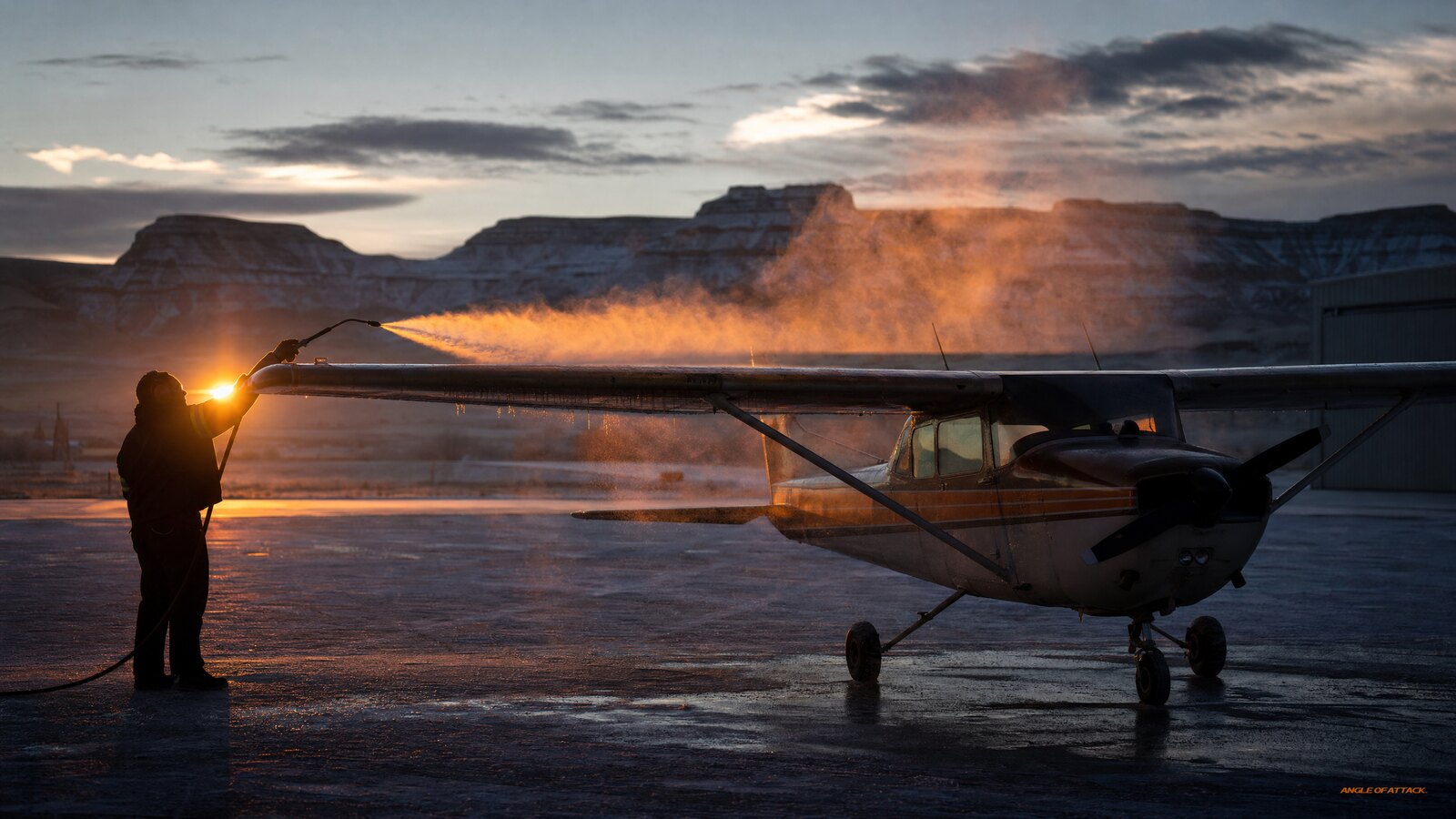
- De-icing removes ice that’s already there; anti-icing stops it from forming. They are two different jobs, and most light trainers have neither — which makes your preflight and your weather decisions the real system.
- Even a thin layer of frost is dangerous. 14 CFR § 91.527 and the FAA’s Pilot’s Handbook of Aeronautical Knowledge (PHAK, FAA-H-8083-25C) are blunt about it: frost can spoil the smooth airflow over a wing and rob you of lift.
- Structural icing needs two ingredients: visible moisture (clouds, rain, drizzle) and a surface temperature at or below freezing. No moisture, no ice.
- Ground de-icing uses heated fluids (the SAE-defined Type I, II, III, and IV fluids), each with a different job and a limited “holdover time.”
- In-flight systems differ by aircraft: pneumatic boots, weeping-wing (TKS) fluid, and heated leading edges each remove or prevent ice in their own way.
- Most training aircraft are NOT approved for flight into known icing. For a student pilot, the correct procedure is avoidance — and a clean airplane before you ever leave the ground.
WHAT’S IN THIS GUIDE
- 1What Is Aircraft De-Icing?
- 2What’s the Difference Between De-Icing and Anti-Icing?
- 3Why Is Ice So Dangerous on an Airplane?
- 4How Does Ground De-Icing Actually Work?
- 5What Are the Different Types of De-Icing Fluid?
- 6How Do Airplanes De-Ice in Flight?
- 7The Morning I Found Frost on My Wing in Homer
- 8PLT Study Guide
- 9Frequently Asked Questions
What Is Aircraft De-Icing?
Aircraft de-icing is the act of removing accumulated ice, frost, or snow from an airplane’s critical surfaces — the wings, tail, control surfaces, propeller, windshield, and sensors like the pitot tube. On the ground, that means spraying heated de-icing fluid before departure. In flight, it means activating an onboard system designed to shed ice that has already started building.
The goal is simple: restore the airplane to a clean, aerodynamically smooth condition. A wing produces lift only when air flows smoothly over it. Ice changes its shape and roughens the surface, and the airflow stops cooperating.
The FAA’s PHAK (FAA-H-8083-25C, Chapter 12) treats a clean aircraft as a non-negotiable starting point — the “clean aircraft concept.” You do not take off with frost, ice, or snow adhering to the wings, stabilizers, or control surfaces, period. For larger operations, 14 CFR § 91.527 spells this out directly.
So when you hear “de-icing,” picture two settings at once: a ramp crew hosing down a frost-covered wing at dawn, and a pilot flipping on a system mid-flight. Both are de-icing — because ice is one of the few weather hazards that can quietly ruin a wing before you notice anything is wrong.
What’s the Difference Between De-Icing and Anti-Icing?
De-icing removes contamination already on the aircraft. Anti-icing prevents contamination from forming or re-forming. That’s the whole distinction in one line — but it drives almost every procedure in cold-weather flying.
Think of your car windshield on a frozen morning. Scraping the ice off is de-icing. Spraying a treatment that keeps new ice from bonding for the next hour is anti-icing. On airliners, the ground crew often does both in sequence: a hot Type I fluid de-ices, then a thicker Type IV fluid buys “holdover time” before takeoff.
In flight, the same split applies. A system that lets ice build and then cracks it off (pneumatic boots) is doing de-icing work. A system that runs continuously so ice never bonds (a heated leading edge or weeping-wing fluid) is doing anti-icing work. Some aircraft do both.
| Feature | De-Icing | Anti-Icing |
|---|---|---|
| Job | Removes ice/frost/snow already present | Prevents ice/frost/snow from forming |
| Timing | Reactive — after contamination forms | Proactive — before or during exposure |
| Ground example | Heated Type I fluid sprayed on a frosty wing | Thickened Type IV fluid applied for holdover |
| In-flight example | Pneumatic deice boots cracking off ice | Heated leading edges; weeping-wing (TKS) fluid |
| Light trainer reality | Brush/scrape frost off before flight | Avoid icing conditions entirely |
For a student pilot, here’s what matters: your Cessna 172 or Piper Cherokee almost certainly has neither a ground de-icing system nor an in-flight anti-icing system. Your anti-icing system is your judgment, your weather briefing, and your willingness to stay on the ground.
Why Is Ice So Dangerous on an Airplane?
Ice is dangerous because it attacks the airplane four ways at once: it disrupts the airflow that produces lift, adds weight, increases drag, and can jam control surfaces or block sensors. The FAA’s PHAK (FAA-H-8083-25C) is direct — even frost the texture of fine sandpaper can reduce lift significantly and increase stall speed.
Let that land. We’re not talking about a thick glaze. We’re talking about a thin, rough coating you might barely feel with your fingertips. The roughness is the problem. A wing’s lift depends on air staying attached to its surface, and roughness causes that airflow to separate early.
Structural icing — the kind that builds on wings and tail — comes in three flavors:
- Clear ice forms when large supercooled drops freeze slowly into a smooth, heavy, hard-to-see glaze. It’s the most dangerous and hardest to remove.
- Rime ice forms when small drops freeze on contact, trapping air to create a rough, milky, brittle deposit — lighter, but it disrupts airflow badly.
- Mixed ice combines both and is common in real clouds.
Two conditions must be present together for structural ice to form: visible moisture (clouds, rain, drizzle, wet snow) and a surface temperature at or below 0°C (32°F). Take away either ingredient and ice can’t accumulate. A dry, clear, freezing day is no threat — but a cloud layer at freezing temperatures absolutely is.
Ice can also block your pitot tube and static ports, feeding you false airspeed and altitude readings, freeze a control surface in place, or build on the propeller and rob you of thrust. This is why the rule is a clean aircraft, not a mostly clean aircraft.
How Does Ground De-Icing Actually Work?
Ground de-icing works by spraying a heated glycol-based fluid onto the airplane’s surfaces, melting and washing away accumulated ice, frost, and snow before takeoff. At airline gates you’ll see trucks with booms and heated tanks; on a small aircraft, “ground de-icing” might be a soft brush, a broom, or moving the airplane into a heated hangar.
The professional process follows standards published by SAE International. It’s often one or two steps. In a one-step procedure, a single heated fluid both removes the contamination and provides brief protection. In a two-step procedure, a hot fluid de-ices first, then a thicker fluid is applied for anti-ice protection.
That second step introduces a concept every pilot should know: holdover time — the estimated window during which the anti-icing fluid keeps protecting the wing before ice starts forming again. It depends on the fluid type, precipitation rate, and temperature. When holdover time runs out, the protection is gone, and in heavy snow that happens fast.
For your training airplane, the practical version is humbler but just as important. If there’s frost on the wings at dawn, you remove it — every bit of it — before you fly. A heated hangar, a frost cover applied the night before, or patient brushing all count. What does not count is hoping it’ll melt on the taxi out or telling yourself a “little” frost is fine. It isn’t.
What Are the Different Types of De-Icing Fluid?
Ground de-icing and anti-icing fluids come in four SAE-standardized types — I, II, III, and IV — each with a different thickness, color, and purpose. Type I is a hot, thin de-icing fluid; Types II, III, and IV are thickened fluids that cling to the wing longer for anti-icing holdover protection. They’re dyed different colors so crews can tell them apart.
You won’t be ordering these for your Cessna, but understanding them makes you sharper when you fly larger aircraft — and they show up on knowledge tests under the anti-icing/de-icing learning topics.
| Fluid Type | Typical Color | Primary Job | Key Trait |
|---|---|---|---|
| Type I | Orange | De-icing (removal) | Thin, applied hot; flows off quickly, short holdover |
| Type II | Pale straw / clear | Anti-icing | Thickened; clings longer; for faster aircraft |
| Type III | Yellow-green | Anti-icing | Designed for slower commuter/GA-class aircraft |
| Type IV | Green | Anti-icing | Thickest; longest holdover protection |
A few principles. The thickened fluids (II, III, IV) cling to a parked wing but shear off cleanly as the aircraft accelerates for takeoff — which is why they’re only used on aircraft with enough rotation speed to shed them. Type I, being thin, is the workhorse for melting and removing contamination. And every fluid has limits: holdover time shrinks as precipitation gets heavier or temperatures drop.
The takeaway isn’t to memorize colors. It’s to understand that de-icing and anti-icing are deliberate, standardized, time-limited processes — not a casual hose-down.
How Do Airplanes De-Ice in Flight?
Airplanes equipped for flight in icing use one of three main system types: pneumatic de-ice boots that inflate to crack ice off, weeping-wing (TKS) systems that ooze anti-ice fluid through tiny holes in the leading edge, or thermal systems that heat the leading edges with engine bleed air or electric elements. Each removes or prevents ice differently, and the airplane’s POH dictates exactly how to use it.
Pneumatic de-ice boots are rubber strips bonded to the leading edges of the wings and tail. When ice builds, the pilot activates the system, the boots inflate and crack the brittle ice so the airstream blows it away, then deflate — a classic de-icing tool. Current FAA and manufacturer guidance is generally to activate boots at the first sign of ice.
Weeping-wing systems (commonly the TKS brand) pump glycol-based fluid through thousands of tiny laser-drilled holes in titanium leading-edge panels. The fluid spreads over the surface and prevents ice from bonding — pure anti-icing — and some installations can dissolve ice that has already formed.
Thermal anti-ice systems heat the leading edges with hot engine bleed air (common on turboprops and jets) or electric elements, keeping the surface above freezing so ice never gets a foothold.
Here’s the critical point for you as a student pilot: having one of these systems is what allows an aircraft to be certified for flight into known icing (FIKI). Most training aircraft are not FIKI-approved. A heated pitot tube alone doesn’t make your airplane an ice-fighter — it only protects one sensor. For the average student pilot, the in-flight de-icing system is the one you’ll never have: the decision not to go.
The Morning I Found Frost on My Wing in Homer
Let me tell you about an ordinary morning that taught me more about de-icing than any textbook.
Early fall in Homer. Clear sky, dead calm, the kind of crisp morning where the mountains across Kachemak Bay look close enough to touch. I had a flight planned and a Cessna 172 that had sat on the ramp overnight. I walked up to preflight expecting a quick turn.
And there it was — a thin, even layer of frost across the top of both wings and the horizontal stabilizer. Not much; you could see the paint through it. I could have told myself it was “just a little” and it would “blow off on the takeoff roll.” Pilots have told themselves exactly that, and some of them didn’t come home.
I ran my hand across it. Rough, like fine sandpaper — exactly the texture the PHAK warns about. That roughness is the killer. A wing robbed of lift by that thin frost might feel fine at rotation, then sag right back onto the runway — or stall just after liftoff when you can least afford it.
So I did the boring thing. I waited. I turned the airplane so the rising sun hit the wings, wiped what I could reach with a soft cloth, and let the rest sublimate off. It cost me forty-five minutes. The flight was beautiful once I finally went.
Here’s what to carry from that morning: de-icing for a student pilot isn’t a fancy truck or a cockpit switch. It’s the discipline to look at a frosted wing and refuse to fly until it’s clean. That decision is free. The alternative can cost everything. Building that preflight discipline from day one is exactly what we drill into pilots inside the Private Pilot Ground School.
PLT Study Guide
The FAA tags knowledge-test questions with PLT (Pilot Learning Topic) codes. For aircraft de-icing and anti-icing, these are the codes that match the content above, with the official FAA learning-statement wording translated into plain-English study points.
PLT108 — Recall aircraft anti-icing / de-icing — methods / fluids
Know the difference between de-icing (removal) and anti-icing (prevention). Know that ground fluids come in SAE Types I–IV: Type I is thin and hot for removal; Types II, III, and IV are thickened for holdover protection. Understand that holdover time is the limited window the fluid stays effective before ice re-forms.
PLT128 — Recall aircraft performance — effects of icing
Understand how ice degrades performance: it reduces lift, increases stall speed, adds weight, and increases drag — all at once. Even a thin layer of frost the texture of fine sandpaper can significantly reduce lift. Ice can also block sensors and jam control surfaces.
PLT136 — Recall aircraft systems — anti-icing / de-icing
Know the in-flight system types: pneumatic de-ice boots (inflate to crack ice off), weeping-wing/TKS (fluid through porous leading edges), and thermal systems (bleed-air or electric heat). Recognize that these systems are what allow certification for flight into known icing.
PLT206 — Recall effects of temperature — density altitude / icing
Recognize that structural icing requires two conditions together: visible moisture AND a surface temperature at or below 0°C (32°F). Understand the temperature ranges where clear, rime, and mixed ice tend to form.
PLT274 — Recall icing — formation / characteristics
Know the three structural ice types: clear (smooth, heavy, hardest to see and remove), rime (rough, milky, brittle), and mixed. Know they form when supercooled water drops strike a freezing airframe.
PLT493 — Recall the dynamics of frost / ice / snow formation on an aircraft
Understand the “clean aircraft concept”: frost, ice, and snow must be removed before flight because they disrupt airflow over lifting and control surfaces. Frost forms by deposition on a surface colder than the surrounding dew point — and even a thin, smooth layer is hazardous.
Frequently Asked Questions
Is de-icing the same as anti-icing?
No. De-icing removes ice, frost, or snow that has already formed on the aircraft. Anti-icing prevents ice from forming or re-forming in the first place. Ground crews often do both in sequence — a hot fluid de-ices, then a thickened fluid provides anti-ice holdover protection until the airplane takes off.
Can I just let frost blow off during takeoff?
No, and this is a deadly myth. Frost roughens the wing surface and disrupts the airflow that produces lift, increasing stall speed and reducing lift at the worst possible moment. The FAA’s clean aircraft concept requires removing all frost, ice, and snow before flight. Remove it on the ground — never count on it sliding off.
Why is even thin frost dangerous?
Because lift depends on air flowing smoothly over the wing, and frost the texture of fine sandpaper roughens that surface enough to make the airflow separate early. The FAA’s PHAK (FAA-H-8083-25C) warns that thin frost can significantly reduce lift and raise stall speed — even though it adds almost no weight.
What conditions are needed for structural ice to form?
Two ingredients must be present at the same time: visible moisture, such as clouds, rain, drizzle, or wet snow, and a surface temperature at or below 0°C (32°F). Remove either ingredient and structural ice cannot accumulate. A dry, clear, freezing day poses no structural icing threat in flight.
What are the four types of de-icing fluid?
SAE Types I, II, III, and IV. Type I is thin, applied hot, and used to remove contamination (de-icing). Types II, III, and IV are progressively thicker fluids used for anti-icing holdover protection, clinging to the wing until takeoff speed shears them off. The fluids are dyed different colors to tell them apart.
Does my Cessna 172 have a de-icing system?
Almost certainly not in any meaningful sense. Most training aircraft have at most a heated pitot tube, which protects one sensor — not a true airframe de-icing or anti-icing system. They are not approved for flight into known icing. For a student pilot, the system is avoidance: check the weather, stay clear of icing, and never fly a contaminated airplane.
What is holdover time?
Holdover time is the estimated window during which anti-icing fluid keeps protecting an aircraft after it’s applied, before ice begins forming again. It shrinks as precipitation gets heavier or temperatures drop. When holdover time runs out, the protection is gone — which is why crews track it closely and re-treat the aircraft if a departure is delayed.
How do pneumatic de-ice boots work?
Pneumatic boots are rubber strips on the leading edges of the wings and tail. When ice builds up, the pilot activates the system, the boots inflate and crack the brittle ice, the airstream carries it away, then the boots deflate. They are a de-icing tool — they remove ice that has already formed, and current guidance is to activate them at the first sign of ice.
We cover icing, weather decision-making, and aircraft systems in plain English inside the Private Pilot Ground School — the same way we just walked through de-icing here, so the knowledge sticks for the checkride and for the day you’re actually staring at a frosted wing.
Master every system on your checkride — and on day one.
The Private Pilot Ground School breaks down every FAA subject area in the same plain-English, real-world way you just read — with quizzes, scenarios, and the explanations that finally make it click.
De-icing comes down to one idea you can carry from your very first lesson: a clean airplane is a non-negotiable. The systems get fancier as the airplanes get bigger, but the principle never changes. Brushing frost off a Cessna at dawn, watching a truck hose down an airliner — the goal is the same. Give that wing the smooth, clean surface it needs to do its one job. Respect the ice, and it’ll never surprise you.


ON THE SAME TOPIC
What Is Aircraft Stability? Static, Dynamic & Why It Keeps You Flying Straight
What Is Aircraft Stability? Static, Dynamic & Why It Keeps You Flying Straight 16 min read Last updated June 2026 · Chris Palmer Aircraft stability is an airplane’s built-in tendency to return to its original flight attitude after a disturbance — a gust, a control input, a bump — without the pilot having to fight […]
 Read more
What Is Adverse Yaw? The Reason Your Nose Swings the Wrong Way in a Turn
What Is Adverse Yaw? The Reason Your Nose Swings the Wrong Way in a Turn 32 min read Last updated June 2026 · Chris Palmer Adverse yaw is the tendency of an airplane’s nose to swing toward the outside of a turn — the opposite direction you’re rolling — at the moment you deflect the […]
Read more 
Advection Fog Explained: The Moving Fog That Blankets Coastlines and Catches Pilots Off Guard
Advection Fog Explained: The Moving Fog That Blankets Coastlines and Catches Pilots Off Guard 25 min read Last updated June 2026 · Chris Palmer Advection fog forms when warm, moist air moves horizontally on the wind over a colder surface, such as cool ocean water or chilled ground, cooling from below until the air reaches […]
Read more 
What Is a Warm Front? Weather, Clouds & Hazards for Pilots
What Is a Warm Front? Weather, Clouds & Hazards for Pilots 16 min read Last updated June 2026 · Chris Palmer A warm front is the boundary where an advancing mass of warm air rides up and over a retreating, denser mass of cold air. Because the warm air climbs that shallow slope gradually, it […]
Read more 
Stay Connected
Be the very first to get notified when we publish new flying videos, free lessons, and special offers on our courses.
