How to Renew Your CFI in 2026: The Five Pathways for Recent Experience

CFI renewal is the 24-calendar-month recent-experience requirement under 14 CFR 61.197, the rhythm that keeps your flight instructor privileges current. As of December 1, 2024, CFI certificates no longer print expiration dates (per 89 FR 80020). Instead, a Recent Experience End Date (REED) in the FAA Airmen Registry tracks when you must satisfy one of five FAA-recognized pathways to keep teaching.
Most “CFI renewal” content was written before December 2024 and is structurally wrong about how the system works now. I’m Chris Palmer, founder of Angle of Attack. I’ve been in aviation education since 2006, became a CFI in 2017, and I’m a two-time Master Aviation Educator and Gold Seal CFI. I’ve personally been through multiple renewal cycles, and I’ve watched the post-Dec-2024 dust settle on what “renewal” even means anymore. Renewal isn’t an expiration date anymore. It’s a recency rhythm. Here’s the independent map.
Walking into your first lesson with a 50-page binder won't help you.
Get my Anti-Binder One-Page Lesson Plan Template free — the lesson plan tool I built for CFI candidates who want to be ready Day 1.
Get the Anti-Binder Template Free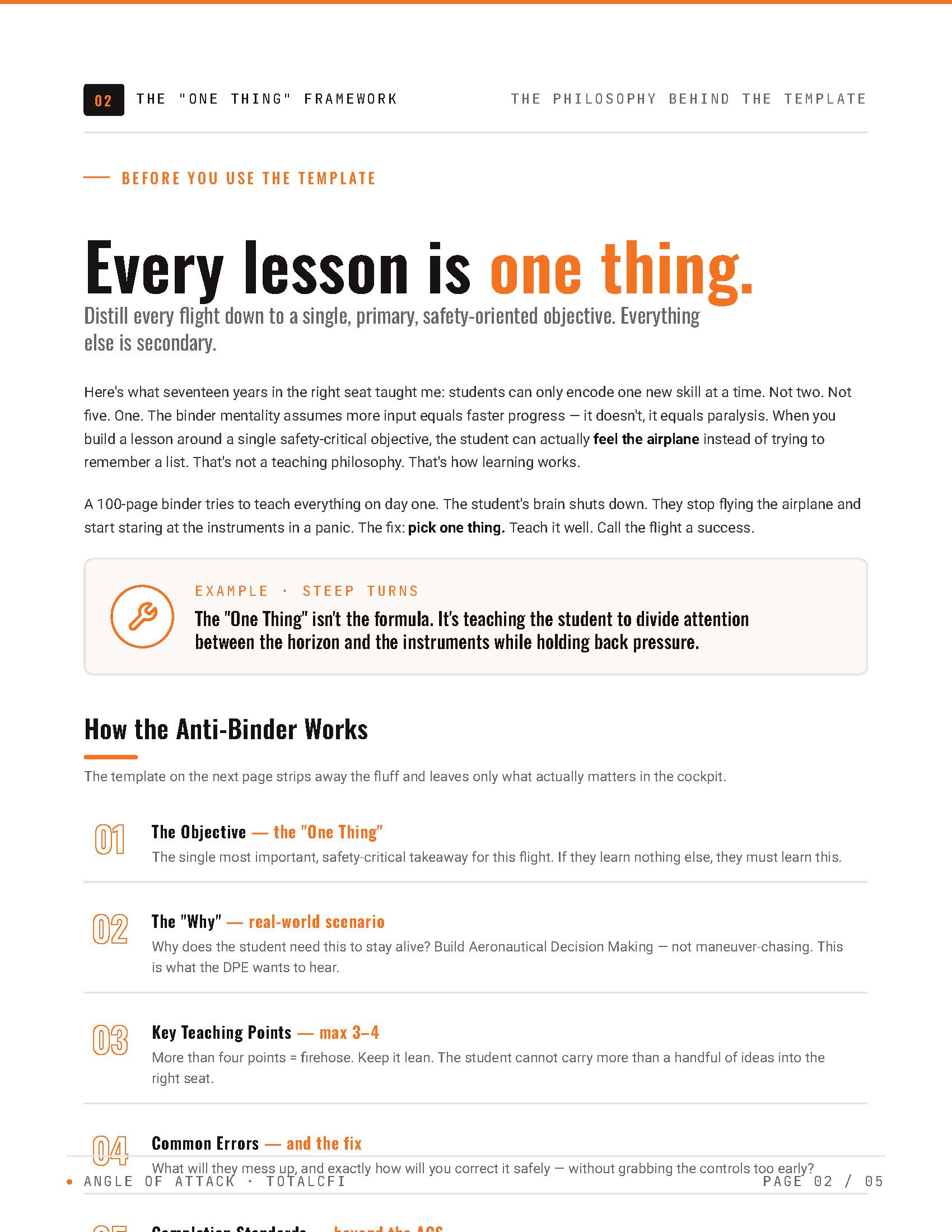

- As of December 1, 2024, CFI certificates no longer print expiration dates per 89 FR 80020 (document 2024-22018). The 24-calendar-month requirement still exists. It now lives in the FAA Airmen Registry as a Recent Experience End Date (REED).
- 14 CFR 61.197(b) recognizes five pathways to demonstrate recent experience: practical test, student-endorsement record (5 students with 80% first-try pass rate), Part 121/135 service, FIRC, or military instructor proficiency check. A sixth, the WINGS pathway, was added by the December 2024 rule but stays niche.
- The four-month renewal window (3 calendar months before your REED through the month of the REED itself) is when you complete your pathway and sign the IACRA 8710. Sign earlier than the window and your next REED gets set early, costing you weeks of cycle time.
- If your REED passes, you have 3 calendar months to complete a FIRC and reinstate per 14 CFR 61.199. During those 3 months your instructional privileges are revoked. After 3 months, the FIRC pathway closes and a practical test is required.
- Most working CFIs default to FIRC out of habit. But the student-endorsement record is free if you teach full-time, the practical test stacks naturally with adding CFII or MEI, and your CFII and MEI renew on the same cycle as your CFI. One renewal covers all instructor ratings you hold.
WHAT'S IN THIS GUIDE
- 1Do CFI Certificates Still Expire? (The 2024 Rule Change)
- 2The Five Pathways to Renew Your CFI
- 3Pathway 1: Pass a Practical Test
- 4Pathway 2: Endorse Five Students With 80% First-Try Pass Rate
- 5Pathway 3: Serve in Part 121/135 Operations
- 6Pathway 4: Complete a FIRC
- 7Pathway 5: Military Proficiency Check or WINGS Program
- 8The Five Pathways Compared at a Glance
- 9How to Submit Your Renewal in IACRA (Step-by-Step)
- 10What If Your CFI Lapses? (The 3-Month Reinstatement Period)
- 11The One Thing Most CFIs Get Wrong About Renewal
- 12Frequently Asked Questions
Do CFI Certificates Still Expire? (The 2024 Rule Change)

Short answer: not the way they used to.
Effective December 1, 2024, the FAA’s final rule 89 FR 80020 (Vol. 89, No. 190 / document 2024-22018) removed the printed expiration date from newly issued CFI certificates. The 24-calendar-month requirement is still in force; it now lives in the FAA Airmen Registry as a Recent Experience End Date (REED). A second phase on March 1, 2027 will strip the word “expiration” out of the FARs themselves. The old language is being walked off the field in two stages.
In practice, if your CFI certificate was issued before December 2024, the printed date is still real until you renew. When you complete your next pathway and the FAA reissues the card, it comes back without the expiration field. The clock keeps running in the registry, but it’s no longer printed on what you carry in your wallet.
The framing flipped. What runs out now is your recent experience, not the certificate itself. The 24-month cycle, the 4-month renewal window, the 3-month reinstatement grace, all still apply. What changed is the language and the place it’s tracked.
For the broader context of what your CFI ticket actually lets you do, and where it stops, see our Privileges & Limitations Refresh.
Professionalism is not a certificate — it’s behavior. Whether your card prints an expiration date or doesn’t, the standard you hold yourself to between cycles is what makes you a CFI worth flying with.
The Five Pathways to Renew Your CFI

Most CFI articles call this “the four ways to renew.” Pull up 14 CFR 61.197(b) and count again. There are five, plus a sixth that was added by 89 FR 80020 and rarely makes anyone’s short list. Any one of the following, completed in the preceding 24 calendar months, satisfies the requirement:
- Pass a practical test for one of the ratings on your flight instructor certificate or for an additional FI rating. Section (b)(1).
- Endorse five students for a practical test in 24 months with at least 80% passing first try. Section (b)(2)(i).
- Serve in Part 121 or 135 operations in a position involving regular evaluation of pilots: company check pilot, chief flight instructor, check airman, or flight instructor. Section (b)(2)(ii).
- Complete an FAA-approved FIRC within the preceding 3 calendar months. Section (b)(2)(iii).
- Pass a U.S. Armed Forces military instructor proficiency check in 24 months. Section (b)(2)(iv).
And the sixth, codified by 89 FR 80020: serve as a flight instructor in an FAA-sponsored pilot proficiency program (WINGS) in 24 months. At least 15 flight activities, evaluating 5 different pilots, with the necessary endorsements. Section (b)(2)(v). It’s a real pathway. Most working CFIs won’t use it.
The rest of this article is the pathway-by-pathway map. Which one fits which CFI, what each one costs, what each one demands of you. You don’t pick a pathway for your CFI in the abstract. You pick it for the way you actually work.
Pathway 1: Pass a Practical Test

The cleanest reset in the regulation. Take a fresh practical test for one of the ratings on your flight instructor certificate, or for an additional CFI rating, and the cycle starts over. No FIRC required. Per 14 CFR 61.197(b)(1).
This pathway fits two CFIs especially well. The first is anyone adding CFII or MEI in the same cycle. The second is anyone returning from a stretch of inactivity who wants a real proficiency check rather than a 16-hour video course. CFIs who treat renewal as a chance to be sharp again rather than a tax to pay tend to land here too.
The upside: it forces you to study and fly to ACS standards. It doubles as a new rating if you stack it. The certificate you walk out with is the strongest possible evidence you’re current.
The downside is cost, calendar, and risk. Figure $800 to $1,500-plus for the DPE fee, on top of aircraft and prep time. DPEs are booked weeks or months out. And it’s still a checkride, with a real chance of a notice of disapproval.
The smart play: if you’re adding CFII or MEI in this cycle, you’ve already triggered renewal. Most CFIs miss this timing alignment and pay separately for both. One ride, two outcomes. For the full picture of what an initial CFI ride looks like, and how the renewal version is similar, see our CFI checkride breakdown.
Pathway 2: Endorse Five Students With 80% First-Try Pass Rate

The working-CFI’s quiet flex. Per 14 CFR 61.197(b)(2)(i), endorse at least five applicants for a practical test in the preceding 24 calendar months, and have at least 80% of them pass on first attempt. You’re current. No FIRC. No fee. The records you already keep ARE the documentation.
This pathway fits full-time flight-school CFIs running a steady pipeline of checkride candidates, active CFIIs sending instrument students for practical tests, and anyone whose day job naturally produces five-plus practical-test endorsements per cycle.
The upside is that the renewal is free, and it’s a function of the work you already do. The FAA is recognizing your students’ performance as proof of your currency, which is a more honest measure than 16 hours of video could ever be.
The downside is pipeline discipline. One bad cohort can break the math. If you only sent six students to checkride and two failed first try, your pass rate is 67% and the pathway is closed for the cycle. You need the volume and the quality.
Recordkeeping is load-bearing here. 14 CFR 61.189 requires you to keep records of every solo flight endorsement and every knowledge-test or practical-test endorsement (including the test type, date, and results) for at least 3 years. Lose those records and you’ve lost the pathway. The endorsement reference that backs all of this is in AC 61-65K (issued November 14, 2025, supersedes 61-65J). That’s the current authority on what each endorsement looks like.
If you’re going the student-endorsement route, your students passing first try IS your renewal. If you mentor CFI candidates working toward initial, TotalCFI is the course I built for them. Well-prepared candidates protect your 80% pass rate and your pathway.
Pathway 3: Serve in Part 121/135 Operations

Per 14 CFR 61.197(b)(2)(ii), serve in the preceding 24 calendar months as a company check pilot, chief flight instructor, company check airman, or flight instructor in a Part 121 or 135 operation, or in a position involving the regular evaluation of pilots. Either qualifies.
This one fits working professional pilots and instructors at airlines, charter operators, fractional operators, and Part 142 training centers. Anyone whose job description includes “evaluate pilots.”
The upside: it’s built into the work. Renewal is automatic if your professional life qualifies. No course to take, no checkride to schedule.
The downside: it’s not available to most independent or part-time CFIs. The pathway exists but it isn’t a choice in the same way the others are. You either live in this world or you don’t.
If you’re in this pathway, the regulation does most of the work for you. Document the qualifying service, file the IACRA, and keep flying.
Pathway 4: Complete a FIRC

The pathway most working CFIs use. Per 14 CFR 61.197(b)(2)(iii), successfully complete an approved Flight Instructor Refresher Course in the preceding 3 calendar months. About 16 hours of FAA-approved content. Online or in-person. The current authority is AC 61-83K, issued October 30, 2024, which cancels and replaces AC 61-83J.
This is the default. Most CFIs whose work doesn’t naturally produce a student-endorsement record, who aren’t adding a rating, and who aren’t in Part 121/135 land here. Time-pressed renewers too. Anyone who wants the lowest-friction option that doesn’t depend on what their day job looks like.
The upside is predictability. Available to everyone. Online formats let you spread it across a week or two of evenings. In-person closes in a weekend. Provider pricing in 2026 ranges from FREE (Sporty’s) to $349 (Aviation Seminars).
The downside is that it’s still 16 hours of your life every two years. Content quality varies. The course only matters as much as you let it matter.
For the full provider comparison (pricing verified for 2026, the IACRA timing gotcha at depth, and which provider fits which CFI), see our 2026 FIRC guide.
Pathway 5: Military Proficiency Check or WINGS Program

Two niche pathways live under (b)(2)(iv) and (b)(2)(v). Both are real. Both are rare for a typical working CFI.
Pathway 5a. Military Instructor Proficiency Check
Per 14 CFR 61.197(b)(2)(iv), pass a U.S. Armed Forces military instructor pilot or pilot examiner proficiency check in the preceding 24 calendar months. If you’re in the active-duty world or a reservist holding an instructor pilot designation, your military proficiency check satisfies civil renewal. The two systems talk to each other.
Pathway 5b. WINGS (the new one)
Per 14 CFR 61.197(b)(2)(v), added by 89 FR 80020, serve in the preceding 24 calendar months as a flight instructor in an FAA-sponsored pilot proficiency program (WINGS). The bar: at least 15 flight activities recognized under the program, evaluating at least 5 different pilots, with the necessary endorsements in each pilot’s logbook. The pathway exists for CFIs who are deeply embedded in FAASTeam WINGS work.
Both pathways fit a specific subset of CFIs: military instructors, and CFIs who run WINGS phases regularly as part of their work with FAASTeam. Both are built into work that’s already happening, so no additional course is required. Eligibility is the catch. Most independent and part-time CFIs won’t use either.
These pathways are worth knowing exist, both because the rules require us to know them and because the WINGS pathway, in particular, is a quietly-updated piece of the December 2024 rule that most current articles still don’t mention.
The Five Pathways Compared at a Glance
The decision often comes down to a quick gut-check across cost, time, and fit. Here’s the same map at a glance, with the WINGS pathway included as the sixth row for completeness.
| Pathway | Direct Cost | Time | Best For | Tradeoff |
|---|---|---|---|---|
| 1. Practical Test | $800-$1,500+ DPE fee | 4-8 hours of testing + prep | CFIs adding CFII or MEI; returning-from-inactivity CFIs | Highest friction; highest re-cert refresh value |
| 2. Student-Endorsement Record | $0 | Distributed across 24 months | Full-time flight-school CFIs producing 5+ practical-test endorsements per cycle | Free if your work qualifies; lost if recordkeeping slips |
| 3. Part 121/135 Service | $0 (built into salary) | Built into the job | Airline, charter, fractional, training-center pilots in evaluation roles | Not available to independent or part-time CFIs |
| 4. FIRC | FREE-$349 | ~16 hours over 1-3 weeks | The default — most working CFIs | Predictable but content-quality varies; lowest dependency on day job |
| 5. Military Proficiency Check | $0 (built into service) | Built into military training | Active-duty / reservist military instructors | Niche eligibility |
| 6. WINGS Program | $0 | 15+ flight activities over 24 months | CFIs deeply embedded in FAASTeam WINGS | Niche; new pathway codified by 89 FR 80020 |
A practical principle: pick the pathway that matches the way you actually work. The student-endorsement record is free if your day job is already producing five qualified candidates. The practical test ends up cheaper than a FIRC if you’d be paying for a CFII checkride anyway. Neither is automatically “harder” or “more expensive” than the default. The right one is the one that aligns with your existing work.
Pathway choice is fit, not difficulty.
How to Submit Your CFI Renewal in IACRA (Step-by-Step)

Whichever pathway you pick, the paperwork end is the same. An IACRA submission of the electronic FAA Form 8710-1, processed by a designated reviewer (a DPE, a FAASTeam Rep, or an ASI). The mechanical sequence:
- Find your REED in the FAA Airmen Registry. Confirm the exact month. Block it on the calendar. Month 21 of your cycle is the right time to start prep.
- Wait until you’re inside the 4-month window before signing the IACRA 8710. The window opens 3 calendar months before your REED and runs through the month of the REED itself. Coursework and prep can happen earlier. The 8710 cannot.
- Pick your pathway: FIRC, practical test, student endorsement, professional ops, or military/WINGS.
- Complete the pathway requirements. Finish the FIRC. Pass the practical. Document your student endorsements. Confirm your professional service. Whatever applies.
- Initiate an IACRA application for “Recency” and complete FAA Form 8710-1 in IACRA inside the 4-month window. Sign electronically only when you’re inside.
- Have it processed by a designated reviewer. A DPE, a FAASTeam Rep, or a Flight Standards ASI signs on the FAA side. The new card follows in a few weeks; as of December 1, 2024, it ships without an expiration line.
The IACRA timing gotcha. Do not sign the electronic 8710 in IACRA until you’re inside the 4-month window. The 8710 stamps your completion date. Sign it a month early and you’ve quietly given the FAA a month of your next cycle. Your next REED gets set 24 months from your completion date instead of 24 months from your current REED. AOPA’s Common CFI Recent Experience FAQ flags this and most CFIs miss it. Sign inside the window. Boring is good.
If you went the FIRC route, most providers offer a paperless renewal service that bundles steps 5 and 6 into the course price (or a small add-on). We compare those services in the FIRC guide.
What If Your CFI Lapses? (The 3-Month Reinstatement Period)

You missed the window. The REED passed. Now what?
14 CFR 61.199 gives you 3 calendar months after your REED to complete a FIRC and reinstate, keeping your original REED as the basis for your next 24-month cycle. That 3-month grace is the new reality post-Dec 2024, codified more cleanly than it was under the prior rule.
The load-bearing part: during those 3 reinstatement months, you cannot exercise CFI privileges. No instruction. No endorsements. You’re a current pilot with an inactive flight instructor credential. Your students stop. Your income stops if you teach full-time.
After 3 months, the FIRC pathway closes. A practical test is the only way back, per 14 CFR 61.199(a)(2). Military instructors get a 6-month lookback; everyone else, 3 months.
The honest take: never let the REED pass. The 3-month reinstatement is a real safety net, but punitive. Your students stop, your income stops, and you’re paying for a FIRC anyway from a worse position than if you’d planned ahead. Note that your CFII and MEI ride the same cycle — see our CFII privileges and limitations and MEI privileges and limitations for the parallel rules. One renewal cycle covers all instructor ratings you hold; one missed REED takes them all out at once.
The One Thing Most CFIs Get Wrong About Renewal

Most CFIs treat renewal as a deadline. It’s actually a rhythm.
The certificate doesn’t tick down to zero anymore. What ticks is your recency, the question of whether you’re still actively living the privileges you hold. Post-December 2024, the regulation is asking you to demonstrate that you’re not just credentialed but current in the practice. Five pathways are five different ways to demonstrate the same thing: that you’re still in the cockpit, still teaching, still evaluating, still studying.
Pick the pathway that matches how you actually live in aviation. If you’re a working flight-school CFI, the student-endorsement record is naturally true. It’s a function of the work you already do. If you’re a part-timer flying weekends, FIRC is the rhythm that fits. If you fly Part 121 or 135 with an evaluator role, that pathway is built into your job. The pathway choice should reflect the shape of your career, not the marketing of whichever provider has the loudest ad.
A CFI certificate is a license to learn. That phrase is true the day you pass the initial. It’s also true the day of your tenth renewal. The renewal is a checkpoint on you, not on the certificate. The pathway is just the form the checkpoint takes.
There’s a deeper version of this. The same December 2024 rule that removed the expiration date also added 14 CFR 61.195(h), a new framework for the qualifications required to train initial CFI applicants. Including (h)(3), the Enhanced Qualification Program: 25 hours of ground training plus 10 hours of flight training under Part 141 or 142, with written and proficiency exams. Most renewing CFIs will never use it directly. But it tells you something about where the FAA is heading. The bar for instructing instructors is being raised, the bar for staying current is being reframed as a rhythm rather than a deadline, and the whole posture of the regulation is shifting toward demonstrated competence over time. TotalCFI is built to make new instructors Day-One ready — exactly the standard the regulation is increasingly asking for.
If you mentor a CFI candidate working through their initial, TotalCFI is the course I built for them. Well-prepared candidates protect your renewal math if you’re going the student-endorsement route, and they protect the profession if you’re not.
How often do CFIs need to renew?
Every 24 calendar months, per 14 CFR 61.197(a). The rolling date is now stored as a Recent Experience End Date (REED) in the FAA Airmen Registry rather than printed on the certificate.
Do CFI certificates still expire?
Not the way they used to. As of December 1, 2024, newly issued CFI certificates no longer print expiration dates per 89 FR 80020 (document 2024-22018). The 24-month requirement still applies in the FAA Airmen Registry as a REED. A second phase on March 1, 2027 will strip the word “expiration” out of the FARs themselves.
How much does CFI renewal cost?
Pathway-dependent. The student-endorsement record, Part 121/135 service, military proficiency check, and WINGS pathways are $0 in direct cost. A FIRC ranges from FREE (Sporty’s) to $349 (Aviation Seminars in-person). A practical test runs $800-$1,500-plus for the DPE fee, plus aircraft and prep.
Can you renew CFI without a FIRC?
Yes. 14 CFR 61.197(b) lists five pathways: practical test, student-endorsement record (5 students with 80% first-try pass rate), Part 121/135 service, FIRC, or military instructor proficiency check. A sixth, WINGS program service, was added by 89 FR 80020.
How many students do you need for the student-endorsement pathway?
At least five applicants endorsed for a practical test in the preceding 24 calendar months, with at least 80% passing on first attempt. Per 14 CFR 61.197(b)(2)(i). Records must be retained at least 3 years per 14 CFR 61.189.
What is the 4-month renewal window?
The 3 calendar months before your REED through the month of the REED itself. Complete your pathway and sign the IACRA 8710 inside this window and your next REED is set 24 months from the current REED. No time lost. Sign earlier and your next REED gets set 24 months from your completion date, costing you weeks of cycle time.
What happens if your CFI expires?
You have 3 calendar months after your REED to complete a FIRC and reinstate, per 14 CFR 61.199. During those 3 months you cannot exercise CFI privileges. After 3 months, the FIRC pathway closes and a practical test is required. Military instructors get a 6-month lookback.
Does CFII or MEI renew separately?
No. One renewal cycle covers all instructor ratings you hold. Complete one pathway (FIRC, practical test, student endorsement, professional service, or military/WINGS) and your CFI, CFII, and MEI all renew together. Don’t pay for separate renewals.
Mentoring a CFI candidate? This is the course I built for them.
If the CFI checkride is keeping you up at night, you're prepping for the wrong thing.
TotalCFI teaches you to walk into the oral as a teacher, not a test-taker — the reframe most candidates only figure out after they've already failed once.

Meeting the FAA eligibility checklist gets you legal. Doing the work that follows is what makes you ready. Check the boxes — then start the real work.