How to Teach a Stall: A New CFI’s Guide (The Scenario-First Method)

Most new CFIs teach stalls as a maneuver: clear the area, slow the airplane, hold the yoke back, recover at the break. That’s not teaching a stall — that’s demonstrating one. The CFIs whose students leave with real stall awareness teach the scenario: the airplane is on final, configured for landing, throttle at idle, slow. Now the lesson means something. I’m Chris Palmer — two-time Master Aviation Educator, Gold Seal CFI, founder of Angle of Attack — and the first time I taught a stall to a real student, I taught it wrong. Here’s how to do it right.
- Most stall lessons fail because they teach the maneuver — not the scenario it represents. Power-off is an approach stall; power-on is a departure stall; accelerated is a maneuvering stall.
- AC 61-67C Change 2 requires teaching stall recognition and prevention, not just recovery. AC 120-109A locks in the recovery doctrine: “Reducing angle of attack is the most important pilot action in recovering from an impending or full stall.”
- Loss of control in flight is the leading cause of fatal GA accidents — stall/spin its primary mechanism. About half of LOC accidents happen in the traffic pattern, the regime we practice the least.
- The 4-part brief (scenario, demo plan, error correction, debrief) replaces procedure-first lesson plans and matches FAA-H-8083-9B Chapter 5’s Teaching Process.
- Your job on the CFI ACS (FAA-S-ACS-25 Area X — Slow Flight, Stalls, and Spins) isn’t perfect stalls — it’s teaching the scenario well enough that your student leaves with awareness, not a checkride trick.
The CFI Toolkit Every New Instructor Wishes They Had on Day One
Most new CFIs build their teaching system from scratch — a binder of borrowed lesson plans and scattered notes. The Anti-Binder Template is the one-page framework I use to plan every lesson, including the stalls block. Same scenario-first shape. Same Day-One focus.
Grab the Anti-Binder Template — Free →
Walking into your first lesson with a 50-page binder won't help you.
Get my Anti-Binder One-Page Lesson Plan Template free — the lesson plan tool I built for CFI candidates who want to be ready Day 1.
Get the Anti-Binder Template Free
WHAT'S IN THIS GUIDE
- 1Why Most Stall Lessons Fail to Teach Stalls
- 2What Does AC 61-67C Say About Stall Training?
- 3The Scenario-First Method (The TotalCFI Approach)
- 4How to Brief a Stall Lesson (The 4-Part Brief)
- 5The 5 Most Common Student Errors on Stalls (And What Each One Reveals)
- 6What Do You Say When a Student Panics During a Stall?
- 7Teaching Different Stall Types (Power-Off, Power-On, Accelerated, Cross-Control)
- 8How Long Should a Stall Lesson Last?
- 9What Are Students Actually Learning When You Teach Stalls Well?
- 10Frequently Asked Questions
Why Most Stall Lessons Fail to Teach Stalls

The first stall I ever taught was in Wisconsin in 2017. Fresh CFI ticket. My student climbed us to 4,000 AGL. I briefed the maneuver the way I’d been briefed: throttle to idle, hold altitude, watch for the buffet, lower the nose, add power, level the wings. Clean. ACS-aligned. He flew three, recovered each one, and we came home. I taught him how to do the maneuver. I didn’t teach him anything about stalls. He could have flown that exercise a hundred more times and never been any more prepared for the scenario that actually kills people — slow on final, distracted, configured for landing, the airplane sliding into a stall the pilot doesn’t see coming.
The FAA has been trying to close this gap for years. After Colgan 3407 in February 2009 — a Q400 crew that pulled back on the stick during a stick-shaker warning and rode the airplane down — the FAA rewrote the ATP PTS in 2012, removing the old “minimum altitude loss” recovery standard. Pilots were pulling back in a stall to save 100 feet. That’s what we’d accidentally trained them to do. The same year, Air France 447 went down with the co-pilot holding the side-stick aft for three full minutes while the airplane stalled into the South Atlantic.
In November 2015, the FAA published AC 120-109A — Stall Prevention and Recovery Training. One sentence sits at the center: “Reducing angle of attack is the most important pilot action in recovering from an impending or full stall.” The handbook followed — the Airplane Flying Handbook (FAA-H-8083-3C, October 2021) integrated stalls into Chapter 5: Maintaining Aircraft Control — Upset Prevention and Recovery Training, with the energy framework underlying all of it in Chapter 4: Energy Management — Mastering Altitude and Airspeed Control. Structurally, the FAA is telling us: stalls are a category of upset, and the lesson is energy management plus AOA awareness — not maneuver mechanics.
NTSB data backs the doctrine. Loss of control in flight is the leading cause of fatal GA accidents, and stall/spin is its primary mechanism. About half of LOC accidents happen during maneuvering in the traffic pattern — the regime we almost never practice in. Practice areas at 4,000 AGL aren’t where pilots stall. Final approach is.
Most new CFIs miss this entire chain. They were trained on the maneuver, they teach the maneuver, the student leaves with the maneuver. Professionalism is not a certificate — it’s behavior — and the behavior the FAA wants is the scenario, not the demonstration.
What Does AC 61-67C Say About Stall Training?
 ac-61-67c-scaled.png" alt="" />
AC 61-67C Change 2 — Stall and Spin Awareness Training is the regulatory backbone of stall instruction under Part 61. Read it before you teach your first stall lesson, and re-read it after your first ten.
The stated goal is stall awareness and prevention, not recovery skill. The phrase recognition of situations that could lead to an inadvertent stall repeats throughout. The deliverable is your student can see the stall coming in real flight and stop it before it happens.
The AC is built on FAA-RD-77-26, the FAA’s stall awareness study from the late 1970s. It found stall/spin accidents accounted for about 25 percent of fatal GA accidents, with distraction as the most common precursor. Pilots weren’t stalling because they didn’t know how to recover. They were stalling because they were looking at something else — checklist, radio, passenger — when the airplane got slow. Scenario-based, distraction-style training has been the FAA’s recommended approach for nearly fifty years.
What AC 61-67C asks CFIs to teach, in priority order:
- Recognize — pitch attitude, airspeed bleed, sound, control feel, buffet.
- Prevent — lower the AOA before the break. Most “stalls” in real flight should never get to one.
- Recover — fallback. Third priority, not the first.
How do you recover? AC 120-109A answers it with the GA simplification of its full 6-step template: reduce angle of attack, level the wings, then add power. Pitch, wings, power — in that order. The wing has to be flying and the bank has to be coordinated before the power matters. Same universal recovery for impending, full, accelerated, training, and real-life stalls. One technique. One priority.
That ordering — recognize, prevent, recover — is the doctrine. The scenario-first method is the teaching shape that delivers it.
The Scenario-First Method (The TotalCFI Approach)

Five steps. Same five for every stall type — only the scenario changes.
Step 1: Pick the real-flight scenario the maneuver represents.
- Power-Off → Approach Stall. Slow on final, landing config, throttle idle. The stall that kills pilots in the pattern.
- Power-On → Departure Stall. Just rotated, pitched too aggressively, or banked into the crosswind early.
- Accelerated → Maneuvering Stall. Tight turn — wake avoidance, traffic — wing loaded past critical AOA well above unaccelerated stall speed.
- Cross-Controlled → Base-to-Final Skid Stall. Overshot final, fed in bottom rudder. The killer in the GA fatal record. Per AC 61-67C and the CFI ACS, you demonstrate this one — never hand it off.
Step 2: Brief the scenario, not the procedure.
“Today we’re going to fly the scenario of being slow on final. Here’s what the airplane will tell you. Here’s what I want you to do.” Brief a procedure, they go up looking at steps. Brief a scenario, they go up looking at the airplane.
Step 3: Demonstrate as if you’re flying that scenario in real life.
Narrate as if the runway were ahead of you. “We’re high on final. I’m slowing it down. Watch the airspeed, listen for the buffet — here it comes, AOA is too high, the wing breaks.” They’re watching a CFI fly a flight, not perform a maneuver. They start mapping cues to a context, which is how memory works in airplanes.
Step 4: Hand the controls — coach through the same scenario.
“Your airplane. You’re on final. I’ll point at the airspeed if you’re getting slow. I won’t take the controls unless you ask. Fly the scenario.”
The hardest part of Step 4 is keeping your hands off the controls. The instinct is to grab. Calm as a skill — yours, first, before it’s theirs. Grab during a recovery the student would have flown and you’ve robbed the learning moment.
Step 5: Debrief the scenario, not the tolerances.
“What did the airplane tell you before the break?” Not “you lost 150 feet, the ACS allows 100.” Tolerances are a checkride concern. The scenario is the lesson. What did the airspeed do? What did the controls feel like? Where was the nose? When the student can answer in their own words, you’ve taught a stall.
This scenario-first approach is the centerpiece of TotalCFI Lesson 3.4 — Scenario-Based Stall Training — the lesson that turns a procedure-trained candidate into a scenario-trained instructor. Be the CFI your student will trust on final.
How to Brief a Stall Lesson (The 4-Part Brief)

The brief is where the lesson is won or lost. Four parts, five minutes, no PowerPoint.
-
Scenario. “Today we’re going to fly the scenario of being slow on final — landing config, idle throttle, full flaps — and let the airplane get too slow on purpose, so you learn what it tells you before the stall.”
-
Demo plan. “I’ll fly it first. Notice what I’m watching — airspeed, attitude, sound, control feel. I’ll narrate. When the stall breaks, I’ll recover AOA first: pitch, wings, power.”
-
Error correction expectation. “When you fly it, I’ll point at the airspeed if you’re getting slow, at the attitude indicator if you’re pitching too high. I won’t take the controls unless you ask. If I do, I’ll say ‘I have the airplane’ clearly. Otherwise it’s yours.”
-
Debrief expectation. “After we recover, before we set up for the next one, I’ll ask: what did the airplane tell you before it stalled? Not ‘did you lose more than 100 feet.’ What did the airplane tell you?”
The brief is the contract. The Aviation Instructor’s Handbook (FAA-H-8083-9B, Chapter 5 — The Teaching Process) calls this preparation. See the CFI lesson plan template for the full lesson-plan shape this 4-part brief sits inside of. New CFIs almost always skip the brief or replace it with a procedure brief. Don’t.
The 5 Most Common Student Errors on Stalls (And What Each One Reveals)

Errors aren’t problems to fix. They’re data.
1. Pulls too aggressively into the stall. Fighting the airplane instead of letting it slow. Say: “Let it come to you. Hold the attitude.” Demo: a stall entered by maintaining attitude, not yanking the nose up. Debrief: “Why did you pull so hard?”
2. Releases back pressure at the buffet, not at the break. Fear of the stall regime — reacting to the warning, not the stall. Say: “Buffet is the warning. The break is where recovery starts.” Demo: hold through the buffet to the actual break — show the difference. Debrief: “What scared you about going past the buffet?”
3. Adds power too early or too late in recovery. Procedural confusion — sequencing the recovery instead of flying it. Say: “AOA first, then power. The wing has to be flying before the power matters.” Demo: a recovery with deliberate AOA reduction first, then progressive power. Debrief: “Walk me through the sequence you flew.”
4. Loses heading or altitude during recovery. Task saturation. They’ve stopped flying the airplane. Say: “Recovery is flying. Hold the heading with rudder. Look outside.” Demo: recovery with heading bug visible — rudder holds heading while pitch handles AOA. Debrief: “What were you watching?”
5. Recovers but can’t explain what they did. The maneuver was memorized, not understood — the failure mode the article exists to prevent. Say: “Walk me through what just happened.” Demo: nothing in the airplane — back to the briefing room. Debrief: “If you can’t talk about it, you didn’t learn it yet.”
The pattern across all five: the student is processing a procedure when they should be reading the airplane.
What Do You Say When a Student Panics During a Stall?
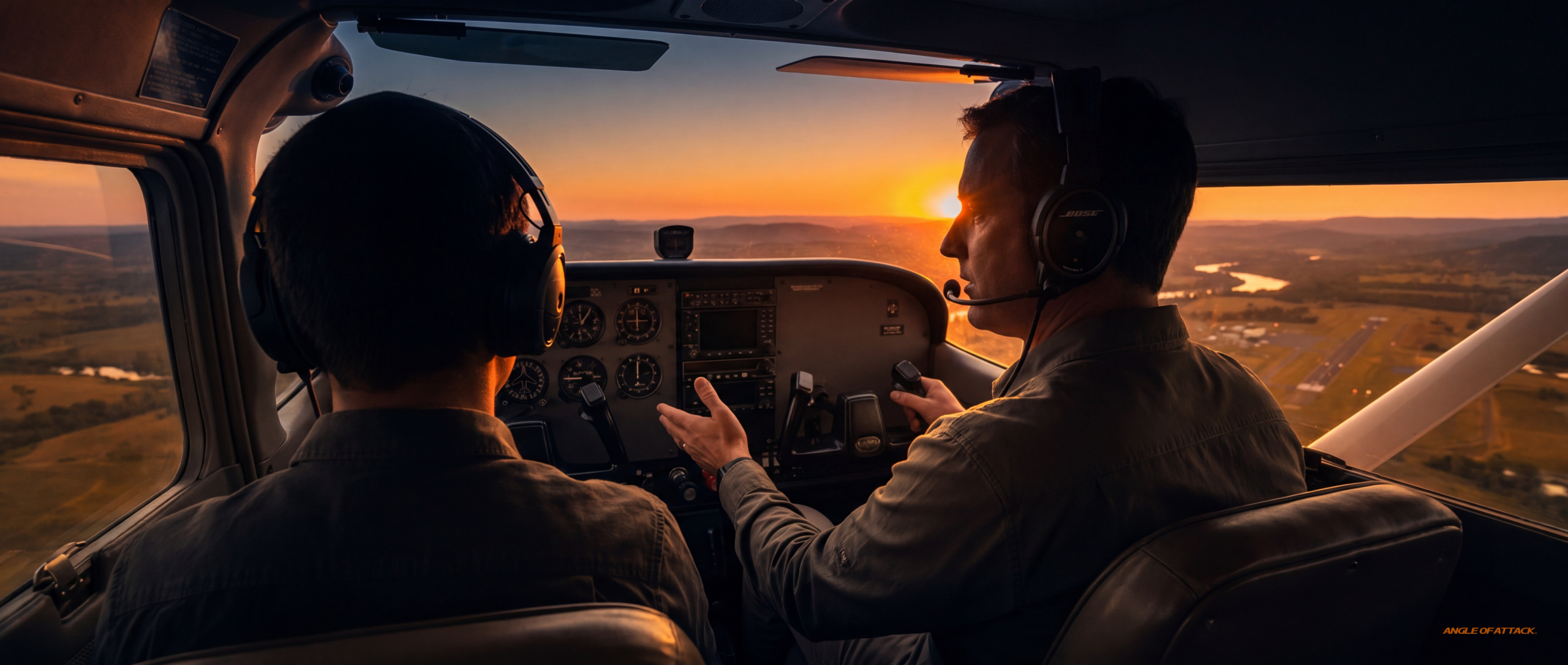
Sooner or later, a student is going to lock up. Hands tight on the yoke, eyes wide, breathing high. The airplane is fine. The student is not.
Your voice is the lesson. Low. Slow. Calm. Don’t shout instructions; describe what’s happening. Describing externalizes the experience and breaks the lock. “Okay — the nose dropped. That’s the stall. Now we’re flying again. Relax your grip. Look outside.”
Then make the call. If their recovery is diverging — pitch wrong, power wrong, wings wrong, getting worse — take it. “I have the airplane.” Fly the recovery, give it back when the airplane is stable. The wrong call is letting a divergence become an upset because you didn’t want to interrupt the learning moment.
If the recovery is just rough — timing off, heading wandering, but the airplane is recovering — leave it alone. Coach with one finger and three words. “Airspeed.” “Heading.” “Wings.” Let the airplane teach while you guard the perimeter.
After the flight, the debrief beats the moment. “What were you thinking when the nose dropped?” Their answer is gold. Panic is data, not failure. Calm as a skill — yours, modeled in real time, becomes theirs over weeks.
Teaching Different Stall Types (Power-Off, Power-On, Accelerated, Cross-Control)
The CFI ACS (FAA-S-ACS-25, May 31, 2024) Area X — Slow Flight, Stalls, and Spins — is your stalls map. Pair it with the CFI checkride pillar guide for the full Area X context. The Private ACS (FAA-S-ACS-6D) Task VII and Commercial ACS (FAA-S-ACS-7B) Task VII tell you what the student demonstrates. Each stall type maps to a different real-flight scenario — the scenario changes, the method doesn’t.
| Stall Type | Real-Flight Scenario | Brief Emphasis | Common Student Error | Demo vs. Student-Flown |
|---|---|---|---|---|
| Power-Off (Approach) | Slow on final, idle throttle, landing configuration | Energy management, sight picture, what the airplane tells you | Releases too early — at the buffet, not the break | Student-flown |
| Power-On (Departure) | Just rotated, pitched too aggressively, or banked into the crosswind early | Pitch attitude, P-factor, rudder coordination | Stall break with insufficient rudder = wing drop | Student-flown |
| Accelerated (Maneuvering) | Tight evasive turn, wake avoidance, traffic avoidance — pulling too hard | Load factor, AOA at higher airspeed, surprise factor | Surprised by the stall at "normal" airspeed | Student-flown (commercial); demo-only at private |
| Cross-Controlled (Skid) | Base-to-final skid, overshoot, bottom rudder fed in | Rudder discipline, why skids kill | Spin entry — DO NOT hand off | CFI demonstration only (per AC 61-67C + CFI ACS) |
| Secondary | Pulling back too aggressively during the first recovery | The stall-after-the-stall, where AOA-first recovery saves you | Re-stalls during recovery | Student-flown (after primary recovery is solid) |
| Elevator Trim | Go-around with landing trim still set, pitch-up runaway | Trim management on go-around | Can't push the nose down fast enough | CFI demonstration only (CFI ACS Task X.G) |
A note on slow flight: the 2017 Private ACS rewrite confused a generation of CFIs. Slow flight is not a stall task. PA.VII.A flies at 5–10 KIAS above stall warning activation — the horn shouldn’t be going off. The stall tasks are PA.VII.B (Power-On) and PA.VII.C (Power-Off). The CFI ACS pushes deeper — demonstration at minimum controllable airspeed with the warning fully active. Know which ACS your student is on. For single-maneuver depth, see the power-off stall teaching playbook and the power-on stall teaching playbook. For the regulatory pair to AC 61-67C — spin awareness — see the CFI spin endorsement guide.
How Long Should a Stall Lesson Last?

A first-time stalls lesson, run scenario-first, is a 2-hour syllabus block.
- Ground brief: 20-30 minutes. Scenario, AOA, AC 61-67C and AC 120-109A priority ordering, the 4-part brief. End with: “What does the airplane do before it stalls?”
- Flight: 1.0–1.2 hours. Climb to safe altitude. Demo the approach-stall scenario. Hand off, coach. Reset. Move to the departure-stall scenario. Demo, hand off, coach. You’re flying scenarios, not reps. Three good handoffs beat eight rushed ones.
- Debrief: 20-30 minutes. What did the airplane tell you, before, during, and after the break. Then the error patterns. Then the next lesson plan.
Don’t fly the same stall lesson twice in a row. Let it breathe. Come back a few flights later with a different scenario. The student needs time to integrate.
For a CFI candidate, you’ll spend more time on demonstration stalls (Tasks X.E-X.H). They’ve flown these as a pilot. Your job now is to teach them to teach them. That’s the heart of TotalCFI.
What Are Students Actually Learning When You Teach Stalls Well?

When you teach stalls well, four things happen at once — and only one of them is “they can recover from a stall.”
Energy management. What airspeed feels like, sounds like, looks like at every stage — cruise to slow flight to buffet to break. The durable lesson, carried into every approach and go-around for the rest of their flying life.
AOA awareness. Airspeed is incidental; angle of attack is causal. The airspeed indicator is one of several cues, not the master variable. It’s what lets them survive the day they’re maneuvering at 70 KIAS in a 60-degree bank and the wing stalls 30 knots above book.
Decision-making in the stall regime. Recognize → prevent → recover. Pitch → wings → power. Priorities, not procedures.
Calm-as-skill. They watch you fly a stall, talk through it, correct a slightly-off recovery without snapping. They take that voice with them.
The deepest version is what I call Restorative Airmanship — teaching a pilot to fly in a way that restores their relationship with the airplane every time it’s threatened by stress, procedure, distraction, or fear. (Same through-line in your first day as a CFI — the way you handle the first stall lesson is the way you handle every flight you’ll fly with that student.) The CFI who teaches the scenario sends a pilot home with airmanship. The CFI who teaches the maneuver sends them home with a checkride trick.
Your certificate is your license to learn. So is theirs. They aren’t done with stalls when they walk out of that 2-hour block — they’re starting a 50-year conversation with the airplane about energy and AOA. Your job is to give them the first chapter.
How do you teach a power-off stall to a student?
Frame it as the approach stall — slow on final, idle throttle, landing config. Brief the scenario, demonstrate it while narrating what you’re watching, hand the controls and coach through it, then debrief on what the airplane told the student before the break — not on tolerance numbers.
How do you teach a power-on stall to a student?
Frame it as the departure stall — just rotated, pitched too aggressively, or banked early into the crosswind. Emphasize pitch attitude, P-factor, and rudder coordination. Be ready for a wing drop at the break if the student undercorrects with rudder.
How do you recover from a stall?
Three priorities, in order: reduce angle of attack, level the wings with coordinated rudder, add power. Universal recovery per AC 120-109A. The wing has to be flying and the bank has to be coordinated before the power matters.
What’s the difference between a power-on and power-off stall?
The scenario, not the method. Power-off is an approach stall (slow on final, idle, landing config). Power-on is a departure stall (just rotated, high pitch, full power, clean). Recovery technique is the same — reduce AOA first.
What does AC 61-67C say about stall training?
AC 61-67C (Change 2 current) requires CFIs to teach stall recognition and prevention — not just recovery. Priority order: recognize, prevent, recover. Training should include distraction-based scenarios mirroring real-flight situations where inadvertent stalls happen.
How long does a stall lesson take?
A first-time scenario-first stalls block is about 2 hours: 20-30 minute ground brief, 1.0-1.2 hour flight, 20-30 minute debrief. Quality of handoffs beats quantity of reps.
If the CFI checkride is keeping you up at night, you're prepping for the wrong thing.
TotalCFI teaches you to walk into the oral as a teacher, not a test-taker — the reframe most candidates only figure out after they've already failed once.
What’s the toughest thing you’ve run into teaching stalls? The student who kept locking up? The one who couldn’t get AOA-first into their hands? Drop a comment below — I read every one.